
You shouldn't have to spend years in a lecture theatre to prove you can do a job you've already mastered. Many experienced professionals eventually hit a career ceiling where their expertise outpaces their formal documentation, leading them to ask: what is RPL and how can it bridge that gap? It's a common frustration to feel stuck in a role simply because you lack a specific certificate, especially when the thought of traditional study feels like a waste of both time and money. The Australian vocational sector is rigorous, and navigating the requirements of the Australian Skills Quality Authority can feel overwhelming without the right guidance.
We understand that your experience has significant value. This guide shows you how to convert your years of practical knowledge into formal Australian qualifications through the Recognition of Prior Learning process. We'll explore the definition of RPL within the current 2026 regulatory framework, explain the high standards of evidence required by Registered Training Organisations (RTOs), and outline a clear, pragmatic path to help you secure the professional validation you deserve. Please note that Right Pathway is a facilitation service that supports evidence preparation; we are not an RTO and do not issue qualifications or provide migration advice. Formal assessment and certification are always completed by our partner RTOs.
Key Takeaways
- Define what is rpl and understand its role in mapping your practical skills to formal standards within the Australian Qualifications Framework.
- Learn why the process requires high-quality, authentic evidence of your work history rather than being a simple paperwork exercise.
- Clarify that while Right Pathway guides your evidence preparation, the formal assessment and issuance of qualifications are handled by partner RTOs.
- Discover how a qualification obtained through RPL can facilitate career progression and meet the requirements for professional trade licensing.
- Map out the journey from a free initial eligibility assessment to the final receipt of a certificate from an ASQA-regulated provider.
Defining Recognition of Prior Learning (RPL) in the Australian Context
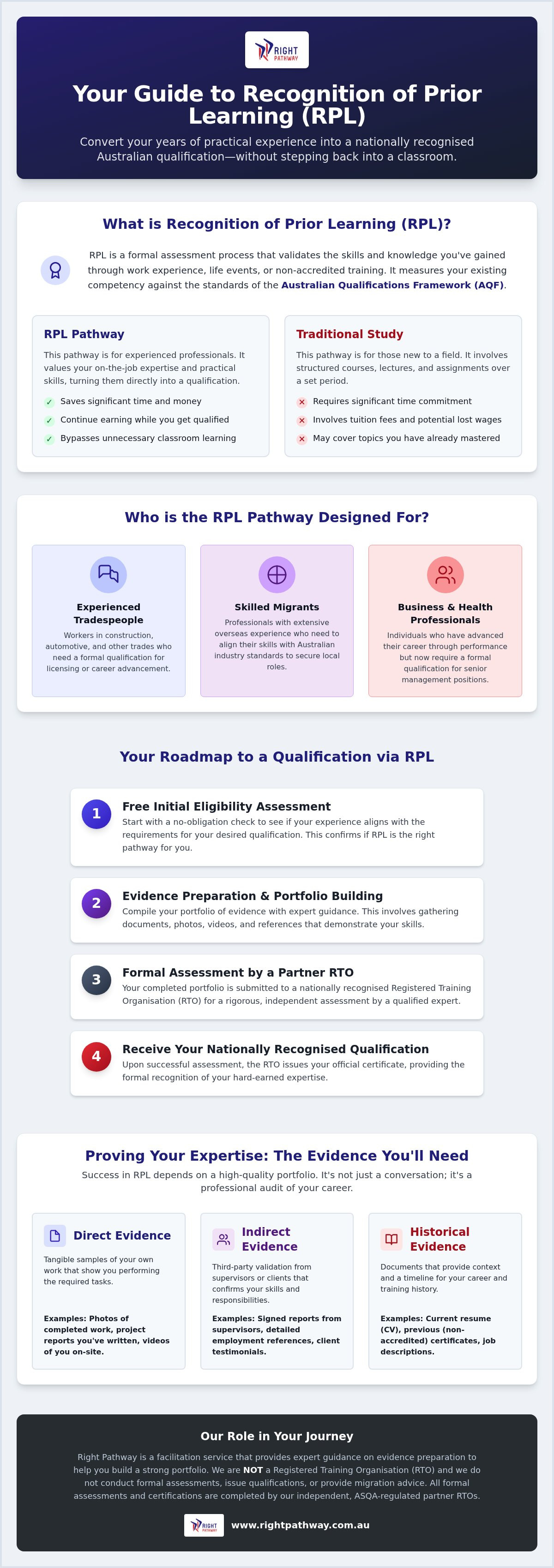
In simple terms, what is rpl? Recognition of Prior Learning is a formal assessment process that validates the skills and knowledge you've acquired through work experience, life events, or previous non-accredited training. Instead of making you sit through classes for things you already know, it measures your existing competency against the standards set out in the Australian Qualifications Framework (AQF). This ensures that the outcome is a Recognition of Prior Learning result that leads to a nationally recognised qualification.
It's vital to distinguish this from a "Credit Transfer." While a credit transfer recognises formal units you've already completed at another institution, RPL focuses on the practical application of your expertise in the field. Registered Training Organisations (RTOs) use a competency-based model for this assessment. They don't look at how long you've been in a classroom; they look at whether you can perform specific tasks to the required industry standard. Right Pathway is not an RTO and does not conduct formal assessments. Instead, we act as your essential guide through this landscape, providing evidence preparation guidance to ensure your portfolio meets these rigorous RTO requirements.
Who is RPL designed for?
The RPL pathway is specifically tailored for those who have already "done the time" in their industry. This includes:
- Experienced Tradespeople: Workers in construction or automotive industries who have the skills but lack the paperwork needed for a formal trade licence.
- Skilled Migrants: Professionals with extensive overseas experience who need to align their skills with Australian standards to secure local employment.
- Healthcare and Business Professionals: Individuals who have climbed the clinical or corporate ladder through performance but need a formal qualification to move into senior management.
RPL vs. Traditional Classroom Study
Choosing RPL over traditional study is a strategic career decision. It allows you to bypass the "re-learning" phase, saving hundreds of hours that would otherwise be spent in lectures. For full-time workers, this flexibility is indispensable. You can continue earning while your existing skills are mapped to a qualification, avoiding the lost wages and time commitments associated with campus-based learning. It turns your past work into a future asset without the need to start from scratch.
How the RPL Process Validates Your Professional Expertise
There's a common misconception that Recognition of Prior Learning is a "tick-and-flick" exercise or a simple interview. In reality, the process is a rigorous professional audit of your career. When asking what is rpl in a practical sense, it's best to view it as a mapping exercise. You must prove that your daily work tasks align perfectly with specific "Units of Competency" defined in national training packages. This requires more than just a conversation; it requires a high-quality portfolio of proof that demonstrates your mastery of the trade or profession.
To navigate this successfully, you need to understand the distinct roles involved. Right Pathway acts as your evidence facilitator and knowledgeable navigator. We provide the guidance and support needed to compile your documentation and map your skills to the correct standards. However, Right Pathway is not a Registered Training Organisation (RTO). We do not conduct formal assessments, and we do not issue qualifications directly. All formal assessments are completed by our partner RTOs, who serve as the final authority on whether your evidence meets the strict requirements for a nationally recognised qualification.
The Types of Evidence You Will Need
Success depends on the quality of your portfolio. You'll typically need to gather three distinct categories of proof:
- Direct evidence: This includes tangible samples of your work, such as project reports, photos of completed installations, or videos showing you performing specific technical tasks on-site.
- Indirect evidence: These are third-party validations, such as signed reports from supervisors or detailed employment references that confirm your skills.
- Historical evidence: Documentation like your current resume, previous position descriptions, and non-accredited certificates from industry-specific short courses.
Maintaining High Standards
Assessors evaluate your portfolio against the "VSAC" rule. This means your evidence must be Valid, Sufficient, Authentic, and Current. Documentation from a decade ago is rarely enough; your proof must reflect current 2026 industry standards and safety regulations. Because these benchmarks are high, completing a free initial eligibility assessment is the most practical first step to determine if your current experience is likely to result in a successful outcome.
The Strategic Advantages of Securing a Qualification via RPL
Experience is essential, but in the Australian job market, formal documentation acts as the ultimate resume booster. When professionals investigate what is rpl, they often find it's the missing link between their current role and a higher salary bracket. According to ABS Employee Earnings data from August 2025, Australians with a Certificate III or IV earn a median of $1,400 per week, compared to just $1,000 for those without formal qualifications. This $400 weekly difference highlights the tangible financial rewards of professional validation.
Beyond salary, there's the critical issue of professional licensing. For trades like building or plumbing, you cannot operate legally as a contractor without specific certifications. Securing a qualification through an RTO assessment allows you to meet these regulatory benchmarks without pausing your income. You can explore a more comprehensive list of the benefits of RPL to see how it applies to your specific career goals.
Industry-Specific Impact: From Construction to Healthcare
Consider a site manager who has run multi-million dollar projects for years but lacks a diploma. Through RPL, they could map their project management and safety expertise toward a BSB50420 Diploma of Leadership and Management. Similarly, an experienced carer who has worked in aged care for half a decade can certify their clinical skills with a CHC33021 Certificate III in Individual Support. These aren't just titles; they are gateways to senior roles and more secure employment. Note that your suitability for these pathways depends entirely on the quality of your evidence and the final assessment by a partner RTO.
Bridging the Gap for Skilled Migrants
For international professionals, the Australian workforce can feel inaccessible despite their high expertise. RPL serves as a vital bridge, allowing skilled migrants to obtain their first nationally recognised qualification based on their overseas experience. This reduces the entry barrier significantly, moving them from underemployment into roles that match their true capability. It's a pragmatic way to align international standards with local requirements without the need for redundant retraining.
Your Roadmap to Success: Navigating the RPL Pathway
Understanding what is rpl is the first step, but executing the process correctly requires a methodical approach. The journey from experienced worker to qualified professional involves several high-stakes stages. Suitability for any qualification depends entirely on the quality of evidence provided and the final assessment by a partner RTO. Many applicants struggle when dealing with RTOs directly because they lack the technical knowledge to map their experience to specific units of competency. This is where professional facilitation becomes an essential asset, helping you avoid documentation errors that lead to delays or rejections. You can view the full RPL process details to understand the timeline.
Step 1: The Free Initial Eligibility Assessment
The journey begins with a free initial eligibility assessment. During this consultation, we conduct a transparent appraisal of your current skills and the documentation you have on hand. It's a pragmatic session where we determine if your experience aligns with the standards of a formal Australian qualification. We don't provide migration or visa advice; our focus is purely on your professional competency and whether you have enough proof to proceed to a formal RTO assessment. This honesty ensures you don't invest time in a pathway that isn't viable.
Step 2: Evidence Collection and Skills Mapping
Once eligibility is confirmed, the work of organising your portfolio begins. We act as your knowledgeable navigator, guiding you through the collection of direct and indirect evidence. We help you bridge the gap between your daily tasks and the formal language of the training package. This stage also involves preparing you for the RTO requirements, which might include a technical interview or a practical observation to verify your expertise in the field. Our role is to ensure your evidence is presented in a way that makes the assessor's job straightforward.
Step 3: Formal RTO Assessment and Certification
The final stage is the formal assessment conducted by one of our partner RTOs. They review the mapped portfolio to ensure it meets all regulatory standards. If the RTO identifies any minor gaps in your knowledge, they may suggest gap training to complete the qualification. Upon a successful result, the RTO issues your certificate. Right Pathway supports your preparation, but the RTO remains the final authority that grants the qualification and ensures all standards of the Australian Qualifications Framework are met.
Formalise Your Career Expertise for 2026
Securing a qualification through Recognition of Prior Learning is a strategic move that acknowledges your professional history as a valuable asset. We've explored how this evidence-based process turns years of practical work into formal certification, bridging the gap between your current expertise and the requirements of the Australian Qualifications Framework. By understanding what is rpl and preparing a high-quality portfolio, you can bypass redundant study and focus on career progression.
Right Pathway acts as your expert facilitator, helping you navigate the documentation requirements that often cause confusion. Since 2019, we've supported over 2,000 professionals across 18 different industries nationwide. Our role is to provide the mapping and guidance necessary for a successful RTO assessment, ensuring your experience is recognised without unnecessary stress. We offer a no-obligation initial consultation to help you understand your options clearly from the start.
You've already mastered your trade or profession through years of dedication. Now is the time to secure the formal credentials that reflect your true capability and open the door to new opportunities.
Frequently Asked Questions
Is RPL easier than doing the full course?
RPL isn't necessarily easier than traditional study; when asking what is rpl in terms of difficulty, it's simply a different method of assessment that focuses on existing competence. While you won't spend hours in a classroom, you'll need to invest significant effort into gathering authentic evidence that proves you meet national standards. This process requires a high level of professional discipline to document your skills accurately for the final RTO assessment.
How much does an RPL certificate cost in Australia?
The cost of an RPL pathway varies depending on the specific qualification, the industry, and the complexity of the assessment required by the Registered Training Organisation. Fees are set by the individual providers rather than a single national rate. While Right Pathway provides evidence preparation guidance to help organise your portfolio, the final assessment fees are determined by the partner RTOs who issue the certificate.
Can I get a nationally recognised qualification entirely through RPL?
Yes, it's possible to obtain a formal Australian certificate entirely through the RPL process if your evidence portfolio covers every unit of competency within the training package. If the RTO assessor determines that your work history and practical skills meet 100% of the requirements, they can issue the full qualification. However, this outcome depends entirely on the quality and currency of the proof you provide during the assessment phase.
How long does the RPL process typically take?
The timeline for the RPL process typically ranges from a few weeks to several months, depending on how quickly you can compile your evidence. When considering what is rpl in terms of speed, it's considerably faster than a traditional course, which could take years, but it isn't an instant result. Once your portfolio is submitted to the partner RTO, the formal assessment period begins. The speed depends on your commitment to the evidence collection phase.
What happens if I don’t have enough evidence for a full qualification?
If an RTO identifies gaps in your evidence, they'll typically recommend gap training for the specific units you couldn't prove through prior experience. This allows you to complete most of the qualification via RPL while only studying the small sections where you lack current competency. Right Pathway can help identify these potential gaps during a free initial eligibility assessment before you commit to the formal RTO process, ensuring you have a realistic path forward.
Article by
Right Pathway Team
Right Pathway is an Australian Recognition of Prior Learning (RPL) support and facilitation service helping experienced workers, tradespeople and skilled migrants prepare evidence for nationally recognised qualification pathways.
Founded in 2019, Right Pathway has supported over 2,000 applicants across construction, mining, healthcare, aged care, business, community services, hospitality, automotive and the trades.
We work with ASQA-regulated partner Registered Training Organisations (RTOs) to support evidence preparation, skills mapping and qualification pathway guidance. Right Pathway is not an RTO and does not issue qualifications directly.
Start with a free RPL eligibility assessment at rightpathway.com.au.
Disclaimer
Right Pathway is a facilitation and support service only. We are not a Registered Training Organisation (RTO), do not conduct formal RPL assessments and do not issue qualifications. All formal RPL assessments and certifications are completed by partner RTOs regulated by ASQA. Eligibility and qualification outcomes depend on each applicant’s evidence, experience and the RTO’s assessment decision.


