

Your IT experience may help you earn a diploma, but it doesn’t automatically replace assessment. You may be able to get a diploma in IT based on experience through recognition of prior learning (RPL), credit transfer for relevant previous study, or a combination of both. The responsible Registered Training Organisation (RTO) assesses your evidence against the qualification requirements.
It’s understandable to want clear recognition for skills you’ve built on the job, especially if you’ve also completed relevant courses or hold professional qualifications. This guide explains how work experience and study may support an IT RPL pathway, what evidence can help demonstrate your competence, and where further assessment or learning may be needed. You’ll also learn how an Australian nationally recognised IT diploma differs from industry experience alone, so you can understand the pathway before choosing your next step.
Key Takeaways
- Map your IT work experience to the skills and competencies a diploma requires, then identify evidence that demonstrates what you can do.
- Gather details of previous study and professional qualifications, as they may support credit transfer or inform your pathway.
- Check that the diploma is nationally recognised and consider whether its course content matches your experience and goals.
- Understand which factors affect RPL costs and prepare to discuss your evidence and potential next steps.
Diploma entry eligibility based on prior study and work experience
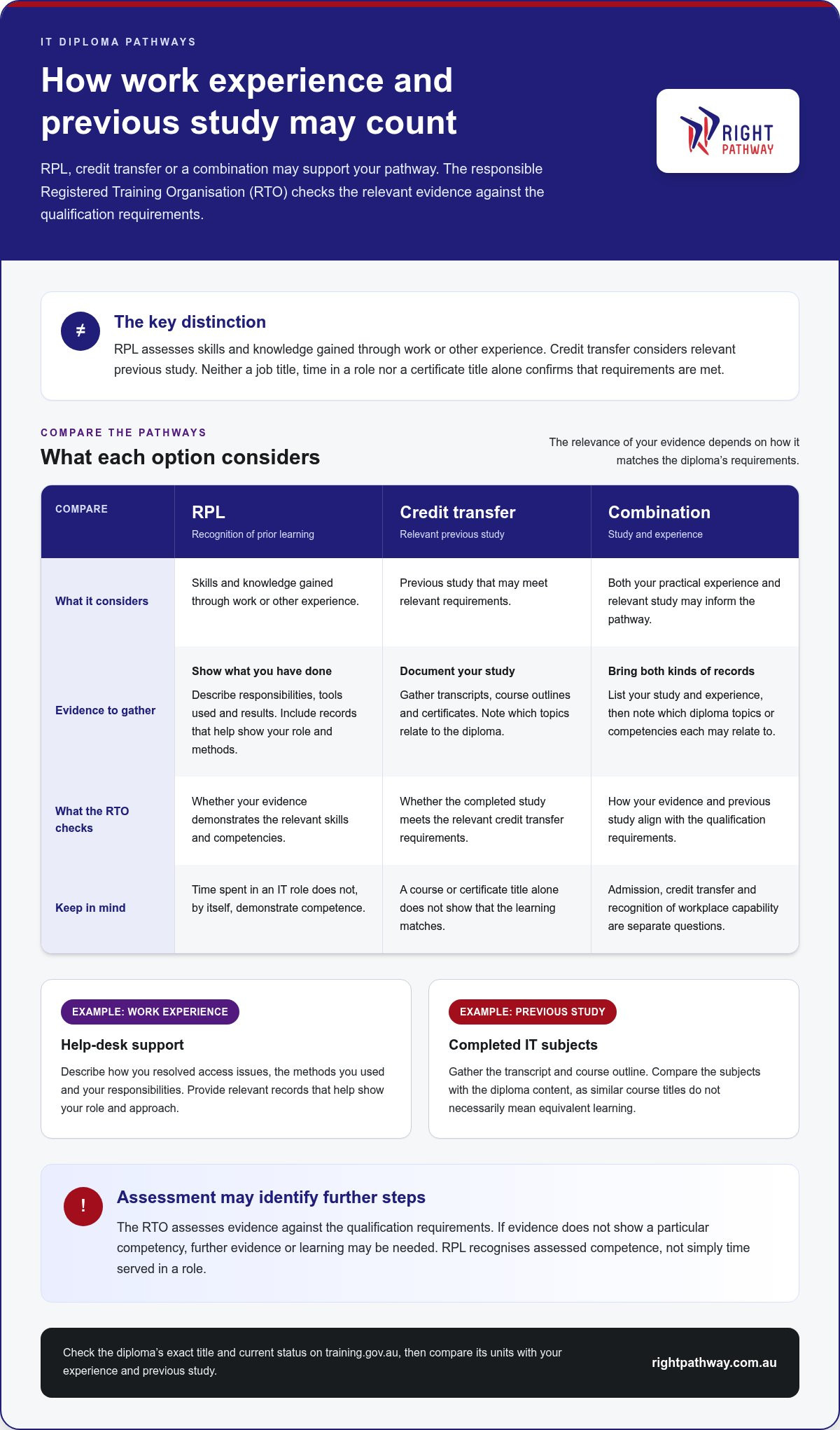
You may be able to get a diploma in IT based on experience, but eligibility depends on how your knowledge and skills match the qualification’s competencies. An RTO assesses evidence of what you can do, not simply how long you’ve held a job. For example, a help-desk worker could describe resolving access issues and provide records that show their role and methods. The evidence needs to relate to the competencies being assessed.
Previous study may also inform your pathway. An IT subject you’ve completed could be considered for credit transfer if it meets the relevant requirements. RPL is different: it assesses skills and knowledge gained through work or other experience. Gather transcripts, course outlines and certificates, then note which topics relate to the diploma you’re considering. A certificate’s title alone does not show whether its learning matches the qualification.
Life experience may be relevant if it involved practical IT tasks. For instance, maintaining a community group’s website or setting up devices for a small business can help demonstrate what you’ve done. Describe your responsibilities, the tools you used and the results. Government subsidies are separate from RPL. RPL does not establish subsidy entitlement, and funding eligibility is assessed separately.
Start by listing your study and experience, then identify the competencies each item may relate to. This can help highlight areas where further evidence or learning may be needed. For an overview of RPL pathways, keep preliminary guidance separate from the RTO’s formal assessment. What are the risks of using an RPL provider that isn’t an Australian RTO? Before using a provider, clarify what role it can play in preparing your evidence and the formal assessment process. You could prepare documents without completing the formal RTO assessment needed for a qualification.
Existing professional qualifications as an entry consideration
Existing IT qualifications can provide useful context when you explore diploma options. Their relevance depends on the subjects covered, the issuing organisation and how closely the learning aligns with the diploma. A networking certificate, for example, may show focused technical study, while a project-management qualification may help explain your experience coordinating IT work. Neither credential automatically meets course entry requirements or replaces an assessment of your skills.
Before discussing your options, make a record of each qualification. Note its full title, issuer, completion date, subjects and practical components. Gather transcripts, certificates and course outlines where available. If a credential is from overseas, keep the original documents and any official English translations you have. Clear records help distinguish formal study from vendor training or workplace development.
Compare your previous study with the diploma’s published course information. Identify whether it covered topics such as database concepts, systems support or cybersecurity, then note how recently you applied those skills. A professional credential may show specialised knowledge, but the RTO considers its relevance to the qualification and the evidence available. Similar course titles do not necessarily mean equivalent content.
Entry requirements for a graduate certificate, advanced diploma and diploma are not interchangeable. A graduate certificate is a higher education award, while a vocational diploma or advanced diploma follows a different qualification pathway. The institution or RTO sets the relevant course requirements. Review the course information for prerequisites, accepted prior learning and relevant experience. An advanced diploma or graduate certificate does not automatically provide entry to, or credit towards, an IT diploma.
For a useful discussion, bring your qualification record and identify the course you’re considering. Separate the questions of admission, credit transfer and recognition of workplace capability. A free initial eligibility assessment can help you discuss your background and possible next steps before the RTO’s formal process.
Nationally recognised diploma courses
Check a diploma’s exact title and current status on training.gov.au before choosing a pathway. A diploma is a nationally recognised vocational education and training qualification. Its official status matters because a course marketed as an IT diploma may not lead to that qualification. Review the qualification details, delivery information and units of competency, then compare them with the capabilities you want recognised.
RPL is based on competency, not simply time spent in an IT role. The RTO considers whether your skills and knowledge meet the relevant units. VET assessment focuses on individual competencies rather than exam grades. If your evidence shows you can configure a network but not explain how you troubleshoot faults, the RTO may request further evidence or assess that area.
Look beyond a course’s broad label. Compare its units with the work you do and the skills you want to formalise. For example, if you manage user accounts and resolve access issues, review whether the qualification’s competencies cover those responsibilities. Check the full qualification title and code, its current status, and the RTO’s assessment approach before preparing an application.
Diploma courses generally take between one and two years to complete. This is a general course duration, not a forecast for someone using RPL. Your pathway depends on which competencies you demonstrate and whether further assessment or learning is needed. RPL recognises assessed competence, not time served in a role.
Will an IT diploma gained through RPL be recognised by employers or universities in Australia? If an RTO issues a current nationally recognised qualification after formal assessment, it is an Australian VET qualification. Employers consider its relevance alongside your experience, while universities set their own admission and credit requirements.
Keep your qualification record and related documents together. Include the award title, issuing RTO and records of the competencies assessed. These details help you explain what the diploma covers when discussing a role or further study.
How much does an IT diploma through RPL cost in Australia?
There is no single Australian price for an IT diploma through RPL. Costs depend on the qualification pathway and the work required to assess your evidence. Compare what each quote includes, not just its headline figure. A quote should clarify whether it covers RTO assessment, evidence support, additional assessment activities or gap training. These are distinct parts of the process, so ask for an itemised explanation before deciding.
The cost depends on your circumstances and the qualification pathway. Factors may include the qualification scope, how ready your evidence is, assessment requirements and any gap training. For example, someone with organised project records may need different support from someone whose evidence needs substantial clarification. The RTO may also identify competencies that need further demonstration or learning. Consider these requirements alongside any initial fee.
Clarify who charges each amount. An RPL support service may charge for administrative assistance, while the RTO sets charges for formal assessment and enrolment. Ask whether the quote includes both or whether separate charges apply. Also check how extra evidence reviews, competency conversations, practical demonstrations or challenge tests are treated. Comparing these items helps you understand the overall cost.
Before requesting a quote, prepare the qualification title you’re considering and a brief summary of your IT experience. List available evidence, such as project documentation, system records, work samples and study documents. This gives the support service and RTO clearer information about your pathway. Don’t assume the lowest quote covers the same work as another. Compare what is included, possible additional charges and who conducts the formal assessment.
Right Pathway: RPL support and administrative facilitation
Right Pathway can help you organise an IT RPL pathway if you have relevant experience and need guidance on evidence or next steps. Support includes a preliminary skills and experience consultation, an evidence-readiness review and administrative facilitation.
Use the preliminary review to identify relevant documents and possible gaps before formal assessment. For example, organise work samples, project records and study documents around the IT skills they demonstrate. This preparation can help you understand what to discuss with the responsible Registered Training Organisation (RTO).
Right Pathway is not an RTO and does not conduct formal competency assessments or issue qualifications. The partner RTO handles enrolment, assesses your evidence and makes the qualification decision. Right Pathway’s free initial eligibility check provides preliminary guidance; it is not a formal assessment or a guarantee of an outcome.
For support with your next steps, contact Right Pathway.
Plan your next step with confidence
If you want to get a diploma in IT based on your experience, consider how it fits your broader career plans. Think about which capabilities you want a formal qualification to reflect and how you intend to use it in future roles or further study. A clear goal can help you prepare and choose a pathway that suits your circumstances.
Before taking action, organise your records and note any questions about the process. You don’t need to have every answer in advance. A focused discussion can clarify what information matters and what your next step could be, while keeping preliminary guidance distinct from the RTO’s formal decision.
Right Pathway can help you explore the pathway and prepare for discussions with the responsible RTO. The RTO makes the formal assessment and qualification decision based on its requirements and your evidence.
Your experience is worth presenting carefully. When you’re ready, take the next step with a clearer view of the pathway ahead.
Frequently Asked Questions
Can you get an Australian IT diploma based on work experience through RPL?
Yes, an Australian IT diploma may be awarded through RPL if the responsible RTO finds that your evidence demonstrates the required competencies. For example, a systems administrator could present incident records, configuration documents and supervisor confirmation. The RTO assesses the evidence and decides whether further assessment or learning is needed. Work experience alone does not qualify you, and preliminary eligibility guidance is not a formal assessment.
Which Australian IT qualifications offer recognition of prior learning or skills recognition?
RPL availability depends on the qualification and the RTO offering it. Search the exact IT qualification title on training.gov.au to review its current status, then identify RTOs delivering it and ask whether they consider RPL applications. Vendor certificates, such as a networking credential, may support an application but are not automatically equivalent to an Australian vocational qualification.
What evidence is required to get an IT diploma through RPL in Australia?
Evidence should show your personal role and demonstrate relevant IT tasks. Examples include a position description, employer reference, project documentation, system change records, work samples, licences or qualifications. A reference confirming that you maintained user accounts is more useful when paired with records showing the work. Remove confidential client or employer information before sharing documents, while retaining enough context to verify your evidence.
Which registered training organisations assess IT experience for a diploma?
Check that the organisation assessing your experience is equipped to assess the relevant IT qualification. Use training.gov.au to locate the qualification and see which RTOs list it. Then ask whether the RTO accepts RPL applications for that course and what assessment activities it uses. A facilitation service can help organise evidence and guide pathway discussions, but it cannot replace the RTO’s formal assessment or qualification decision.
How long does an RPL assessment for an Australian IT diploma take?
Right Pathway’s general RPL information gives an approximate timeframe of four to eight weeks after complete evidence is received. This is a general guide, not a guaranteed duration for an IT diploma. The time involved can depend on how quickly you provide evidence, whether the RTO requests further demonstrations or documents, and its assessment process. Organised project records can help you prepare a complete submission.
What are the eligibility rules for RPL under Australian vocational education and training?
RPL considers whether your existing skills and knowledge match the competencies in the chosen VET qualification. There is no universal minimum number of years of experience for eligibility. For example, recent IT support work may relate to some units, while older experience may need evidence of current capability. The RTO evaluates your evidence and may require further assessment or gap training if competencies remain unproven.

Article by
Right Pathway Team
Right Pathway supports experienced workers, tradespeople and skilled migrants with preliminary RPL eligibility guidance, evidence preparation and qualification pathway navigation.
Right Pathway is not a Registered Training Organisation and does not conduct formal competency assessments or issue qualifications. Formal enrolment, competency assessment and qualification issuance are completed by the responsible Registered Training Organisation.
Start with a free initial RPL eligibility assessment at https://www.rightpathway.com.au/eligibility-check
Disclaimer
Right Pathway is a facilitation and support service only. We are not a Registered Training Organisation (RTO), do not conduct formal RPL assessments and do not issue qualifications. All formal RPL assessments and certifications are completed by partner RTOs regulated by ASQA. Eligibility and qualification outcomes depend on each applicant’s evidence, experience and the RTO’s assessment decision.


