

Recognition of Prior Learning for commercial cookery assesses existing kitchen skills against qualification requirements, rather than awarding credit for experience alone. Eligibility commonly centres on 2-3 years of relevant commercial-kitchen experience, including 12 to 24 months gained in Australia, alongside evidence of competence. The SIT30821 Certificate III in Commercial Cookery comprises 25 units, and a Registered Training Organisation (RTO) makes the formal assessment decision.
It’s understandable to want a clear picture of the process before gathering documents or choosing a pathway. RPL is not just a paperwork review: the RTO may assess your evidence and ask for further demonstrations or information to establish how your skills match the required units.
This guide explains who may be eligible, what evidence can help, how assessment works, and why the RTO’s role matters. You’ll also see how partner RTOs fit into the pathway, what can affect the process, and where support with preparation and qualification navigation may be useful.
Key Takeaways
- Map your kitchen experience to the qualification’s competency requirements, then gather evidence that demonstrates what you can do in practice.
- Prepare a range of supporting material, such as work records, referee testimonials, photos or videos, to help show how your skills are current and relevant.
- Understand how a formal RTO assessment may involve more than document review, including follow-up questions or practical demonstrations.
- Check how the delivering RTO fits into the pathway and what support is available to help organise evidence and understand next steps.
RPL assessment process
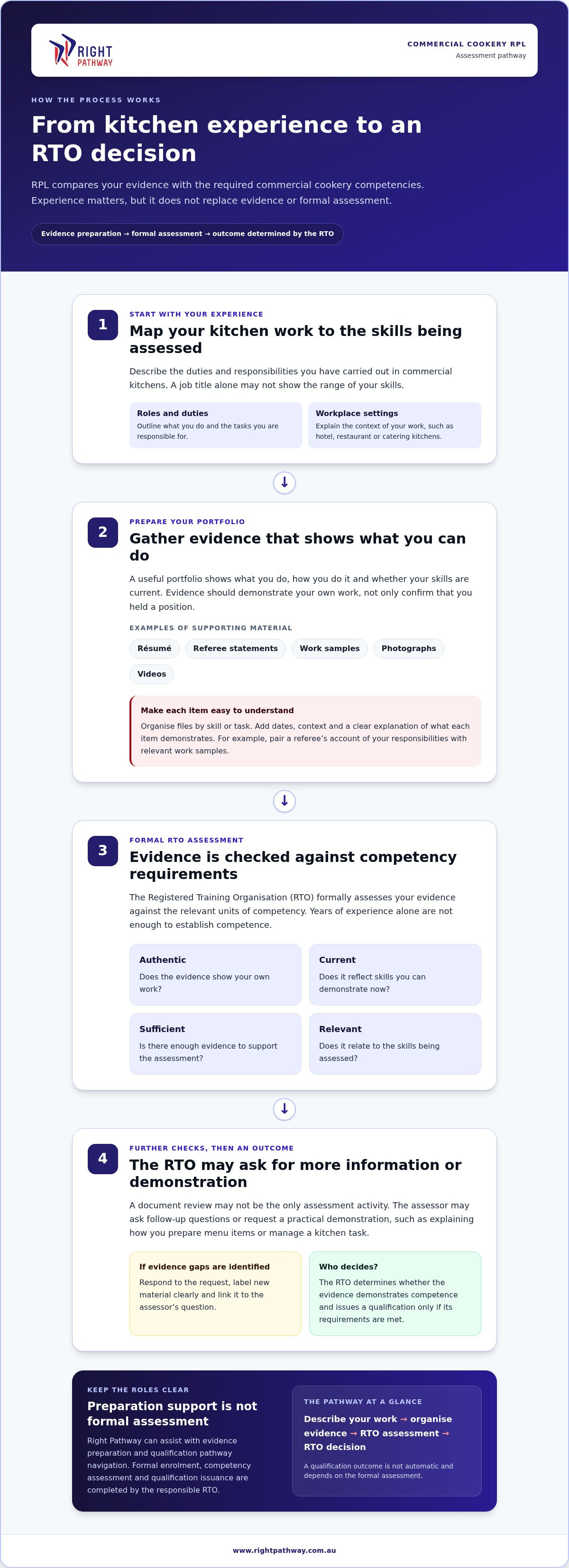
For commercial cookery RPL, a Registered Training Organisation (RTO) compares your evidence with the competency requirements of the qualification. The process includes preparing evidence and undergoing formal assessment. The RTO issues a qualification only if you meet its requirements.
Building the evidence portfolio
Start by organising evidence of your skills across commercial kitchen operations. Useful material may include a résumé, referee statements, work samples, photographs and videos. A strong portfolio shows what you do, how you do it and whether your skills are current.
For example, photos of prepared dishes can support work samples, while a referee can describe your responsibilities in a hospitality workplace. Include identification documents that total 100 points. Organise files by skill or task, then use the RPL pathway overview to understand how evidence fits into the broader process.
RTO assessment and qualification issuance
The RTO formally assesses your evidence against the relevant units of competency. It considers whether the evidence is authentic, current, sufficient and relevant, rather than relying on years of experience alone.
After reviewing your portfolio, the assessor may ask questions or request a practical demonstration. You might, for example, explain how you prepare menu items or manage a kitchen task. The RTO decides whether your evidence demonstrates competence and issues a qualification if you meet its requirements.
Assessment and qualification timeframe
The advertised timeframe is typically 4 to 6 weeks after evidence is submitted to the RTO. This period relates to the assessment stage, not the time needed to gather and organise your portfolio beforehand.
Evidence gaps or requests for further demonstrations can affect the assessment pathway. Respond promptly, label new material clearly and link each item to the assessor’s request. Before submitting, make sure files open and examples relate to the skills being assessed. Clear, organised evidence helps the RTO review your submission, but the RTO determines the outcome and any next steps.
RPL eligibility
Eligibility for commercial cookery RPL in Australia depends on how your experience and evidence align with the SIT30821 Certificate III in Commercial Cookery. There is no universal minimum number of years: the RTO considers the relevance, quality and coverage of your demonstrated skills.
Eligibility across applicant backgrounds
Cooks develop skills through workplace learning, formal education or a combination of both. A job title alone does not show the full scope of your capability, so describe the duties and responsibilities you have carried out in commercial kitchens.
For example, experience in a hotel kitchen may build different strengths from work across restaurants and catering settings. Overseas experience can also be relevant: explain how your roles relate to the qualification requirements. The key is to connect your background to relevant cookery tasks.
Eligibility and evidence requirements
Check that your supporting material demonstrates your own work, rather than merely confirming that you held a position. A referee who observed your work can describe your responsibilities, while dated work samples or images can illustrate specific tasks.
Organise evidence by competency or work function. For instance, pair a referee statement with examples of your role in food preparation, following kitchen procedures or contributing to service. Clear dates, context and explanations help the assessor understand what each item shows.
RPL eligibility consultations
A preliminary eligibility consultation can help you organise your work history and identify where supporting evidence may need clarification. Before discussing a potential pathway, prepare a summary of your roles, main duties, workplace settings and previous cookery learning.
This guidance is separate from formal RTO assessment. The RTO makes the competency decision after reviewing your evidence and may identify areas requiring further demonstration. To discuss your experience and evidence readiness, complete a free initial eligibility assessment.
What are the benefits of getting certified for commercial cookery through RPL?
The SIT30821 Certificate III in Commercial Cookery gives experienced cooks a formal way to have relevant skills assessed against a defined qualification. Its 25 units cover core and elective competencies, with the RTO deciding whether your evidence meets the requirements.
RPL compared with courses and apprenticeships
RPL assesses prior learning and workplace skills; a course or apprenticeship provides structured learning and training. RPL may suit experienced cooks who can provide evidence across the required competencies. A course may be more suitable if you are building your skills or need supervised practice.
The qualification includes 20 core units and 5 electives. Compare the pathway with your learning needs, current kitchen experience and evidence, not just the certificate title. RPL does not mean receiving a qualification without assessment, and an apprenticeship or course may provide training that an RPL applicant still needs.
RPL can result in a chef qualification only if the RTO’s assessment supports that outcome. A qualification does not itself grant a licence or migration recognition, and RPL is not a migration skills assessment.
Qualification, licensing and migration recognition
The qualification discussed here is SIT30821 Certificate III in Commercial Cookery. RPL can result in this certificate when the responsible RTO finds the applicant competent against its requirements. A Certificate IV in Kitchen Management, SIT40521 or a diploma is a separate qualification pathway, not an automatic upgrade from Certificate III.
A formal qualification can document assessed cookery skills for hospitality employers, including hotels. It does not guarantee work, licensing, registration or a visa outcome. Any work must also comply with relevant Commonwealth and State or Territory legislation, Australian standards and industry codes of practice.
A certificate bought without a genuine competency assessment is not a reliable RPL pathway. Formal assessment and qualification issuance are the responsibility of an RTO. Avoid credentials offered without an assessment of your skills.
Assessment is based on the qualification requirements. Fees and funding may depend on the RTO and applicable state or territory arrangements. Consider how those details apply to your circumstances when comparing a course with an RPL pathway.
Partner registered training organisations
The RTO is responsible for formal enrolment, competency assessment and qualification issuance. Right Pathway provides administrative support, evidence preparation guidance and help navigating the referral process. The partner RTO conducts the formal assessment and decides whether to issue a qualification.
To verify an RTO, search its legal name or registration code on training.gov.au, the National Register. Check its registration status and confirm its scope includes the qualification you are considering, SIT30821 Certificate III in Commercial Cookery. A provider’s general claim of registration does not establish that it can deliver every qualification.
Before sharing documents, find out which partner RTO will receive your application and assess your evidence. Consider how your portfolio shows practical cookery skills, such as preparing menu items, applying kitchen management practices and working in a commercial setting. The assessor may request more information or a practical demonstration if your evidence does not demonstrate a required competency.
Keep the partner RTO’s legal name and code with your enrolment records. This distinguishes the formal assessor from the organisation providing administrative support and referral coordination, and gives you a clear record of who makes assessment decisions and issues any qualification.
Check that the qualification title and code match the pathway discussed, then confirm the RTO’s scope on the National Register. For the SIT30821 pathway, the RTO’s assessment concerns evidence against the qualification requirements. A referral or a well-organised portfolio does not replace that assessment.
Qualification assessment is separate from occupational licensing. A qualification does not itself grant a licence or registration. If a role has separate requirements, check them carefully: recognition of a qualification and permission to perform regulated work are different matters.
Right Pathway: RPL support and administrative facilitation
Right Pathway helps experienced cooks organise an RPL pathway through preliminary guidance, evidence preparation and administrative support. We can help you explore whether your experience may align with a cookery qualification and organise documents for the RTO’s assessment.
A preliminary skills and experience consultation can help map your work history to a potential pathway. An evidence-readiness review can help you organise relevant material before it goes to the RTO. Right Pathway does not conduct formal competency assessments or issue qualifications. The partner RTO makes the assessment decision and issues any qualification.
To discuss your experience and possible next steps, complete a free initial RPL eligibility assessment.
Plan your next step with confidence
Before choosing a pathway, identify the qualification that fits your intended work and consider whether your experience reflects its scope. A clear account of your goals helps keep commercial cookery RPL Australia focused on relevant recognition, rather than gathering documents without a defined purpose.
Right Pathway can help you organise this first stage through RPL support and administrative facilitation. Our free initial eligibility check and preliminary consultation provide a starting point to discuss your background and a possible pathway. The partner RTO is responsible for formal assessment and any qualification decision.
Treat the next step as a practical discussion, not a promise of an outcome. Bring an accurate outline of your work history and the qualification you have in mind. Then use the guidance to decide what evidence to prepare next.
Your experience deserves a careful review. When you’re ready, take the next step and explore how it may align with a formal qualification.
Frequently Asked Questions
How does the RPL process work in commercial cookery and hospitality?
An RTO compares your skills and evidence with the requirements of the relevant qualification. For example, a cook may link workplace records to preparing menu items, coordinating service and following kitchen procedures. The assessor may ask follow-up questions or request a practical demonstration to clarify competence. Label each item clearly so the RTO can see how it relates to the work being assessed.
Can I get credit for units I have already completed?
An RTO must grant credit transfer when you have completed an equivalent unit and your certification is authenticated, subject to limited exceptions. For example, provide your statement of attainment or qualification details so the RTO can compare the unit. A licensing or regulatory requirement for reassessment may be an exception. Credit transfer recognises prior formal learning; RPL assesses skills and knowledge gained through experience.
How does RPL work?
RPL assesses skills and knowledge gained through work or other relevant learning. The RTO maps your evidence to the units in the proposed qualification and determines whether it demonstrates competence. A cook might explain a kitchen task in a competency conversation or demonstrate a technique in practice. If a competency is not yet demonstrated, the RTO can identify gaps and discuss further evidence or training.
How long does the RPL process take?
Commercial cookery assessment is typically advertised as taking 4 to 6 weeks after evidence reaches the RTO. The time before submission depends on how quickly you gather suitable records and respond to evidence requests. An assessor may need more information or a practical demonstration before completing the review. Treat the advertised period as an assessment guide, not a guaranteed date for receiving a qualification.
How much does RPL cost?
RPL costs depend on the qualification, the RTO’s assessment arrangements and whether further evidence or gap training is needed. Ask for a breakdown of any support or administration charges, RTO assessment fees and training fees. Right Pathway discusses service costs after you request a quote. The free initial eligibility check provides preliminary guidance, not a formal RPL assessment.
What are the benefits of RPL?
RPL can formally recognise relevant skills developed through work by assessing them against a qualification’s requirements. It may offer an alternative to studying every competency from the beginning, although identified gaps may still require training. For example, an RTO-issued qualification can document a cook’s assessed capabilities. RPL does not guarantee a job, licence or migration outcome.

Article by
Right Pathway Team
Right Pathway supports experienced workers, tradespeople and skilled migrants with preliminary RPL eligibility guidance, evidence preparation and qualification pathway navigation.
Right Pathway is not a Registered Training Organisation and does not conduct formal competency assessments or issue qualifications. Formal enrolment, competency assessment and qualification issuance are completed by the responsible Registered Training Organisation.
Start with a free initial RPL eligibility assessment at https://www.rightpathway.com.au/eligibility-check
Disclaimer
Right Pathway is a facilitation and support service only. We are not a Registered Training Organisation (RTO), do not conduct formal RPL assessments and do not issue qualifications. All formal RPL assessments and certifications are completed by partner RTOs regulated by ASQA. Eligibility and qualification outcomes depend on each applicant’s evidence, experience and the RTO’s assessment decision.


