

Your experience can count towards a formal construction qualification, but it doesn’t automatically become one. RPL for a construction site manager qualification assesses your skills and knowledge against the applicable units of competency. The responsible Registered Training Organisation (RTO) makes the formal assessment decision and issues the qualification when requirements are met.
If you’ve led crews, coordinated work or managed site responsibilities, you may be wondering whether that experience can count toward a construction site manager qualification through RPL. The key is whether you can provide relevant, authentic evidence of your competence, not simply how long you’ve worked in construction.
This guide explains which industry workers may be suited to RPL, what the assessment involves and how it compares with studying a Diploma. It also covers the evidence to prepare and the factors that affect cost, so you can understand your options before choosing a pathway.
Key Takeaways
- RPL may suit experienced site supervisors and construction workers when their skills align with the qualification’s competency requirements.
- Build an evidence portfolio that shows what you’ve done and how your skills remain current; an RTO may also ask you to demonstrate your competency.
- RPL and traditional study can lead to the same qualification, but the pathway differs: one assesses existing competence, while the other develops it through learning.
- Costs depend on the qualification pathway, the evidence available and any further assessment or training required. Compare these factors before deciding how to proceed.
Recognition of Prior Learning eligibility and assessment
Recognition of Prior Learning (RPL) is an evidence-based process in which a Registered Training Organisation (RTO) assesses your existing skills against qualification requirements. A certificate from an unaccredited provider may not be a nationally recognised Australian qualification or meet employer or regulator requirements, so check the issuing RTO and qualification details.
RPL eligibility criteria
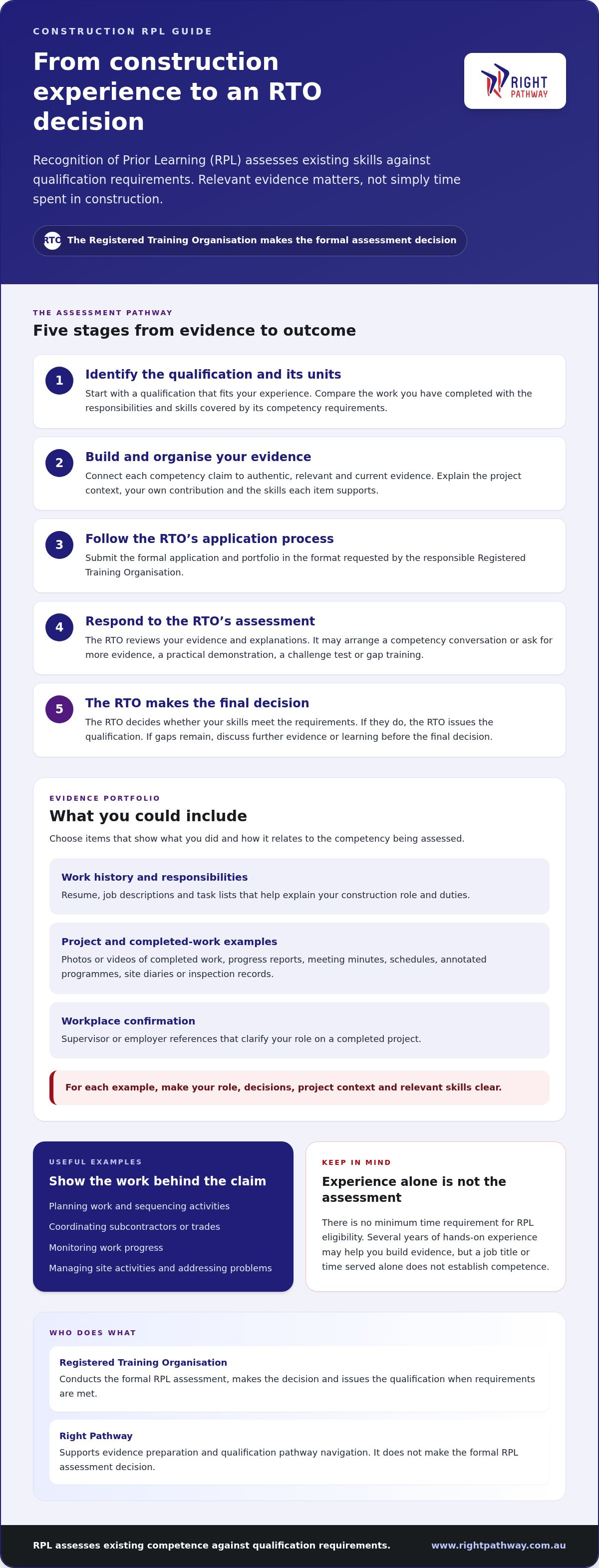
There’s no minimum time requirement for RPL eligibility, but several years of hands-on construction industry experience can help you build relevant evidence. Consider whether your completed work matches the responsibilities and skills covered by the qualification, rather than relying on job title or time served alone. The RPL pathway starts with identifying the qualification that fits your experience.
Competency conversation
The RTO compares your evidence and explanations with the required competency units. A competency conversation may explore how you planned work, coordinated trades, managed site activities or addressed problems. Give specific examples from completed projects, explaining your role and decisions. The RTO may request further evidence, a practical demonstration, a challenge test or gap training if your material does not fully demonstrate competence.
Evidence requirements
Build a portfolio that connects each competency claim to authentic, relevant and current evidence. Useful items can include a resume, job descriptions, task lists, supervisor or employer references, and photos or videos of completed work. Add details about the construction activities you performed, such as coordinating subcontractors or monitoring work progress. A White Card, such as CPCCWHS1001 or equivalent, is also identified as evidence of construction induction.
Application and assessment steps
Start by identifying the qualification and its units, then organise evidence against each requirement. The formal application and portfolio follow the RTO’s process. The RTO reviews your material, may arrange a competency conversation or request more evidence, and decides whether your skills meet the requirements. If gaps remain, discuss further evidence or learning, including gap training, before the RTO makes its final decision.
Is my Diploma the same as one done through traditional study?
RPL and study can lead to the same formal qualification, but they address different needs. RPL assesses existing skills against qualification requirements, while study develops skills through learning.
RPL for experienced supervisors
Site supervisors, leading hands and construction managers can explore RPL when their actual duties align with the relevant competency units. Coordinating trades, monitoring work and managing site tasks may help demonstrate building and construction skills. A job title alone does not establish competence. Compare your responsibilities and project evidence with the qualification requirements, then note any areas where further learning may be needed.
Qualification pathways with RPL
In Australia, the CPC60220 Advanced Diploma of Building and Construction (Management) has an RPL pathway. The full qualification comprises 10 units, while the package covering the four units QBCC lists for open-class site supervision is a narrower pathway. It isn’t the full Diploma. Check with an RPL provider whether this qualification is available through RPL. Check that the qualification and units suit your intended role, because a qualification doesn’t itself grant a licence.
Registered training organisation assessment
The Registered Training Organisation (RTO) conducts the formal RPL assessment for a qualification. It maps your evidence to the applicable units, reviews whether your knowledge and skills meet the requirements, and may ask for further evidence or a practical demonstration. The RTO makes the assessment decision and issues the qualification if you meet the requirements. Right Pathway supports evidence preparation and coordinates the referral process, while the partner RTO handles formal assessment and certification.
In Queensland, QBCC’s open-class site supervisor pathway covers building classes 1 to 10 and construction types A, B and C. The four-unit CPC60220 package relates to that supervision pathway, but RPL and licensing are separate processes. To map your background to a suitable qualification pathway, review your experience and potential pathway.
How much does RPL construction certification cost?
Construction RPL fees vary with the qualification, your evidence and the assessment required. Right Pathway offers a free initial eligibility check, with fees discussed after eligibility is confirmed. The overall cost may also depend on the units assessed and whether further assessment or gap training is needed. Clarify what the RTO’s assessment fee covers before proceeding.
For a Diploma of Building and Construction pathway, organise evidence around the relevant units rather than submitting an unlabelled collection of files. A site manager might map project records to planning, coordination and quality responsibilities. An annotated programme or site diary can show how work was sequenced; inspection records may help demonstrate how quality issues were managed.
- Project records: examples such as progress reports, meeting minutes or schedules can show your decisions and responsibilities.
- Workplace confirmation: a supervisor reference can clarify your role on a completed project.
- Currency: include recent examples that show your competency remains current.
For each item, note the project context, your specific contribution and the skill it supports. Redact confidential client or commercial details where needed, while retaining enough context for the assessor to understand the work. A photo may show a completed task, but a brief explanation can connect it to your actions and knowledge.
Before submitting, arrange documents by unit and check that dates, project names and responsibilities are consistent. Identify any unit with limited evidence, then prepare an explanation or further example. The RTO may request more evidence or another assessment activity. A guide to Australian RPL costs can help you understand the factors that shape fees, while your own evidence portfolio helps clarify the assessment work involved.
Eligibility for construction industry workers
Construction RPL may suit workers whose duties align with the competencies in a relevant qualification. Site supervisors, leading hands and construction managers may have experience planning work, coordinating trades, monitoring progress or resolving site issues. What matters is showing how you performed those tasks, not simply having “manager” or “supervisor” in your job title.
Large-project experience can be relevant for supervisors seeking the top QBCC site supervisor class. The identified experience profile is 4+ years on large projects. This is not a universal RPL eligibility threshold. An RTO assesses your experience against the qualification’s units, evidence and assessment requirements.
Review your work history project by project. For example, a leading hand may have coordinated subcontractors but had limited responsibility for budgets or client reporting. That experience may support some competency claims, while other units could require further evidence, assessment or learning. Describe your own decisions and responsibilities, not just what the wider project team delivered.
Your employment arrangements also affect which evidence you can access. A permanent employee might be able to obtain a supervisor reference and project records, while a contractor may draw on contracts, task records and client references. In either case, link each item to your contribution and the relevant supervision or management skill.
A formal qualification and occupational licensing are separate matters. A Registered Training Organisation (RTO) assesses RPL against its standards and makes the qualification decision. Licensing requirements depend on the state or territory and the work involved. For Queensland building work, check the applicable requirements with QBCC; an RPL qualification alone doesn’t establish licensing eligibility.
To choose a next step, map your project duties to qualification requirements, then identify any evidence gaps. This can help you decide whether RPL, further learning or another formal pathway better fits your construction experience.
Right Pathway: RPL support and administrative facilitation
Right Pathway helps construction workers organise their next steps through RPL support and administrative facilitation. If you’re unsure whether your site management experience aligns with a qualification, our free initial eligibility check can help you explore possible pathways.
A preliminary evidence-readiness review can help you see what you’ve gathered and where your portfolio may need more support. Right Pathway also guides evidence preparation and qualification pathway navigation. These are preparatory services, not a formal RPL assessment. The partner Registered Training Organisation conducts the formal assessment and decides the outcome.
To outline your experience and discuss possible next steps, start with Right Pathway’s free initial RPL eligibility assessment.
Make your next move with a clear pathway
Before choosing your next qualification step, define what you want it to help you do. You might be aiming to take on broader site coordination, move into management responsibilities or formalise skills developed across different projects. A clear career goal can help you focus on a qualification pathway that fits your direction, rather than choosing by title alone.
RPL for a construction site manager qualification may be one option to explore alongside further study. Consider what you want your next role to involve, then use that goal to guide questions about qualification suitability and development needs.
A considered next step can help connect your experience with your future plans. Choose a pathway that reflects the work you want to do.
Frequently Asked Questions
Is RPL a real qualification?
Yes, RPL can lead to a real Australian qualification. For RPL for a construction site manager qualification, check the certificate’s exact title and code against the current listing on training.gov.au. You can also use your USI transcript to review vocational qualifications and statements of attainment issued from 2015 onwards. These checks help you distinguish a recognised award from a course completion document.
Who is eligible for RPL?
Workers whose construction skills align with a qualification’s competency requirements may be eligible to apply. A useful first step is to separate your work history by role and project, especially if you’ve moved from trade work into supervision. For example, list your leading-hand tasks separately from later site coordination duties. This helps clarify which experience relates to the qualification you’re considering.
Do overseas qualifications count?
Yes, overseas qualifications can be included as supporting information in an Australian RPL application. Keep the original certificate and transcript together, and include an English translation if the documents are in another language. Add course descriptions if available to clarify the learning and subject coverage. This information explains your background, but does not determine migration, visa or licensing outcomes.
Does my past experience count?
Yes, relevant past work can support your application, including experience on completed projects. Look beyond routine duties and note decisions you made, such as responding to a changed site condition or coordinating a handover. A concise project record can describe the situation, your action and the result, giving a clearer account of your contribution than job titles alone.
How long does RPL take?
Building and construction RPL certification may take 4-6 weeks, depending on the evidence provided. Your preparation can influence how smoothly the review proceeds: group related records together, label files clearly and respond promptly if further details are requested. The RTO’s assessment activities and the completeness of your application affect the process, so the estimate isn’t a fixed completion date.
What suitable evidence can support your evidence portfolio?
Evidence is easier to assess when its source, date and connection to your work are clear. Create an index that gives each file a clear name and identifies the competency it supports. If project records use different names for the same site, explain the connection in your index. This can make your portfolio easier to review without altering the original records.

Article by
Right Pathway Team
Right Pathway supports experienced workers, tradespeople and skilled migrants with preliminary RPL eligibility guidance, evidence preparation and qualification pathway navigation.
Right Pathway is not a Registered Training Organisation and does not conduct formal competency assessments or issue qualifications. Formal enrolment, competency assessment and qualification issuance are completed by the responsible Registered Training Organisation.
Start with a free initial RPL eligibility assessment at https://www.rightpathway.com.au/eligibility-check
Disclaimer
Right Pathway is a facilitation and support service only. We are not a Registered Training Organisation (RTO), do not conduct formal RPL assessments and do not issue qualifications. All formal RPL assessments and certifications are completed by partner RTOs regulated by ASQA. Eligibility and qualification outcomes depend on each applicant’s evidence, experience and the RTO’s assessment decision.


