

Could years in a workshop count for less than you expect if you can’t show how your skills match the qualification? RPL for automotive mechanic qualification considers your relevant knowledge and experience against specific units of competency. Your work history matters, but paperwork alone may not demonstrate practical capability.
If you’re unsure which qualification fits your actual work, or how to turn everyday workshop tasks into useful evidence, that uncertainty is understandable. The formal decision rests with the responsible Registered Training Organisation (RTO), which assesses whether your evidence is sufficient, authentic, current and relevant. It may also ask for more evidence or a practical demonstration.
This guide explains how the process works, what workplace records and examples may help support an application, and how to organise them around your experience. You’ll also learn what to expect before and during the RTO’s assessment, so you can consider a suitable pathway and prepare with a clearer understanding of what will be required.
Key Takeaways
- RPL for automotive mechanic qualification may suit workers whose experience aligns with the relevant competency requirements, but the RTO decides the outcome.
- Map your work scope and recurring tasks to the qualification pathway before gathering evidence.
- Organise workplace records, references and job documentation so they clearly relate to the skills being assessed.
- Right Pathway can provide preliminary guidance and help organise evidence before referral to the responsible RTO.
Can RPL support an automotive mechanic qualification? Start with pathway fit
Relevant automotive experience may support an RPL pathway, but experience alone doesn’t determine eligibility or guarantee a qualification. RPL for automotive mechanic qualification compares your demonstrated skills and knowledge with the applicable units of competency. The responsible Registered Training Organisation (RTO) considers whether your evidence shows that you meet those requirements.
Start by looking at the work you actually perform, not just your job title or time in the trade. The relevance, authenticity and quality of your evidence matter. Preliminary eligibility guidance can help you consider a suitable pathway and organise information, but it isn’t a formal assessment. The RTO enrols candidates, assesses competency and makes the final decision. It may identify competencies already demonstrated and areas that need more evidence or development.
What does RPL mean for an experienced mechanic?
Recognition of Prior Learning recognises relevant skills and knowledge gained through work and other experience when they can be demonstrated against the required competencies. It doesn’t automatically convert workshop experience into a qualification. For example, experience with servicing or fault diagnosis may be relevant, but the RTO must determine whether the evidence demonstrates the specific requirements being assessed.
For broader context on the process, Right Pathway’s guide to RPL in Australia explains how prior learning can be considered against qualification requirements.
Is an RPL qualification the same as a mechanic’s licence?
No. An RPL outcome relates to an educational qualification. It doesn’t itself provide an occupational licence, professional registration or permission to perform regulated work, and it doesn’t guarantee employment. Licensing requirements can depend on the work and your state or territory. If you need to understand rules that apply to your situation, refer to the relevant state or territory regulator.
Matching Automotive Experience to Qualification Pathways
Start with the work you actually do, then compare its scope with the requirements of a current automotive qualification. For RPL for automotive mechanic qualification, examples such as diagnosis, servicing and repair are useful prompts, not proof that you meet a particular competency.
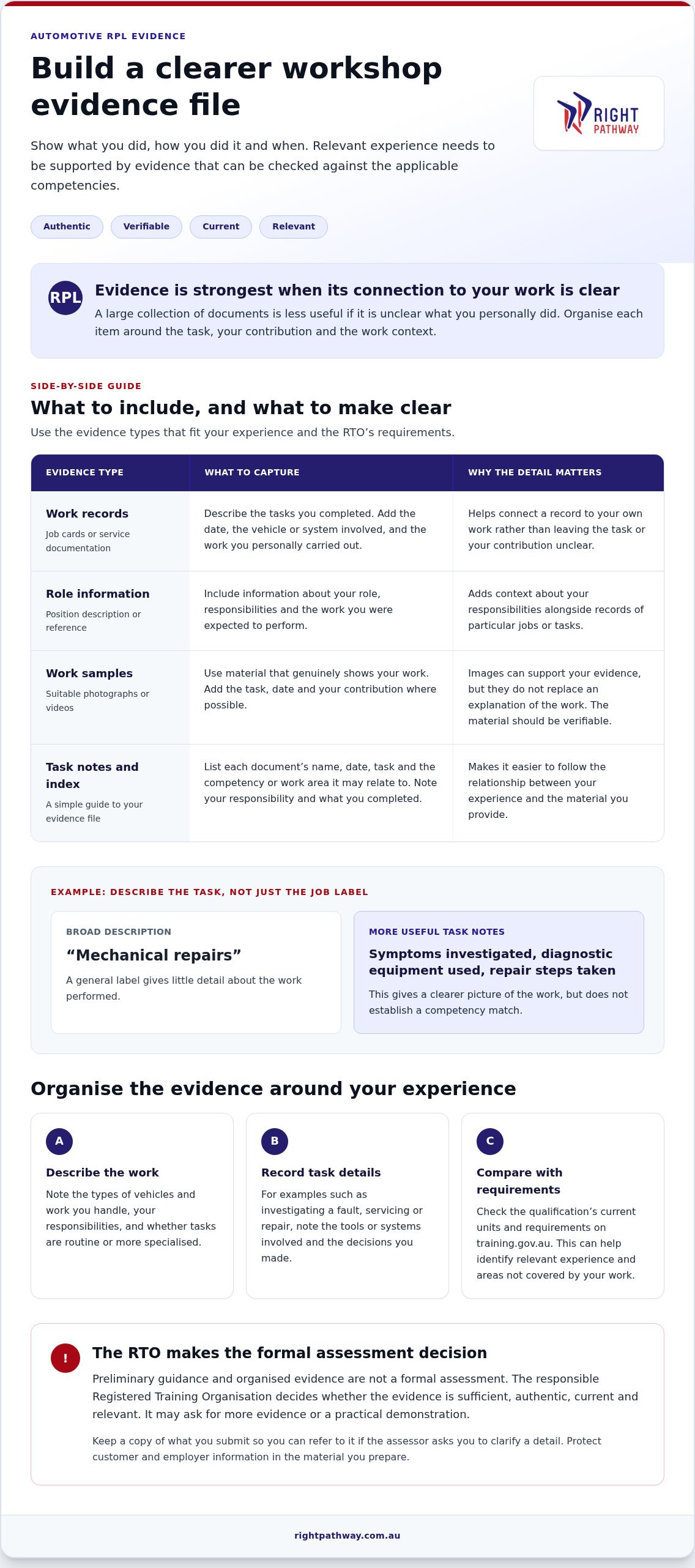
- Document your work scope. Note the types of vehicles and work you handle, your responsibilities, and whether tasks are routine or more specialised.
- Identify recurring tasks. Record examples such as investigating a fault, carrying out a service or completing a repair. Include the tools or systems involved and the decisions you made.
- Compare with verified units. Check the qualification’s current units and requirements on training.gov.au. This helps you identify relevant experience and areas where your work may not cover the required scope.
For instance, recording the symptoms you investigated, diagnostic equipment used and repair steps taken gives a clearer picture than listing “mechanical repairs” alone. It still doesn’t establish a competency match. The responsible RTO makes that assessment using the qualification requirements and your evidence.
What should you check before naming an automotive qualification?
Confirm the exact title, code, current status and competency requirements on training.gov.au before choosing a pathway. For example, the current light vehicle mechanic qualification is AUR30620 Certificate III in Light Vehicle Mechanical Technology. Recheck the listing when preparing your application, rather than relying on an old document or an example from another provider. Keep licensing, registration and migration skills assessment questions separate from qualification selection.
How do your day-to-day duties help show pathway fit?
Make brief notes against each task: what you did, which tools or systems you used, your level of responsibility and the work context. These details help organise experience for comparison with relevant units, without assuming a match. Right Pathway’s general RPL guide provides broader context. If your experience aligns only partly, another pathway or further evidence may be worth discussing with the RTO.
How to prepare authentic evidence for automotive mechanic RPL
Build an evidence file that shows what you did, how you did it and when. For RPL for automotive mechanic qualification, each item should be authentic, verifiable, current and relevant to the competencies being assessed. A large collection of documents is less useful if the connection to your own work isn’t clear.
Depending on your experience and the RTO’s requirements, useful evidence may include:
- Work records, job cards or service documentation that describe tasks you completed.
- A position description or reference that explains your role and responsibilities.
- Suitable work samples, photographs or videos that genuinely show your work and can be verified appropriately.
Use images as supporting evidence, not as a substitute for explaining the work. Add the date, task and your contribution where possible, and make sure the material can be checked by the RTO. Keep a copy of what you submit so you can refer to it if the assessor asks you to clarify a detail.
How can you organise workshop evidence before referral?
Create a simple index with the document name, date, task and the competency or work area it may relate to. Add brief context, including the vehicle or system involved, your level of responsibility and what you personally completed. Be accurate about shared jobs: don’t present a team result as solely your own. Remove or protect customer and employer details, and don’t submit confidential material without appropriate permission.
What if an employer reference is unavailable?
Flag the gap during preliminary guidance rather than waiting until your evidence file is complete. A former supervisor’s reference, relevant work records or a statutory declaration may help explain your experience, but the responsible RTO decides what it can accept. Keep details consistent across documents and be ready to explain how each item supports your account of the work.
Documents may not be enough to demonstrate every competency. The RTO may request further evidence, a competency conversation, practical demonstration, challenge test or gap training as part of its formal assessment.
How Right Pathway supports your automotive RPL next steps
Right Pathway helps you organise a potential pathway for RPL for automotive mechanic qualification. The support sequence starts with a free initial eligibility check, followed by preliminary guidance, evidence organisation and, where appropriate, referral facilitation. This helps you understand possible next steps before engaging with the responsible Registered Training Organisation (RTO).
What happens after the initial eligibility check?
Right Pathway reviews the information you submit and discusses potential next steps in light of your experience, goals and available evidence. Support may include identifying useful workplace documents and organising them for referral. This is guidance and administrative facilitation, not a formal competency assessment. The RTO handles enrolment, assesses your skills and knowledge against the requirements, decides the outcome and issues any qualification. You can see the broader support sequence in the RPL process guide.
When are you ready to take the next step?
Prepare a concise work history and a few specific examples of relevant automotive duties. Note your responsibilities and the records you may be able to provide. You don’t need to resolve every evidence question before seeking preliminary guidance, but be open about gaps. The RTO may request further evidence or assessment, such as a competency conversation or practical demonstration. Outcomes and timeframes aren’t guaranteed, and the initial check is free and non-obligatory, not a formal RPL assessment.
If you’re ready to discuss possible next steps, complete Right Pathway’s free initial eligibility check. It doesn’t guarantee RTO enrolment or a qualification outcome.
Take a considered next step with your experience
Think about what you want your experience to support next. A useful starting point is to describe the work you want recognised and the direction you hope to take, then consider whether your available evidence can tell that story clearly. This helps keep RPL for automotive mechanic qualification focused on a relevant pathway, rather than on years worked alone.
Right Pathway can provide preliminary pathway guidance and help you organise evidence for discussion with the responsible RTO. The RTO remains responsible for formal assessment and any decision about competency or qualification. An initial check is a way to explore possible next steps, not a promise of enrolment or an outcome.
Bring your experience into focus, one clear step at a time. Your workshop knowledge deserves to be considered against the right requirements.
Frequently Asked Questions
Can I get an automotive mechanic qualification through RPL?
Possibly, if your relevant skills and knowledge can be demonstrated against the applicable competency requirements. For RPL for automotive mechanic qualification, consider whether your evidence covers the scope of the qualification, not just familiar tasks. The RTO may ask you to explain how you completed particular work or demonstrate a skill. It decides whether the evidence meets the requirements, and experience alone doesn’t guarantee a qualification.
How many years of experience do I need for automotive RPL?
There’s no universal number of years that guarantees eligibility. The relevance and quality of your evidence matter more than simply counting time in a workshop. For example, a clear record of varied duties may help explain your experience better than a long employment history with little detail about your actual work. An initial eligibility check can help explore pathway fit, but it isn’t the RTO’s formal assessment.
What evidence can an automotive mechanic use for RPL?
Potential evidence includes employment records, references, logbooks, invoices, prior qualifications and suitable work samples, where relevant. Choose items that help verify your role and connect your experience to the requirements. For instance, an invoice or job record may provide context for work completed, while a reference can clarify your responsibilities. The RTO determines whether evidence is suitable and may ask for additional information or assessment.
Does Right Pathway assess automotive mechanic skills or issue the qualification?
No. Right Pathway provides preliminary eligibility guidance, evidence preparation support and administrative facilitation. It doesn’t formally assess competency or issue qualifications. The responsible RTO handles enrolment, assessment and the outcome decision, and issues any qualification. A free initial eligibility check is non-obligatory, but it doesn’t guarantee RTO acceptance or a particular result.
Does an automotive qualification through RPL automatically provide a trade licence?
No. A qualification and an occupational licence or registration are separate, and a qualification doesn’t automatically authorise regulated work. Requirements can vary depending on the work and jurisdiction. If you need to establish what applies to a particular activity, check with the relevant state or territory regulator. This FAQ explains the distinction but doesn’t provide licensing advice.

Article by
Right Pathway Team
Right Pathway supports experienced workers, tradespeople and skilled migrants with preliminary RPL eligibility guidance, evidence preparation and qualification pathway navigation.
Right Pathway is not a Registered Training Organisation and does not conduct formal competency assessments or issue qualifications. Formal enrolment, competency assessment and qualification issuance are completed by the responsible Registered Training Organisation.
Start with a free initial RPL eligibility assessment at https://www.rightpathway.com.au/eligibility-check
Disclaimer
Right Pathway is a facilitation and support service only. We are not a Registered Training Organisation (RTO), do not conduct formal RPL assessments and do not issue qualifications. All formal RPL assessments and certifications are completed by partner RTOs regulated by ASQA. Eligibility and qualification outcomes depend on each applicant’s evidence, experience and the RTO’s assessment decision.


