

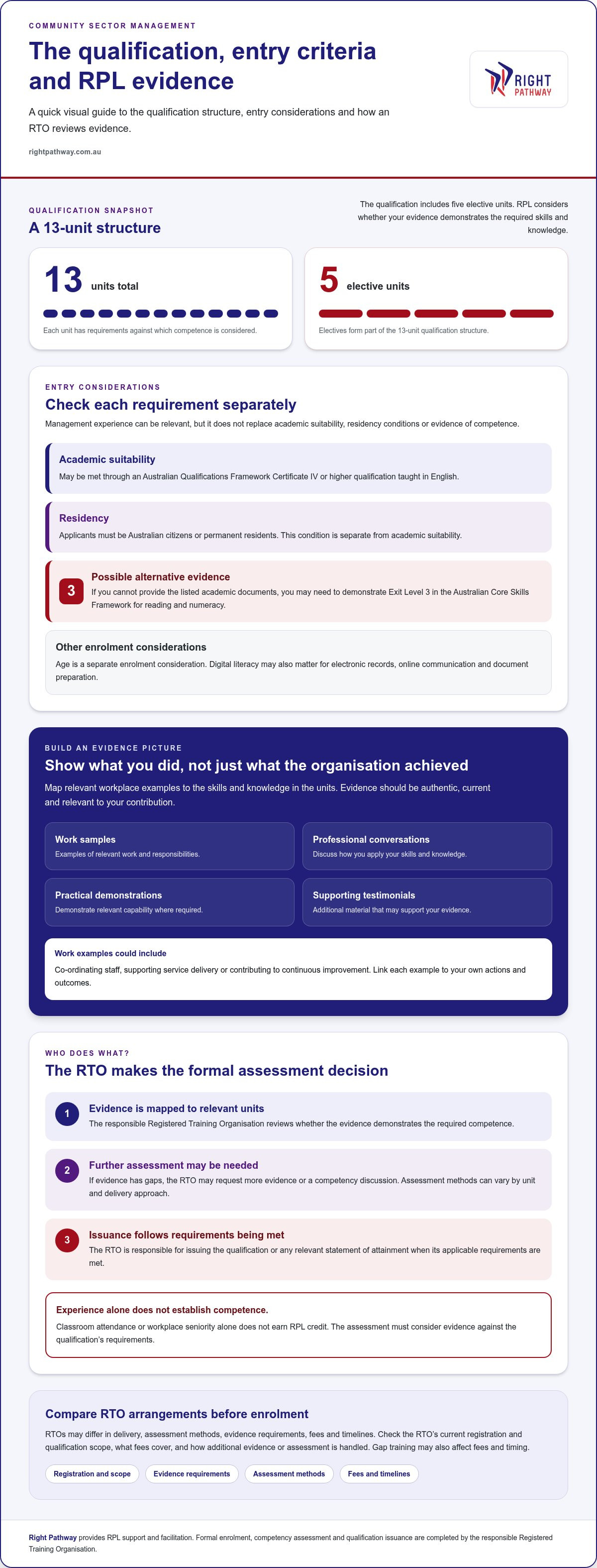
Experience in community services can be assessed through advanced diploma of community sector management RPL, but time on the job alone does not establish competence. For the CHC62015 Advanced Diploma of Community Sector Management, the qualification comprises 13 units, including five elective units, and RPL considers whether your evidence demonstrates the required skills and knowledge.
If you already manage teams, services or programmes, it’s reasonable to want clear answers before choosing a qualification pathway. This article explains whether RPL may be available, what entry requirements apply, how an RTO reviews evidence and decides whether further assessment is needed, and what happens if you meet the requirements. You’ll also learn how the qualification’s structure can help you identify relevant workplace evidence and consider possible next steps.
Key Takeaways
- Check the qualification’s academic suitability requirements, including whether your previous study was an Australian Qualifications Framework Certificate IV or higher taught in English.
- Organise evidence that shows your relevant skills and knowledge. An RTO may consider work samples, professional conversations, practical demonstrations and supporting testimonials.
- The responsible RTO conducts the formal assessment and issues the qualification when its requirements are met; experience alone does not establish competence.
- Use the qualification’s structure and your career goals to consider suitable further study or professional pathways.
What are the entry requirements?
Entry to the CHC62015 Advanced Diploma of Community Sector Management involves academic suitability and residency considerations. For RPL, also consider whether your workplace evidence demonstrates relevant skills and knowledge.
Academic, age and English entry criteria
Academic suitability may be met through an Australian Qualifications Framework Certificate IV or higher qualification taught in English. This allows the RTO to consider your previous study and English-language learning. Residency is a separate condition: applicants must be Australian citizens or permanent residents. Treat age as a separate enrolment consideration, not a substitute for academic suitability or residency. Review all these criteria when preparing an application.
Management experience for entry
Management experience can help demonstrate how you apply leadership in a community-services workplace. Examples might include coordinating staff, supporting service delivery or contributing to continuous improvement. However, experience alone does not replace academic suitability or establish competence for every unit. For RPL, map each example to the relevant skills and knowledge, then organise evidence showing your actions and their outcomes. This helps distinguish general seniority from demonstrated capability.
Language, literacy, numeracy and digital literacy
Reading and numeracy matter when a student interprets workplace information, records service activity, or prepares written material. Applicants unable to provide the listed academic documents may need to demonstrate competence at Exit Level 3 in the Australian Core Skills Framework for reading and numeracy. Digital literacy also matters in course tasks involving electronic records, online communication, or document preparation. Consider which everyday work examples show these capabilities. They can help guide the evidence you prepare for an RPL pathway.
International applications and work placement
Applicants must be Australian citizens or permanent residents, so consider this residency condition before planning enrolment. This qualification requirement is separate from visa eligibility or migration advice. If your pathway includes industry placement, prepare for any placement-related screening. EQUALS states that a DCSI check must be acquired before industry placement for the qualification. Keep this step distinct from RPL evidence: the RTO assesses competency, while placement conditions relate to undertaking the placement.
Assessment and qualification issuance by an RTO
An RTO decides whether your evidence demonstrates competence against the qualification’s requirements. Delivery and assessment methods depend on your enrolment pathway and the RTO’s process.
RPL eligibility and assessment process
For RPL, the RTO maps your evidence to the relevant units. Work samples, professional conversations, practical demonstrations and supporting testimonials may contribute. If your portfolio has gaps, the assessor may request more evidence or a competency discussion. Prepare authentic, current examples that show your contribution, not just the organisation’s overall results.
Classroom delivery involves scheduled learning and assessment activities. Online delivery may use digital learning materials, submitted work and remote discussions. Either way, the RTO must assess competence: attendance or experience alone does not earn credit. Course content covers the qualification’s required skills, including leadership, service development, innovation and continuous improvement.
The CHC62015 qualification comprises 13 units, including five electives. RTO assessment may involve written tasks, workplace evidence or demonstrations, depending on the unit and delivery approach. Once the RTO determines that you have met the applicable requirements, it is responsible for issuing the qualification or any relevant statement of attainment.
RTO options, fees and timelines
RTOs offering this qualification through RPL may have different delivery and assessment arrangements. Before enrolling, compare the RTO’s current registration, qualification scope, evidence requirements and assessment methods. An unregistered provider may not be able to issue a valid nationally recognised qualification, so confirm which RTO conducts the formal assessment and issues the credential.
Fees and timelines differ with the RTO, evidence already available, additional assessment needs and any gap training. One provider reports that most candidates receive a qualification within 4 to 6 weeks after submitting a complete evidence portfolio; this is not a standard timeframe across providers. Compare what each quoted fee covers and how the RTO handles further evidence or assessment. A free initial eligibility check can help you consider your potential pathway before formal RTO assessment.
What are the Qualification Pathways?
RPL fees vary by RTO and individual case. The volume of evidence, assessment requirements and any gap training can affect the fee.
Qualification certification and further study
After a successful assessment, the responsible RTO issues the qualification. A qualification earned through RPL is nationally recognised under the Australian Qualifications Framework and equivalent to one earned through classroom study. It formally recognises assessed skills, but is not a migration skills assessment or a guarantee of employment. For further study, compare the next course’s entry criteria with your qualification and career goals. Credit or admission depends on the receiving provider’s requirements.
Management responsibilities and qualification overview
The CHC62015 Advanced Diploma of Community Sector Management focuses on management capability in community organisations. In practice, responsibilities may include coordinating teams, supporting service delivery and contributing to organisational change. These examples help you consider how your skills align with the qualification’s purpose. Managers also need to review quality frameworks, identify service gaps and support continuous improvement. In an RPL pathway, connect relevant workplace responsibilities to evidence of your own competency.
Community sector management qualification
Compare the advanced diploma with the CHC52025 Diploma of Community Services before choosing a pathway. The diploma focuses on community services practice, while the advanced diploma is oriented towards sector management. The CHC52025 qualification has no formal entry requirements listed in the research information. It also requires at least 100 hours of work in a community service environment. Check how each course fits your existing skills, intended responsibilities and further study plans.
The two qualifications can support different development goals. The right sequence depends on whether you need to build community-services practice first or demonstrate existing management competency. An RTO maps prior learning to the requirements of the relevant qualification; it does not treat the two awards as interchangeable. Keep that distinction in mind when discussing your pathway.
Advanced Diploma of Community Sector Management reference
Use training.gov.au to check the CHC62015 reference, its qualification record and the RTO’s registration details. Compare the record with the course and enrolment information before proceeding.
Qualification reference details
Search training.gov.au using the code CHC62015 or the title Advanced Diploma of Community Sector Management. Read the qualification record carefully, including its status and any listed qualification details. This helps Australian workers distinguish the specific credential from similarly named community services courses or older education materials.
The reference record is a starting point, not proof that an individual has completed the qualification. For RPL, an RTO assesses skills and evidence against the applicable requirements. The responsible RTO issues a certificate only after determining that those requirements have been met.
Use the record to confirm that you and the RTO are discussing the same qualification. Then compare the RTO’s enrolment information and assessment process with your intended pathway. Keep copies of the course details and any written enrolment information for your records.
Checking an RTO and qualification
On training.gov.au, search for the RTO by its legal or trading name and review its registration details. Check that it is registered and its scope includes the qualification you intend to pursue. Match the provider’s details against its enrolment documents rather than relying on a course title alone.
Next, search CHC62015 separately. Compare the qualification title and status shown in the record with the RTO’s advertised course. If the details differ, pause before enrolling and clarify which qualification is being offered. This step helps reduce the risk of paying for training from an organisation that cannot issue the credential you expect.
Distinguish RPL support from formal assessment. A facilitator can help organise evidence, but the registered RTO conducts the competency assessment and issues any resulting certificate. An Australian qualification is not a migration skills assessment, licence or guarantee of employment. Consider each purpose separately before relying on the credential for work or further education.
Right Pathway: RPL support and administrative facilitation
Right Pathway helps community sector professionals organise their experience and explore a suitable RPL pathway. A preliminary skills and experience eligibility consultation can help you identify how your work may align with qualification requirements. A preliminary evidence-readiness review can also help you organise relevant documents and workplace examples, such as records of service coordination or team leadership.
Right Pathway’s support is preparatory and administrative. The responsible Registered Training Organisation handles formal enrolment and competency assessment, decides whether your evidence meets the requirements, and issues any qualification. Right Pathway helps you prepare for the process, while the RTO makes the formal assessment decision.
If you’d like to discuss your next steps, contact Right Pathway or visit its website.
Plan your next qualification step
Before choosing a pathway, consider what you want your next role to involve. If you’re exploring an advanced diploma of community sector management RPL pathway, compare the qualification’s focus with the responsibilities you hope to take on. This can help you decide whether it supports your professional direction, rather than pursuing a credential without a clear purpose.
Set aside time to review your career goals, existing commitments and the records you can access. Note any questions to resolve before formal enrolment, including how the qualification may fit your longer-term development. A considered plan gives you a practical basis for deciding what to do next.
When you’re ready, take the next step with a clear sense of where you want your experience to lead.
Frequently Asked Questions
Is Recognition of Prior Learning (RPL) available?
Yes, an RTO may offer RPL for this qualification. RPL assesses workplace skills against competency requirements, while credit transfer recognises relevant prior formal study. If you’ve completed related units elsewhere, provide your transcripts for consideration. If your experience is mainly workplace-based, prepare examples showing how you applied your knowledge. The RTO determines which pathway suits your circumstances.
Where can it take your career?
The qualification may support career planning in community sector organisations, but it does not determine a particular job outcome. Compare the credential with position descriptions for roles you’re considering, and note any additional experience or requirements they identify. If further study is your goal, review the next programme’s admission criteria before enrolling. This helps you assess whether the qualification fits your intended direction.
What is the Advanced Diploma of Community Sector Management qualification code in Australia?
The code is CHC62015. Use the code alongside the full title, Advanced Diploma of Community Sector Management, when discussing the qualification with an employer or education provider. Matching both details can help distinguish it from other community-services awards in records or applications. For current qualification status, use the official training.gov.au listing rather than relying on an old certificate description or course advertisement.
What are the eligibility requirements for RPL for this advanced diploma?
There’s no universal minimum number of years of experience for RPL. Eligibility depends on how relevant your evidence is and how well it demonstrates the qualification’s competencies. Before applying, list your responsibilities and identify records that can verify your work. This helps you distinguish a preliminary view of your suitability from the RTO’s formal decision, which is based on its assessment of your evidence.
What evidence is required for an RPL application in community sector management?
Create an evidence register recording each item’s date, context, your role and the capability it demonstrates. For example, note whether a report reflects your own analysis or summarises a team’s work. Add brief explanations where documents need context, and keep original records available in case the assessor asks about them. This makes your evidence easier to follow and shows how each item relates to your practice.
How does the RPL assessment process work, including interviews and workplace observation?
An RTO may use an interview or workplace observation alongside document review to assess how you perform relevant duties. In a professional conversation, be ready to explain your reasoning, the options you considered and how you reviewed the result. During observation, carry out the task as you normally would and explain your decisions when asked. The assessor selects methods to evaluate your evidence against the competency requirements.

Article by
Right Pathway Team
Right Pathway supports experienced workers, tradespeople and skilled migrants with preliminary RPL eligibility guidance, evidence preparation and qualification pathway navigation.
Right Pathway is not a Registered Training Organisation and does not conduct formal competency assessments or issue qualifications. Formal enrolment, competency assessment and qualification issuance are completed by the responsible Registered Training Organisation.
Start with a free initial RPL eligibility assessment at https://www.rightpathway.com.au/eligibility-check
Disclaimer
Right Pathway is a facilitation and support service only. We are not a Registered Training Organisation (RTO), do not conduct formal RPL assessments and do not issue qualifications. All formal RPL assessments and certifications are completed by partner RTOs regulated by ASQA. Eligibility and qualification outcomes depend on each applicant’s evidence, experience and the RTO’s assessment decision.


