

RPL for self-employed professionals can recognise skills gained through independent work, provided the evidence demonstrates the relevant competencies. Business records can help show what you did, but invoices or work samples alone may not explain your contribution or how you completed a task. RPL assesses your skills and knowledge against the applicable units of competency.
If you’re unsure whether invoices, contracts, client feedback or project records could support an application, start by sorting the records you can verify and linking them to the work you performed. This guide explains how to choose useful evidence, organise it clearly and understand the roles of Right Pathway and the Registered Training Organisation (RTO).
Right Pathway provides preliminary eligibility guidance and evidence-preparation support. The responsible RTO conducts the formal assessment and decides whether your evidence demonstrates competency. It may also request additional evidence or another assessment activity.
Key Takeaways
- Self-employed work can be considered for RPL when authentic, relevant evidence demonstrates the applicable competencies.
- Sort potential evidence into work history, client or project records, practical work samples, and relevant licences or prior qualifications.
- Choose a pathway based on how your skills and evidence relate to the competencies, not just your business title.
- Use an evidence map to show what each item may demonstrate and where information is missing. The RTO makes the formal assessment decision.
Can self-employed professionals use RPL without an employer?
Yes. Self-employed work can be considered for RPL when relevant, authentic evidence demonstrates the required skills and knowledge. RPL, or Recognition of Prior Learning, assesses skills gained through work and other experience against applicable units of competency. This is the basis of Recognition of Prior Learning in Australia.
The key question is not whether you had a conventional employer. It is whether your evidence helps verify what you did, your role in the work and how you demonstrated the required skills. Experience alone does not establish competency or guarantee a qualification. The responsible RTO reviews the evidence against the relevant units and makes the formal decision.
What changes when you are your own employer?
Payslips and employer references may not exist or accurately describe a sole trader’s responsibilities. Instead, your work history may be documented through business and client records. An invoice, for example, can help show that a project took place, but usually does not explain how you completed the work or which skills you applied. A contract, project notes, work samples and a client’s description of your contribution may add useful context. The RTO decides what evidence it can accept and whether the material is sufficient.
Experience, eligibility guidance and formal assessment are different
Right Pathway can provide preliminary eligibility guidance and help you organise evidence before formal assessment. This can help you explore whether your experience and records may fit a qualification pathway. It is not a formal competency assessment or a decision about the outcome.
The responsible RTO handles formal enrolment and assessment, compares the evidence with the applicable competencies, and determines the result. It may ask for more evidence or another assessment activity. Relevant experience is a starting point, not a guarantee of eligibility, demonstrated competency or a qualification. The decision depends on how well your evidence supports the required skills and knowledge.
Which evidence can self-employed professionals use for RPL?
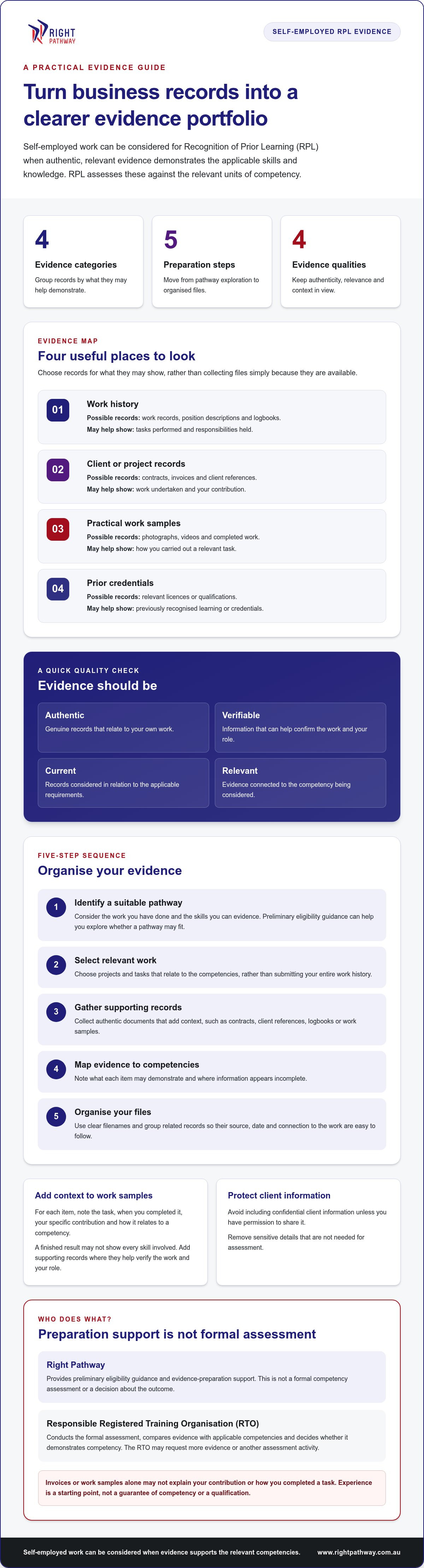
Organise evidence by what it may demonstrate, rather than simply by file type. Evidence should be authentic, verifiable, current and relevant to the applicable competency requirements. A large portfolio is not automatically persuasive. Each item should help show your own skills, knowledge, decisions or work.
How can client records replace a conventional employer reference?
Client references, contracts, invoices and project records can help corroborate the work you performed and your role in it. Someone else who observed your work, such as a former supervisor or contractor, may also be able to provide relevant information. If you cannot obtain an employer reference, alternative evidence may be considered, subject to the RTO’s approval. These records are not guaranteed substitutes, and the RTO decides whether the evidence is suitable and sufficient.
What makes a work sample useful evidence?
Photographs, videos, logbooks and other work samples are more useful when you explain their context. For each item, note the task, when you completed it, your specific contribution and how it relates to a competency. A finished result does not necessarily show every skill involved. Add supporting records where they help verify the work and your role.
Use this evidence-to-competency map as a starting point. The examples are possible evidence sources, not a promise that an RTO will accept them.
| Evidence category | Possible evidence | What it may help demonstrate |
|---|---|---|
| Work history | Work records, position descriptions, logbooks | Tasks performed and responsibilities held |
| Client or project records | Contracts, invoices, client references | Work undertaken and your contribution |
| Practical work samples | Photographs, videos, completed work | How you carried out a relevant task |
| Prior credentials | Relevant licences or qualifications | Previously recognised learning or credentials |
For a clearer portfolio, choose records that show different aspects of your work instead of repeating the same point. A project record might establish the task, while a related work sample illustrates how you carried it out. Label each item with the competency it may support and be ready to explain details that the documents do not show. Avoid including confidential client information unless you have permission to share it, and remove sensitive details that are not needed for assessment.
How to organise self-employed RPL evidence step by step
A clear sequence can turn scattered business records into a portfolio that is easier to review. Pathway suitability depends on your experience, available evidence and the applicable competencies, not your business title alone.
- Identify a suitable pathway. Consider the work you have done and the skills you can evidence. Preliminary eligibility guidance can help you explore whether a pathway may fit.
- Select relevant work. Choose projects and tasks that relate to the competencies instead of submitting your entire work history.
- Gather supporting records. Collect authentic documents that provide context for those tasks, such as contracts, client references, logbooks or work samples.
- Map evidence to competencies. Note what each item may demonstrate and where information appears incomplete.
- Organise your files. Use clear filenames and group related records so their source, date and connection to the work are easy to follow.
This preparation follows the general stages of the RPL process from preparation to assessment, while keeping your evidence focused on your independent work.
Build a simple evidence-to-competency map
Create a table with columns for the relevant competency, work example, supporting record and any evidence gap. For example, for a competency involving planning and completing a client project, you might list the project brief as the work example and the contract as a supporting record. If you do not have evidence showing how you checked the completed work, note that gap rather than assuming the other documents cover it. The map organises your portfolio, but it does not replace the RTO’s assessment.
What if a document or reference is missing?
Record the gap instead of asking one document to prove more than it can. Look for other authentic records, such as business documents or a reference from someone who observed your work. If an employer reference is unavailable, alternatives such as a former supervisor’s reference, tax records or a statutory declaration may be considered, subject to RTO approval. The RTO decides whether the alternatives are sufficient and may request more evidence, a competency conversation or a practical demonstration.
Before submitting your portfolio, check that each file opens, its label matches your evidence map, and the records support the role you have described. Keep notes about anything that needs explanation so you can address it clearly during the RTO’s assessment process.
What happens next: Right Pathway support and the RTO's role
The next steps separate preparation support from formal assessment. Right Pathway can help you understand the process, organise evidence and navigate a potential qualification pathway. The responsible RTO handles formal enrolment, competency assessment, decisions and certification.
- Enquire and receive RPL information. Share a summary of your work and the qualification area you are considering.
- Collect relevant evidence. Bring together records that may help demonstrate your skills and experience.
- Have an initial review. Right Pathway can provide preliminary eligibility guidance and help organise your evidence. This is not a formal assessment.
- Proceed to the RTO, if appropriate. Referral facilitation can help you navigate the next step. The RTO manages formal enrolment and assessment.
- Receive the assessment outcome. The RTO decides whether your evidence demonstrates competency and determines any further steps.
The free initial eligibility check has no obligation to proceed. It helps review your initial information and discuss potential next steps, but it does not confirm an RTO outcome or replace formal assessment.
What the RTO may require during formal assessment
Your submitted records may not cover every requirement. The RTO may request additional evidence, a competency conversation, practical demonstration, challenge test or gap training. Only the responsible RTO determines whether you have demonstrated competency, what further steps are needed and whether certification can be issued.
Prepare for an informed next step
Before making an enquiry, summarise your work history, the qualification area you are considering and the evidence you currently have. Note any missing records too. This gives the preliminary review useful context. Once eligibility is confirmed, applicable RTO assessment or gap-training fees can be discussed. See the RPL cost information for Australia for further context.
Take the next step with a clear evidence plan
You do not need to collect every business record you own. Choose a potential qualification area, then list projects that show the skills you want recognised. Note what each record may support and where you still need clarification. For RPL for self-employed professionals, a focused evidence plan is a more useful starting point than an oversized folder without context.
Right Pathway can help you organise documents and explore a potential pathway through preliminary guidance. This support is separate from the responsible RTO’s formal assessment and decision. The initial review can help you discuss possible next steps, while the RTO determines what your evidence demonstrates. You do not need a perfect portfolio before seeking guidance, but be candid about missing records and areas you are unsure about.
Start with evidence you can verify, then complete Right Pathway’s free initial eligibility assessment to discuss potential next steps.
Frequently Asked Questions
Can I get RPL if I am self-employed and do not have an employer reference?
Yes. Self-employed work can be considered for RPL without an employer reference if you can provide relevant evidence. For example, a sole trader might use a client’s project confirmation alongside a contract or job records to describe their role. The responsible RTO decides whether the material demonstrates the required competencies and is sufficient for assessment. If an employer reference is unavailable, alternative evidence may be considered, subject to RTO approval.
What evidence can a sole trader provide for an RPL application?
Possible evidence includes contracts, invoices, client references, work samples, photographs or videos, logbooks, relevant licences and previous qualifications. Choose items that show your own work, rather than simply proving that your business exists. A logbook, for instance, may record tasks completed, while a related work sample can provide context. Evidence should be verifiable and connected to the competencies. The RTO may request more material.
Do I need a minimum number of years of experience for RPL?
There is no universal minimum number of years of experience for RPL. Suitability depends on whether your experience relates to the applicable competency requirements and whether your evidence supports your claims. Time in business, by itself, does not establish competency or guarantee a qualification. The responsible RTO reviews your evidence through formal assessment and decides whether the requirements have been met.
Can invoices and client references prove my work experience for RPL?
They may help corroborate projects and work history if they are genuine and relevant. An invoice can show that work was billed, while a client reference may add context about your involvement. Neither document automatically demonstrates every required skill. An RTO may consider them alongside other evidence, such as a work sample, and can request further material or assessment before deciding whether competency has been demonstrated.
Does Right Pathway formally assess my RPL evidence?
No. Right Pathway provides preliminary eligibility guidance and support to organise evidence, but it does not conduct formal competency assessments. The responsible RTO enrols applicants, assesses evidence, makes the competency decision and issues any qualification or statement of attainment. Right Pathway’s free initial eligibility check is preliminary and carries no obligation to proceed. It does not confirm an RTO decision or replace formal assessment.

Article by
Right Pathway Team
Right Pathway supports experienced workers, tradespeople and skilled migrants with preliminary RPL eligibility guidance, evidence preparation and qualification pathway navigation.
Right Pathway is not a Registered Training Organisation and does not conduct formal competency assessments or issue qualifications. Formal enrolment, competency assessment and qualification issuance are completed by the responsible Registered Training Organisation.
Start with a free initial RPL eligibility assessment at https://www.rightpathway.com.au/eligibility-check
Disclaimer
Right Pathway is a facilitation and support service only. We are not a Registered Training Organisation (RTO), do not conduct formal RPL assessments and do not issue qualifications. All formal RPL assessments and certifications are completed by partner RTOs regulated by ASQA. Eligibility and qualification outcomes depend on each applicant’s evidence, experience and the RTO’s assessment decision.


