

Five years on the tools can strengthen an RPL application, but it doesn’t decide the outcome. If you’re asking, “can I get RPL with 5 years experience?”, the short answer is possibly. There’s no single Australia-wide minimum number of years: the key question is whether you can demonstrate the skills and knowledge required for the relevant units of competency.
It’s understandable to wonder whether time served is enough, especially when your day-to-day work doesn’t neatly match formal training requirements. Five years may give you valuable examples to draw on, but your evidence also needs to be relevant, current, authentic and sufficient. The responsible Registered Training Organisation (RTO) makes the formal assessment decision and may ask for more evidence, a practical demonstration or a competency conversation.
This article explains how experience can support an RPL application, what kinds of evidence can help show your capability, and what to expect from preliminary guidance and formal RTO assessment. It also clarifies how an RPL qualification differs from a trade licence or a migration skills assessment, so you can understand the pathway before taking the next step.
Key Takeaways
- If you’re asking “can I get RPL with 5 years experience?”, use your work history as a starting point, then focus on showing how your skills match the relevant competencies.
- Make your evidence easier to review by identifying relevant tasks, gathering supporting records and examples, then noting any gaps.
- Use preliminary guidance to organise your experience and explore a potential qualification pathway before formal assessment by an RTO.
- Prepare for the RTO to seek clarification or ask you to demonstrate your skills as part of its assessment.
Can I get RPL with 5 years’ experience? The short answer
Five years may support an RPL application, but the length of your experience alone doesn’t establish eligibility. Whether you can get RPL with 5 years experience depends on what you’ve done and how it relates to the applicable units of competency in a suitable qualification.
RPL recognises demonstrated competency, not time served alone. The responsible Registered Training Organisation (RTO) assesses whether your skills and knowledge meet the relevant requirements. You can find more about the support available through Right Pathway’s RPL guidance, while the RTO makes the formal assessment decision.
Why experience duration is only one part of the picture
Five years in a role can involve repeating the same duties or taking on a broad mix of tasks, decisions and responsibilities. Those differences matter: time in a job doesn’t show, by itself, which skills you’ve developed or whether they match a qualification’s requirements.
For example, workers with the same length of experience in an industry may have handled very different tasks. The RTO considers the work performed and its relevance to the applicable competencies, not just a job title or employment dates. There’s no universal experience period that guarantees an RPL outcome.
What RPL can and cannot establish
RPL may provide a pathway to having existing skills and knowledge assessed towards a qualification. It doesn’t automatically grant an occupational licence or professional registration, confirm visa eligibility, or secure employment. Licensing requirements are separate and can depend on the relevant state or territory regulator.
The RTO is responsible for formal enrolment, assessment and the final decision. Right Pathway provides preliminary guidance and evidence preparation support, but this isn’t a formal assessment or a promise of an outcome.
What makes five years of experience relevant to an RPL assessment?
Five years can give you a substantial work history to draw on, but its relevance depends on what that experience demonstrates. An RTO compares your skills and knowledge with the applicable units of competency. For background on the Australian training framework, see the RPL Australia guide and Australia’s National Training Register.
- Years in a role: Shows how long you’ve worked in a position, but not necessarily the tasks or skills you’ve demonstrated.
- Evidence mapped to competencies: Connects specific work tasks and supporting records to the requirements being assessed.
How assessors connect work tasks with competencies
Hypothetical example: A construction worker may have experience coordinating materials, interpreting job instructions and documenting completed work. An RTO could consider these activities against relevant competencies, but its assessor determines whether the evidence demonstrates the required skills and knowledge. No qualification or unit codes are used here. Check specific references against training.gov.au before relying on them.
Evidence is stronger when it’s relevant to the qualification, current enough to reflect your capability, authentic and genuinely your own, and sufficient to cover the requirements. A job title or general statement of duties may provide context, but may not show how you performed a task.
Why experience gaps may still matter
Five years focused on one part of a role may not demonstrate every competency in a potential qualification. That doesn’t decide the outcome by itself. The RTO may request further records, discuss your work in a competency conversation, ask for a practical demonstration or identify a need for gap training. Its assessor determines the next step.
RPL for an Australian qualification is distinct from a migration skills assessment. The processes serve different purposes, and an RPL outcome doesn’t itself establish migration or visa eligibility. If you’re unsure how your work history may align with a qualification pathway, a free initial eligibility check can provide preliminary guidance, not a formal RTO assessment.
How to prepare evidence from five years of work experience
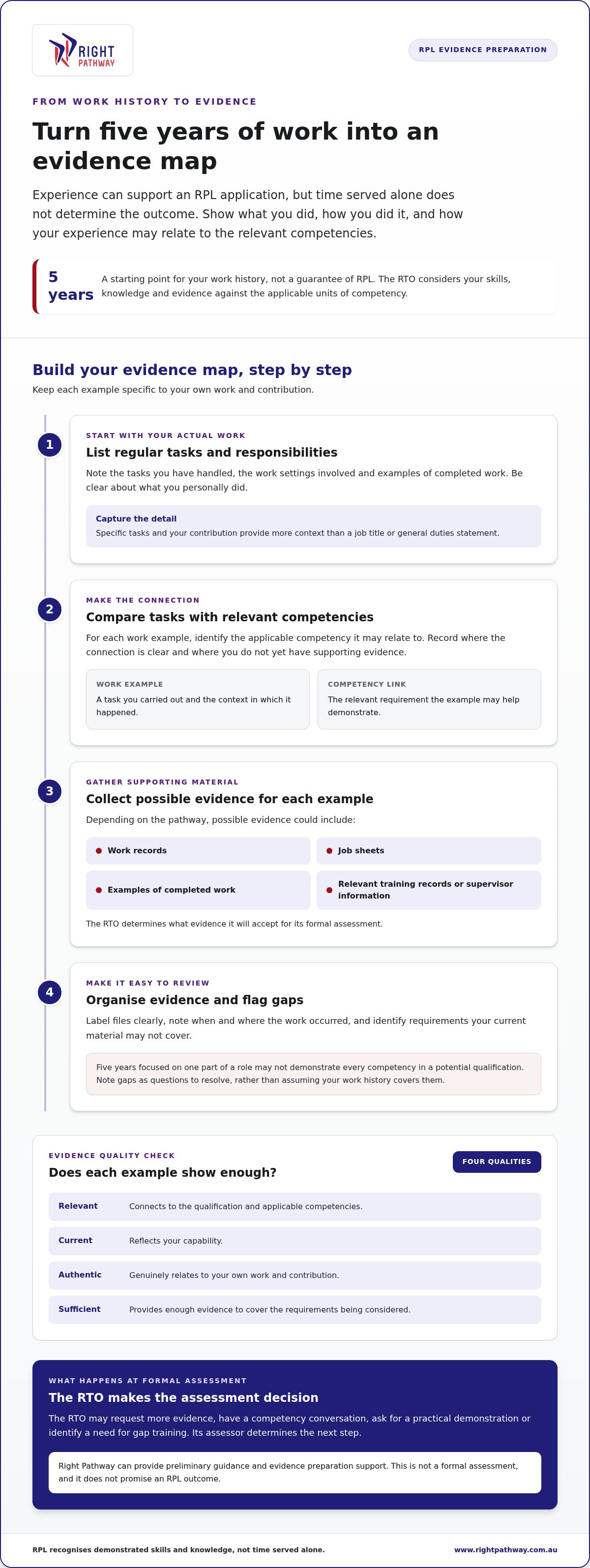
Turn your work history into evidence by showing what you did, how you did it and which relevant competencies it may demonstrate. Five years of experience can support an RPL application, but an evidence map helps organise your work history. The RTO decides what evidence is suitable for its formal assessment.
- List your regular tasks. Record the responsibilities you’ve handled, the work settings involved and examples of completed tasks. Be specific about your own contribution.
- Map tasks to competencies. Compare each example with the applicable competency requirements. Note where the connection is clear and where you don’t yet have supporting evidence.
- Gather possible evidence. Depending on the pathway, this could include work records, job sheets, examples of completed work, relevant training records or information from a supervisor. An RTO determines what it will accept.
- Organise gaps and questions. Label files clearly, note when and where the work occurred, and identify any competency that your current material doesn’t appear to cover.
Build an evidence map from real work tasks
Use a simple table with columns for the task, work context, possible evidence and related competency. For example, a worker might connect a completed job record with a task they carried out, then note what additional material could help show the method or result. Follow the RPL process steps to understand how evidence fits into the broader pathway.
Evidence should be authentic, current, relevant and sufficient for the requirements being assessed. Strong evidence is about clear competency coverage, not the size of your document pile. Keep original records where possible, and don’t present another person’s work as your own.
Prepare for follow-up assessment requirements
Documents may not be the only way an RTO checks your competence. It may ask questions in a competency conversation, request a practical demonstration or challenge test, or identify gap training. These steps depend on the evidence and assessment requirements, so prepare to explain your work rather than relying on paperwork alone.
What happens next: preliminary RPL guidance and formal assessment
If you’re still asking, “can I get RPL with 5 years experience?”, the next step is to separate preliminary guidance from formal assessment. Right Pathway can help you organise your experience and explore a potential qualification pathway. The responsible Registered Training Organisation (RTO) handles formal enrolment, competency assessment and the decision about whether your evidence meets the requirements.
What a free initial eligibility assessment can clarify
A free initial eligibility assessment is an early guidance step, not a formal RPL assessment. It gives you an opportunity to share information about your work history and discuss potential qualification pathways. Preliminary guidance can also help identify what evidence you may need to prepare and what questions to raise as you consider the next steps.
Qualification suitability depends on how your experience and evidence relate to the applicable competencies, as well as the outcome of the RTO’s formal assessment. The RTO may ask for additional information or assessment activities before it decides whether you’ve demonstrated the required skills and knowledge. An initial discussion can help you prepare, but it can’t determine or promise the RTO’s outcome.
Keep qualification, licensing and migration outcomes separate
An RPL outcome towards a qualification doesn’t automatically provide a trade licence, professional registration or authority to perform regulated work. Licensing requirements are separate and depend on the relevant occupation and jurisdiction. For licensing questions, refer to the regulator in your state or territory.
Likewise, an Australian qualification and a migration skills assessment are different processes. RPL doesn’t itself establish visa eligibility or determine a migration assessment result. For migration-related questions, seek advice from an appropriately registered migration professional.
Use preliminary guidance to organise your information, then follow the RTO’s formal process. Neither an eligibility discussion nor years of experience guarantees acceptance, a qualification or any other outcome.
Turn your experience into a clear next step
If you’re still asking “can I get RPL with 5 years experience?”, use your next step to make your work history easier to understand. Choose a few examples that show the range of your responsibilities, what you personally contributed and how the work relates to a potential qualification pathway. A focused starting point can make it easier to organise your information and identify what you may need to clarify.
Founded in 2019, Right Pathway provides preliminary guidance and evidence preparation support. Client-provided information states it has supported over 2,000 applicants across 18 industries. Right Pathway can help you explore potential next steps, while the responsible RTO conducts formal enrolment and assessment and decides whether your evidence meets the applicable requirements.
A preliminary eligibility assessment is a starting point, not a promise of acceptance or a qualification. Share your initial information to discuss a possible pathway and evidence readiness.
With a clearer picture of your experience and evidence, you can take the next step with greater confidence.
Frequently Asked Questions
Is five years of experience enough to get RPL in Australia?
Five years may provide useful experience, but it isn’t enough by itself to secure RPL. The RTO considers whether your knowledge and skills meet the requirements of the relevant competencies. If you’re wondering, “can I get RPL with 5 years experience?”, consider the range of work you’ve actually performed and whether you can support it with evidence, rather than relying on your employment dates alone.
Can I get RPL if my five years of experience were overseas?
Overseas experience may be considered if it’s relevant to the Australian qualification pathway and can be documented. For instance, records from an overseas employer could help explain your role, responsibilities and the work you completed. The RTO decides whether the material is suitable and may need clarification or further evidence. RPL is separate from a migration skills assessment, so don’t assume one process determines the outcome of the other.
What evidence do I need for RPL after five years of work?
Evidence depends on the competencies and pathway being assessed. You might prepare dated work records, examples of completed tasks, employer or supervisor information, and relevant training records. Add context to each item: note your role, what you personally did and which skills it may demonstrate. A collection of documents isn’t automatically sufficient, and the RTO determines whether the evidence is relevant and can be verified.
Can an RTO refuse RPL even if I have five years of experience?
Yes. An RTO may decide your evidence doesn’t demonstrate some or all of the required competencies, regardless of how long you’ve worked. It may ask questions, request a practical demonstration or identify further learning as a next step. Keep a record of any areas the RTO says need clarification, so you can understand what its decision relates to and what options it outlines.
Does RPL after five years give me a trade licence?
No. An RPL qualification doesn’t automatically grant a trade licence or registration. Licensing requirements are separate and vary according to the occupation and relevant state or territory rules. Before relying on a qualification for regulated work, check the requirements with the appropriate state or territory regulator. The RTO assesses competency for the qualification pathway, not whether you meet a regulator’s licensing criteria.

Article by
Right Pathway Team
Right Pathway supports experienced workers, tradespeople and skilled migrants with preliminary RPL eligibility guidance, evidence preparation and qualification pathway navigation.
Right Pathway is not a Registered Training Organisation and does not conduct formal competency assessments or issue qualifications. Formal enrolment, competency assessment and qualification issuance are completed by the responsible Registered Training Organisation.
Start with a free initial RPL eligibility assessment at https://www.rightpathway.com.au/eligibility-check
Disclaimer
Right Pathway is a facilitation and support service only. We are not a Registered Training Organisation (RTO), do not conduct formal RPL assessments and do not issue qualifications. All formal RPL assessments and certifications are completed by partner RTOs regulated by ASQA. Eligibility and qualification outcomes depend on each applicant’s evidence, experience and the RTO’s assessment decision.


