

Building and construction RPL compares your existing skills and knowledge with relevant units of competency, using evidence to show what you can do. Your site experience is a useful starting point, but years in the industry, a job title or a list of duties do not determine what can be recognised.
It can be difficult to know whether your project work matches formal requirements or which records best demonstrate your contribution. This article explains how the RPL pathway works, how to organise useful evidence and what to expect from formal assessment.
You’ll learn how to connect authentic, relevant evidence to your work and why an RTO may ask for more information or a practical demonstration. We’ll also clarify the difference between an RPL qualification and a licence or registration. Right Pathway provides preliminary eligibility guidance, evidence preparation and qualification pathway navigation. The responsible Registered Training Organisation (RTO) conducts the formal assessment and decides the outcome.
Key Takeaways
- Building and construction RPL considers how your skills and knowledge align with applicable units of competency, not simply your job title or time on site.
- Sort project records, work samples, plans and supervisor references by the tasks they may help demonstrate.
- Make a project list of your responsibilities, tools and completed tasks to help organise your evidence.
- Preliminary eligibility guidance can help you understand potential next steps, but the responsible RTO makes formal assessment decisions.
What does building and construction RPL assess?
Building and construction RPL compares your skills, knowledge and work experience with the requirements of applicable units of competency. These units describe workplace tasks and the knowledge needed to perform them to the required standard. Time on the job, a senior title or a list of duties can provide context, but none proves competency on its own.
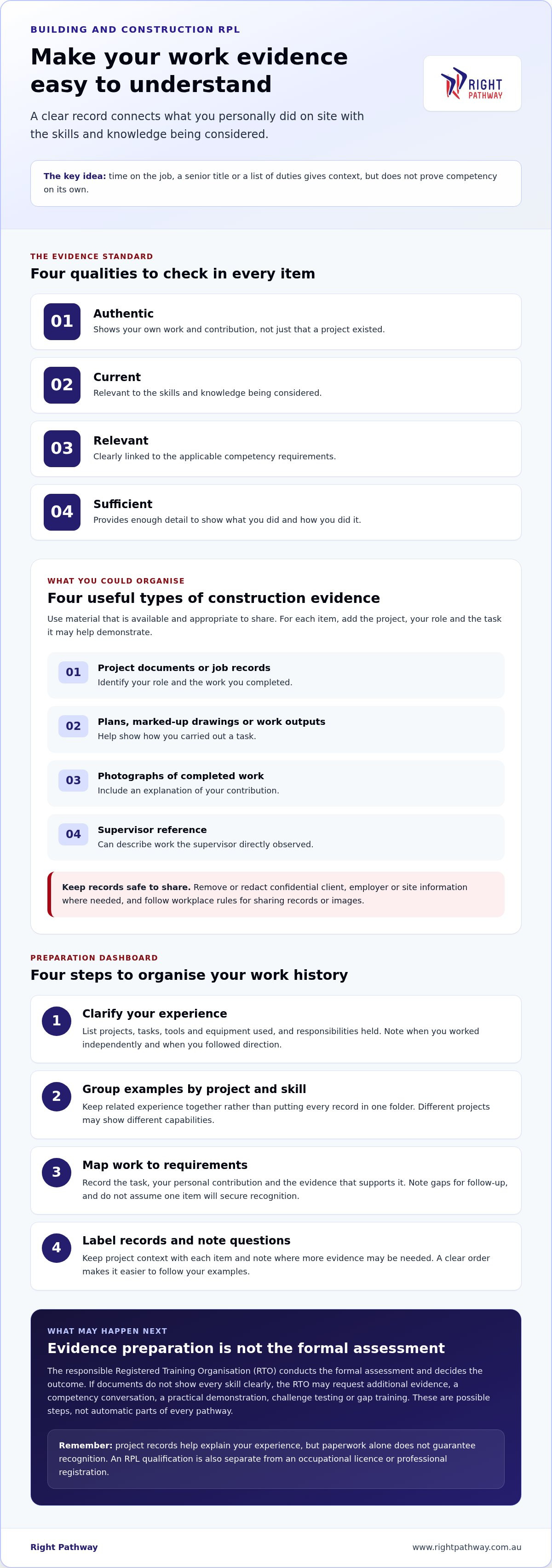
Evidence needs to be authentic, current, relevant and sufficient to show what you personally did. Project records, plans, work samples and supervisor references may help when they relate directly to the competencies being assessed. The responsible RTO conducts the formal assessment and decides whether your evidence supports recognition. Paperwork alone does not guarantee an outcome. The RTO may request further evidence or use other assessment methods.
How site experience relates to units of competency
A unit describes a defined set of skills and knowledge, rather than a broad job title. Requirements may relate, for example, to interpreting plans, preparing a work area or carrying out a construction task. Experience across several projects could provide evidence for different competencies, subject to the RTO’s assessment. The RPL process overview explains how experience can be considered as part of a formal pathway.
RPL is not a licence or migration skills assessment
An RPL assessment may result in recognition of some competencies or contribute towards a qualification, depending on the formal assessment. It is not an occupational licence or professional registration, and it does not by itself establish eligibility for a visa, a job or regulated work. A migration skills assessment is separate from an RPL qualification assessment. For licensing questions, refer to the relevant state or territory regulator. Right Pathway can provide preliminary pathway guidance, while the RTO makes formal assessment decisions.
What evidence can support building and construction RPL?
For building and construction RPL, evidence should show your own work and how it relates to the applicable competency requirements. A document showing that a project existed may provide context, but it may not explain what you personally did. Add details about your role, tasks, level of responsibility and the stage of work shown.
Strong RPL evidence is authentic, current, relevant and clearly linked to the competency being assessed. A smaller set of well-explained records is more useful than a large collection that does not show your contribution.
Examples of construction evidence to organise
Gather material that is available and appropriate to share. Depending on your work history, this could include:
- Project documentation or job records that identify your role and the work you completed.
- Plans, marked-up drawings or other work outputs that help show how you carried out a task.
- Photographs of completed work, with an explanation of your contribution.
- A supervisor reference describing work they directly observed.
Add a brief note to each item explaining which project it relates to, what you did and which skill it may demonstrate. Remove or redact confidential client, employer or site information where needed, and follow workplace rules for sharing records or images. Clear file names and a consistent order also make it easier to connect each item to its project context.
When evidence gaps lead to further assessment
Documents may not show every skill clearly. The RTO may request additional evidence, a competency conversation or a practical demonstration. Depending on its assessment, it may also require challenge testing or gap training. These are possible steps, not automatic parts of every pathway. Right Pathway can guide you on preparing evidence and understanding how it fits into the wider process.
If you’re gathering records and are unsure what may be relevant, a free initial eligibility assessment can help clarify potential next steps. It is preliminary guidance, not a formal RTO assessment or a decision about recognition.
How to prepare for a building and construction RPL assessment
Prepare in stages. The aim is to make your work history clear and connect relevant examples to the skills being considered. A project list or document bundle helps organise your case, but does not prove competency on its own.
- Clarify your experience. List the projects you’ve worked on, the tasks you completed, the tools and equipment you used, and the responsibilities you held. Note when you worked independently and when you followed direction.
- Group your examples. Sort your experience by project and skill area instead of putting every record in one folder. Different projects may demonstrate different capabilities.
- Map work to requirements. Compare each example with the relevant competency requirements. Record what the task involved, your personal contribution and which evidence supports it. Note gaps for follow-up, and don’t assume any one item will secure recognition.
- Organise and discuss next steps. Label supporting records clearly, keep project context with each item and note where further evidence may be needed. Use preliminary guidance to consider a suitable qualification pathway and what the formal RTO process may involve.
Create a clear work-history and evidence map
A simple table can help you organise your preparation. Include the project or role, task performed, skill area, available evidence and questions to resolve. For example, describe your responsibility for coordinating a stage of work, then list records that show your contribution. This makes it easier to see where examples are strong, unclear or need more supporting detail.
Understand who guides the pathway and who assesses it
Right Pathway provides preliminary eligibility guidance, helps you prepare evidence and supports qualification pathway navigation. The responsible RTO handles formal enrolment, competency assessment and qualification issuance. Its assessment determines the outcome and may identify further steps.
A free initial eligibility assessment can help you discuss your experience and potential next steps. It does not replace the RTO’s formal assessment.
What happens after building and construction RPL eligibility guidance?
Preliminary guidance helps you consider whether your construction experience may align with a qualification pathway and what evidence could be useful. It is not a formal RPL decision or an enrolment offer, and it does not guarantee that an RTO will accept your application. The RTO makes its decision based on the evidence and its formal assessment.
From initial eligibility discussion to RTO assessment
Potential next steps can be considered in sequence. The responsible RTO sets the formal requirements:
- Share a concise summary of your construction roles, tasks, responsibilities and experience.
- Discuss a potential qualification pathway in light of your background and available evidence.
- Organise relevant records and address any evidence gaps identified during preparation.
- Proceed to the RTO’s formal enrolment and assessment requirements if you choose to do so.
Right Pathway supports preliminary eligibility guidance, evidence preparation and pathway navigation. The RTO conducts the formal competency assessment and handles any qualification issuance. It may review your evidence, request more information, assess your skills through other methods or identify areas for further learning. These decisions rest with the RTO. The RPL process overview explains the broader pathway.
Choose a next step based on your experience
Before taking the next step, prepare a short record of your construction roles, the work you carried out, your level of responsibility and the evidence you can access. This summary can make an initial discussion more focused and help identify questions to explore. It does not establish competency or guarantee a qualification, licence, migration or employment outcome. The RTO’s formal assessment determines whether any skills are recognised.
If you’d like to discuss potential next steps, complete the free eligibility check. This is an initial guidance step, not a formal assessment or a guarantee of RTO acceptance.
Take your next step with a clearer pathway
Building and construction RPL can provide a way for your existing capability to be considered against formal competency requirements. You don’t need to have every record ready before taking an initial step. Start by documenting the work you’ve done and the evidence you can access, then use guidance to identify what may need further attention.
Right Pathway has supported applicants across construction and other industries with preliminary eligibility guidance, evidence preparation and pathway navigation. This support can help you understand potential options, while formal assessment and any qualification issuance remain the responsibility of the relevant Registered Training Organisation.
To discuss a practical direction based on your experience, complete Right Pathway’s free initial eligibility assessment. It can help clarify possible next steps without assuming a particular outcome.
Frequently Asked Questions
Can overseas building and construction experience be considered for RPL in Australia?
Yes. Overseas experience may be considered if it can be evidenced against the relevant Australian competency requirements. Records from a project completed overseas, for example, could help explain the tasks you performed, your level of responsibility and the work context. The RTO determines whether the evidence is suitable for its assessment. An RPL outcome is separate from a migration skills assessment. If you need migration advice, seek it from an appropriately registered migration professional.
Does building and construction RPL give me a builder’s licence?
No. An RPL qualification does not itself grant a builder’s licence or professional registration. Licensing requirements depend on the relevant state or territory and the type of work involved. For information about requirements that apply to your circumstances, refer to the relevant state or territory regulator. An RPL outcome is not authority to carry out regulated work.
How long does building and construction RPL take?
There is no single timeframe for every RPL application. The time involved can depend on how quickly relevant evidence is available, whether the RTO needs clarification or further assessment, and its enrolment and assessment arrangements. Right Pathway’s initial eligibility guidance is not a formal assessment and does not set an assessment completion date.
Can an RTO recognise some construction competencies but not others?
Yes. An RTO may find that your evidence supports some competencies but does not yet demonstrate others. For example, records might show your experience in one area of work, while another competency needs further evidence or assessment. The RTO determines what, if anything, can be recognised and explains any gaps or further requirements. Recognition of selected competencies does not automatically mean you’ll receive a full qualification.

Article by
Right Pathway Team
Right Pathway supports experienced workers, tradespeople and skilled migrants with preliminary RPL eligibility guidance, evidence preparation and qualification pathway navigation.
Right Pathway is not a Registered Training Organisation and does not conduct formal competency assessments or issue qualifications. Formal enrolment, competency assessment and qualification issuance are completed by the responsible Registered Training Organisation.
Start with a free initial RPL eligibility assessment at https://www.rightpathway.com.au/eligibility-check
Disclaimer
Right Pathway is a facilitation and support service only. We are not a Registered Training Organisation (RTO), do not conduct formal RPL assessments and do not issue qualifications. All formal RPL assessments and certifications are completed by partner RTOs regulated by ASQA. Eligibility and qualification outcomes depend on each applicant’s evidence, experience and the RTO’s assessment decision.


