

If you’re asking what to do if my RPL application is rejected, start with the written outcome. The responsible Registered Training Organisation (RTO) makes the formal decision, and its explanation should clarify whether it identified competency gaps, requested more information or issued an outcome you may wish to challenge. An RPL rejection is a reason to examine the evidence and the assessment outcome, not automatic proof that your experience has no value.
It can be frustrating when years of practical work don’t appear to be reflected in an application. Compare the RTO’s reasons with the evidence you submitted, then follow the process and timeframes it sets out. This guide explains how to interpret the decision, prepare relevant additional evidence where permitted, and consider a review or appeal if you believe the assessment was unfair. It also covers when gap training or another qualification pathway may be worth exploring, without assuming any option will lead to a particular result.
Key Takeaways
- Use the written outcome to distinguish an unsuccessful decision from a request for more evidence or a partial result.
- Compare each stated competency gap with your evidence, including whether it is relevant, current, authentic and clear.
- Make a response plan: note each gap, organise relevant supporting evidence and follow the RTO’s procedures and timeframes.
- Consider further evidence, a review or another qualification pathway. The responsible RTO decides what assessment and next steps apply.
RPL application rejected? First establish what the outcome means
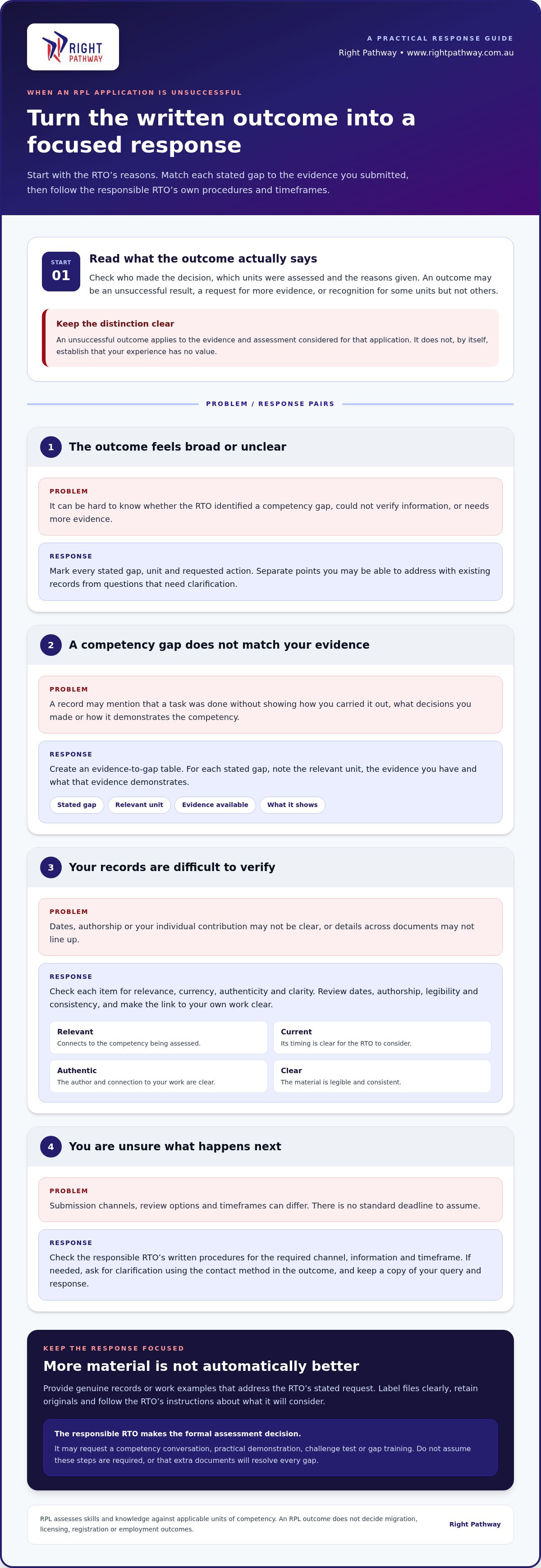
If your RPL application has been rejected, read the written outcome carefully. Identify who made the decision, which units of competency were assessed and the specific reasons given. This is the first step in working out what to do if my RPL application is rejected. It helps you respond to the actual outcome instead of assuming that all your experience was dismissed or that no further steps are available.
How to read the RTO’s written decision
Check whether the outcome records an unsuccessful result, requests additional evidence or grants recognition for some units but not others. Note each stated gap, such as a task the evidence does not demonstrate or information the assessor could not verify. Then look for any next steps, review options and timeframes in the outcome or the RTO’s published procedures. For context on how assessment fits into the wider process, see this RPL process overview.
The responsible RTO conducts the formal assessment and decides whether your evidence demonstrates the required skills and knowledge against the applicable units. RPL support and pathway guidance can help you prepare evidence and understand possible pathways, but it does not replace the RTO’s assessment or decision.
Why an RPL outcome is not automatically the end
An unsuccessful outcome applies to the evidence and assessment considered for that application. It does not, by itself, establish that your experience has no value or that another attempt will have a different result. Any additional evidence needs to address the gaps identified, and the RTO decides whether it can be considered.
Recognition of Prior Learning is an assessment for a qualification, not a migration assessment. RPL considers competency for an Australian qualification; it does not decide migration, licensing, registration or employment outcomes. Keep these purposes separate when interpreting your result.
Why RPL applications are rejected: match the reasons to the evidence
An evidence gap is a mismatch between the capability the RTO needs to assess and what your material demonstrates for a unit of competency. An outcome may identify concerns with relevance, authenticity, currency, clarity or verification. Use the RTO’s stated reasons to guide your review rather than guessing why the application was unsuccessful. Years on the job provide context, but don’t by themselves demonstrate every required skill or area of knowledge.
Map each stated gap to a unit of competency
Start with the RTO’s reasons, then connect each one to the relevant unit and the evidence you submitted. A record that says you performed a task may not explain how you carried it out, what decisions you made or how the work demonstrates the competency being assessed.
Stated concern: The outcome says a task wasn’t demonstrated. Unit: Record the unit named by the RTO. Evidence to review: Identify material that shows both the task and how you performed it.
Stated concern: The evidence can’t be verified. Unit: Note the relevant unit. Evidence to review: Check whether the document’s author, date and connection to your work are clear.
Evidence must relate to the competency being assessed and make your capability clear. Use the RTO’s wording to guide your review. Adding more material is not necessarily useful if it does not address a stated gap.
Check evidence quality before responding
Review dates, authorship, legibility and consistency across documents. Make sure each item is clearly linked to your work and that names, dates and task descriptions do not conflict. For example, a work record may identify a job but say little about your individual contribution. Follow the RTO’s instructions about the evidence it will consider.
Check whether the RTO has requested a competency conversation, practical demonstration, challenge test or gap training. Don’t assume these steps are required, or that extra documents will resolve every gap. If you’re considering what to do if my RPL application is rejected, a free initial eligibility assessment with Right Pathway can provide preliminary guidance on evidence readiness and possible pathways. It is not a formal RPL assessment, which remains the RTO’s responsibility.
Steps to take if your RPL application is rejected
If you’re deciding what to do if my RPL application is rejected, work through the response in order. A measured review helps you address the issues identified without sending a larger, less focused portfolio.
- Pause and keep the documents. Save the outcome, your submitted application and any assessor feedback together. Take time to understand the decision before replying.
- Read the reasons closely. Mark each unit or competency gap, evidence concern and requested action. Separate points you may be able to address with existing records from questions that need clarification.
- Check the RTO’s written procedures. Look for the required submission channel, information to include and any timeframe for feedback, review or appeal. Processes differ, so follow the responsible RTO’s own policy rather than assuming there is a standard deadline.
- Seek clarification if needed. Use the contact method stated by the RTO. Refer to the wording in the outcome and ask what it means or which next step applies. Keep a copy of your query and the response.
Prepare a targeted response, not a larger document pile
Before replying, create an evidence-to-gap table. For each stated gap, record the relevant unit, the evidence you have and what it demonstrates. Label files clearly, retain originals and provide genuine records or work examples that address the RTO’s request. Don’t alter documents or include material that does not relate to a stated competency. Keep a copy of your response and attachments so you can refer to exactly what you submitted.
Use the RTO’s review or feedback process carefully
Follow the RTO’s instructions for a review request, including any required details and timeframe. Explain the specific point you want reviewed and refer to the relevant evidence or feedback. Depending on the RTO’s process and your circumstances, further evidence or reassessment may be available. Neither guarantees a changed decision. If the instructions are unclear, seek clarification through the RTO’s stated channel before responding.
Your options after an RPL rejection, and when support may help
Once you understand the outcome and process requirements, consider which next step best addresses the gaps. You could provide evidence requested by the RTO, use an available review process or explore another qualification pathway. Further evidence, a practical assessment or gap training may be options, depending on the RTO’s procedures and your circumstances.
Decide whether to continue with the same qualification pathway
Compare the stated gaps with the authentic evidence you can provide and the instructions you received. If the gaps are broader, a related qualification may be worth exploring if it aligns with your skills and work history. RPL support and pathway information can help you consider how your experience may relate to potential qualification options.
Get preliminary guidance before preparing again
Before assembling documents again, organise your work history and evidence against the relevant competency requirements. Preliminary evidence-readiness guidance can help you identify where material needs a clearer link to your experience and support your pathway planning. This gives you a more focused plan for the next step, while the formal outcome remains dependent on the RTO’s assessment.
Take your next step with a clear plan
You don’t need to decide your entire qualification pathway at once. Focus on the next practical question: do you need clarification, evidence preparation support or guidance on a suitable pathway? A considered response can help you move forward without assuming the result of any further assessment.
If you’re still weighing what to do if my RPL application is rejected, Right Pathway provides preliminary guidance with evidence preparation and qualification pathway navigation across Australia. The responsible RTO retains responsibility for formal competency assessment and qualification decisions. Right Pathway’s free initial eligibility assessment is a starting point for discussing possible next steps, not a formal RPL assessment or a guarantee of acceptance.
Take the process one step at a time. Start with the written outcome, then choose the next action that addresses the specific issue it identifies.
Frequently Asked Questions
Does an RPL rejection affect my visa or migration outcome?
An RPL decision is not itself a visa or migration decision. It concerns whether your evidence meets the requirements for a qualification, while migration matters are assessed separately. If your qualification plans relate to a visa application or migration skills assessment, don’t assume one outcome determines the other. Speak with an appropriately registered migration professional about your circumstances.
Can overseas work experience be considered in a new RPL application?
Yes, overseas experience may be considered if it is relevant to the qualification and supported by suitable evidence. Work records, project documents or employer references, for example, may help show the tasks you performed and your role in them. The responsible RTO decides whether the material is sufficient and how it can be assessed against the applicable units.
Will I need to pay again if I submit a new RPL application?
Possibly. Fees and any charges for reassessment or gap training depend on the RTO’s terms and the next step it offers. Before proceeding, check the fee information that applies to your application and clarify whether the proposed action is a new application, reassessment or another service. This helps you understand potential costs before committing, without assuming the RTO will offer a particular option.
Can I move my RPL application to another RTO after rejection?
You can approach another RTO about making a new application, but don’t assume your original assessment or application will transfer. The new RTO may have its own enrolment and evidence process and will make its own decision. If you’re considering what to do if my RPL application is rejected, keep copies of your submitted evidence and outcome so you can explain the application history accurately.

Article by
Right Pathway Team
Right Pathway supports experienced workers, tradespeople and skilled migrants with preliminary RPL eligibility guidance, evidence preparation and qualification pathway navigation.
Right Pathway is not a Registered Training Organisation and does not conduct formal competency assessments or issue qualifications. Formal enrolment, competency assessment and qualification issuance are completed by the responsible Registered Training Organisation.
Start with a free initial RPL eligibility assessment at https://www.rightpathway.com.au/eligibility-check
Disclaimer
Right Pathway is a facilitation and support service only. We are not a Registered Training Organisation (RTO), do not conduct formal RPL assessments and do not issue qualifications. All formal RPL assessments and certifications are completed by partner RTOs regulated by ASQA. Eligibility and qualification outcomes depend on each applicant’s evidence, experience and the RTO’s assessment decision.


