

You can apply for RPL without formal training if your work experience, skills and knowledge can be demonstrated against the relevant units of competency. Experience from more than one job or employer may contribute, provided your evidence is relevant, authentic and clearly shows what you did.
It’s understandable to wonder whether not having a certificate or training record will rule you out. You can get RPL without formal training: the assessment considers what you can demonstrate, not just how you learned it. Time in a role alone isn’t enough, though. The assessor needs evidence that your skills meet the qualification requirements.
This guide explains how RPL assessment works, how experience from different workplaces can support an application, and what evidence may help show your capabilities. It also covers what to expect when applying without formal training, including why an RTO may ask for more information, a practical demonstration or gap training if your evidence doesn’t cover every requirement.
Key Takeaways
- RPL can recognise skills gained through work or life experience, even without formal training. What matters is how your capabilities match the relevant units of competency.
- Experience from different jobs may help build a stronger evidence picture. Bring together records such as work samples, references and training documents that show your own contribution.
- An RTO assesses your evidence and may ask for more information or practical demonstration. If some requirements are not met, additional training may help address the gaps.
- Start by mapping your experience to the qualification requirements, then organise evidence that is authentic, current and relevant to your work.
1. How RPL assessment works
Recognition of Prior Learning (RPL) compares your skills and knowledge with the requirements of a qualification’s units of competency. In Australia, a qualified assessor at a Registered Training Organisation (RTO) reviews your evidence and decides whether it demonstrates the required competence. Formal assessment and qualification issuance are completed by the responsible RTO, not an RPL support service. The RPL process starts by identifying the qualification and the units relevant to your experience.
Evidence needs to be authentic, relevant and clearly attributable to you. An assessor may review work samples, employment records or training documents, then discuss your experience or request a practical demonstration. For example, a tradesperson could provide job records alongside examples of completed work. Each item should show how their skills meet specific unit requirements, rather than simply record time spent in a role.
The assessment may recognise some or all relevant units. If your evidence doesn’t demonstrate a required skill, the RTO may request additional evidence, a competency conversation or a practical assessment. Where gaps remain, it may offer gap training to address the skills and knowledge needed before issuing a qualification. RPL is separate from licensing, so a qualification alone doesn’t authorise regulated work.
Can you appeal an RPL assessment decision in Australia? Yes. If you believe the outcome is unfair, you can challenge the RPL decision through the RTO’s appeals process.
How much does RPL cost in Australia? Costs vary by case, and a quote request establishes the applicable amount. The qualification, evidence requirements and any gap training can affect the cost.
What are the risks of using an unregistered RTO or RPL provider? A support provider may help you prepare, but formal assessment and qualification decisions should be handled by the responsible training organisation. Confirm that an authorised RTO is responsible for assessment and certification, and understand which organisation makes the final decision.
2. Can I combine experience from more than one job or employer?
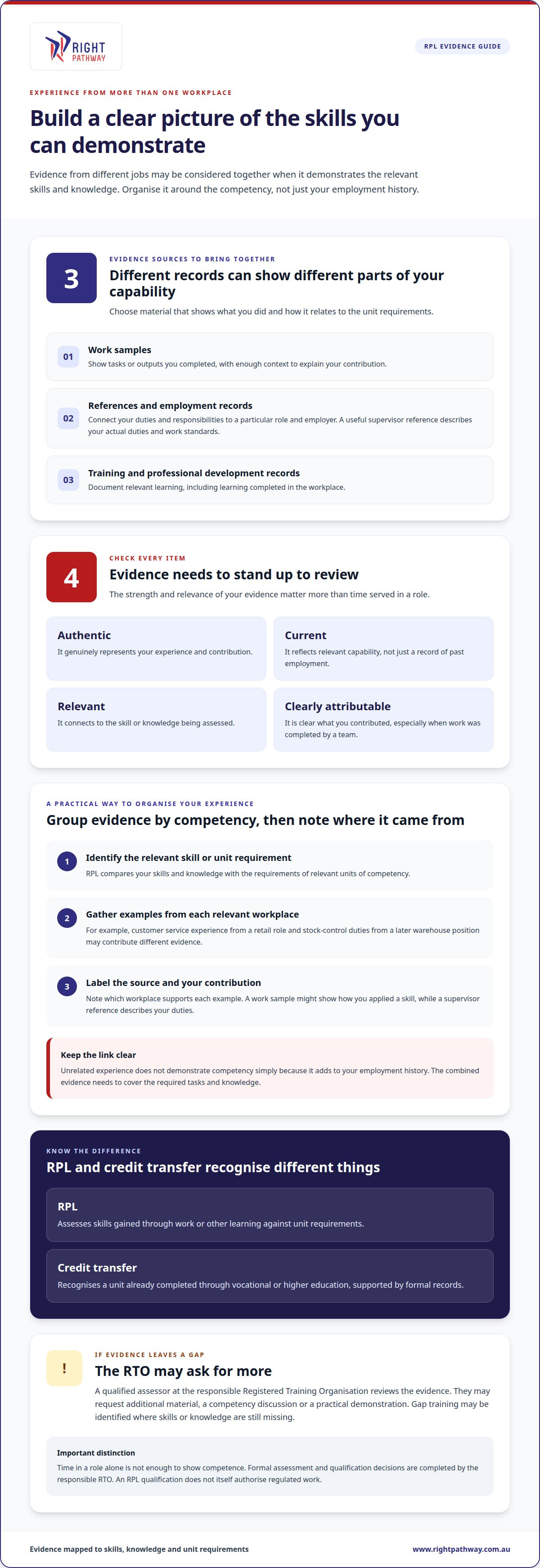
Yes. Evidence from different employers can be considered together when it demonstrates the same relevant skills and knowledge. The RTO’s qualified assessor considers the full picture against the qualification’s units of competency, not just one job title or workplace. For example, a worker might draw on customer service experience from a retail role and stock-control duties from a later warehouse position.
Organise evidence by the competency it demonstrates, and note which workplace supports each example. Employment records, job descriptions, supervisor references, work samples, training records and professional development documents can all help. A former supervisor’s reference is useful when it describes your actual duties, responsibilities and work standards. Make sure each item is clearly attributable to you, especially when a team produced the work.
- Work samples: show tasks or outputs you completed, with enough context to explain your contribution.
- References: connect duties to a particular role, employer and period of work.
- Training records: document relevant learning, including workplace or professional development.
Evidence from different sources can build a fuller account of your prior learning, but unrelated experience won’t demonstrate competency simply because it adds to your employment history. For instance, a supervisor’s reference about rostering could support a rostering unit, while a work sample might show how you applied that skill. The assessor considers whether the combined evidence covers the required tasks and knowledge.
RPL differs from credit transfer. Credit transfer recognises a unit already completed through vocational or higher education, supported by formal records. RPL assesses skills gained through work or other learning against unit requirements. If your evidence leaves a gap, the RTO may request more evidence, a discussion or a practical demonstration. It may also identify gap training to develop the missing skills before issuing a qualification.
To map your employment history and prepare supporting material, start with a free initial eligibility check. It helps clarify potential next steps before formal assessment by an RTO.
3. What does recognition of prior learning (RPL) actually mean?
Recognition of prior learning is an assessment of skills and knowledge gained through work, life experience, previous study or self-directed learning. It compares what you can demonstrate with the requirements of relevant units of competency. You don’t need a formal qualification to apply, and there’s no universal minimum number of years of work experience. The strength and relevance of your evidence matter more than time served.
For experienced workers without previous qualifications, RPL may offer a pathway to have existing skills recognised. For example, a worker who has developed management skills on the job can present evidence of relevant responsibilities and completed work. The assessor considers that evidence against the qualification requirements, rather than treating experience alone as proof. Depending on the assessment, RPL may recognise some or more of the relevant units.
RPL doesn’t automatically replace a prerequisite qualification for another course, job or licence. The RTO assesses your experience against the relevant qualification requirements, while the organisation setting a separate entry condition decides whether to accept an alternative pathway. An RPL qualification also doesn’t grant an occupational licence or professional registration.
Overseas work experience and learning may also be relevant. You need to show how your evidence relates to the Australian units being assessed. RPL is not a migration skills assessment, and recognition of a qualification doesn’t determine a visa outcome.
What qualifications can be obtained through RPL in Australia? RPL may be available for vocational qualifications and units offered by an RTO when your evidence matches the relevant requirements. The pathway depends on the RTO’s scope and the qualification’s current requirements.
When an RTO issues a qualification through RPL, the assessment must meet the same national qualification requirements as a qualification completed through coursework. The certificate doesn’t state that RPL was the method of achievement. It recognises assessed competency, not a licence or authority to perform regulated work.
4. Applying for RPL without formal training
If you’re asking, “Can I get RPL without formal training?”, start by identifying a vocational qualification that reflects your work. Compare your duties with the relevant units of competency instead of relying on your job title. Unit information on training.gov.au, particularly the Application section, can help you judge whether the required work aligns with your skills and experience.
Build your application around specific tasks you’ve performed and the standards involved. A certificate isn’t essential if you gained your skills through work, but your evidence must show what you can do. For example, a site supervisor might organise rosters, job records and work samples to explain how they planned and coordinated work. Make your own contribution clear when others shared responsibility.
- Match your experience: connect duties and work examples to the relevant unit requirements.
- Organise supporting material: group references, records and samples by the skills they demonstrate.
- Prepare to discuss your work: provide the requested information and be ready to explain how you performed key tasks.
The RTO’s qualified assessor may ask follow-up questions, request further evidence or observe a practical task. These steps help determine whether your demonstrated competency meets the unit requirements. If a requirement remains unmet, the RTO may identify gap training to address the relevant skills. Any recognition depends on the assessment of your evidence, not simply on completing an application.
Before submitting, make sure each example is relevant to the qualification and explains your own work. If your experience doesn’t cover a particular unit, the RTO’s assessment can clarify what evidence or learning may be needed. This gives you a practical basis for deciding whether to proceed with the formal RPL pathway.
Right Pathway
Right Pathway helps you explore whether your work experience may align with an RPL pathway, even without formal training. A preliminary skills and experience consultation can clarify potential qualification options, while an evidence-readiness review helps identify useful supporting material.
Use this support if you’re unsure how to organise experience from different roles or what to discuss with an RTO. Right Pathway guides evidence preparation and administrative steps, but doesn’t conduct the formal competency assessment or decide whether units are recognised. The responsible RTO makes the assessment decision and issues any qualification.
For an initial discussion of your experience and possible next steps, complete a free initial eligibility assessment with Right Pathway.
Take the next step with your experience
If you’re asking, “Can I get RPL without formal training?”, focus on turning your work history into a clear account of what you can do. Identify the tasks you’ve carried out, the responsibilities you’ve held and the examples that best show your contribution. This gives your RPL pathway discussion a practical starting point, especially if your experience spans different roles or industries.
The right qualification depends on how your experience and evidence align with its requirements. A preliminary conversation can help you consider suitable options and prepare for the formal process with an RTO. Right Pathway provides initial eligibility guidance and RPL support, while the RTO remains responsible for assessment and any qualification decision.
Your experience has value. Take the next step by exploring how it may be formally recognised.
Frequently Asked Questions
Can I combine experience from more than one job or employer?
Yes, experience from different employers can contribute if it relates to the same qualification requirements. A practical way to organise it is to create a timeline of each role, its responsibilities and the evidence connected to those duties. This helps explain how your work has developed and which examples come from each workplace, particularly if job titles differed between employers.
Can You Get RPL Without Qualifications?
Yes, you can apply without a previous formal qualification. RPL considers whether you can demonstrate the skills and knowledge required for relevant units, rather than requiring classroom learning. Your application still needs suitable evidence, and an assessor may identify requirements you haven’t demonstrated. If so, you may need to provide further evidence or complete additional training.
How does RPL work?
RPL starts with choosing a suitable qualification pathway and submitting evidence of your relevant skills. The RTO’s assessor reviews your material against the qualification requirements and may ask follow-up questions or arrange a practical demonstration. The outcome may recognise some or all relevant units, or identify areas requiring further evidence or training. The RTO communicates the formal outcome and handles any resulting enrolment or certification.
What does recognition of prior learning (RPL) actually mean?
Recognition of prior learning means assessing skills and knowledge gained outside formal study, such as through employment, volunteering or independent learning. It allows an assessor to consider whether your existing capabilities meet vocational unit requirements. For example, a worker who learned a task on the job can seek recognition by showing how they perform it to the required standard.
Does an RPL qualification carry the same weight as one earned through study?
Yes, an RTO-issued qualification achieved through RPL is the same qualification as one achieved through study, provided the assessment requirements are met. The qualification is assessed against the applicable standards, and the certificate doesn’t identify RPL as the achievement method. However, a qualification is separate from occupational licensing or registration, which may have additional requirements.
How can I get an RPL certificate?
Apply through an RTO offering the relevant qualification and ask about its RPL process. You’ll need to provide evidence that demonstrates your capabilities, then participate in any assessment activities the RTO requires. If the assessment identifies skills gaps, the RTO may require further evidence or training. The RTO, not a support service, makes the assessment decision and issues any resulting certificate.

Article by
Right Pathway Team
Right Pathway supports experienced workers, tradespeople and skilled migrants with preliminary RPL eligibility guidance, evidence preparation and qualification pathway navigation.
Right Pathway is not a Registered Training Organisation and does not conduct formal competency assessments or issue qualifications. Formal enrolment, competency assessment and qualification issuance are completed by the responsible Registered Training Organisation.
Start with a free initial RPL eligibility assessment at https://www.rightpathway.com.au/eligibility-check
Disclaimer
Right Pathway is a facilitation and support service only. We are not a Registered Training Organisation (RTO), do not conduct formal RPL assessments and do not issue qualifications. All formal RPL assessments and certifications are completed by partner RTOs regulated by ASQA. Eligibility and qualification outcomes depend on each applicant’s evidence, experience and the RTO’s assessment decision.


