

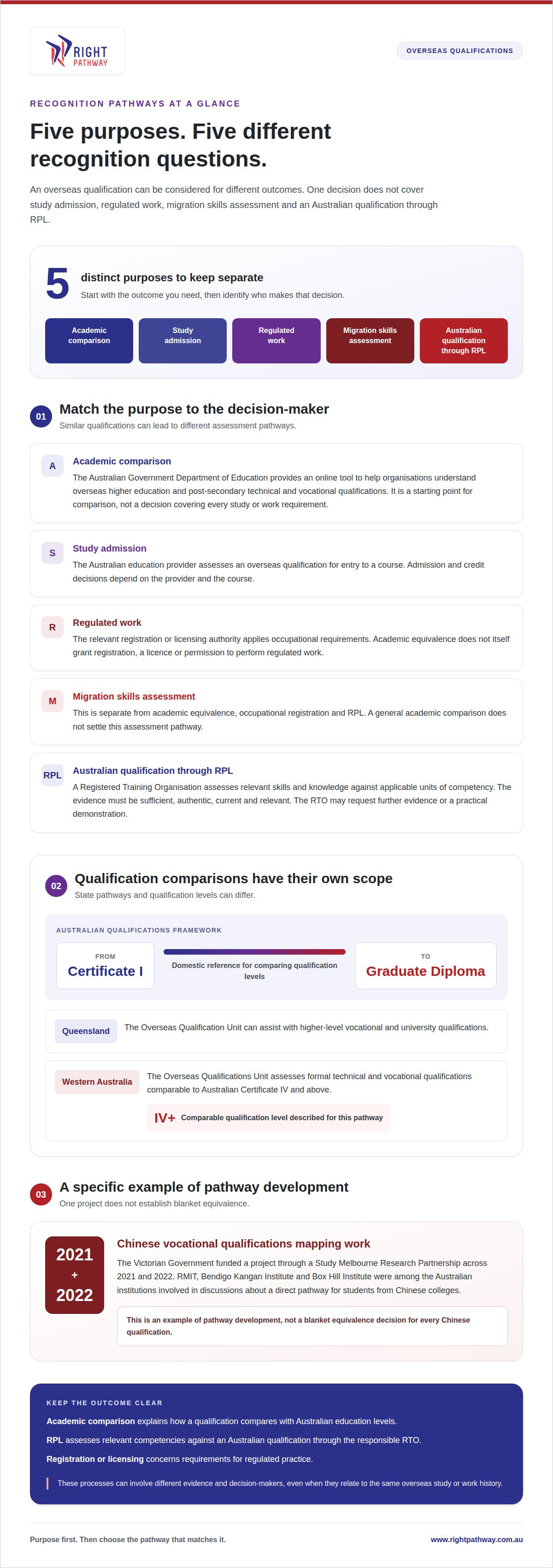
Whether your overseas qualification is recognised in Australia depends on what you need it for. There is no single decision that covers study admission, occupational registration, migration and an Australian qualification through Recognition of Prior Learning (RPL). The Australian Government Department of Education provides an online tool to help organisations understand overseas higher education and post-secondary technical and vocational qualifications.
It is understandable to expect one assessment to settle the question, but academic equivalence and permission to work in a regulated occupation are separate matters. A university or training provider considers qualifications for study admission, while registration and licensing depend on the occupation.
This guide explains the main recognition pathways for overseas vocational and university qualifications in Australia, what an academic assessment can tell you, and how it differs from professional registration, migration skills assessment and RPL. You will also learn how RPL may help experienced workers have relevant skills and knowledge assessed against an Australian qualification, and where evidence-preparation and pathway-navigation support can help.
Key Takeaways
- Choose a recognition pathway based on whether you need an academic comparison, study admission, occupational approval or an Australian qualification.
- Separate academic equivalence from professional registration, licensing and migration skills assessment, as each serves a different purpose.
- Explore the state or territory pathway that applies to your circumstances, since eligibility and assessment options can differ.
- For an RPL pathway, relevant evidence of your skills and experience is central to the formal assessment by a Registered Training Organisation.
Higher-level vocational and university qualifications
Recognition depends on the purpose of the assessment and the qualification involved. The Australian Government Department of Education provides an online tool to help organisations understand overseas higher education and post-secondary technical and vocational qualifications. It is a starting point for comparison, not a decision covering every study or work requirement.
For a general academic assessment, Queensland’s Overseas Qualification Unit can assist with higher-level vocational and university qualifications. Western Australia’s Overseas Qualifications Unit assesses formal technical and vocational qualifications comparable to Australian Certificate IV and above. These pathways differ by state, qualification level and assessment purpose. The Australian Qualifications Framework spans Certificate I to Graduate Diploma and provides a domestic reference for comparing qualification levels.
Fees also depend on the route. A full qualification program and an RPL assessment are different processes, so their costs should not be treated as interchangeable. RPL fees may relate to the units being assessed and the evidence involved, while course costs relate to the program itself. In Victoria, applicants usually pay a fee for RPL and should check the amount with their training provider. The factors that affect RPL costs in Australia can help clarify what to consider when comparing pathways.
Chinese vocational qualifications have also been examined through Australian mapping work. The Victorian Government funded a project through a Study Melbourne Research Partnership in 2021 and 2022. RMIT, Bendigo Kangan Institute and Box Hill Institute were among Australian institutions involved in discussions about a direct pathway for students from Chinese colleges. This project provides a specific example of pathway development, not a blanket equivalence decision for every Chinese qualification.
Start by identifying whether you need an academic comparison, study entry or skills recognition. Then choose the assessment route that matches your purpose and qualification level. A general assessment may explain how a qualification compares academically, while admission and credit decisions remain with the education provider and depend on the course.
Academic equivalence versus professional registration and RPL
Academic equivalence, occupational approval and an Australian qualification through RPL serve different purposes. Identify whether your next step involves further study, regulated work or formal recognition of practical skills.
Academic equivalence and professional registration
Academic equivalence describes how an overseas qualification compares with Australian education levels. It does not grant professional registration, a licence or permission to perform regulated work. For study admission, the Australian education provider assesses the overseas qualification. For regulated employment, the relevant registration or licensing authority applies occupational requirements.
Choose an assessment that matches your intended outcome. A university admission decision addresses entry to a course, while a registration decision addresses the requirements for practising a profession. Employers make hiring decisions separately, so academic equivalence alone does not secure a job.
Professional requirements and RPL
Overseas-trained doctors, nurses, teachers and engineers must follow the requirements for their occupations. Specialised professions may require registration, licensing, professional membership or other industry approval before work begins. The applicable authority assesses the relevant standards, which may include qualification and professional requirements.
RPL serves a different purpose. A Registered Training Organisation assesses relevant skills and knowledge against applicable units of competency. It considers sufficient, authentic, current and relevant evidence, and may request further evidence or a practical demonstration. RPL alone cannot grant professional registration where a licensing board’s approval is required.
For example, an overseas-trained engineer seeking a workplace qualification pathway may explore RPL for demonstrated vocational competencies. This does not replace any registration requirement for the engineering role. Similarly, evidence of a healthcare worker’s skills may support an RPL assessment, but does not authorise regulated practice.
Keep the intended outcome clear: academic equivalence helps explain a qualification’s education level; RPL assesses competencies against an Australian qualification; registration or licensing governs regulated practice. These processes may involve different evidence and decision-makers, even when they relate to the same overseas study or work history.
If you’re considering an Australian qualification through RPL, a free initial eligibility check can help map your experience and potential qualification pathway. It is preliminary guidance, not the RTO’s formal competency assessment or a professional registration decision.
Australian qualification recognition pathways
The right pathway depends on whether you need study admission, employment, migration assessment or an Australian qualification. Start by matching your purpose to the organisation responsible for that decision.
Checking qualification recognition
For a general comparison, Australian citizens and permanent residents can seek advice from a state or territory Overseas Qualifications Unit. These units may assess a qualification in general terms or explain how recognition works. Queensland’s Overseas Qualification Unit assists eligible people living in Queensland with completed post-secondary overseas qualifications. For study admission, the Australian education provider assesses your qualification against its course requirements.
If an assessment does not recognise your qualification, consider another route that fits your goal. Options may include applying to an education provider for admission, seeking credit transfer or having relevant work skills assessed through RPL.
Choosing an assessing authority
No single Australian authority assesses every overseas qualification for every purpose. A state or territory Overseas Qualifications Unit may provide general academic guidance, while an education provider assesses qualifications for admission. For trade skills, Trades Recognition Australia provides assessment and eligibility information. For a regulated occupation, the relevant registration or licensing authority considers that profession’s requirements.
For migration, requirements vary according to the application and occupation. The Department of Education does not assess qualifications for migration purposes. For advice about your migration circumstances, consult an appropriately registered migration professional.
Assessment documents and employment
Document requirements depend on the assessment route. South Australia’s Overseas Qualifications Recognition service requires certified qualification certificates and transcripts, with certified English translations where applicable. For documents translated in Australia, the service requires a NAATI-accredited translator. An authority may request other records to understand the qualification and its context.
For general employment, employers decide whom to hire. They may consider your qualification alongside relevant experience and the role’s requirements. Some occupations have separate requirements, such as registration or licensing, that must be met before work begins.
Options for unrecognised qualifications
An assessment outcome does not close off every pathway. You can explore study admission with an Australian education provider, ask about credit transfer or pursue relevant competency assessment through RPL. RPL evaluates skills and knowledge against applicable units using sufficient, authentic, current and relevant evidence. A Registered Training Organisation conducts the formal assessment.
For visa or migration applications, a general academic assessment is not a substitute for a migration skills assessment. Review and appeal processes depend on the assessing authority and assessment type. Read the outcome information and follow the authority’s stated review process, including any requirements for supporting documents.
Is my overseas qualification recognised in Australia?
There is no single recognition decision for every Australian purpose. First identify whether you need an academic comparison, study admission, occupational approval, migration assessment or an Australian qualification.
First, match your purpose to the assessment route. Australian citizens and permanent residents seeking general advice can contact a state or territory Overseas Qualifications Unit. Queensland’s Overseas Qualification Unit assists people living in Queensland with completed post-secondary qualifications from overseas. The Australian Government Department of Education’s online tool helps organisations understand overseas higher education and post-secondary technical and vocational qualifications.
Next, confirm the route’s eligibility and scope. South Australia’s Overseas Qualifications Recognition service requires applicants to live in the state and hold Australian citizenship, permanent residency or a temporary visa with work rights. Western Australia’s unit assesses formal technical and vocational qualifications comparable to Australian Certificate IV and above. It does not assess short courses under one year of full-time study.
Then consider what the outcome can establish. A general assessment can explain a qualification’s level or how it may be recognised. It does not replace an education provider’s admission decision, an occupational regulator’s registration process or a migration skills assessment. For example, a qualification comparison for study does not authorise work in a regulated occupation.
For work skills gained overseas, Trades Recognition Australia provides assessment and eligibility information. For general information about migration skills assessments, check the relevant assessing authority. For advice about your circumstances, consult an appropriately registered migration professional. The Department of Education does not assess qualifications for migration purposes. If your goal is an Australian qualification, RPL is a separate route: a Registered Training Organisation assesses relevant skills and evidence against applicable units of competency.
Keep your intended outcome clear when choosing an assessment. A general academic comparison, professional approval and RPL answer different questions, even when they relate to the same overseas study or experience.
Right Pathway: Skilled migrant and overseas-experience RPL support
Right Pathway helps skilled migrants and experienced workers explore whether their overseas skills and work history may support an Australian qualification pathway through RPL.
Use this support when you need preliminary guidance on how your experience may relate to a qualification or help understanding the evidence an RTO may require. Right Pathway provides an initial eligibility assessment and a skills and experience consultation. These steps help clarify potential next steps, but they are not a formal competency assessment.
The responsible Registered Training Organisation handles formal enrolment and competency assessment, then decides whether the evidence demonstrates the required skills and knowledge. An Australian qualification does not replace a migration skills assessment or occupational registration.
Organising a clear account of your overseas roles and responsibilities can make preliminary pathway discussions more focused.
Choose a pathway that supports your next move
The useful question is not only whether your overseas study compares with an Australian qualification. Consider what you need recognition to do next: support further study, meet an occupational requirement or turn practical experience into an Australian qualification. Keeping that purpose clear helps distinguish academic comparison from work approval or a migration skills assessment.
If you are still considering whether your overseas qualification is recognised in Australia, define the outcome you need and the experience you want assessed. Right Pathway offers a preliminary skills and experience eligibility consultation, a free initial RPL eligibility assessment, and RPL support with administrative facilitation. This support helps clarify a potential pathway. The responsible Registered Training Organisation makes the formal assessment and qualification decision against relevant competency requirements.
Use the initial guidance to identify relevant evidence and the pathway that fits your goal. For RPL, evidence needs to show current, authentic and relevant skills, not simply time spent working. A clear next step can make preparing for the formal process easier.
Your overseas study and experience can be a useful starting point for planning your next Australian qualification step.
Frequently Asked Questions
How do I get an overseas qualification recognised for a regulated profession in Australia?
Follow the application pathway for your occupation and the state or territory where you intend to practise. For a New South Wales certificate of competence application, include certified assessment documents and course outlines or transcripts for every course studied. Documents in another language need a certified English translation from an authorised service, such as a NAATI-accredited translation service. Check the certificate guide’s evidence requirements before applying.
How much does an overseas qualification assessment cost and how long does it take?
Fees and timeframes depend on the assessment type and state or territory. South Australia’s Overseas Qualifications Recognition service charges no fee, while Western Australia lists a processing time of 20 working days for its Overseas Qualifications Unit assessments. These figures apply to those specific services, not every assessment or RPL pathway. RTO RPL fees are separate and depend on the assessment and evidence requirements.

Article by
Right Pathway Team
Right Pathway supports experienced workers, tradespeople and skilled migrants with preliminary RPL eligibility guidance, evidence preparation and qualification pathway navigation.
Right Pathway is not a Registered Training Organisation and does not conduct formal competency assessments or issue qualifications. Formal enrolment, competency assessment and qualification issuance are completed by the responsible Registered Training Organisation.
Start with a free initial RPL eligibility assessment at https://www.rightpathway.com.au/eligibility-check
Disclaimer
Right Pathway is a facilitation and support service only. We are not a Registered Training Organisation (RTO), do not conduct formal RPL assessments and do not issue qualifications. All formal RPL assessments and certifications are completed by partner RTOs regulated by ASQA. Eligibility and qualification outcomes depend on each applicant’s evidence, experience and the RTO’s assessment decision.