
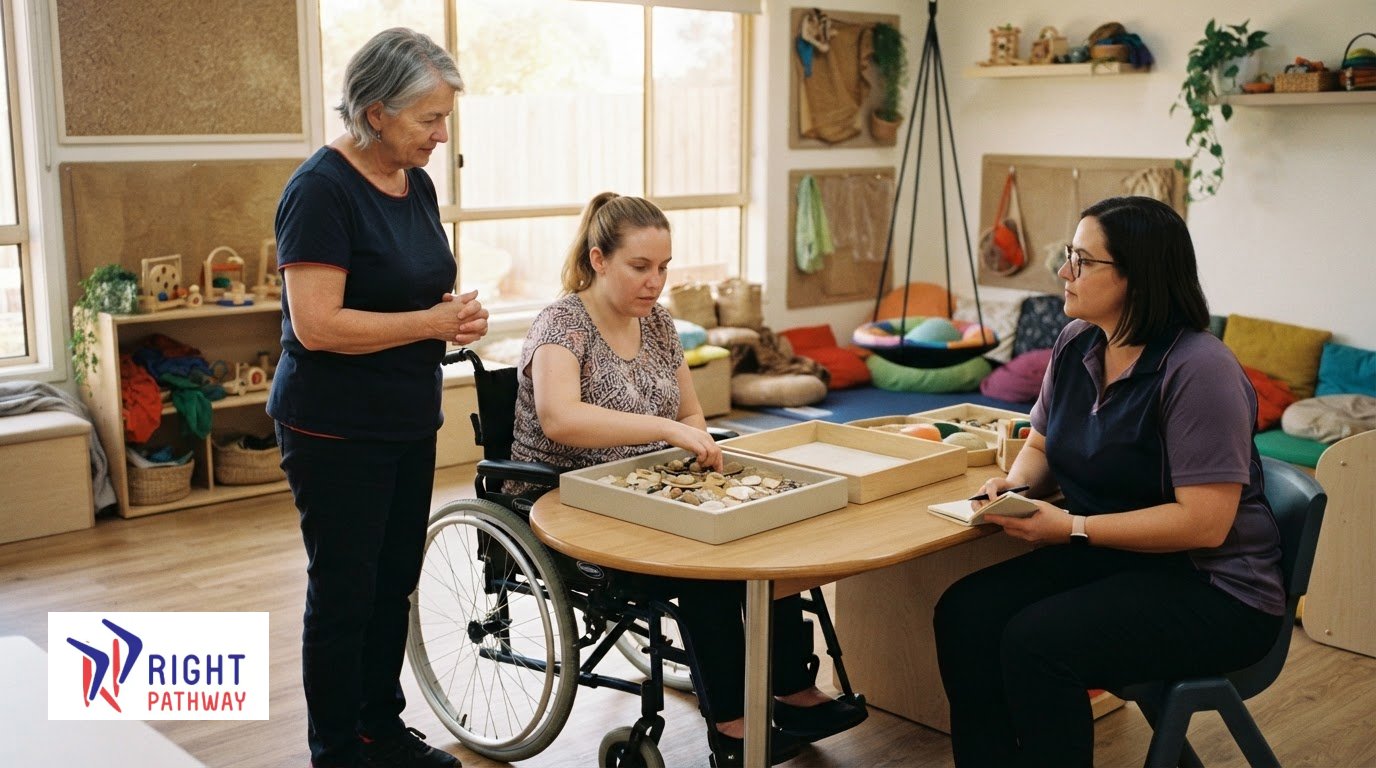
Experience can support a qualification, but it does not automatically count as credit. Certificate IV in Disability RPL is a process where a Registered Training Organisation (RTO) assesses your skills, knowledge and experience against the qualification requirements. Relevant workplace evidence may demonstrate competency, while gaps can mean further learning or assessment is needed.
If you have worked in disability support, you may want your experience recognised rather than repeat learning you can already demonstrate. RPL is one pathway. Credit transfer is different: it applies to relevant units you have already completed through formal training.
A Pre-Training Review helps clarify your existing skills, learning needs and potentially suitable study pathway. This article explains the differences between RPL and credit transfer, the evidence that may support an application, and how the review can inform your Certificate IV pathway. It also covers what happens when evidence does not address every requirement, so you can understand the process before choosing your next step.
Key Takeaways
- Understand how the Certificate IV pathway is structured and how prior qualifications may relate to entry.
- See how relevant disability support experience and evidence are considered for RPL eligibility.
- Distinguish RPL, which assesses demonstrated skills, from credit transfer for completed formal study.
- Learn how a Pre-Training Review can identify learning support needs and help guide your next steps.
What Is Certificate IV in Disability?
CHC43121 Certificate IV in Disability Support is an Australian qualification comprising 10 units: 7 core units and 3 electives. Its unit requirements provide the reference point for training, assessment and any application for recognition of prior learning.
Qualification overview and entry qualifications
At Australian Qualifications Framework Level 4, CHC43121 covers disability support knowledge and skills through its core and elective units. The elective component can shape which learning areas a course includes, so check the specific units linked to the training pathway.
Entry requirements depend on the RTO and the pathway it offers. Some RTOs may set prerequisite qualifications for enrolment, while an RPL assessment considers evidence against the relevant units. Ask which entry conditions apply to the course, and distinguish these from whether your work experience may support an RPL application.
Career outcomes and pathways
This qualification relates to disability support work, where workers assist people with day-to-day needs and individual support goals. Specific duties depend on the role and workplace, not the qualification title alone.
The qualification may also support further study or related community services roles, depending on the course and your experience. For example, experience supporting someone with disability and mental health needs may be relevant evidence, but it does not replace assessment against the qualification units. A qualification also does not guarantee a particular job or authorise you to perform regulated work.
Training and assessment requirements
An RTO’s qualification self-assessment compares a learner’s existing knowledge and experience with the training requirements. For RPL, the RTO assesses evidence against the applicable units and decides whether it demonstrates competency. The RTO delivering formal training or assessment is responsible for explaining its current CHC43121 pathway and entry conditions.
Which Australian RTOs offer this qualification through RPL? Availability is RTO-specific, so the relevant provider is the one responsible for formal enrolment and assessment. A practical RPL pathway starts with identifying the qualification and evidence to be assessed.
The qualification itself does not specify licensing, legislative, regulatory or certification requirements. Requirements may vary by role and jurisdiction, so check with the relevant state or territory regulator. Separate NDIS or employer requirements may also apply to a particular disability support role.
Does RPL require workplace observation or practical assessment? An RTO may ask you to demonstrate a skill or discuss your competency if your evidence does not establish the required skills. The assessment method depends on the units and the evidence being considered.
What is RPL (Recognition of Prior Learning)?
For Certificate IV in Disability RPL, an RTO compares your skills and knowledge with the qualification units. Relevant learning may come from formal study, disability support work or life experience. Your application is assessed against the required competencies, not simply your job title.
Eligibility criteria
You may be eligible if you have relevant disability support experience and can provide evidence that matches the required competencies. The RTO formally assesses your evidence against the qualification units, not just your time in the sector.
Listed eligibility guidance refers to roughly 2-3 years of experience. Most relevant industry experience must have been gained within 10 years before the application date. These are useful indicators when considering an application for Certificate IV in Disability RPL, but experience alone doesn’t show that each unit’s requirements have been met.
Consider the range of tasks you have performed. For example, supporting someone’s independence, following a support plan and responding to mental health needs may relate to different skills. The RTO considers whether your prior learning is current and relevant to the units being assessed. A diploma or other formal study may also provide relevant learning, but it is not automatically equivalent to this qualification.
Evidence for eligibility
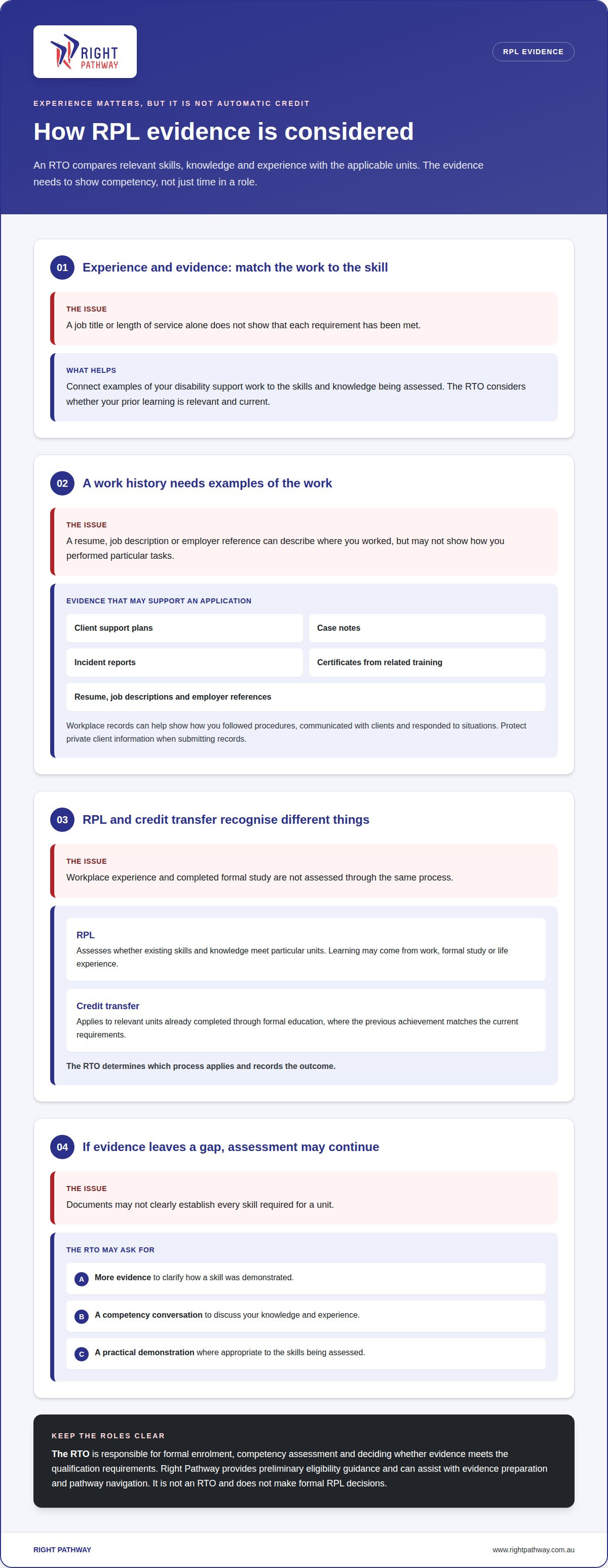
Evidence helps connect your work history to specific competencies. An application may include a resume, job descriptions and employer references. These materials establish where and how you gained experience, but should be supported by examples of the work itself.
For disability support, relevant records may include client support plans, case notes, incident reports and certificates from related training. Together, these can show how you followed procedures, communicated with clients and responded to workplace situations. Keep evidence authentic, current and relevant to the units. Protect private client information when submitting workplace records.
An RTO may ask for more evidence, a competency conversation or a practical demonstration if documents don’t show a skill clearly. A free initial eligibility assessment can help you understand whether your experience and available evidence may suit this pathway.
Recognition of prior learning and credit transfers
Recognition of prior learning (RPL) and credit transfer can both affect a CHC43121 study pathway, but they recognise different things. RPL assesses whether your existing skills and knowledge meet particular units. Credit transfer applies to relevant units completed through formal education, where the previous achievement matches the current qualification requirements.
For example, a disability support worker may demonstrate competency through workplace practice and relevant records. Another applicant may have a statement of attainment for a relevant unit. The first case may be considered through RPL; the second may be considered for credit transfer. The RTO decides which process applies and records the outcome.
RPL can recognise learning gained through formal training, work and life experience. An RTO may award credit for some units or assess whether your evidence supports the full qualification. It may also identify gaps that require further learning or assessment. This can help experienced workers focus on the competencies they still need to demonstrate, rather than having all prior learning treated as irrelevant.
Your evidence should clearly relate to the competency being assessed. In disability support, a support plan, case note or incident report may help show how you followed procedures or supported community participation. If documents do not establish the required skill, the RTO may request more evidence, a competency discussion or a practical demonstration.
If gaps remain, the RTO can identify the units or skills that need further development. Learning materials and trainer support are part of that training pathway, but do not replace formal competency assessment. Clarify how the RTO will address each gap and what evidence it will use to assess your competency.
Recognition of prior learning can make existing education and workplace capability visible, while credit transfer accounts for relevant completed study. Understanding the distinction helps applicants discuss a suitable RPL pathway and its potential benefits with the responsible RTO.
Pre-Training Review and LLND levels
A Pre-Training Review considers your existing skills, learning needs and readiness for a training pathway. LLND stands for language, literacy, numeracy and digital skills. These can affect how you engage with course materials and assessment in Australian disability support settings.
For this course, TAFE Queensland recommends benchmark levels of 4 in English, 4 in maths and 4 in digital technology. These benchmarks provide a reference point, not a result that automatically determines whether you can complete training. An RTO considers your individual support needs and how they relate to the course requirements.
The review can identify practical learning support before training begins. For example, if you understand individual support plans but need help using online learning materials, digital skills support may be useful. If you want to strengthen your written communication, you may need support interpreting workplace documents or recording information clearly.
If your RPL evidence does not demonstrate every requirement, a gap training plan identifies the units or skills still to be completed. The RTO uses those gaps to guide further learning or assessment, rather than treating experience as proof of every competency. The plan should link each gap to the training or evidence needed to address it.
What happens if an RPL application is unsuccessful or only partly approved? The RTO identifies the competencies your evidence did not establish and distinguishes any units already recognised from those still outstanding. A gap training plan can map the remaining requirements and help you understand the next steps towards the qualification.
In the disability support sector, relevant skills must be demonstrated against the qualification requirements, whether gained in community or individual support settings. A Pre-Training Review helps an organisation understand learning needs, while the RTO remains responsible for formal assessment and deciding whether competency has been achieved. To discuss whether your experience may suit this pathway, complete a free initial eligibility assessment.
Right Pathway
Right Pathway can help you understand how your disability support experience may align with a Certificate IV pathway. A preliminary skills and experience consultation considers your background, while an evidence-readiness review helps identify whether your records may support an RPL application. This can help if you are unsure which experience to present or how to organise your next steps.
Right Pathway also provides RPL support and administrative facilitation. The free initial eligibility assessment gives preliminary guidance, not a formal competency assessment or decision on credit. The responsible RTO conducts the formal assessment and determines the outcome, including whether further evidence or gap training is required.
If you’re ready to discuss your circumstances, complete a free initial eligibility assessment with Right Pathway.
Plan your next step with clarity
Use this stage to clarify what you want the qualification to support in your career. You might want to take on broader responsibilities, build on your current disability support work or pursue another role. A clear goal gives your pathway discussion a practical focus.
For your Certificate IV in Disability RPL application, consider how your experience relates to your goal and what information would explain your background. Right Pathway can provide preliminary skills and experience guidance, review your evidence readiness and help you navigate the administrative process. The responsible RTO makes the formal assessment and qualification decision.
If you’re ready to discuss your circumstances and possible pathway, complete a free initial eligibility assessment with Right Pathway.
A thoughtful next step can help you move forward with greater clarity.
Frequently Asked Questions
Can I get credit for units I have already completed?
Yes. An RTO may grant credit for relevant units you have already completed through formal training. For example, a statement of attainment may show that you completed a unit included in the current qualification. The RTO checks whether the unit matches its requirements and records any approved credit. This differs from RPL, which assesses skills and knowledge gained through experience or other learning.
How does RPL work?
An RTO assesses your evidence against the qualification competencies. It may map each item to relevant units, then decide whether the evidence demonstrates the required skills and knowledge. If a work sample raises questions, the RTO may request further documents, a discussion or a practical demonstration. The RTO communicates the outcome and any remaining learning or assessment requirements.
How long does the RPL process take?
RPL typically takes approximately 4 to 8 weeks after complete evidence is received, based on the stated general timeframe. The RTO’s assessment workload, evidence quality and any follow-up requests can affect the process. An application requiring extra documents or practical demonstration may take longer. Treat the timeframe as an estimate, not a promised completion date, and allow time to respond to requests.
How much does RPL cost?
There is no single RPL price across Australian providers. Costs depend on the RTO, assessment scope, available evidence and whether further assessment or gap training is required. Right Pathway discusses its support fees after confirming eligibility. Ask for a breakdown showing facilitation costs separately from RTO assessment and any required training.
What are the benefits of RPL?
RPL allows an RTO to assess your existing capability rather than rely only on course attendance or previous job titles. If your evidence demonstrates particular competencies, the RTO may recognise those units and focus attention on requirements still to be met. This can make your experience more visible when planning a qualification, but does not guarantee less study, a job or a particular outcome.
What suitable evidence can support your evidence portfolio?
Useful evidence may include employment records, role descriptions, supervisor references, relevant training certificates and workplace documents connected to your duties. For disability support, a de-identified case note or support-plan example may show how you carried out a task. Evidence is stronger when it makes your role and the demonstrated skill clear. The RTO may request more material if your portfolio leaves gaps.

Article by
Right Pathway Team
Right Pathway supports experienced workers, tradespeople and skilled migrants with preliminary RPL eligibility guidance, evidence preparation and qualification pathway navigation.
Right Pathway is not a Registered Training Organisation and does not conduct formal competency assessments or issue qualifications. Formal enrolment, competency assessment and qualification issuance are completed by the responsible Registered Training Organisation.
Start with a free initial RPL eligibility assessment at https://www.rightpathway.com.au/eligibility-check
Disclaimer
Right Pathway is a facilitation and support service only. We are not a Registered Training Organisation (RTO), do not conduct formal RPL assessments and do not issue qualifications. All formal RPL assessments and certifications are completed by partner RTOs regulated by ASQA. Eligibility and qualification outcomes depend on each applicant’s evidence, experience and the RTO’s assessment decision.


