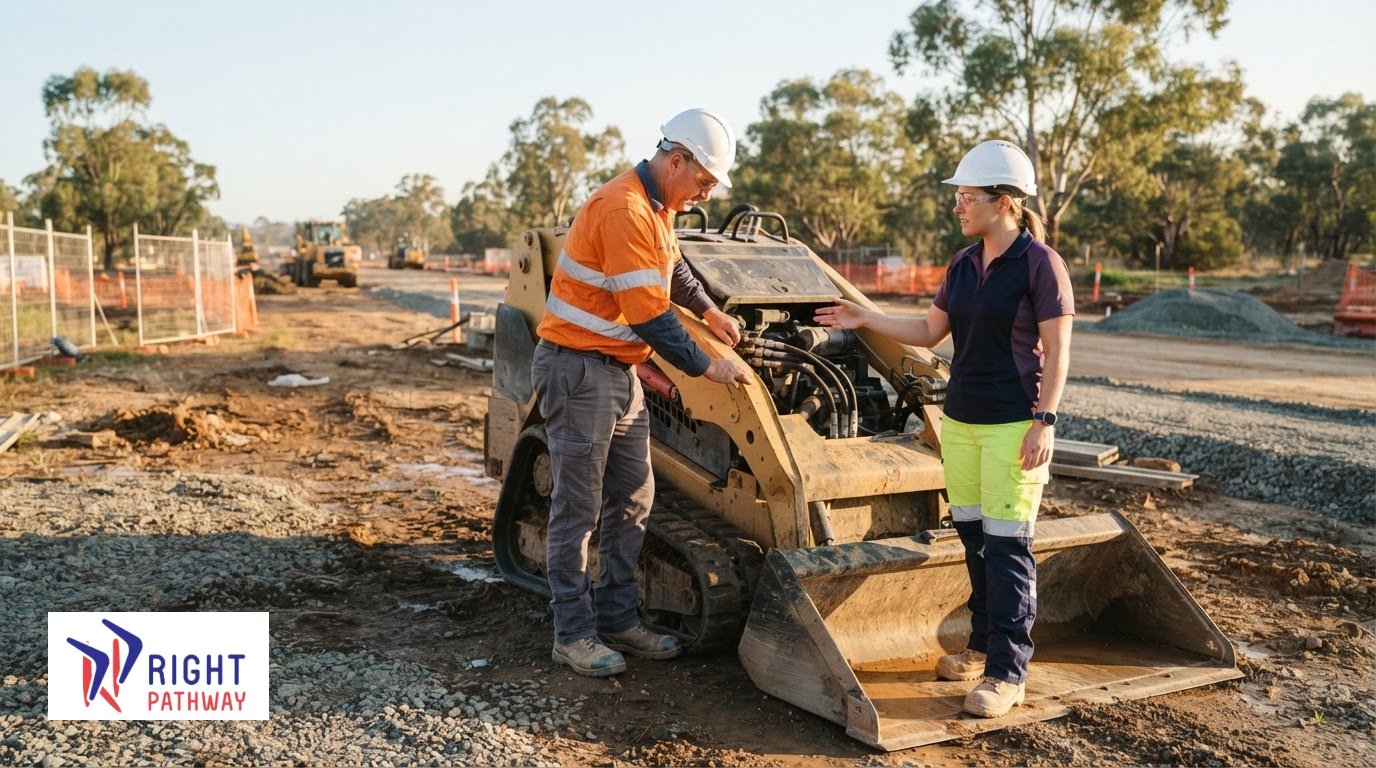

For experienced workers, Recognition of Prior Learning (RPL) may reduce duplicated learning by assessing existing skills and knowledge against a qualification’s requirements. The pathway and timing depend on the responsible Registered Training Organisation’s (RTO’s) formal assessment and any further evidence, assessment or training required. Relevant work experience must be supported by sufficient, authentic, current evidence. Experience alone isn’t enough, and the RTO makes the formal assessment decision.
If you’ve developed skills on the job, starting training from the beginning may not be your only option. RPL can recognise competencies you can demonstrate, while further training may be needed to address evidence or skills gaps.
This article explains how workplace evidence supports an RPL application, what an RTO may require during assessment, and how RPL compares with trade training pathways. It also explains how qualifications fit into the process, helping you choose a practical next step based on your experience and evidence.
Key Takeaways
- Choose a pathway that fits your experience: RPL may suit workers with established skills, while structured training can help address learning gaps.
- Build a clear evidence record using relevant workplace documents, referee input and practical demonstrations where required.
- Compare RPL with TAFE and apprenticeship options by considering how much instruction and supervised workplace learning you need.
- Treat a qualification and an occupational licence as separate requirements, particularly when your trade work is regulated.
Competency assessments and workplace evidence
Recognition of Prior Learning (RPL) compares your existing skills and knowledge with a qualification’s requirements. A Registered Training Organisation (RTO) assesses whether your evidence demonstrates the relevant competencies.
Evidence of Skills and Experience
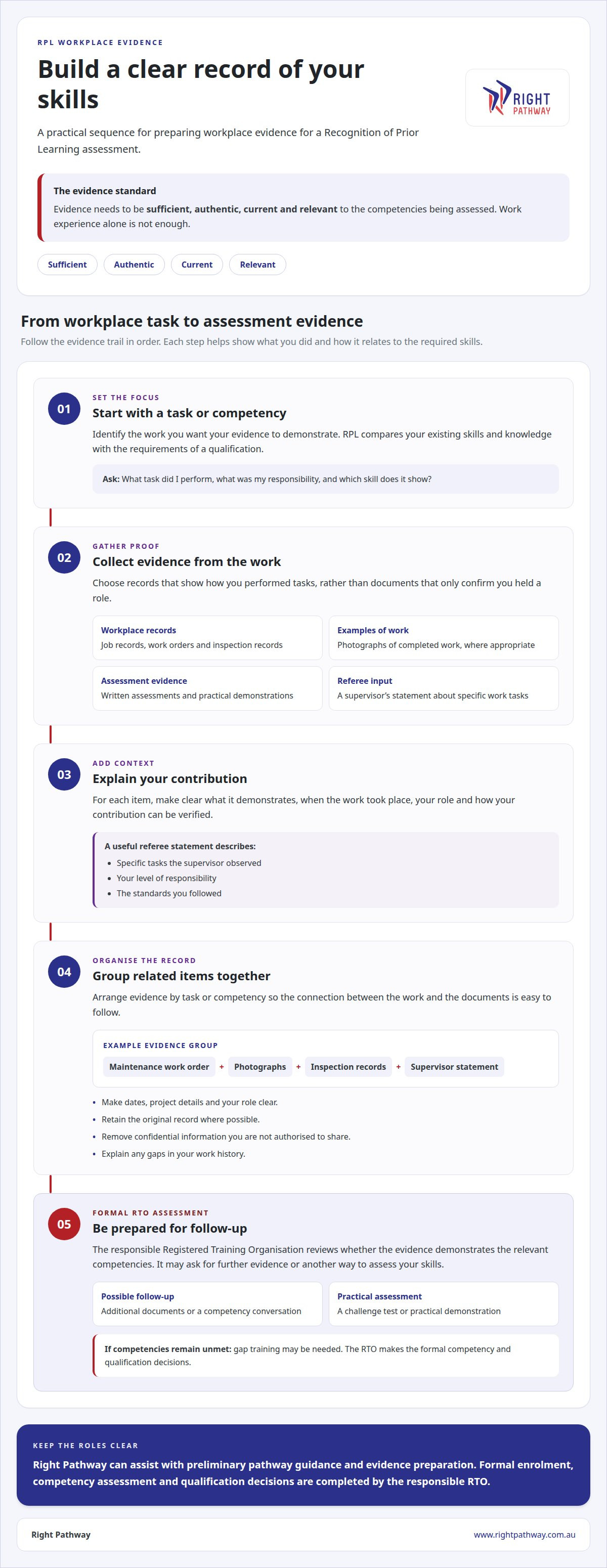
Workplace evidence should show how you perform tasks, not just confirm that you held a role. For example, a carpenter might provide job records and photographs of completed work, along with documents describing their responsibilities. The RTO considers whether each item relates to the relevant competency requirements. Explain what each document demonstrates, when the work took place and how your contribution can be verified. Without supporting evidence, experience alone cannot show the full scope of your skills.
RPL Evidence and Referee Statements
Useful evidence can include workplace documents, written assessments and practical demonstrations. A referee statement is more useful when it describes specific tasks, your level of responsibility and the standards you followed. Ask a supervisor who has observed your work for concrete examples, rather than a general character reference. Evidence must be authentic, current and relevant to the competencies being assessed.
Organise evidence by task or competency before submitting it. For example, group a maintenance work order with photographs, inspection records and a supervisor’s statement about the same job. This helps the assessor see how the documents demonstrate your skills. Make dates, project details and your role clear, and remove confidential information you’re not authorised to share.
After reviewing your evidence, the RTO may identify gaps and request further documents, a competency conversation, a challenge test or a practical demonstration. These steps can assess skills that paperwork alone cannot establish. If some competencies remain unmet, gap training may be needed. Well-organised evidence can make the assessment clearer, but it cannot replace the RTO’s formal competency decision.
Evidence preparation also helps clarify the work involved in an application. The factors that influence RPL costs can include the qualification pathway and assessment requirements. Match each item to a task, retain the original record where possible, and explain any gaps in your work history. Clear references and well-labelled documents give the RTO a practical basis for reviewing your experience.
Nationally recognised qualifications and licences
A nationally recognised qualification records competencies assessed through an approved Australian training pathway. Trade learners demonstrate theory and practical application, while the qualification and any occupational licence remain separate outcomes.
Before choosing a course or RPL pathway, identify the work you want to do and the credential relevant to it. Check the qualification’s exact title and current status on training.gov.au, then compare its units with your experience and career goals. For example, you may have evidence for some competencies but still need training or assessment for others. The responsible Registered Training Organisation (RTO) decides whether your evidence meets the qualification requirements.
A qualification may support an application for a trade licence, but it does not automatically grant one. Licensing requirements depend on the occupation and state or territory. If your goal involves regulated work, identify the relevant regulator and understand its current requirements before choosing a qualification. For air conditioning and refrigeration work, the qualification and licensing pathway relate to the work you can legally perform. A credential alone does not authorise you to carry out regulated work.
What are the risks of choosing a quick or unaccredited qualification? It may not be recognised for your intended career or accepted for the relevant licensing pathway. You could spend time and money on training that doesn’t meet the applicable competency or credential requirements.
Use this sequence to keep your qualification and licensing goals aligned:
- Define the role or work you’re aiming to perform.
- Identify the qualification and any separate licensing requirements that apply.
- Compare your existing competencies with the qualification’s requirements.
- Choose RPL or structured training based on your skills, evidence and learning needs.
For preliminary pathway guidance, a free initial eligibility assessment can help clarify whether your experience may align with an RPL route. Formal competency assessment and qualification decisions remain with the responsible RTO.
Apprenticeships, blended training and RPL
An apprenticeship suits someone entering a trade who needs guided learning across different work tasks. It involves an employer, workplace supervision and a training contract. Before committing, consider whether the role will expose you to the range of tasks your trade requires. For example, a new worker may need supervised practice before handling work independently.
Blended training combines formal learning with workplace experience. It may suit you if you want structured instruction alongside practical tasks. Check how the program schedules study, workplace activities and assessments around your existing commitments. If you already work in a related role, practical tasks can provide useful context for formal learning, while classroom or online study can cover areas you haven’t yet learned.
RPL takes a different approach: it considers your existing workplace skills against a qualification’s requirements. It may suit an experienced worker who already performs relevant tasks and wants those capabilities assessed. The RTO conducts the formal assessment, and you may still need further learning if you don’t meet all requirements. RPL is not a substitute for learning when important skills are still developing.
Choose a pathway based on your starting point and the support you need. Someone new to a trade may value an apprenticeship’s ongoing supervision. A worker with experience but clear learning gaps may prefer blended training. If you already perform relevant work, you could explore RPL. Your employment situation matters too: an apprenticeship depends on an employer, while blended programs organise learning and workplace practice differently.
- Apprenticeship: suits people who need supervised learning while developing trade skills.
- Blended training: combines structured study with practical workplace experience.
- RPL: may suit experienced workers seeking formal recognition of existing capabilities.
List the tasks you perform, the skills you still need to develop and the learning format you can manage. Comparing these factors can help you choose a pathway that supports your trade goals without treating speed as the only measure of fit.
Australian trade qualification pathways
To work out how to get qualified faster, first identify what is slowing your current route: missing evidence, skills gaps or limited study time. Then compare each pathway with that obstacle. If you can document a range of trade tasks, RPL may be worth exploring. If you need instruction in unfamiliar tasks, structured learning may be a better fit.
For an RPL pathway, consider whether your experience covers the range of work in the qualification, not just how long you’ve worked. For example, a mechanic may have strong evidence for some workshop tasks but little experience in other required areas. The RTO’s assessment determines whether you need further evidence, practical assessment or training.
For a TAFE pathway, consider how scheduled classes and assessments fit around your work commitments. Check whether the course will teach skills you need, rather than repeat areas you already know. For an apprenticeship, weigh supervised learning against the commitment to an employer and a training contract. The right fit depends on your starting point and the learning structure you need.
Costs for fast-track courses and qualifications vary depending on the pathway, assessment requirements and any gap training. The price is provided after a quote request. Compare the training included, practical assessment arrangements and likely evidence requirements, rather than choosing based on speed or headline cost alone.
Use these practical checks to narrow your options:
- List the trade tasks you can demonstrate and those you still need to learn.
- Consider whether your work schedule allows classes, supervised work or assessment activities.
- Compare each route’s learning and assessment requirements with your career goal.
Right Pathway
Right Pathway helps experienced workers explore whether RPL may suit their skills, evidence and qualification goals. We provide preliminary eligibility guidance, an evidence-readiness review and help navigating qualification pathways. This support can be useful if you’re unsure which records to gather or whether your experience aligns with a trade qualification.
Right Pathway is not a Registered Training Organisation. The responsible RTO handles formal enrolment, competency assessment and qualification decisions. An initial eligibility discussion is guidance, not a formal RPL assessment, and experience alone does not determine the outcome.
To explore a possible pathway, complete a free initial eligibility assessment with Right Pathway. You can share your experience and goals so potential next steps can be discussed in light of your evidence and RTO requirements.
Choose a pathway that fits your next step
To decide how to get qualified faster, focus on a pathway that matches your experience and career plans, not speed alone. Consider what you can demonstrate and what further learning may support your goals.
Right Pathway provides RPL support and administrative facilitation to help you organise the process and understand potential next steps. A preliminary skills and experience consultation can help clarify whether your background may align with an RPL pathway. The free initial eligibility assessment is a preliminary review, not a formal competency assessment. The responsible Registered Training Organisation makes formal assessment decisions and issues any qualification.
Prepare a clear account of your work experience and the qualification you’re considering. This gives you a practical starting point for discussing a suitable pathway and moving forward with purpose.
Frequently Asked Questions
What is RPL (Recognition of Prior Learning)?
RPL stands for Recognition of Prior Learning. It allows capabilities gained outside formal study to be considered towards a qualification. Relevant skills may come from paid work, self-employment, training or volunteering. RPL differs from credit transfer, which applies to learning or units completed through formal study and assessed for recognition.
How Does RPL Work?
The process starts by identifying a qualification that aligns with your work goals, then preparing information for the responsible RTO. Organise records by project or work area, and explain your role in each example. The RTO may follow up with questions or request further assessment. Preliminary eligibility guidance can help you explore a pathway, but it is not the RTO’s formal decision.
How experienced do I need to be for RPL?
There’s no universal number of years that determines whether you can apply. The tasks you’ve performed matter: a contractor, casual worker or volunteer may have relevant experience, while a job title alone says little about actual duties. Describe what you did, how often you did it and your level of responsibility. The RTO considers this evidence against the qualification requirements.
How long does the RPL process take?
There is no standard completion timeframe. Timing depends on the RTO, the evidence provided and the individual application. If you’re planning around a job change or further study, allow time to gather records and respond to requests for clarification. Your preparation time and the assessment period are separate parts of the overall pathway.
So, what’s actually fastest for experienced workers, RPL vs TAFE vs apprenticeship?
For some experienced workers, RPL may reduce the need to repeat learning they can already demonstrate. The pathway and timing depend on the evidence and the RTO’s assessment. TAFE may be a better fit if you need instruction before demonstrating competence, while an apprenticeship suits people developing trade skills through supervised work. To decide, consider the tasks you already perform confidently, the skills you still need to learn and the training structure you can manage.
What does “get qualified faster” mean in Australia?
It means working towards a suitable formal qualification without repeating learning you can already demonstrate, while still completing the required assessment. If you’re considering how to get qualified faster, distinguish a qualification from a short-course certificate and an occupational licence. Each serves a different purpose, and a qualification alone does not provide licensing, employment or migration outcomes.

Article by
Right Pathway Team
Right Pathway supports experienced workers, tradespeople and skilled migrants with preliminary RPL eligibility guidance, evidence preparation and qualification pathway navigation.
Right Pathway is not a Registered Training Organisation and does not conduct formal competency assessments or issue qualifications. Formal enrolment, competency assessment and qualification issuance are completed by the responsible Registered Training Organisation.
Start with a free initial RPL eligibility assessment at https://www.rightpathway.com.au/eligibility-check
Disclaimer
Right Pathway is a facilitation and support service only. We are not a Registered Training Organisation (RTO), do not conduct formal RPL assessments and do not issue qualifications. All formal RPL assessments and certifications are completed by partner RTOs regulated by ASQA. Eligibility and qualification outcomes depend on each applicant’s evidence, experience and the RTO’s assessment decision.