There isn’t one Australia-wide price for diesel mechanic RPL. The cost of diesel mechanic RPL in Australia depends on the RTO pathway and the evidence and assessment required for your experience to be measured against AUR31120, the Certificate III in Heavy Commercial Vehicle Mechanical Technology.
It’s reasonable to want a clear figure before you commit, but the fee alone won’t explain what the process involves. Your previous work may be relevant, including heavy-vehicle servicing, diagnostics and repairs, but you’ll need evidence that matches the qualification requirements.
This guide explains what can affect RPL costs, which work experience and documents may support an AUR31120 application, and how recognition pathways are available across Australia. It also clarifies the distinction between RPL and licensing, and what to expect when an RTO reviews your skills and evidence. That way, you can understand the likely pathway before deciding on your next step.
Key Takeaways
- Understand what can influence RPL costs, including the evidence and assessment pathway involved, before weighing up your options.
- Identify how formal training, workplace learning and hands-on experience may support an application for AUR31120.
- Learn what to consider when exploring RPL pathways across Australian states and territories.
- See how your experience and evidence can help determine which diesel mechanic qualification pathway may suit you.
Is AUR31120 a Nationally Recognised Qualification?
Yes. AUR31120 is the Certificate III in Heavy Commercial Vehicle Mechanical Technology, an AQF Level 3 qualification in the AUR Automotive Retail, Service and Repair Training Package. Formal assessment is part of the qualification process, and a qualification is awarded only when its requirements are met.
AUR31120 and RPL
Recognition of Prior Learning (RPL) lets an RTO assess your existing skills and knowledge against AUR31120’s units of competency. Heavy-vehicle servicing, diesel engine diagnostics, braking systems and electrical work may be relevant where evidence demonstrates the required competence. The certificate is not awarded solely for years on the job. Ask which RTO will conduct the assessment and how it will evaluate your evidence. The factors affecting RPL costs can include the evidence and assessment pathway.
Recognition and Qualification Risks
A qualification issued by an authorised RTO is nationally recognised, whether delivered through TAFE or another eligible provider. TAFE is a provider, not a separate type of qualification, so focus on the qualification code and the RTO responsible for assessment. Be wary of claims promising a certificate without assessing your skills. Check the RTO and qualification details through training.gov.au before proceeding. An invalid certificate may not provide the formal recognition you expect.
Choose an RTO whose delivery scope covers AUR31120, rather than assuming every automotive training provider can deliver it. The RTO’s role includes formal enrolment, assessment and qualification issuance. It may also identify evidence gaps and require further assessment. This matters for mobile plant work: heavy commercial vehicle mechanical technology and mobile plant mechanic pathways are distinct, so match the qualification to the equipment and tasks in your experience. Don’t assume a heavy-vehicle certificate covers plant mechanic competencies.
AUR31120 can support progression where it matches your work and career plans, but it does not automatically provide a licence or registration. Further study may include a Certificate IV or diploma in an automotive mechanical field, depending on the available qualification and your goals. Compare the next qualification’s focus with your intended duties, such as advanced diagnostics or workshop coordination. Each step has its own competency requirements, so an RTO assesses whether your prior learning applies.
What Experience Counts Towards AUR31120 RPL?
RPL considers whether your existing skills and knowledge match AUR31120’s units of competency. Formal study, workplace learning and practical heavy-vehicle experience can all contribute evidence.
Training and Work Experience
Recognition of prior learning can draw on formal qualifications, employer training and skills developed through daily work. A completed course may support your application, while job cards and service reports can show how you apply that learning to vehicle mechanical tasks.
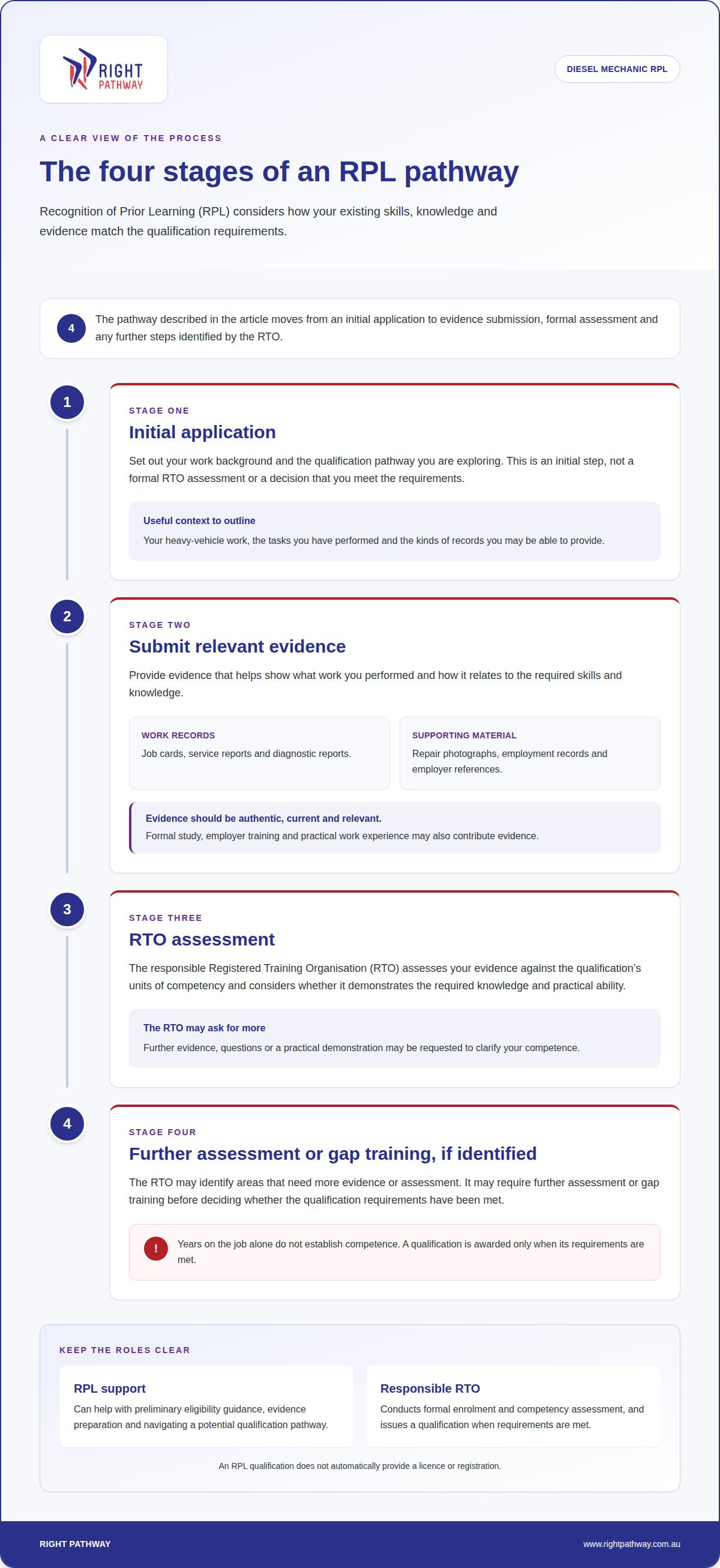
Records of diesel engine diagnostics, electrical repairs or brake servicing may help demonstrate relevant skills. The RTO assesses evidence against the qualification requirements and may ask for more evidence or a practical demonstration. RPL differs from an apprenticeship or training course: it assesses existing competence, while those pathways include structured learning and training for skills still being developed.
Experience and RPL Eligibility
Experienced diesel mechanics may have relevant experience from workshops, transport fleets, mining operations or heavy commercial vehicle maintenance. Job cards, diagnostic reports, repair photographs, employment records and employer references can help show the tasks performed and the worker’s role.
Time on the job alone doesn’t establish competence. Evidence needs to be authentic, current and relevant to the units being assessed. For example, a service report describing fault diagnosis is more useful if it identifies the vehicle system, the work completed and the result. The RTO decides whether the evidence demonstrates the required knowledge and practical ability.
Overseas Experience and Qualifications
Overseas employment records and qualifications can contribute to an Australian RPL application. Examples include translated qualification records, employer references, workshop job cards and fleet maintenance documents. The RTO considers how that evidence relates to AUR31120, rather than treating an overseas certificate as an automatic Australian qualification.
AUR31120 RPL is described as a four-step process: initial application, evidence submission, assessment and any identified gap training or further assessment. The RTO may ask questions or request a practical demonstration to clarify your competence. If you have overseas trade experience, a preliminary eligibility check can help map your background and evidence to a potential qualification pathway.
RPL availability across Australian states and territories
RPL pathways for AUR31120 can be explored across Australia, but delivery arrangements depend on the RTO and assessment pathway. Your location matters when identifying an RTO that can deliver the qualification and assess your evidence, not as a substitute for demonstrating the required skills.
Wherever you live in Australia, start by identifying the qualification and the RTO responsible for formal assessment. Ask how the process handles applicants in your location, including any workplace evidence, practical demonstrations or further assessment. The RTO’s delivery arrangements determine what participation involves.
National recognition means an awarded qualification is recognised across Australia. However, it doesn’t mean every RTO delivers AUR31120 in every state or territory, or that all assessment arrangements are identical. The relevant RTO assesses your prior learning against the qualification’s units and may request further evidence. A recognition of prior learning pathway should therefore be matched to both the qualification and your circumstances.
Does a diesel mechanic qualification obtained through RPL affect licensing or employment requirements in each Australian state? The qualification doesn’t automatically provide a trade licence, registration or employment eligibility. Licensing requirements may vary by state or territory, and employers may set role-specific requirements. Consider these separately from the RTO’s competency assessment.
Before proceeding, separate three decisions:
- Qualification: Confirm the RTO’s proposed outcome is AUR31120, not a different automotive qualification.
- Assessment: Clarify how the RTO assesses workplace evidence and any practical skills relevant to your experience.
- Local requirements: For licensing questions, consult the relevant state or territory regulator; for employment, review the requirements for the specific role.
This distinction applies throughout Australia. An RPL assessment recognises demonstrated competence against qualification requirements; it doesn’t replace separate licensing or employer decisions.
Which Australian qualifications can diesel mechanics obtain through RPL?
The right qualification depends on the vehicles and systems you work on, and the competencies your evidence demonstrates. A heavy commercial vehicle mechanic may consider AUR31120, Certificate III in Heavy Commercial Vehicle Mechanical Technology. A worker focused on diesel engine systems may also consider AUR31520, Certificate III in Automotive Diesel Engine Technology.
These qualifications have different emphases. AUR31120 relates to heavy commercial vehicle mechanical work, while AUR31520 focuses on automotive diesel engine technology. They aren’t interchangeable simply because both involve diesel engines. Match the qualification to your actual duties, such as maintaining heavy vehicles, diagnosing engine faults or servicing diesel systems.
RPL is specific to the qualification and its units of competency. An RTO compares your evidence with the selected qualification’s requirements, then decides which competencies you’ve demonstrated. Work experience alone doesn’t establish that every unit is covered. If your background includes trucks, buses and diesel engine repairs, your evidence may still need to show your knowledge and practical skills across the relevant units.
Other automotive or mobile plant qualifications may suit different work, but don’t assume a heavy vehicle pathway covers plant mechanic competencies. Qualification codes and titles can change, so check current training product details to distinguish the available pathways. The responsible RTO confirms the formal assessment pathway and qualification details.
Use these points to narrow your options:
- Work focus: Identify whether your experience centres on heavy commercial vehicles, diesel engines or mobile plant.
- Evidence: Match work records and training documents to the selected qualification’s competencies.
- Next step: Discuss any gaps with the RTO, which may require further evidence, practical assessment or training.
Choose the pathway that best reflects your actual work, rather than relying on a broad job title. A diesel mechanic’s duties can vary between employers, so the systems you maintain and tasks you perform are more useful indicators when identifying a suitable qualification.
Right Pathway
Right Pathway helps experienced diesel mechanics organise their RPL pathway through preliminary guidance, evidence preparation and administrative support. If you’re unsure whether your heavy-vehicle work aligns with AUR31120, a preliminary skills and experience eligibility consultation can help clarify the potential pathway and identify useful evidence, such as job cards, diagnostic reports or employer references.
A preliminary review isn’t a formal competency assessment. The Registered Training Organisation enrols candidates, assesses skills against the qualification and decides whether further evidence, practical demonstration or gap training is needed. Right Pathway can help you prepare for RTO requirements, but the RTO makes assessment decisions and issues any qualification awarded.
Clear evidence and a suitable qualification pathway give you a practical starting point for the formal RTO process.
Plan your next step with confidence
For diesel mechanic RPL in Australia, start by identifying your target qualification and organising your work history around the skills it requires. This gives you a clearer basis for discussing your pathway and the evidence you may need to prepare.
RPL costs depend on the qualification pathway, your evidence and the assessment requirements. Fees are provided after a quote request. Right Pathway offers administrative RPL support, a preliminary skills and experience consultation, and a free initial eligibility check. These services help you understand potential next steps; the responsible RTO makes formal assessment decisions and issues any qualification awarded.
Use the initial discussion to explain your work background, training and qualification goal. This context can help identify a suitable pathway and evidence to prepare for RTO assessment.
A considered first step can make the process clearer. When you’re ready, complete Right Pathway’s free initial eligibility check.
Frequently Asked Questions
How much does RPL cost?
RPL costs vary according to the qualification pathway, available evidence and assessment requirements. Fees may include the RTO’s formal assessment and any gap training identified. Right Pathway’s initial eligibility check is free, and RTO fees are discussed after eligibility is confirmed. Before proceeding, make sure you understand which charges relate to support and which relate to RTO requirements.
Who is eligible for RPL?
RPL may suit people with relevant skills and knowledge gained through work, study or other learning. There’s no universal minimum number of years that establishes eligibility. For example, experience diagnosing engine faults may be relevant, but your evidence must demonstrate the required competence. The RTO considers the qualification’s units, your experience and the quality of your supporting records.
Can I get credit for units I have already completed?
Possibly. Credit transfer differs from RPL: it recognises a previously completed equivalent unit, while RPL assesses competence gained through experience or learning. Provide your transcript or statement of attainment to the RTO, which can consider the unit details and whether they match the current qualification. Keep the original records, as a course name alone may not establish equivalence.
Can you get AUR31120 through RPL?
Yes, an RTO can assess an applicant for AUR31120 through RPL. The qualification is awarded only if the RTO determines that the required competencies have been demonstrated. For diesel mechanic RPL in Australia, relevant evidence might include workshop records showing diagnostic decisions and completed repairs. The RTO may also ask questions or request a practical demonstration to confirm how the work was performed.
How long does the RPL process take?
Assessment commonly takes approximately 4-8 weeks after complete evidence is received, though the RTO’s process and any evidence gaps affect timing. For example, missing records or a requested practical demonstration can add steps before an outcome is reached. Treat this as a general guide, not a guaranteed completion date. Preparing organised, relevant evidence can help the RTO review your application efficiently.
What is Recognition of Prior Learning (RPL) for diesel mechanics in Australia?
RPL is a process in which an RTO assesses whether your existing skills and knowledge meet a qualification’s requirements. For a diesel mechanic, these may include learning gained through employment, previous study or workplace training. The assessment considers evidence against relevant units, rather than simply counting years worked. The RTO makes the formal decision; RPL support services can help with pathway guidance and evidence preparation.

Article by
Right Pathway Team
Right Pathway supports experienced workers, tradespeople and skilled migrants with preliminary RPL eligibility guidance, evidence preparation and qualification pathway navigation.
Right Pathway is not a Registered Training Organisation and does not conduct formal competency assessments or issue qualifications. Formal enrolment, competency assessment and qualification issuance are completed by the responsible Registered Training Organisation.
Start with a free initial RPL eligibility assessment at https://www.rightpathway.com.au/eligibility-check
Disclaimer
Right Pathway is a facilitation and support service only. We are not a Registered Training Organisation (RTO), do not conduct formal RPL assessments and do not issue qualifications. All formal RPL assessments and certifications are completed by partner RTOs regulated by ASQA. Eligibility and qualification outcomes depend on each applicant’s evidence, experience and the RTO’s assessment decision.