
Your work experience can support a case for course credit, but time on the job alone doesn’t show that your learning matches a course. To understand how to challenge a course with work experience, identify the course outcomes you can demonstrate, gather relevant evidence from work or other settings, and ask the education provider about its recognition of prior learning (RPL) or credit process. The provider decides whether your evidence meets its requirements.
Relevant experience can come from more than formal job duties. A project, volunteer role or other practical activity may help demonstrate skills if it relates to the course outcomes. Before applying, consider how each example shows what you know and can do. A supervisor, colleague or mentor may offer another perspective and help you spot useful details. This guide explains how to connect your experience to course outcomes, prepare evidence and use feedback to clarify your case.
Key Takeaways
- Connect examples from work or other settings to the learning outcomes you want recognised.
- Build a clear evidence picture and use feedback from people with different perspectives to spot gaps.
- Understand what can affect an RPL application’s timeframe, including evidence needs and the provider’s process.
- Learn how eligibility considerations differ across vocational education and higher education before choosing your next step.
Applying learning to work or other settings
Work experience can show how you apply learning beyond a classroom. To seek course credit, connect what you have done to the learning outcomes being assessed. A job title or length of service alone does not explain your knowledge or skills. For example, a team leader could describe allocating tasks, responding to a delay and reviewing the team’s results.
Choose a specific example, then explain the knowledge and actions it demonstrates. It might come from paid employment, volunteering, community activities or a personal project. Relevance is key: explain what you did, why you did it and how it relates to the course content.
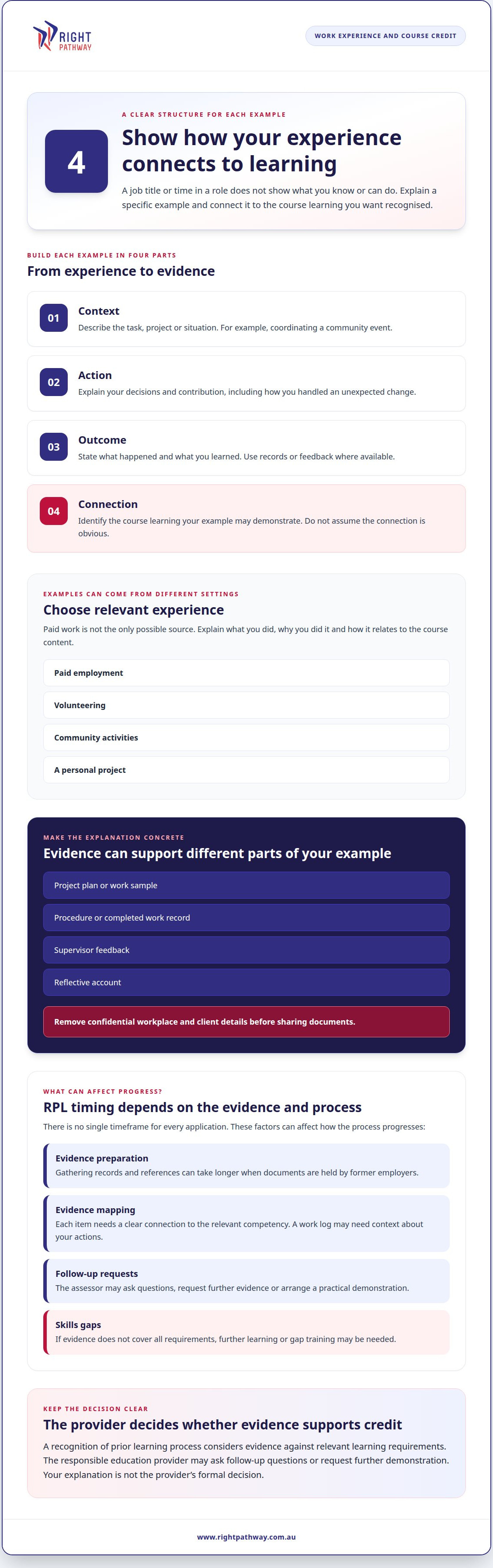
Build each example around a clear sequence:
- Context: Describe the task, project or situation, such as coordinating a community event.
- Action: Explain your decisions and contribution, including how you handled an unexpected change.
- Outcome: State what happened and what you learned, using records or feedback where available.
- Connection: Identify the course learning the example may demonstrate, rather than assuming the connection is obvious.
Evidence makes your explanation more concrete. A project plan, work sample, procedure, supervisor feedback or reflective account may demonstrate different parts of your contribution. For example, a maintenance worker could describe diagnosing an equipment fault and support the account with a completed work record. Remove confidential workplace and client details before sharing documents.
Learning can also develop outside formal study. Project Adventure describes experiential learning as learning through actual experience, or learning by doing. It recommends that program leaders process or debrief an activity instead of relying on participation alone. In a workplace, a debrief after a team exercise can help explain the decisions made and what participants learned.
Project Adventure also says activities should be sequenced to suit the group and prepare participants physically and emotionally. When explaining learning gained in different settings, show how an experience built on earlier knowledge, not just that you took part. A supervisor, colleague or mentor can offer a different perspective and help you identify skills or decisions you may have overlooked.
Use a recognition of prior learning process to understand how evidence is considered against relevant learning requirements. The responsible education provider determines whether the evidence supports credit. It may ask follow-up questions or request further demonstration, so distinguish your own explanation from the provider’s formal decision.
How long does an RPL application take in Australia?
There is no single timeframe for every RPL application. The duration depends on how quickly you prepare relevant evidence, how clearly it matches the required competencies, and whether more information is needed. Someone with accessible work records, for example, may be ready for review sooner than an applicant who needs to gather documents from former employers.
Think of the process in stages. Prepare evidence before the formal assessment, when the RTO reviews it against the course’s relevant units of competency. Even a complete folder may need clarification if it does not show your role, decisions or practical knowledge.
Several factors can affect how the process progresses:
- Evidence preparation: Gathering work samples, records and references can take longer when documents are held by former employers.
- Evidence mapping: Each item needs a clear connection to the relevant competency. A work log, for instance, may need context about the applicant’s actions.
- Follow-up requests: An assessor may ask questions, request further evidence or arrange a practical demonstration.
- Skills gaps: If evidence doesn’t cover all requirements, further learning or gap training may be needed.
How quickly you respond to requests can also affect progress. Prompt replies to requests for clearer records or further explanation help keep the next stage moving. Waiting for a reference or replacing a document with confidential information may add preparation steps. Organise evidence by project or competency, and note who can verify each example.
Assessment requirements shape the sequence too. A practical demonstration or competency conversation requires an additional activity, rather than document review alone. The RTO coordinates formal assessment and decides whether the evidence demonstrates the required skills and knowledge. To consider whether your experience may suit an RPL pathway, you can start with a free initial eligibility assessment.
What are the eligibility rules for RPL in Australian vocational education and higher education?
Eligibility requirements vary across Australian courses. Each provider sets its process for considering prior learning, and the requirements depend on the course and credit sought. Before preparing an application, identify whether you want recognition for a vocational unit, a university subject or a broader course component. This helps you find the relevant policy and application pathway.
Vocational education and training
For vocational education and training (VET), the relevant Registered Training Organisation (RTO) decides whether your prior learning meets the training product’s requirements. Matching a job title to a qualification is not enough. A retail supervisor, for example, may have experience with rosters and customer issues, but those duties alone do not show that every relevant unit’s requirements are met.
An RTO may consider whether your evidence covers the required tasks and demonstrates the knowledge behind them. Work completed under close supervision may need a different explanation from work performed independently. Assessment may also identify a need for further evidence or learning. Being eligible to apply is not the same as being formally assessed as competent.
Higher education
Universities and other higher education providers set their own RPL policies. They may assess work experience, professional development or previous study against a subject’s learning outcomes and academic expectations. Someone with extensive project experience, for instance, may still need to demonstrate the conceptual understanding expected in a particular subject.
Provider rules may specify which course components can be considered and how an application is reviewed. Some components have specific assessment requirements or are excluded under course rules. Read the relevant policy and application instructions carefully, and identify whether your request concerns a subject or another course component.
Keep these distinctions in view when considering eligibility:
- RPL: The provider evaluates learning gained through experience or previous study against course requirements.
- Credit transfer: The provider considers prior formal study for recognition, using its own rules for assessing that study.
- Licensing or registration: Academic or vocational credit does not itself establish permission to perform regulated work.
- Migration assessment: Recognition of learning for an Australian course is separate from a migration skills assessment.
For both VET and higher education, the provider makes its formal decision based on course requirements and its assessment of your application. Preliminary guidance can help you understand whether a pathway may be relevant, but it is not a formal assessment or decision.
Right Pathway
Right Pathway helps you explore whether your work or other experience may support an RPL pathway. A preliminary skills and experience consultation can help connect your background with a suitable qualification pathway. Evidence-readiness guidance can also help you identify documents to organise before the formal assessment.
This support is useful when you’re unsure which experience is relevant, how to present it, or what to expect next. Right Pathway can assist with RPL administration and evidence preparation, but the responsible RTO conducts the formal competency assessment and makes VET RPL decisions. For higher education courses, the relevant university or other higher education provider makes formal credit decisions. Work history alone does not determine that outcome.
If you’d like to discuss your experience and possible next steps, contact Right Pathway.
Set a clear direction for your next step
Before moving forward, define what you want recognition to achieve: credit for a specific subject, fewer repeated learning tasks or a clearer route into further study. Your goal shapes the questions you ask and helps keep discussions with the provider focused.
Knowing how to challenge a course with work experience means making a clear case for the learning you want recognised, not relying on a broad account of your career. Prepare a concise outline of the course you intend to take, the credit you seek and the practical examples that demonstrate your learning. This gives you a focused starting point for discussing a suitable pathway and the information needed next.
Right Pathway can help you explore your experience and potential RPL pathway before the formal RTO process. Start with a free initial eligibility assessment.
Your experience has value. A clear next step can help you present it with purpose.
Frequently Asked Questions
What else do I need to know?
Before accepting an offer or changing enrolment, find out how approved credit could affect your study plan. A subject may be a prerequisite for later study, and its availability can affect your intended sequence. Ask the provider how recognised credit appears on your academic record and whether it changes your remaining course requirements. This helps you weigh the practical value of credit, not just whether it is granted.
What does challenging a course based on work experience mean in Australia?
Usually, this means asking an education provider to consider prior learning for credit, rather than disputing a course result or examination. The phrase can also mean a provider’s formal challenge test, which is an assessment method, not another name for an RPL application. If you want to know how to challenge a course with work experience, clarify which process you mean before preparing a request.
How do Australian universities and TAFEs assess recognition of prior learning (RPL)?
Assessment arrangements vary by provider and course. A university may consider how prior learning fits a subject’s academic level, while a TAFE or other VET provider may focus on a training unit’s requirements. A decision may cover only part of a course, so ask whether conditions apply to the credit offered and how to respond if you disagree with the outcome.
What evidence is required to apply for RPL based on work experience in Australia?
Present evidence so its source and context are clear. Add a short index naming each document, its date and the part of your application it supports. For material owned by an employer or client, remove sensitive details and get permission before sharing it. If records contain workplace abbreviations, briefly explain them so the reviewer can interpret them accurately.
What are the steps to apply for RPL or credit transfer in Australia?
First, establish whether your request concerns RPL for experience or credit transfer for previous formal study. Use the provider’s application process for that request and note any deadline. Keep a copy of your submission and record follow-up dates. When you receive a decision, compare it with your study plan and ask the provider about any review or appeal process it offers.
Can work experience replace course units or practical placements in Australia?
Possibly, but practical placements may have learning objectives or supervision requirements that differ from ordinary paid duties. A role, for example, may involve similar tasks without the observation or structured practice expected in a placement. Ask the provider to consider placement requirements separately from other course components. Its decision depends on the course rules and whether your prior learning meets those requirements.

Article by
Right Pathway Team
Right Pathway supports experienced workers, tradespeople and skilled migrants with preliminary RPL eligibility guidance, evidence preparation and qualification pathway navigation.
Right Pathway is not a Registered Training Organisation and does not conduct formal competency assessments or issue qualifications. Formal enrolment, competency assessment and qualification issuance are completed by the responsible Registered Training Organisation.
Start with a free initial RPL eligibility assessment at https://www.rightpathway.com.au/eligibility-check
Disclaimer
Right Pathway is a facilitation and support service only. We are not a Registered Training Organisation (RTO), do not conduct formal RPL assessments and do not issue qualifications. All formal RPL assessments and certifications are completed by partner RTOs regulated by ASQA. Eligibility and qualification outcomes depend on each applicant’s evidence, experience and the RTO’s assessment decision.