
Experience can support a qualification, but time on the job alone doesn’t earn one. If you’re working out how to get my experience recognised formally, Recognition of Prior Learning (RPL) is a pathway to have relevant skills and knowledge assessed against the units of competency for an Australian qualification. A Registered Training Organisation (RTO) conducts the formal assessment and decides whether your evidence meets those requirements.
It’s understandable to want your practical skills to count, especially when you’ve gained them through work rather than classroom study. If you’re wondering how to get my experience recognised formally, this article explains how Recognition of Prior Learning (RPL) works, what evidence may help and how to take the next step.
You’ll also learn what kinds of evidence may help, what an RTO may ask you to demonstrate, and how RPL differs from credit transfer and licensing. The key point is that your experience needs to show the relevant competencies, not simply how long you’ve worked.
Key Takeaways
- Understand how Australian pathways can recognise overseas qualifications and work experience, and why the two are not the same.
- Learn how to organise examples of your work so they clearly relate to the competencies being assessed.
- See what an RTO may consider during an RPL assessment, including whether further evidence or practical demonstrations are needed.
- Get a clearer sense of what to prepare before seeking preliminary eligibility and evidence-readiness support from Right Pathway.
How Can Your Work Experience Become a Recognised Qualification in Australia?
RPL is an evidence-based assessment of relevant skills against an Australian vocational qualification’s competency requirements. The right pathway depends on the qualification, your evidence and what you need the qualification for.
Recognising Overseas Qualifications and Experience
Recognition can involve assessing an overseas qualification, assessing skills gained through work, or considering both. This distinction matters because an overseas certificate and an Australian qualification are not automatically interchangeable. In Victoria, the Overseas Qualifications Unit assesses overseas qualifications for national recognition, and applicants must be permanent residents of Victoria. For trade skills gained overseas, Trades Recognition Australia provides information about assessment and eligibility. RPL may consider informal learning and overseas work experience when evidence demonstrates relevant competencies.
Choosing an RTO with the Right Qualification
A Registered Training Organisation (RTO) must have the target qualification on its scope of registration to deliver it. Check that the qualification fits your work and career goals. You can use training.gov.au, the National Register of VET maintained by the Australian Government’s Department of Employment and Workplace Relations, to view registered training products and providers. ASQA is Australia’s national vocational education and training regulator. Before proceeding, check the qualification’s current status and the RTO’s scope.
Using RPL Qualifications for Work and Licensing
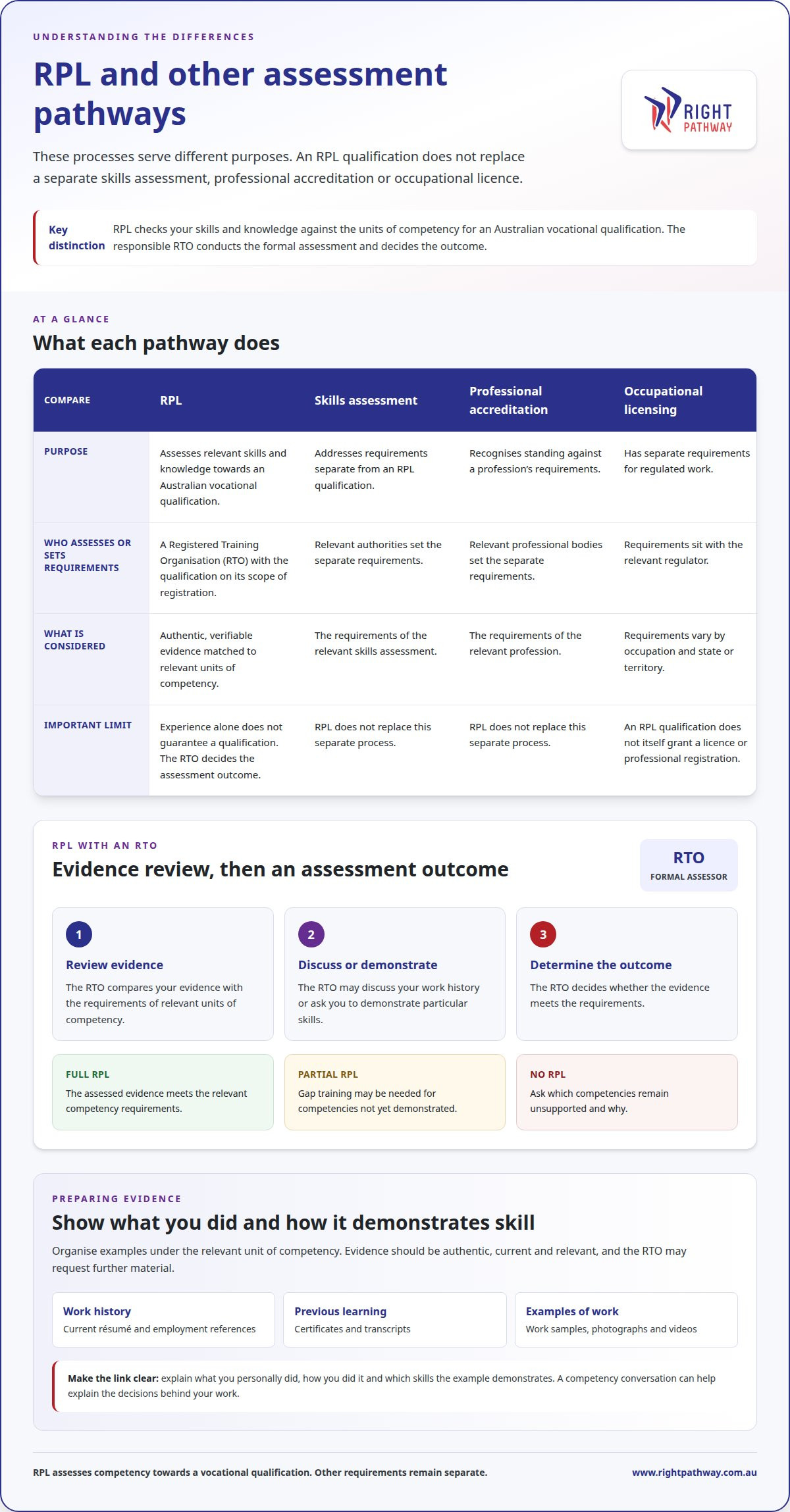
An RTO-issued RPL qualification formally documents the competencies the RTO has assessed, which may help employers understand your vocational skills. Its relevance depends on the role and how well the qualification matches the work. A qualification does not itself grant an occupational licence or professional registration. Licensing requirements are separate and can vary by occupation and state or territory. For regulated work, identify the relevant regulator’s requirements as well as the qualification pathway. Overseas trade recognition for migration purposes is also distinct from an RPL qualification.
RPL Assessment Costs
How much does RPL assessment cost in Australia? There is no single assessment price; the RTO’s fee depends on the qualification and the assessment required. Evidence volume, practical demonstrations and any gap training can affect what the assessment involves. Ask for the fee details and what they cover before formal enrolment. In Victoria, RPL applications usually have a fee, so include the provider’s charge in your planning. Credit transfer is a different process and has separate rules.
RPL assessment by Registered Training Organisations
An RPL assessment compares authentic, verifiable evidence of your skills with the requirements of relevant units of competency. The RTO conducts the formal assessment and decides the outcome.
RTOs and Profession-Specific Assessors
An RTO assesses vocational competencies for qualifications on its scope of registration. To find an authorised RTO, search for the qualification on training.gov.au, the National Register of VET, and check which providers list it within their scope.
A profession-specific skills assessment serves a different purpose from RPL, while professional accreditation recognises standing against a profession’s requirements. Which Australian RTOs can assess RPL? An RTO with the relevant qualification on its scope can assess it. RPL doesn’t replace a separate skills assessment or professional accreditation process.
RPL Assessment Stages and Outcomes
The RTO reviews your evidence against the training requirements. It may discuss your work history or ask you to demonstrate particular skills. An online conversation or digital evidence may form part of the process, but practical tasks can still be requested where needed.
Possible outcomes include full RPL, partial RPL with gap training, or no RPL. What is the difference between RPL, skills assessment and professional accreditation? RPL assesses competency towards an Australian vocational qualification. A skills assessment and professional accreditation address separate requirements set by relevant authorities or professional bodies.
If your application is unsuccessful, ask which competencies remain unsupported and why. You can then discuss whether additional evidence, a practical demonstration or gap training could address the identified gaps.
Documents for an RPL Assessment
Useful evidence may include a current résumé, employment references, certificates, transcripts, work samples, photographs and videos. Choose material that shows what you personally did, how you did it and which skills it demonstrates.
Digital files can help present work completed across different sites or roles, while a competency conversation lets you explain decisions behind an example. The RTO assesses whether evidence is authentic, current and relevant, and may request further material. A preliminary RPL eligibility check can help you consider your experience and evidence before formal assessment.
What Is Recognition of Prior Learning?
Recognition of Prior Learning (RPL) allows a registered training organisation to assess skills and knowledge gained through work, informal learning or previous study against a qualification’s requirements. Organised evidence helps show how your experience matches each competency.
Matching Evidence to Units of Competency
A unit of competency describes the skills and knowledge required for a particular part of a qualification. Group evidence under the relevant unit, then explain what each example demonstrates. A completed work task, for instance, might show planning, safe procedures and quality checks. This mapping helps an assessor connect your work to the competency, rather than relying on your job title alone.
Workplace Evidence and Qualification Pathways
Workplace evidence can show how you apply skills in real tasks, settings and responsibilities. Match examples to the qualification pathway you’re considering, because similar job titles can involve different duties. A tradesperson’s project records, for example, may support practical competencies, while supervisory records may relate to planning or team coordination. The RTO assesses whether your evidence meets the course requirements.
Evidence Portfolios and Supporting Documents
An evidence portfolio brings relevant records together so an assessor can review your skills against the required competencies. It may include employment records, references, certificates, transcripts, work samples, photographs, videos and a current résumé. Add brief notes identifying your role, the task and what each item demonstrates. A clear portfolio makes the connections easy to follow; a large volume of documents alone does not prove competence.
Addressing Evidence and Documentation Gaps
A gap exists when your available evidence does not clearly demonstrate a required skill or knowledge area. Identify the unsupported competency, then consider whether another authentic work example or referee statement can help show it. For overseas experience, translated qualification documents and descriptions of your work duties can provide useful context. If records alone do not establish the required skills, an RTO may request a competency conversation, practical demonstration or gap training.
RPL eligibility
RPL eligibility depends on whether your learning and experience relate to the competencies in a suitable qualification. Employment, previous training and self-study may all contribute to a pathway. If you’re exploring how to get my experience recognised formally, start by identifying the work and knowledge you can demonstrate.
Experience Requirements
There is no universal minimum period of experience for every RPL application. An RTO considers the qualification’s requirements and whether your background gives you a reasonable basis to demonstrate its competencies. Your responsibilities matter: performing tasks under supervision may show different capabilities from planning work or making decisions independently.
Previous learning can also support your application, including formal education, workplace training and informal study. Consider how your roles have changed over time and which responsibilities reflect your current capability. A career history with varied duties may support a broader pathway than a job title alone suggests.
Relevant Work Experience and Suitability
Suitability depends on how your experience relates to the qualification you’re considering. Someone working in a broad industry, for example, may have developed expertise in a particular specialisation rather than every area covered by a qualification. Identifying that distinction helps align the pathway with your actual skills and career goals.
RPL may be relevant whether you gained skills through employment, training or self-study. The assessment focuses on demonstrated knowledge and skills; a particular job title or length of service does not, by itself, prove competence. If your experience spans several roles, explain how each contributed to your professional capability.
A preliminary eligibility discussion can help clarify which qualification pathway may suit your background. The RTO remains responsible for formal assessment and deciding whether you meet the requirements.
Right Pathway
Right Pathway helps experienced workers navigate RPL through preliminary skills and experience guidance, evidence-readiness support and administrative facilitation. This support can be useful if you’re unsure which qualification may fit your work history or how to organise evidence for an RTO.
The initial eligibility check is preliminary, not a formal competency assessment. The responsible Registered Training Organisation reviews your evidence, conducts any required assessment and decides whether you meet the competencies. Right Pathway can help you understand a potential pathway and prepare for the next steps, without promising a qualification outcome.
If you’d like to discuss your experience and possible next steps, contact Right Pathway.
Choose the next step that fits your goal
Before starting, decide what you want formal recognition to support. A qualification for career development, further study or a role with specific requirements can involve different considerations. Being clear about your purpose helps focus an initial discussion on relevant experience and qualification options.
If you’re working out how to get my experience recognised formally, Right Pathway can provide preliminary skills and experience guidance, RPL support and administrative facilitation. The free initial RPL eligibility check is a preliminary review, not a formal competency assessment. The responsible RTO makes the assessment decision and determines whether your evidence meets the qualification requirements.
Use the initial discussion to clarify a potential pathway and identify information that may help with the next stage. You can take it one considered step at a time.
Your experience has value. A clear next step can help you present it with purpose.
Frequently Asked Questions
How long does the RPL process take in Australia?
An RPL assessment commonly takes approximately 4-8 weeks after complete evidence is received. Use that estimate as a planning guide, not a fixed completion date. Before starting, allow time to gather records from past employers and organise overseas documents or translations if relevant. Keeping copies of submitted files can also help you respond clearly if the RTO asks about a particular item.
Can RPL be done in an apprenticeship or traineeship?
Yes, RPL may form part of an apprenticeship or traineeship pathway. For a Class A qualification, an applicant who doesn’t meet the requirements for every necessary unit must complete training under a training contract. RPL may recognise some competencies while structured training continues for the remaining requirements. The result depends on the units demonstrated and the applicable apprenticeship or traineeship arrangement.
Can RPL be used to progress to further study or university?
RPL may support progression, but recognition for one qualification doesn’t automatically establish admission to another course. For example, someone considering university should distinguish the RPL outcome from the university’s entry requirements and its decision about advanced standing. Plan the next course around its published prerequisites and the credit or entry arrangements for that specific program.
Can the RPL process replace formal study entirely?
An RTO may award the full qualification through RPL if its assessment finds that you have met all required competencies. The qualification is the same as one achieved through training, and the certificate doesn’t indicate that RPL was used. If your evidence doesn’t demonstrate every requirement, further learning or training may be needed for the outstanding competencies.
Do I need to be currently employed to apply for RPL?
No, current employment isn’t essential when considering an RPL application. If you’re self-employed or between jobs, records such as invoices, project logs or client references may help document past work. Overseas experience may also be relevant. Keep records showing when and where you worked, your responsibilities and the context of your tasks, so the RTO can interpret your experience accurately.
How is RPL different from just uploading my résumé?
A résumé is a useful starting point because it sets out your employment history, roles and career changes. On its own, however, it may offer little detail about individual projects or your personal contribution. Add context to each relevant role, including your responsibilities and the work you completed, so the assessor can understand what your employment history demonstrates.

Article by
Right Pathway Team
Right Pathway supports experienced workers, tradespeople and skilled migrants with preliminary RPL eligibility guidance, evidence preparation and qualification pathway navigation.
Right Pathway is not a Registered Training Organisation and does not conduct formal competency assessments or issue qualifications. Formal enrolment, competency assessment and qualification issuance are completed by the responsible Registered Training Organisation.
Start with a free initial RPL eligibility assessment at https://www.rightpathway.com.au/eligibility-check
Disclaimer
Right Pathway is a facilitation and support service only. We are not a Registered Training Organisation (RTO), do not conduct formal RPL assessments and do not issue qualifications. All formal RPL assessments and certifications are completed by partner RTOs regulated by ASQA. Eligibility and qualification outcomes depend on each applicant’s evidence, experience and the RTO’s assessment decision.


