

Your trade experience can be recognised, but the right pathway depends on why you need recognition. People with Australian or overseas trade skills may seek a qualification through Recognition of Prior Learning (RPL), or a migration skills assessment through Trades Recognition Australia (TRA). These are separate processes, so getting your trade skills recognised in Australia starts with identifying the outcome you need.
It’s understandable to want your experience and qualifications assessed fairly, especially when you’ve built your skills on the job or trained overseas. This guide explains who may apply, how migration assessments differ from RPL, which Australian qualifications may be relevant, and what evidence can help demonstrate your work experience, income and skills. You’ll also see where RPL support can help you prepare evidence and understand potential qualification pathways, while formal assessment decisions remain with the responsible organisation.
Key Takeaways
- Start by identifying whether you need an Australian qualification, a migration skills assessment or both, as each follows a different pathway.
- Find out which trade qualification may fit your occupation and experience before choosing an RPL pathway.
- Organise relevant evidence of your work history and practical skills, such as employer references, photographs or videos.
- Understand how RPL compares your existing skills and knowledge with qualification requirements, and what role the RTO plays in formal assessment.
Certificate III and Certificate IV qualifications
A relevant Certificate III or Certificate IV can formally recognise trade skills through an Australian qualification. The appropriate level depends on the occupation, your existing training and the evidence of your competency.
Formal trade qualification recognition
Recognition means matching a person’s relevant training and trade capability to an Australian qualification. It can help employers understand what skills have been formally assessed, but it is distinct from a migration skills assessment or occupational licence. For example, MEM 30319 Certificate III in Engineering Fabrication Trade (Welding) is a qualification for people working in metal fabrication. Consider whether the qualification matches the occupation and work actually performed.
Qualification duration and validity
How long completion takes depends on the qualification pathway, any training required and how much relevant competency you can demonstrate. Recognition of Prior Learning (RPL) assesses existing skills against qualification requirements, while formal enrolment may involve training. A qualification records completed learning; it does not automatically grant a licence, registration or migration outcome. For employment, the occupation and any separate workplace or regulatory requirements also matter. Qualification suitability is determined through the formal process, not by experience alone.
Construction trade qualifications
Construction requirements vary by trade and state. Tilers, glaziers and plasterers need a Certificate III before applying for a trade licence, while builders need a Certificate IV, Diploma or Advanced Diploma to acquire one. These qualifications and licensing requirements are not interchangeable. Identify the qualification required for your construction occupation and the state where you intend to work. A certificate supports formal recognition, but a relevant state or territory regulator handles licensing.
Assessment, recognition and licensing differences
A trade skills assessment evaluates skills for a specific purpose, such as migration. Qualification recognition confirms learning against an Australian qualification, while occupational licensing authorises regulated work. To have an overseas qualification recognised by a state licensing authority, the relevant authority assesses it against that occupation’s requirements. Since requirements vary by state and trade, identify the regulator and pathway for your intended work.
For a qualification pathway, RPL support can help map existing trade experience to relevant qualification requirements. Formal assessment and qualification decisions remain with the responsible Registered Training Organisation.
Evidence for work experience and income
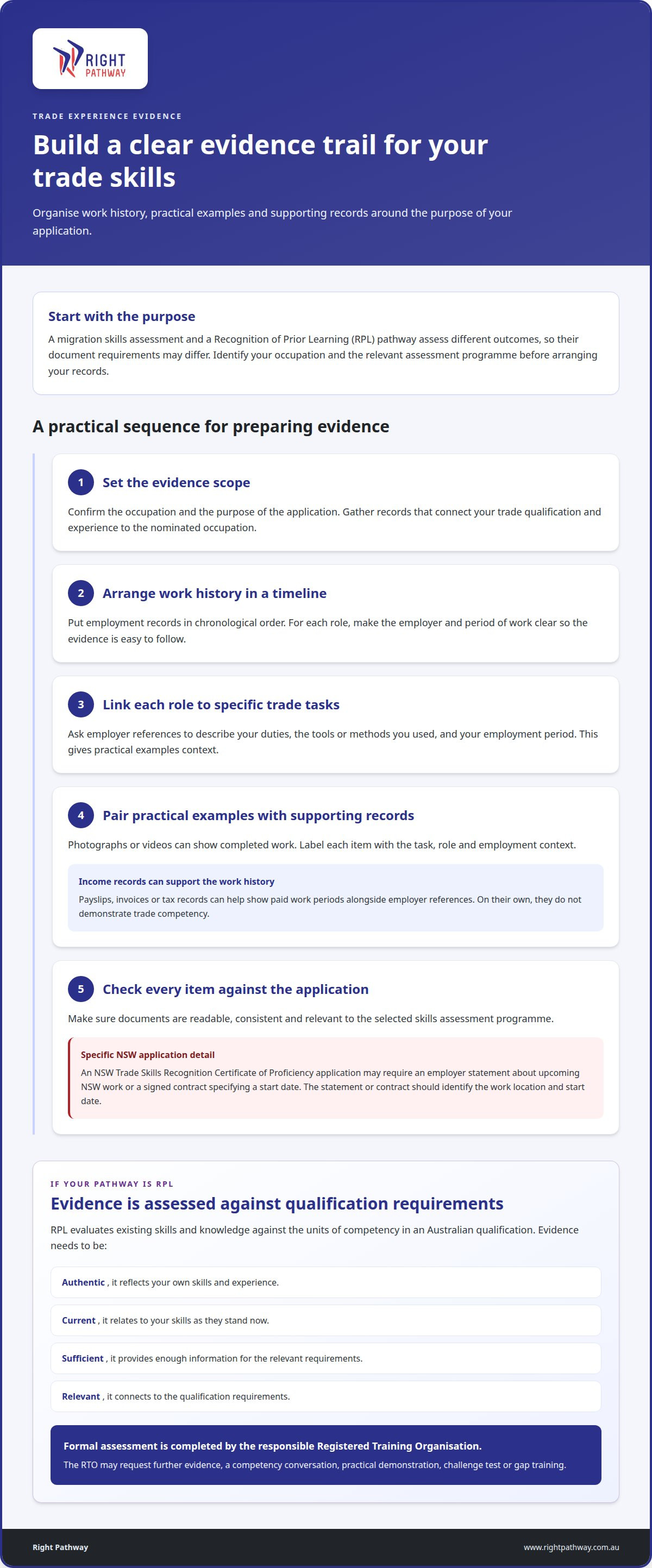
Strong evidence links your trade duties, employment history and practical knowledge to the purpose of your application. Organise records around the occupation and the skills assessment program involved.
Evidence of trade skills and experience
For a documentary trade assessment, evidence may include employer references, photographs or videos of your work. Ask references to describe your trade duties, the tools or methods you used, and your employment period. A photograph of fabrication work, for example, can illustrate practical tasks, while a reference explains the work context. Together, these records can show how you developed and applied your skills.
Evidence for an application
Build an evidence set that matches the purpose of your application. A migration skills assessment and an RPL pathway assess different outcomes, so their document requirements may differ. For an NSW Trade Skills Recognition Certificate of Proficiency application, an employer statement about upcoming work in NSW or a signed contract specifying a start date may be required. Include evidence linking your trade qualification and experience to the nominated occupation.
Gathering work evidence
Arrange records in a clear timeline, then link each role to specific trade tasks. Income documents, such as payslips, invoices or tax records, can help show paid work periods alongside employer references, but they do not demonstrate trade competency on their own. Use photographs or videos to show completed work, and label each item with the task, role and employment context.
Before applying, check that every document is readable, consistent and relevant to the selected skills assessment program. If an NSW application involves upcoming employment, the statement or contract should identify the work location and start date. This distinguishes previous experience from a future work arrangement.
A free initial eligibility assessment can help identify a potential qualification pathway and the evidence to prepare. It is preliminary guidance, not a formal skills assessment or RPL decision.
Recognition of prior learning (RPL)
Recognition of Prior Learning assesses existing skills and knowledge against the units of competency in an Australian qualification. It can recognise learning gained through employment, previous training and other relevant experience, rather than requiring workers to repeat learning they can already demonstrate. The formal assessment is conducted by a Registered Training Organisation (RTO).
RPL is an evidence-based assessment, not an automatic award for time spent in a trade. Evidence must be authentic, current, sufficient and relevant to the qualification requirements. An RTO may review work records, training documents and practical examples, then request further evidence. Depending on the assessment, this may include a competency conversation, practical demonstration, challenge test or gap training.
Western Australia’s Trade Skills Recognition pathway illustrates how specific the process can be. It uses RPL to recognise trade skills and experience for qualifications commonly completed through an apprenticeship pathway. Candidates must demonstrate competency in every unit and provide sufficient evidence that their existing skills and experience meet the qualification requirements. Gap training is not permitted in this pathway, so candidates must already have the complete skill set and knowledge required at assessment.
RPL differs from credit transfer. Credit transfer recognises completed formal units, while RPL evaluates demonstrated capability against relevant units. In Western Australia’s Trade Skills Recognition process, credit transfers and Recognition of Current Competency are not accepted when issuing a trade certificate. Keep this distinction in mind when choosing a pathway: learning gained through work experience may count, but each unit still needs evidence of the required performance and knowledge.
In Western Australia, North Metropolitan TAFE can conduct the RPL process and recommend candidates for Trade Skills Recognition. The Apprenticeship Office of the WA Department of Training and Workforce Development makes the final eligibility assessment and approval. An RPL outcome may lead to a nationally recognised Australian qualification, but it does not itself provide occupational licensing or a migration skills assessment. Each is a separate outcome with its own process.
How can overseas trade qualifications and experience be recognised in Australia?
For migration purposes, getting your trade skills recognised in Australia means pursuing a skills assessment pathway, not simply converting an overseas certificate. Trades Recognition Australia (TRA) assesses trade qualifications, skills and employment for migration purposes. The appropriate pathway depends on factors including your occupation, passport country, study location and intended visa type.
TRA offers the Job Ready Program (JRP), TSS Skills Assessment Program, Offshore Skills Assessment Program (OSAP) and Migration Skills Assessment Program (MSA). Each has its own requirements and process. The JRP is for eligible international graduates with an Australian trade or associate professional qualification issued by a Registered Training Organisation. You must complete a Provisional Skills Assessment before applying to the JRP.
The OSAP is for applicants seeking a skilled migration visa, excluding subclass 485 or TSS visas, or choosing to undertake a skills assessment. It is also available to applicants in a nominated occupation who can travel to Australia or a nominated country for assessment. The applicable pathway is shaped by the applicant’s circumstances and intended assessment.
An Australian qualification pathway is separate from a migration skills assessment. An RTO can assess overseas learning and work experience against relevant qualification requirements. If you have trade proficiency but no Australian apprenticeship or formal qualification, gap training with a registered training provider may be required. The two pathways therefore serve different purposes.
Neither a TRA skills assessment nor an RPL qualification automatically provides a licence, visa or employment outcome. Trade licensing requirements vary by state and territory; consult the relevant regulator for licensing information. For migration advice, speak with an appropriately registered migration professional.
Right Pathway: Preliminary skills and experience eligibility consultation
Right Pathway provides a preliminary skills and experience eligibility consultation to help you explore a trade qualification pathway. It can be useful if you have overseas or Australian trade experience and want guidance on how it may relate to a potential RPL pathway.
The free initial RPL eligibility assessment and preliminary evidence-readiness review help clarify what information may support your next steps. Right Pathway also provides RPL support and administrative facilitation, including evidence-preparation guidance and help navigating qualification options. This preliminary guidance is not a formal competency assessment. The responsible Registered Training Organisation conducts the formal assessment and makes qualification decisions.
Bring details of your trade background, employment and existing training to the initial review. Right Pathway can use this information to discuss potential pathways and evidence preparation, while keeping qualification recognition separate from migration skills assessment, licensing and visa advice.
Contact Right Pathway to discuss your trade experience and possible next steps.
Take a clear next step towards recognition
Before moving ahead, write down the outcome you need and the decision you want your application to support. This gives you a clear starting point for getting your trade skills recognised in Australia and helps keep your next steps focused on your goals.
If you’re unsure how your experience fits the pathway you have in mind, Right Pathway can help you explore potential next steps. The formal decision remains with the relevant assessing body or Registered Training Organisation.
Take the process one step at a time. A clear starting point can help you move forward with confidence.
Frequently Asked Questions
Who can apply?
Eligibility depends on the pathway. For an NSW Trade Skills Recognition Certificate of Proficiency, applicants must be at least 18 and live in NSW, or elsewhere in Australia intending to work in NSW. Trade skills may have been gained through formal training or on-the-job experience in Australia or overseas, provided the applicant meets the pathway criteria. This route has its own application requirements.
What are trade qualifications?
Trade qualifications are credentials linked to learning and competency in a particular trade occupation. Their relevance depends on the occupation and training completed. For an NSW Certificate of Proficiency application, you must have a current Australian trade qualification relevant to the application. The Commissioner considers the qualification alongside the duration and type of training, work history, and evidence of how you developed your trade skills.
What evidence do I need to provide?
The evidence you need depends on your application. If you are seeking credit transfer, provide formal academic transcripts or equivalent records showing the units for which you are requesting credit. For an NSW trade recognition application involving upcoming work, an employer statement about the proposed NSW work or a signed contract specifying a start date may be required. These documents support different parts of an application.
What is the assessment process?
For an NSW Certificate of Proficiency, the Commissioner for Vocational Training considers relevant Australian trade qualifications, the duration and type of training, time worked in the trade, and evidence showing how skills were developed. The Commissioner may also consult employer and employee representatives from the industry. The decision therefore considers both formal learning and your practical trade history.
Which Australian skills assessment authority assesses my trade occupation?
Trades Recognition Australia (TRA) assesses trade skills for migration purposes; state trade recognition is a separate process. In NSW, the Commissioner for Vocational Training considers Certificate of Proficiency applications. In Western Australia, the Apprenticeship Office of the Department of Training and Workforce Development makes the final eligibility assessment and approval for Trade Skills Recognition. The relevant authority depends on the purpose of your application.
What documents are required for an Australian trade skills assessment?
There is no single set of documents for every pathway. For credit transfer, provide transcripts or equivalent formal records identifying the units being considered. An NSW application connected with upcoming work may need an employer statement or signed contract specifying the start date. Match your documents to the pathway and its purpose, since evidence for a qualification application may differ from migration assessment requirements.

Article by
Right Pathway Team
Right Pathway supports experienced workers, tradespeople and skilled migrants with preliminary RPL eligibility guidance, evidence preparation and qualification pathway navigation.
Right Pathway is not a Registered Training Organisation and does not conduct formal competency assessments or issue qualifications. Formal enrolment, competency assessment and qualification issuance are completed by the responsible Registered Training Organisation.
Start with a free initial RPL eligibility assessment at https://www.rightpathway.com.au/eligibility-check
Disclaimer
Right Pathway is a facilitation and support service only. We are not a Registered Training Organisation (RTO), do not conduct formal RPL assessments and do not issue qualifications. All formal RPL assessments and certifications are completed by partner RTOs regulated by ASQA. Eligibility and qualification outcomes depend on each applicant’s evidence, experience and the RTO’s assessment decision.


