

RPL for retail management can recognise relevant workplace skills towards the SIR40316 Certificate IV in Retail Management. The qualification includes 11 units: 7 core units and 4 electives. Applicants with a Certificate III in Retail or relevant retail employment experience can enter the pathway, subject to an RPL process that considers their competence.
Retail leadership covers varied responsibilities, from coordinating daily operations to guiding staff and maintaining service standards. Your job title alone does not show the full scope of your work. A clear account of your responsibilities, supported by examples of how you apply your skills, helps connect your experience to qualification requirements.
This guide explains how to prepare evidence, what eligibility involves and how Certificate IV units are structured. It also clarifies the difference between preliminary guidance and formal assessment by a Registered Training Organisation (RTO), so you can understand who does what before deciding on your next step.
Key Takeaways
- Build an evidence file around your actual retail duties, with examples that show how you apply your skills at work.
- Compare your experience with the qualification requirements to identify where your background may align and where more evidence could be needed.
- Review how the core and elective units relate to different retail management responsibilities before considering a pathway.
- Use preliminary eligibility and evidence-readiness guidance to organise your next steps before formal assessment by an RTO.
What evidence do retail managers need?
For RPL for retail management in Australia, you need evidence showing relevant skills against the qualification units. A Registered Training Organisation (RTO) assesses that evidence against the applicable competency standards.
Preparing Evidence Before RTO Confirmation
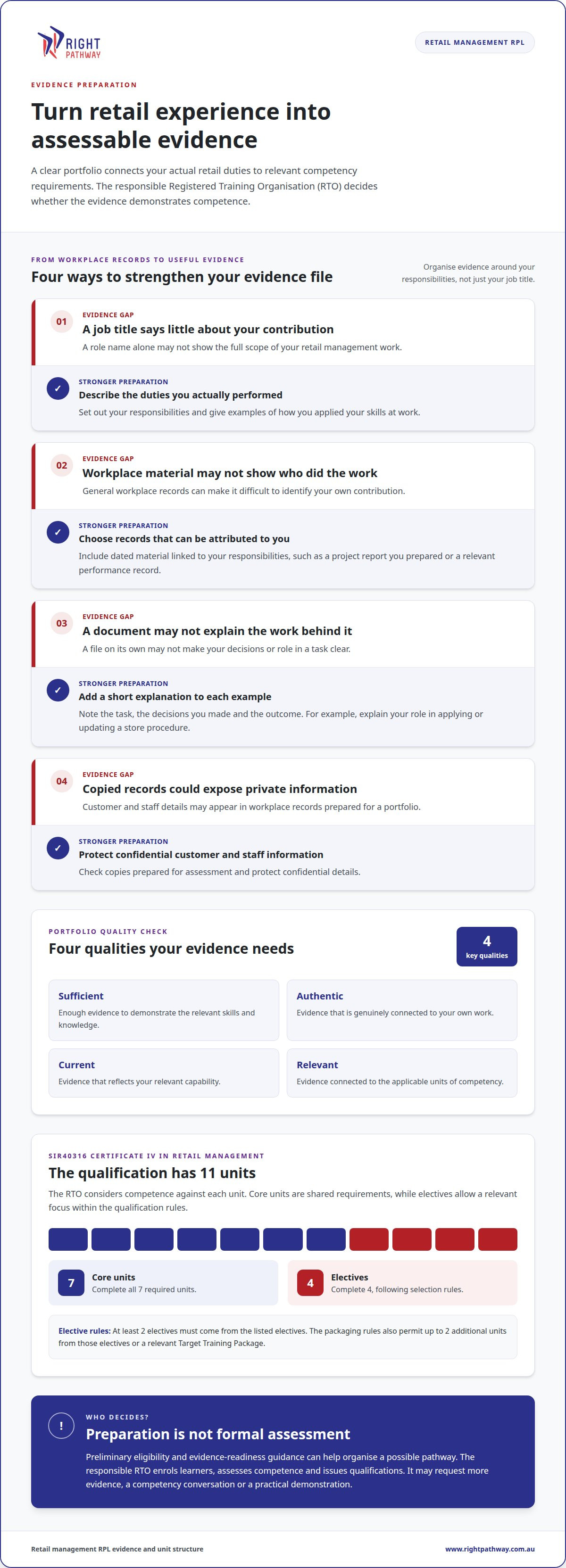
Before an RTO is involved, sort potential records by responsibility and work context. Start with a simple index: list each duty, the document or example that supports it, and when the work took place. This helps distinguish evidence of your own contribution from general workplace material. For instance, explain your role in applying or updating a store procedure.
Evidence for an RPL Portfolio
An RPL portfolio is an organised collection of records showing how you carry out retail management tasks. Include dated material that can be attributed to you, such as a project report you prepared or a performance record linked to your responsibilities. Add a short note explaining the task, your decisions and the outcome. Protect confidential customer and staff information in any copies prepared for assessment.
Australian vocational RPL assesses demonstrated skills and knowledge against units of competency. Evidence needs to be sufficient, authentic, current and relevant. An RTO may also ask for a competency conversation or practical demonstration to clarify how you work.
For a VETASSESS Retail Manager (General) skills assessment, an organisational chart is required. If your employer cannot provide one, submit a statutory declaration explaining the required information and why the chart is unavailable. This is a separate occupation assessment requirement, not a substitute for evidence assessed by an RTO.
Recognition may help you document your capability for a job application, promotion discussion or further study, but it does not secure a job or study place. A clear portfolio can help an employer or education provider understand the management duties you have performed.
Recognition of Prior Learning eligibility
For the SIR40316 Certificate IV in Retail Management, entry is open to people with a Certificate III in Retail or relevant industry employment experience. An RPL process then considers whether their existing skills and knowledge match the qualification’s competency requirements. RPL for retail management is assessed against relevant units, not a job title or years of service alone.
Eligibility depends on the duties you have performed and how well your evidence demonstrates them. A department manager, for example, might document staff supervision, customer service and store operations. Training records, performance documents and examples of workplace decisions can show how those responsibilities developed. An RTO may identify units that need more detailed evidence or another form of assessment.
Retail workers may seek RPL towards a Certificate III in Retail, while experienced store and area managers may consider a diploma pathway in retail leadership or merchandise management. Choose a qualification that reflects your actual responsibilities, then check whether your work examples relate to its units.
Before formal assessment, organise your employment history and training records, and prepare a concise outline of your duties. Note where your experience relates to areas such as health and safety, staff coordination and customer service. This preparation can help clarify a possible pathway and identify evidence to gather, but preliminary guidance is not the RTO’s competency decision.
When choosing RPL support, understand the difference between administrative guidance and formal assessment. The responsible RTO enrols learners, assesses competence and issues qualifications. Check an organisation’s RTO registration and scope on training.gov.au, and be cautious of claims that paperwork or experience alone guarantees a qualification.
For Retail Manager (General) skills assessment, VETASSESS has separate occupation-specific criteria. Retail employment must be highly relevant to the nominated occupation for Pathways 1, 2 or 3. A retail qualification and an occupational skills assessment are different processes, and one does not replace the other.
Core and elective units
The SIR40316 Certificate IV in Retail Management requires 11 units: 7 core units and 4 electives. Core units form the shared qualification requirements, while electives allow a relevant focus within the packaging rules. The RTO’s assessment considers competence against each unit, rather than treating the Certificate IV as one overall task.
Elective choices matter because retail roles differ. A supermarket supervisor’s responsibilities may not match those of a speciality retailer or quick service restaurant manager. The qualification rules require at least 2 electives to come from the listed electives. They also allow a maximum of 2 additional units from those electives or a relevant Target Training Package.
- Core units: complete all 7 required units.
- Electives: complete 4, following the qualification’s selection rules.
- Additional units: the packaging rules permit up to 2 from the specified sources.
For RPL, link each piece of evidence to the unit it may demonstrate. A completed workplace project might show capability for one unit, while another may require different examples or further assessment. The RTO decides whether your evidence demonstrates the required competency. If it does not, the RTO may request more evidence or another assessment activity.
Credit transfer is different from RPL. In Australia, an authenticated AQF certification document or VET transcript confirming an equivalent unit may support credit transfer, subject to limited exceptions. Gather the original qualification document or transcript and identify the matching unit. Credit transfer recognises an equivalent completed unit; it does not assess broader workplace experience against other Certificate IV requirements.
Keep your records organised by unit. Mark each unit as completed through prior study, potentially demonstrated through work evidence, or needing further discussion. This gives the RTO a clearer basis for reviewing your learning and assessment pathway. An Advanced Diploma is a separate qualification, so its units should not be assumed to replace Certificate IV requirements.
Certificate IV in Retail Management (SIR40316)
SIR40316 is the Certificate IV in Retail Management, an AQF level 4 qualification in the SIR Retail Services Training Package. It can suit retail supervisors and second-in-charge staff whose work involves supporting store operations. The pathway may lead to roles in speciality retailers, supermarkets, department stores and quick service restaurants.
People with a Certificate III in Retail or relevant industry employment experience may apply. The RTO uses the RPL process to determine competency. A Certificate II may be part of your previous learning, but the RTO assesses evidence against the units of the qualification you are pursuing.
The qualification is delivered in the workplace, so examples from real retail duties can be useful. These might include coordinating a shift, managing stock processes or supporting team performance. Visual merchandising examples can help explain your work context, but evidence must relate to the applicable competency requirements.
RPL and course-based study use the same RTO competency standards. The difference is how you demonstrate your learning: RPL assesses existing skills and knowledge, while course study involves learning and assessment activities. If your existing material does not clearly demonstrate a unit, the RTO may request more evidence or a practical demonstration.
For the flexible learning pathway, allow up to 600 hours for the total volume of learning, assuming sufficient and current evidence is available. The course takes approximately 1 year to complete. These are different measures: learning hours describe volume, while completion time reflects the course duration.
Before choosing this Certificate IV, compare your responsibilities with its requirements. A team member aiming to move into supervision may need a different pathway from an experienced department manager. The RTO’s formal assessment determines whether your evidence demonstrates the required competence and whether further learning is needed.
Start a free initial RPL eligibility assessment
Right Pathway: RPL support and administrative facilitation
Right Pathway helps retail workers prepare for RPL through administrative support and evidence guidance. If you’re unsure whether your experience aligns with the Certificate IV, a preliminary skills and experience eligibility consultation can help clarify possible next steps.
A preliminary evidence-readiness review can help you organise documents and identify areas that may need stronger examples. This is guidance, not formal competency assessment. The responsible Registered Training Organisation enrols applicants, assesses competence against the units and issues qualifications when requirements are met.
Use this support if you need help mapping retail duties to a possible qualification pathway or preparing evidence for RTO consideration. Start with a free initial RPL eligibility assessment to discuss your background and possible next steps, which depend on your evidence and RTO requirements.
Contact Right Pathway to discuss your retail RPL pathway.
Make your retail experience count towards your next goal
Let your next career move guide how you approach RPL for retail management. Consider the responsibilities you want to take on, then identify which parts of your experience best demonstrate your readiness. A clear goal gives your evidence a practical purpose beyond gaining a qualification.
Right Pathway provides RPL support and administrative facilitation, including a free initial eligibility assessment and preliminary skills and experience consultation. This can help you understand potential pathways and prepare for discussions with an RTO. Formal competency assessment and qualification decisions remain with the responsible RTO.
Bring a clear outline of your retail responsibilities and the roles you’re working towards. This gives the initial conversation a useful focus and helps shape next steps around your experience.
Your experience is a practical starting point for planning what comes next.
Frequently Asked Questions
Which retail qualification can I get through RPL?
Retail workers may pursue a Certificate III in Retail, while supervisors and second-in-charge staff may consider the SIR40316 Certificate IV in Retail Management. Experienced store or area managers may explore a diploma pathway in retail leadership or merchandise management. The appropriate option depends on your role, experience and evidence. An RTO determines whether your skills meet the selected qualification’s requirements.
What suitable evidence can support your evidence portfolio?
Useful supporting records include employment contracts, payslips, position descriptions, references, work samples, photographs or videos, licences, logbooks and invoices. Choose verifiable items that show your own work, rather than documents that only describe the workplace. For example, a former supervisor’s reference may clarify your responsibilities if an older position description lacks detail.
Who is eligible for RPL?
Eligibility depends on relevant skills and evidence, not a universal minimum number of years in retail. For SIR40316, entry is open to people with a Certificate III in Retail or relevant industry employment experience. The RTO’s RPL process considers whether your demonstrated competence matches the qualification. A free initial eligibility check can help you understand whether your background appears aligned before formal assessment.
Can I get credit for units I have already completed?
Yes. An RTO may grant credit transfer for an equivalent unit recorded on an authenticated AQF certification document or VET transcript, subject to limited exceptions. Credit transfer differs from RPL, which assesses skills and experience. If your transcript lists an equivalent retail unit, provide the official document so the RTO can consider it separately from units requiring RPL assessment.
How long does the RPL process take?
The assessment timeframe is approximately 4-8 weeks after complete evidence is received, according to Right Pathway’s current FAQ. The timing relates to the RTO assessment stage, not necessarily all preparation beforehand. Organising documents, responding to requests for further evidence or completing any required gap training can affect the overall pathway, so submit clear, complete records from the outset.
How much does RPL cost?
RPL costs depend on the qualification, the RTO’s assessment fees and whether gap training is needed. There is no single price for every retail applicant. Fees and pathway requirements are discussed after eligibility is confirmed. A free initial eligibility check can help clarify a potential route before you decide whether to proceed.

Article by
Right Pathway Team
Right Pathway supports experienced workers, tradespeople and skilled migrants with preliminary RPL eligibility guidance, evidence preparation and qualification pathway navigation.
Right Pathway is not a Registered Training Organisation and does not conduct formal competency assessments or issue qualifications. Formal enrolment, competency assessment and qualification issuance are completed by the responsible Registered Training Organisation.
Start with a free initial RPL eligibility assessment at https://www.rightpathway.com.au/eligibility-check
Disclaimer
Right Pathway is a facilitation and support service only. We are not a Registered Training Organisation (RTO), do not conduct formal RPL assessments and do not issue qualifications. All formal RPL assessments and certifications are completed by partner RTOs regulated by ASQA. Eligibility and qualification outcomes depend on each applicant’s evidence, experience and the RTO’s assessment decision.


