

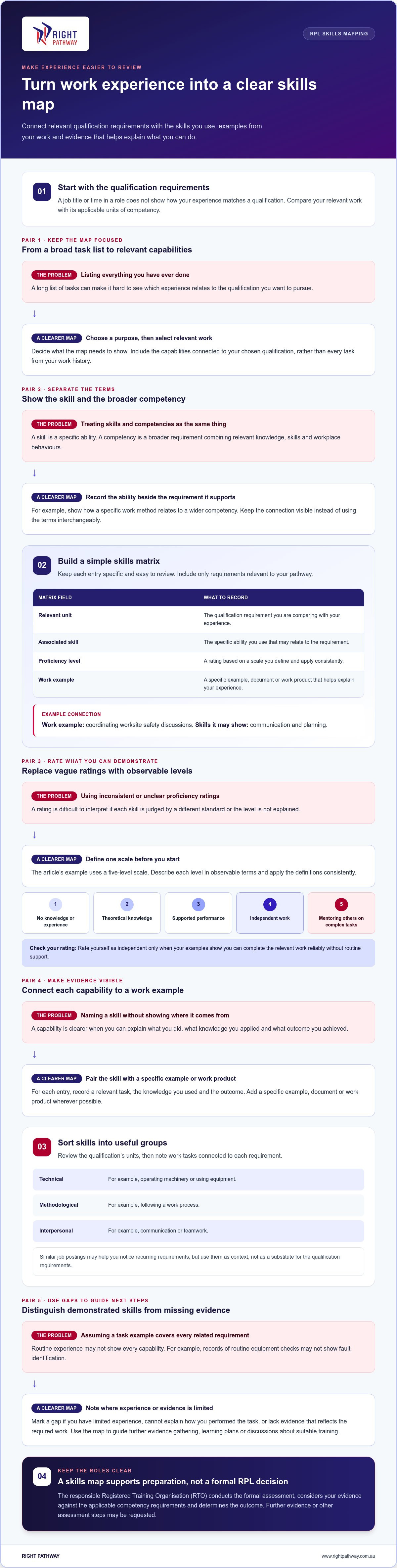
Knowing your job inside out isn’t the same as showing how your experience matches a qualification. To understand how to map your skills to a qualification for Recognition of Prior Learning (RPL), compare your work experience with the qualification’s units of competency, then identify relevant skills and evidence that show what you can do. A useful skills map makes those connections clear without assuming that experience alone is enough.
You may already have substantial practical experience, but deciding what to include can feel less straightforward. To learn how to map your skills to a qualification, first define the purpose of your map. Then focus on skills that relate to your chosen qualification, rather than listing every task you’ve ever done.
This article explains how to identify relevant technical and workplace skills, assess your proficiency honestly, and connect each skill to examples from your work. You’ll also learn how to organise evidence so the links between your experience and the qualification requirements are clear. The responsible Registered Training Organisation (RTO) conducts the formal RPL assessment and considers your evidence against the applicable competency requirements.
Key Takeaways
- Set a clear purpose for your skills map so it stays focused on the qualification you want to pursue.
- Compare relevant skills with qualification requirements and support each match with examples from your work.
- Use a simple matrix to organise skills and describe your proficiency accurately.
- Separate preliminary eligibility and evidence guidance from the formal assessment completed by the responsible RTO.
What is skills mapping?
Skills mapping records the abilities you use and compares them with the requirements of a role, task or qualification. For RPL, it helps you organise your existing knowledge and experience against relevant competencies, rather than relying on your job title or time in a role alone.
- Set a practical purpose. Decide what the map needs to show: for example, whether your maintenance experience aligns with the skills required for a trade qualification. A clear purpose keeps the mapping focused on relevant capabilities. It can also show an employer where talent is ready for development, support more informed hiring and highlight skills that are underused.
- Record evidence of existing skills. List tasks you’ve completed, the knowledge you applied and the outcomes you achieved. An employee who has coordinated worksite safety discussions, for instance, may have evidence of communication and planning skills as well as technical experience. Connect each ability to a specific example, document or work product wherever possible.
- Distinguish skills from competencies. A skill is a specific ability, such as using equipment or following a process. Competencies are broader requirements that combine relevant knowledge, skills and workplace behaviours. A competency framework describes those expectations, while a skills map records your capabilities and proficiency against them. This comparison helps you spot strengths and areas requiring further evidence or development. You can explore the potential benefits of RPL as you consider how existing experience may relate to formal recognition.
- Use tools to organise and develop the map. A spreadsheet or skills-mapping software can group abilities, evidence and proficiency ratings in one place. For employee development, managers can use the map to identify training needs or opportunities to apply skills at work. RPL differs from study, which involves learning, and credit transfer, which recognises previously completed formal learning. RPL evaluates relevant skills and experience against competency requirements. Costs depend on the qualification and assessment needs; subsidies vary by program and eligibility. An unregistered support provider cannot make the formal RPL decision or issue a qualification. Confusing support with formal assessment can leave you with no recognised outcome, so establish who the responsible RTO is.
Skills matrices and proficiency levels
A matrix provides a practical way to compare your experience with qualification requirements. Keep each entry specific, consistent and easy to review.
-
Build a skills and competencies matrix
Set up columns for the relevant unit, the associated skill, your proficiency level and a work example. Keep skills distinct from competencies: record the specific ability alongside the broader requirement it supports. A work method, for instance, may relate to a wider competency. Show that connection rather than treating the terms as interchangeable. Include only requirements relevant to your pathway so the matrix stays useful and manageable.
-
Set proficiency levels for each skill
Choose one rating scale and define each level in observable terms before you begin. For example, a five-level scale could range from no knowledge or experience, through theoretical knowledge and supported performance, to independent work and mentoring others on complex tasks. Apply the definitions consistently. Rate yourself as independent only when your examples show you can complete the relevant work reliably without routine support.
-
Compare skills and qualification matrices
Use your skills map to connect your experience with the relevant qualification units. A qualification matrix lists those units; your map shows how your work examples may relate to them. To check whether an Australian qualification is nationally recognised, search its title or code on training.gov.au. Compare the applicable qualification and unit requirements with your mapped experience. Don’t rely on a similar title alone.
RPL assessment timeframes vary according to the evidence you provide, the units being assessed and any further steps the RTO requests, such as a practical demonstration or gap training. The RTO manages the formal process and determines the assessment outcome.
Identifying relevant technical, methodological and soft skills
Start with the work and tasks connected to your target qualification. Then separate the skills you use from the evidence that can demonstrate them.
-
Identify relevant types of skills
Review the qualification’s units and note the tasks you’ve performed that relate to each requirement. Include technical skills, such as operating machinery; methodological skills, such as following a work process; and interpersonal skills, such as communication or teamwork. A tradesperson might map equipment checks alongside problem-solving and explaining hazards to colleagues. Job postings for similar roles can help you spot recurring requirements, but use them as context, not as a substitute for the qualification requirements.
For leadership-related competencies, note examples of coordinating work, supporting colleagues or making decisions. Focus on skills you can explain and demonstrate through your work.
-
Identify skill gaps and plan actions
Compare each requirement with your examples and evidence. Note a gap if you have limited experience, can’t explain how you performed the task or lack evidence that reflects the required work. Skills mapping can guide your learning plans, further evidence gathering or discussions about suitable training. For example, if your records show routine equipment checks but not fault identification, record that distinction instead of overstating your experience.
In a workplace, a manager may use identified gaps to inform training or hiring decisions. For your own map, ask a supervisor or colleague who has observed your work to check that your examples are accurate.
-
Gather evidence of skills
For each relevant requirement, gather authentic, current and relevant evidence showing what you did and how you did it. Depending on the task, this could include work records, project documents, photographs of completed work or an appropriate supervisor account. Label each item with the task it supports, and protect private or confidential information.
RPL assessors at the responsible RTO evaluate evidence against the applicable units of competency. There is no universal evidence list for every qualification. The RTO may request more evidence, a competency conversation or a practical demonstration. An evidence-readiness review can help you organise your material before formal assessment, but the RTO decides whether it meets the requirements.
Defining the purpose of a skills map
- Define the decision your map needs to support. For an RPL pathway, use your map to organise preparation around the relevant qualification requirements. Keep the purpose specific, such as clarifying which parts of your work history you want to discuss. Career planning and succession planning call for different maps, so avoid combining those purposes in one document.
- Set the scope before listing skills. Identify the qualification or work area you’re mapping, then use its requirements as your framework. For example, if you’ve worked across several construction tasks, focus on those relevant to your chosen qualification instead of recording every duty. This keeps the map focused and its purpose clear to anyone reviewing it.
- Choose how you’ll use the result. Decide whether the map is for your own preparation, a discussion with an RTO or an organisation’s workforce planning. For RPL preparation, arrange the information so you can readily discuss the experiences you consider relevant. An employer mapping skills for succession planning may instead use a visual overview to identify development needs across roles. Keep these uses distinct.
- Set a review point and update the map. Revisit it when your duties change, you complete training or your intended pathway shifts. An organisation can review its workforce map as roles change; you can revise your personal map before an RPL discussion. Use consistent labels to show what has changed, and remove entries that no longer serve the map’s purpose.
Right Pathway: RPL support and administrative facilitation
Right Pathway helps you organise the next steps after mapping your skills to an RPL pathway. Support includes a free initial eligibility assessment, preliminary guidance on how your experience may relate to a qualification, and a preliminary review of your evidence readiness.
This support can help if you’re unsure which work examples to gather or how to organise your documents. Right Pathway provides evidence preparation guidance and administrative facilitation. The responsible RTO handles formal enrolment, competency assessment and qualification decisions, evaluating your skills, knowledge and evidence against the applicable units of competency.
Use preliminary guidance to clarify a possible pathway and prepare for the RTO process. It is not a formal assessment and does not guarantee a qualification outcome.
For help with your next steps, contact Right Pathway.
Put your skills map to work
Turn your map into a clear account of your experience. Select examples that show your responsibilities, the work context and how you applied your knowledge. This gives you a practical basis for discussing a potential pathway and identifying where you may need further evidence.
Knowing how to map your skills to a qualification gives you a structured starting point for that discussion. Keep your notes specific, organise supporting documents so each is easy to find, and prepare to explain your contribution. The responsible RTO uses its formal assessment process to decide whether your evidence meets the relevant competency requirements.
If you’d like to discuss your experience and possible next steps, Right Pathway can provide preliminary guidance through a free initial eligibility assessment. This is not a formal RPL assessment and does not determine the RTO’s decision.
Take the process one step at a time. A well-organised map can help you approach your next conversation with greater clarity and confidence.
Frequently Asked Questions
Who assesses skills?
For an RPL application, the responsible Registered Training Organisation (RTO) appoints the assessor who reviews your competence. A supervisor can describe your duties or confirm how you work, but their input is supporting evidence, not the formal decision. When preparing examples with a manager, focus on work they directly observed, such as a specific task, your role and the result.
What is a skills map?
A skills map is a working record that can help you prepare for a conversation about your capabilities. It helps you find examples across different jobs, projects or training, rather than relying on memory during an application. Note where and when you used each skill, who can verify it and which records could help explain the work.
How can I assess competencies objectively?
Apply the same evidence test to each competency: can you describe the task, explain your own contribution and point to evidence supporting your account? Compare your self-rating with dated work records or feedback from someone who observed the task. If the accounts differ, find out why before finalising your notes. This helps distinguish confidence in a skill from evidence of consistent performance.
How do I map my skills and work experience to an Australian qualification?
Use the qualification’s current unit descriptions as your reference. Then create a crosswalk showing which work examples relate directly, partly or not yet clearly to each requirement. Check the qualification title and status before relying on an old document or course name. Keep overseas job titles in their original form, then explain the duties and work context in plain English for review.
What is Recognition of Prior Learning (RPL) in Australia?
RPL is a formal process for considering relevant learning gained outside a qualification course against its requirements. That learning may come from employment, independent practice or previous training. RPL considers competency for a qualification; it is not a migration skills assessment, occupational licence or professional registration. Those are separate processes with different purposes and decision-makers.
How does the RPL assessment process work with an Australian RTO?
The RTO explains its evidence requirements and assessment arrangements, then reviews the material you submit. Be ready to clarify dates, responsibilities or the context of a work sample, especially if a document does not show your individual contribution. The assessor may request further evidence or ask you to demonstrate a task. The RTO communicates the outcome and handles any resulting qualification or statement of attainment.
Article by
Right Pathway Team
Right Pathway supports experienced workers, tradespeople and skilled migrants with preliminary RPL eligibility guidance, evidence preparation and qualification pathway navigation.
Right Pathway is not a Registered Training Organisation and does not conduct formal competency assessments or issue qualifications. Formal enrolment, competency assessment and qualification issuance are completed by the responsible Registered Training Organisation.
Start with a free initial RPL eligibility assessment at https://www.rightpathway.com.au/eligibility-check
Disclaimer
Right Pathway is a facilitation and support service only. We are not a Registered Training Organisation (RTO), do not conduct formal RPL assessments and do not issue qualifications. All formal RPL assessments and certifications are completed by partner RTOs regulated by ASQA. Eligibility and qualification outcomes depend on each applicant’s evidence, experience and the RTO’s assessment decision.


