

For Australian RPL, what counts as evidence for prior learning is material that shows your skills and knowledge match the requirements of the qualification. This can include certificates and transcripts, alongside workplace records, references and examples of your work. Evidence needs to be relevant, authentic, current and sufficient for the competencies being assessed.
It’s understandable to assume a qualification certificate or long work history tells the whole story. In practice, documents support your claim only when they show what you can do and how your experience relates to the required learning outcomes.
This article explains what prior learning recognition can cover, which records may support a claim and how existing skills and knowledge are assessed. You’ll also see how workplace evidence can help, what makes it useful and how assessors may ask you to demonstrate or clarify your competence.
Key Takeaways
- Match each piece of evidence to the specific skills or learning outcomes it is intended to demonstrate.
- Use formal study records alongside relevant workplace documents to build a clearer picture of your experience.
- Consider whether your evidence is authentic, current and sufficient, not just whether you have a large volume of documents.
- Prepare to explain or demonstrate your skills, as documents may be only one part of an RPL assessment.
How will evidence be assessed?
RPL assessment compares your evidence with the competencies required for a qualification. It focuses on what you can demonstrate, not simply how long you have worked.
Assessment of learning starting points
Tests and past assessments can show what you already know and where misunderstandings remain. In RPL, teachers’ comments, marked work and assessment records may help explain how a skill developed, while current evidence shows what you can do now. For example, an earlier task may reveal a gap, while a later work sample can show how you developed that skill.
An assessor may ask questions or use another assessment activity to clarify a gap. This can help distinguish a misunderstanding from a skill you have not yet demonstrated.
Evidence rules and verification
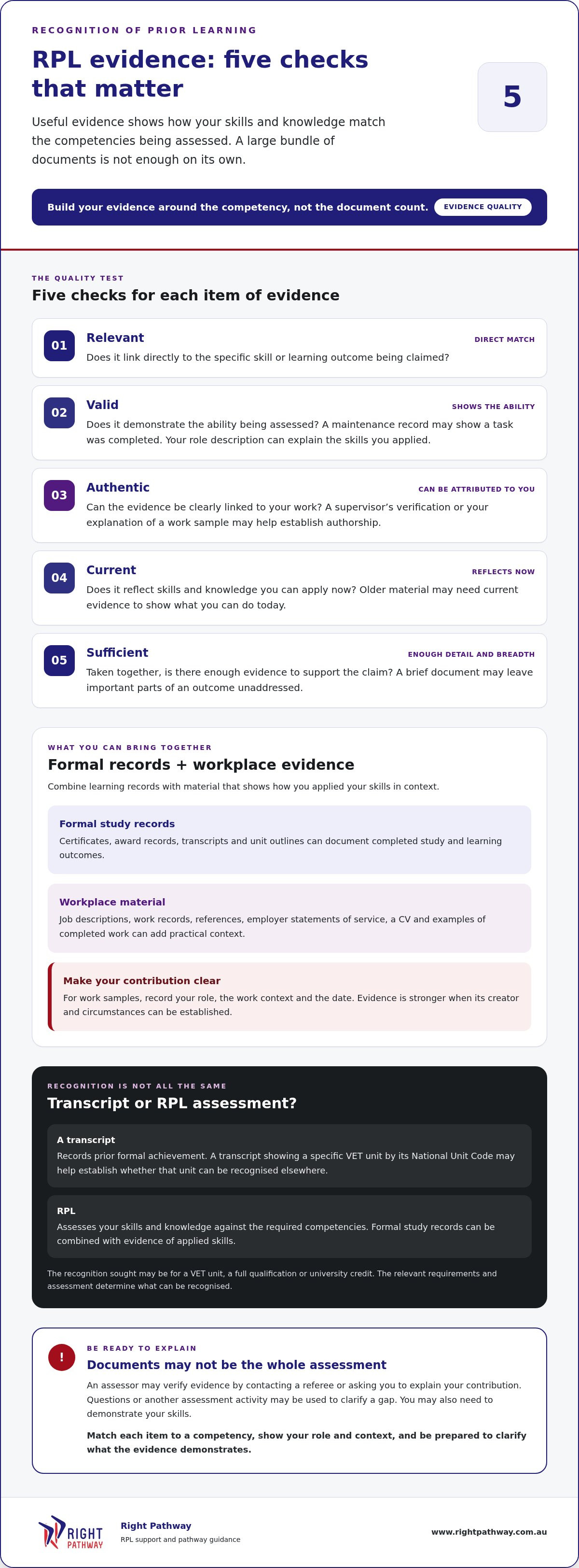
Rules of evidence guide whether material is relevant, authentic, current and sufficient to support an assessment decision. Evidence must relate to the competency and be clearly attributable to you. A work sample is stronger when its creator, context and date can be established.
An assessor may verify evidence by contacting a referee or asking the applicant to explain their contribution. In Western Australia, RPL assessments follow the assessment principles in Outcome Standard 1.4. These checks help establish whether the evidence supports the claimed competence.
RPL evidence requirements
For Australian VET, evidence needs to show the applicant’s skills and knowledge against the relevant units of competency. It may include work records, references, certificates or practical demonstrations, provided each item supports the claim. Read more about Australian RPL and how evidence fits the process.
RPL assessment fees vary by RTO and qualification. Processing time depends on the amount of evidence, verification needs and whether further assessment or gap training is required.
An application may fall short if its evidence is outdated, unrelated, difficult to verify or insufficient to support a competency. Reduce this risk by mapping each item to a specific skill, recording your role and the work context, and preparing to explain your contribution.
Formal evidence such as qualifications and transcripts
Formal education records can show what you studied and achieved. Their value depends on how clearly they relate to the skills being considered for recognition.
Qualifications and transcripts
A certificate, award record or transcript can document completed study and learning outcomes. Transcripts, unit outlines and award certificates help an assessor understand the content and level of your previous education.
Work samples and workplace records add practical context. Examples include job descriptions, meeting minutes, publications, employer statements of service and a CV outlining relevant work history. For early childhood roles, observations, conversations, work samples and records gathered over time may help show practice related to National Quality Standard responsibilities.
VET qualification recognition
Mutual recognition may apply when an official transcript records achievement of a specific VET unit identified by its National Unit Code. This can help establish whether a completed unit may be recognised elsewhere.
Recognition differs from RPL: a transcript records prior formal achievement, while RPL assesses skills and knowledge against required competencies. Keep the transcript and relevant unit information together to show the learning in context. The final decision depends on the qualification requirements and assessment.
Qualifications pathways and evidence
The Australian Qualifications Framework Qualifications Pathway Policy addresses decisions about credit into or towards an AQF qualification. Credit may be based on individual negotiation between a student and provider, or formal negotiation between providers.
For RPL, combine formal records with evidence that reflects applied skills. A trade worker might provide a transcript alongside job records and examples of completed work. In early childhood, dated observations or learning documentation can help explain the work represented by a sample. RTOs also use validation to check assessment quality, including RPL evidence. In Western Australia, Outcome Standard 1.5 addresses RPL examples in assessment validation schedules.
If you’re organising records and want to understand how they may support a pathway, a free initial eligibility assessment can help clarify potential next steps.
What does Credit and Recognition of Prior Learning encompass?
Recognition of prior learning considers knowledge and skills gained through work, study or other experience. The evidence must relate to the outcomes being claimed, whether for a VET unit, a full qualification or university credit.
Evidence quality criteria
Evidence quality is assessed through relevance, validity, authenticity, currency and sufficiency. These criteria help determine whether the material supports the learning or competence claimed.
Relevance links an item directly to an outcome. Validity considers whether it demonstrates the ability being assessed. For example, a maintenance record may show that a task was completed, while a description of your role explains the skills you applied. Together, these details help establish what counts as evidence for prior learning in your claim.
Authenticity means the evidence can be attributed to you. A supervisor’s verification or your explanation of a work sample may help establish authorship. Currency concerns whether the evidence reflects skills you can apply now. Sufficiency asks whether the evidence, taken together, provides enough detail and breadth to support an assessment decision. A brief document may leave important parts of an outcome unaddressed.
RPL and credit evidence contexts
The evidence you need depends on the recognition sought: a VET unit, full qualification and university credit each have different outcomes. Understanding this distinction helps you choose material that addresses the relevant assessment criteria.
For a VET unit, evidence should demonstrate the specific skills and knowledge described by that unit. A full qualification claim covers a broader range of competencies, so evidence may need to address different tasks and contexts. A job description can explain your responsibilities but may not show how you performed each task. The scope of your claim, not just the document type, determines which evidence is relevant.
University credit considers whether previous learning is equivalent to learning in a course or subject. Course outlines, transcripts and assessed work can help link that learning to the intended outcomes. In Australia, credit decisions rely on evidence and academic judgement about equivalence. Explain what you studied and how it relates to the course to make the basis of your claim clear.
Identifying students’ existing knowledge, understanding and skills
Assessment identifies what you already know and can do, then compares it with the relevant course or competency outcomes. In RPL, this helps distinguish skills demonstrated through experience from areas where further evidence or learning may be needed.
A structured review may consider work samples, previous assessment results, training records and explanations of workplace tasks. Records may show that you completed a procedure, while a practical demonstration or conversation can clarify your understanding and decision-making. This helps identify your current skills and any areas that need closer review.
Recognition of prior learning and credit can affect student progress through a course. In Australian higher education, Threshold Standards criterion 5.3 requires providers to monitor student progress and attrition cohort data. This supports ongoing review of learning outcomes and potential risks. Monitoring can help show whether a student is progressing appropriately after credit is granted, or needs additional learning support in a particular subject.
Australia’s National Code of Practice for Providers of Education and Training to Overseas Students 2018 requires providers to have a documented policy and process for RPL and granting credit. Section 2.4 requires a written record when credit is granted or prior learning is recognised. If credit shortens a course, section 2.5 requires the provider to inform the student and issue confirmation of enrolment for the reduced duration.
Providers must retain overseas student credit or RPL records for at least two years after the student ceases to be an accepted student. Clear records explain the credit granted and its effect on course progress. If you have overseas experience, a preliminary eligibility discussion can help organise your background for consideration. The formal RTO process is separate, and the provider assesses your claim against the course requirements.
Right Pathway: RPL support and administrative facilitation
Right Pathway helps you organise your RPL pathway with preliminary eligibility guidance, evidence preparation and administrative support. This support can be useful when you have relevant experience but need help connecting your records and work examples to a suitable qualification pathway.
A preliminary evidence-readiness review can help you identify which documents to organise and where further evidence may be useful. Right Pathway also offers a preliminary skills and experience eligibility consultation to help you understand possible next steps before formal assessment.
The responsible Registered Training Organisation handles formal enrolment, competency assessment and qualification decisions. Right Pathway does not conduct formal assessments or issue qualifications. The RTO considers your evidence against the relevant competency requirements and may ask for more information or a demonstration.
To discuss your experience and possible pathway, complete a free initial RPL eligibility assessment with Right Pathway.
Turn your experience into a clear next step
Knowing what counts as evidence for prior learning is a starting point. Next, organise your experience so its relevance to a potential qualification pathway is clear. A concise record of your roles, responsibilities and learning can help you prepare for a focused discussion about your options.
Right Pathway provides RPL support and administrative facilitation, including a preliminary skills and experience eligibility consultation and a free initial RPL eligibility assessment. These services provide preliminary guidance, not formal competency assessment. The responsible Registered Training Organisation makes formal assessment decisions and issues any qualification.
Use the free eligibility check to share your background and explore possible next steps. The information you provide can guide a discussion about your experience and evidence readiness, while the formal RTO process determines how your claim is assessed.
Take the next step at a pace that suits you, with a clearer way to prepare your experience for consideration.
Frequently Asked Questions
How does RPL work?
RPL begins by identifying the qualification or units relevant to your work goals. The RTO then explains its process and assessment activities. Depending on your claim, you may discuss your experience with an assessor, complete a practical task or provide further material. The outcome records which requirements your evidence supports and whether any learning remains.
What are auditors looking for?
Auditors examine an RTO’s systems and records; they do not decide whether an individual deserves recognition. They may review how assessment decisions are recorded, whether staff follow provider procedures and whether assessment practices are checked for quality. Keep copies of your submitted material and written assessment outcome so you can refer back to the process and decision.
What do the frameworks say about evidence of learning?
Australian VET qualifications use units of competency to describe workplace performance, while higher education courses set learning outcomes for subjects or programs. These frameworks provide a basis for comparing previous learning with the intended outcome. They do not make unrelated experience equivalent by itself. Before gathering evidence, identify the specific outcome you want considered.
What will you need to acquire your RPL?
Prepare a clear record of your employment and learning history, then follow the RTO’s instructions for forms and supporting documents. If evidence comes from different employers, label each item with its source and relevant role. Keep original files where possible and retain copies of everything you submit. This makes it easier to clarify a document or provide another example if the RTO asks.
Who qualifies for RPL?
There is no universal minimum period of experience for RPL. Suitability depends on how closely your experience and evidence match the qualification requirements. Extensive experience in one area may still leave gaps in other required skills. Compare your recent responsibilities with the qualification outcomes, then identify where you can provide clear examples and where further learning may be needed.
Can informal learning, work experience, volunteering or hobbies count as prior learning in Australia?
Learning from hobbies or volunteering may be considered when it relates to the outcomes being assessed. For example, repairing and maintaining equipment as a hobby could demonstrate practical skills if you can explain the tasks and show your work. Volunteering may also develop relevant capabilities. The experience alone does not establish recognition; what matters is how it relates to the qualification requirements.

Article by
Right Pathway Team
Right Pathway supports experienced workers, tradespeople and skilled migrants with preliminary RPL eligibility guidance, evidence preparation and qualification pathway navigation.
Right Pathway is not a Registered Training Organisation and does not conduct formal competency assessments or issue qualifications. Formal enrolment, competency assessment and qualification issuance are completed by the responsible Registered Training Organisation.
Start with a free initial RPL eligibility assessment at https://www.rightpathway.com.au/eligibility-check
Disclaimer
Right Pathway is a facilitation and support service only. We are not a Registered Training Organisation (RTO), do not conduct formal RPL assessments and do not issue qualifications. All formal RPL assessments and certifications are completed by partner RTOs regulated by ASQA. Eligibility and qualification outcomes depend on each applicant’s evidence, experience and the RTO’s assessment decision.


