

Your experience can count towards a carpentry qualification, but it doesn’t automatically earn you one. You may get qualified as a carpenter based on experience through recognition of prior learning (RPL) towards the CPC30220 Certificate III in Carpentry. A Registered Training Organisation (RTO) assesses your evidence against the qualification’s 34 units of competency and decides what, if anything, you still need to demonstrate.
If you’ve built your skills on worksites over the years, it makes sense to ask whether you need to start from the beginning. RPL gives an RTO a way to assess relevant skills and knowledge you’ve already gained, including through workplace experience.
This guide explains how an RPL pathway works, what evidence can help demonstrate your carpentry skills, and how the RTO’s assessment determines the outcome. It also covers what may happen if your evidence doesn’t address every required competency, so you can understand the steps before proceeding.
Key Takeaways
- Identify whether the Certificate III in Carpentry matches your work history and the skills you want formally recognised.
- Gather current, relevant evidence of your carpentry work, then map it to the qualification’s competency requirements.
- Understand that the RTO reviews your evidence and determines whether further assessment or gap training is needed.
- Check that an RTO is registered and offers the carpentry qualification and RPL pathway relevant to your circumstances.
Step 1: What Qualifications Do You Need to Become a Carpenter?
CPC30220 Certificate III in Carpentry is the Australian trade qualification for carpenters. Before proceeding, check the exact title, code and status on training.gov.au. An RPL support service and an RTO have different roles: the responsible RTO conducts the formal assessment and issues any qualification.
-
Identify the Certificate III in Carpentry
Check that the pathway relates to CPC30220 Certificate III in Carpentry, rather than a general construction certificate. The qualification carries the same AQF accreditation as the equivalent qualification earned through an apprenticeship or full course.
When comparing qualification information, use the exact qualification code and title. Carpentry RPL support services can help organise evidence, but the RTO is responsible for formal assessment and qualification decisions.
-
Check the CPC30220 Requirements
Review the qualification’s 34 units of competency, comprising 27 core units and 7 elective units. These units set the skills and knowledge standard for assessment. Compare your work experience with the requirements, rather than relying only on years worked or a job title.
The qualification includes CPCCCM3001, covering operation of elevated work platforms up to 11 metres. It also states that general construction induction training is required for carpentry work. Check training.gov.au for the qualification’s current listing and details before choosing a pathway.
- Make a record of the carpentry tasks you’ve completed and the projects where you did them. Describe your responsibilities in areas such as framing, fitting doors or roof work. Link each example to specific skills instead of assuming one project demonstrates every competency.
- Consider your starting point and learning needs. Completing Year 10 or Year 12 can help prepare you for carpentry, but neither is mandatory. If you already have trade experience, organise examples of your work before deciding whether RPL or a course better suits your pathway.
RTO assessment and qualification decisions
If your evidence doesn’t cover every Certificate III requirement, an RTO may request more evidence, practical demonstration or gap training. According to ASQA, additional training or support may help you complete remaining requirements.
-
Complete the RTO Assessment
Prepare evidence that enables the RTO to assess your skills against the qualification’s units. The RTO reviews your experience and supporting material, then decides whether you’ve demonstrated the required competencies. RPL is a formal assessment conducted by an authorised RTO.
Give each example context. Rather than submitting timber-work photos without explanation, describe your role on the project, the task, your method and how the finished work met project requirements. Employer references and work records can help clarify what you personally completed.
-
Review the Qualification Decision and Options
Ask the RTO which requirements your evidence addresses and where further demonstration may be needed. The decision is based on the qualification’s competencies, not simply the time you’ve worked in the trade. Keep a record of the outcome and any next steps.
If some skills remain unverified, the RTO may identify further evidence, a practical demonstration or gap training as a next step. Any additional learning depends on the assessment findings. The focus is on addressing the specific competencies that have not yet been demonstrated.
- Plan around the gaps the RTO identifies. If you need to demonstrate a practical skill, clarify the task and assessment requirements. If evidence is missing, look for a relevant work record, supervisor reference or project example that addresses the requirement.
Keep copies of your submitted evidence and the RTO’s feedback. This helps you track requirements and avoid resending material that is unclear or incomplete.
- Use preliminary guidance to organise your records before formal assessment. A free initial eligibility assessment can help you consider whether your background and available evidence may suit an RPL pathway. The RTO remains responsible for formal assessment and qualification decisions.
Once you understand the RTO’s findings, follow its requirements for any competencies still to be demonstrated. Focus on those skills rather than repeating work you’ve already evidenced.
Recognition of prior learning for experienced carpenters
Recognition of Prior Learning (RPL) allows an RTO to assess skills and knowledge gained through carpentry work, not just formal study. Prepare evidence that shows what you can do and how your experience relates to the qualification.
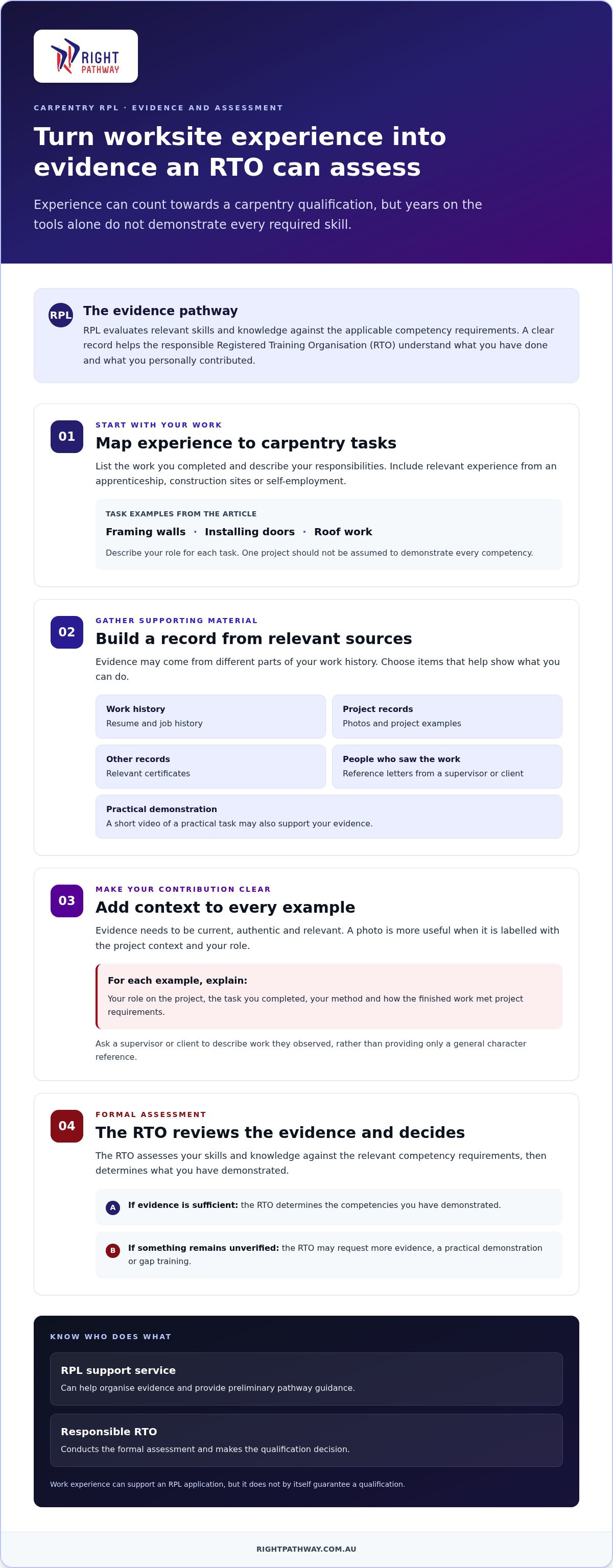
- Before beginning an RPL application, map your experience to carpentry tasks. Include work completed during an apprenticeship, on construction sites or through self-employment. Note whether you framed walls, installed doors or completed roof work, and describe your responsibilities for each task.
RPL assesses relevant skills and knowledge against a qualification’s competencies. Your work history can support your application, but time on the tools alone doesn’t demonstrate every required skill.
- Gather evidence from different sources to show how you work. A resume, job history, project photos, reference letters and relevant certificates can help build a clear record. A short video demonstrating a practical task may also support your evidence.
Choose material that is current, authentic and relevant. Label each photo with the project context and your role. Ask a supervisor or client to describe the work they observed, rather than providing a general character reference.
- Include relevant work completed outside standard employment. Self-employed carpenters, contractors and people working in a family business can use evidence from those settings. For example, combine invoices or job records with project images and references explaining your contribution.
Keep personal and business records organised, and connect each item to a specific task or skill. This helps the RTO understand the scope of your experience and assess your evidence.
- Be prepared to address any gaps identified by the RTO. If your RPL evidence does not demonstrate all the required competencies, further training or support may help you complete the remaining units.
Ask which competencies still need to be demonstrated, then follow the RTO’s guidance on further documents, a practical demonstration or targeted learning. RPL is an evidence-based assessment, not a shortcut, and it does not mean an apprenticeship or course is unnecessary for every applicant.
Which Australian RTOs offer carpentry RPL, and how can I check they are registered?
Carpentry RPL is formally assessed by an RTO authorised to deliver the relevant qualification. You can use the national training register to review the provider and qualification details.
- Search the register using the provider’s legal name or RTO identifier. Match the entry to the organisation responsible for your assessment, rather than relying on a similar trading name. Review its registration information and qualification details.
An RPL support service can help you prepare your application and organise evidence. The RTO conducts the formal competency assessment and makes the qualification decision.
- Find CPC30220 Certificate III in Carpentry on training.gov.au. Compare its exact code and title with the RTO’s listed scope and course information. A provider’s general construction services alone don’t show that it can deliver this qualification.
Keep the RTO’s name and qualification details together in your notes. This gives you a clear reference when a website uses abbreviated wording such as “carpentry RPL”.
- Review the RTO’s explanation of its RPL process. Look for details on how it assesses skills against units, what evidence it considers, and whether practical demonstrations or further training may be involved.
For example, distinguish an RTO that assesses CPC30220 from an organisation that assists with evidence preparation or referrals. Formal assessment and qualification issuance are the responsibility of the RTO.
- Compare the RTO’s qualification requirements with your work background and available evidence. Look for a clear explanation of how competency gaps are handled. Work history alone does not guarantee a qualification.
Right Pathway: RPL support and administrative facilitation
Right Pathway helps experienced carpenters organise an RPL pathway through preliminary guidance, evidence preparation and administrative support. This can be useful if you’re unsure how your work history relates to carpentry competencies or how to organise evidence for an RTO.
A preliminary skills and experience consultation can help you understand possible next steps, while an evidence-readiness review can help you organise relevant information. This is guidance, not formal competency assessment. The responsible RTO assesses your skills, decides the RPL outcome and issues any qualification.
To discuss your experience and possible pathway, complete Right Pathway’s free initial RPL eligibility assessment.
Prepare your next move with confidence
Start by noting the carpentry work you want recognised, the evidence you can access and your questions about the qualification pathway. This preparation can make an initial discussion more focused and help you organise information for the RTO.
If you want to get qualified as a carpenter based on experience, Right Pathway offers RPL support and administrative facilitation, including a free initial eligibility assessment and preliminary skills and experience consultation. We help you consider a potential pathway and prepare evidence; the RTO conducts the formal assessment and decides the outcome.
When you’re ready, discuss your background and possible pathway with Right Pathway. A clear starting point can help you set realistic expectations and plan what evidence to organise.
Your experience is a useful starting point. Build on it with a clear next step.
Frequently Asked Questions
Can I get qualified without completing an apprenticeship?
Yes, an apprenticeship isn’t the only pathway to a carpentry qualification. An RTO can assess relevant work experience through RPL. For example, a self-employed carpenter might use project records to show their responsibilities and completed work. The RTO decides whether the evidence demonstrates the required competencies or whether further assessment or training is needed.
How long does the RPL process take?
Carpentry RPL may take from a few weeks to a couple of months. The timeframe depends on how quickly you provide suitable evidence and how the RTO conducts its assessment. For example, missing project details may lead to requests for clarification. Responding promptly to requests for documents or demonstrations can help keep the process moving.
What could I provide as evidence of my work experience?
Provide material that shows both the work and your personal contribution. For example, pair site photographs with a supervisor’s reference describing your role and the completed task. A job history, certificates or self-employment records can add context. Keep project dates, descriptions and responsibilities consistent so the RTO can understand and verify your experience.
What if I trained as a carpenter overseas?
Overseas training and work experience may be relevant to an Australian RPL application. Gather qualification records, employment references and examples of carpentry work, with translations where needed. Explain the tasks you performed and the standards involved. The RTO assesses your evidence against the Australian qualification requirements. RPL is separate from a migration skills assessment and does not determine a visa outcome.
How can experienced carpenters get a qualification in Australia through Recognition of Prior Learning (RPL)?
Organise your work history and supporting evidence, then submit them through the RTO’s RPL process. The RTO assesses the evidence against the relevant competencies and may request further information or a practical demonstration. If you want to get qualified as a carpenter based on experience, document your own role in each project rather than relying only on an employer’s project list.
Which Australian Certificate III qualification is required for carpentry, and what is its course code?
The carpentry qualification to check is CPC30220 Certificate III in Carpentry. Qualification listings can change, so confirm the current title and status on training.gov.au before choosing a course or RPL pathway. Also check that the RTO’s registered scope includes the qualification. This helps you distinguish the carpentry trade pathway from broader construction training.

Article by
Right Pathway Team
Right Pathway supports experienced workers, tradespeople and skilled migrants with preliminary RPL eligibility guidance, evidence preparation and qualification pathway navigation.
Right Pathway is not a Registered Training Organisation and does not conduct formal competency assessments or issue qualifications. Formal enrolment, competency assessment and qualification issuance are completed by the responsible Registered Training Organisation.
Start with a free initial RPL eligibility assessment at https://www.rightpathway.com.au/eligibility-check
Disclaimer
Right Pathway is a facilitation and support service only. We are not a Registered Training Organisation (RTO), do not conduct formal RPL assessments and do not issue qualifications. All formal RPL assessments and certifications are completed by partner RTOs regulated by ASQA. Eligibility and qualification outcomes depend on each applicant’s evidence, experience and the RTO’s assessment decision.


