

A practical example of a third-party report for RPL can show how workplace experience is presented as supporting evidence. The report gives the RTO information to consider alongside other material, while the RTO remains responsible for assessing evidence against the relevant requirements. Seeing how the information fits together can help you prepare a clearer application.
Knowing what makes a useful third party report for RPL can be difficult, especially when your work experience spans different roles, employers or tasks. A broad endorsement may not explain what the referee actually observed, while an overly technical report can obscure the details of your work. The goal is a clear, relevant account grounded in the referee’s direct knowledge.
This guide explains how supervisor reports support RPL, what referee and work-history details to include, and how to organise evidence so an assessor can follow it. It also covers how requirements may differ between RTOs and qualifications, why dates and context matter, and how to avoid common reporting problems. Use these points to prepare a report that accurately reflects your workplace experience and supports a well-organised application.
Key Takeaways
- Use a supervisor’s report to describe specific work they personally observed, including the tasks and conditions involved.
- Include the referee’s role, organisation, work contact details, relationship to you and observation period so their account has clear context.
- Explain when the work took place and whether your skills remain current, rather than relying on dates alone to show relevance.
- Connect each example to the relevant competency requirements and organise it alongside other evidence for the RTO’s assessment.
Third-party reports from supervisors as RPL evidence
A supervisor’s report can support RPL by describing work relevant to the target qualification. The RTO considers it alongside other evidence and makes the formal assessment decision.
Information in a third-party report
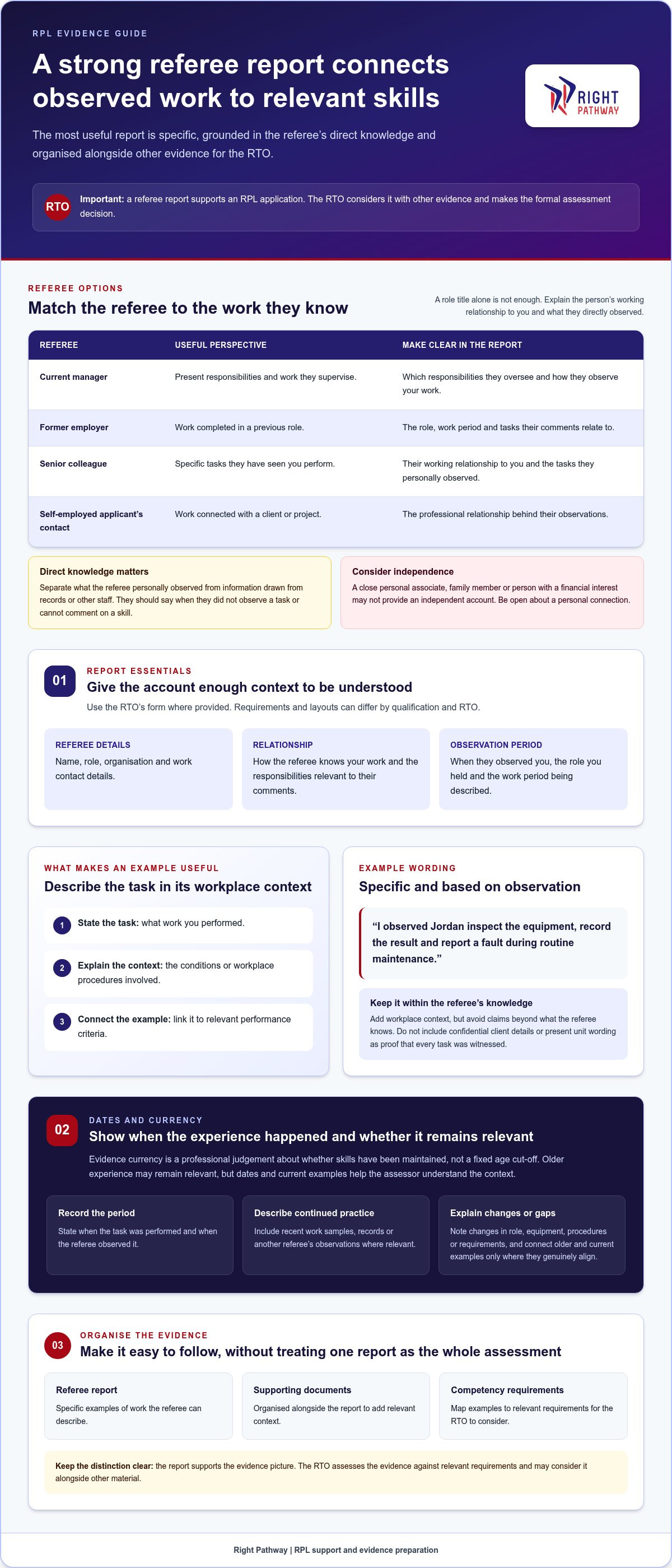
The report should explain how the referee knows your work, what they observed and which tasks you performed. Include the referee’s name, role, organisation, work contact details and the period they observed you.
Requirements vary by qualification and RTO because the relevant competencies and forms differ. Use the RTO’s form and answer its questions with specific examples from the workplace.
Referee evidence and competency examples
Useful referee evidence describes actual performance in context. For example, a supervisor might explain how you prepared a job, followed workplace procedures and checked the completed work.
Link each example to relevant performance criteria rather than relying on general praise. The referee should say if they did not observe a task or cannot comment on a skill. Their report supports the assessment but does not replace it.
Completed report examples
A report might state: “I observed Jordan inspect the equipment, record the result and report a fault during routine maintenance.” The referee should explain the workplace context and avoid claims beyond their direct knowledge.
Use the RTO’s template if one is provided. Australian RTOs and training packages do not use a single universal report format, so questions and layouts can differ. Avoid copying unit wording as if the referee witnessed every task, omitting context or including confidential client details.
Organise report examples with supporting documents, then map them to the relevant competency requirements. For an overview of how workplace evidence fits the pathway, RPL pathway information provides useful context.
Referee identity and working relationship
The referee’s position helps the RTO understand the basis for their comments. A supervisor who allocates work may describe daily performance, while a technical lead may have observed specialist tasks but not routine duties. Explain how the referee’s responsibilities relate to your work, rather than leaving the assessor to infer this from a job title.
Choose a referee whose professional knowledge matches the experience you want recognised. A former manager can describe work you completed in a past role, while a current supervisor may be better placed to discuss your present responsibilities. The report should distinguish direct observation from information based on records or other staff, especially if the referee did not oversee every task.
Independence matters too. A close personal associate, family member or person with a financial interest in the outcome may not provide an independent account. If your only available referee has a personal connection, explain it openly and discuss with the RTO what other workplace evidence could support your application.
- Current manager: clarify which responsibilities they supervise and how they observe your work.
- Former employer: identify the role and work period their comments relate to.
- Senior colleague: explain their working relationship and the specific tasks they have seen you perform.
- Self-employed applicant: identify the professional relationship behind a client or project contact’s observations.
For example, a site manager may oversee project scheduling without personally witnessing every technical task. Their report should focus on work they can describe from direct knowledge. Another referee or separate records may provide context for other responsibilities. This avoids treating one person as an all-purpose witness and helps the RTO assess each account in light of its source.
If you’re organising work history and referee details for a potential pathway, a free initial eligibility assessment can help you consider possible next steps.
Dates and recency of experience
Dates help an assessor understand when you performed a task and whether the experience reflects current competency. In Australian RPL, evidence currency is a professional judgement about whether skills have been maintained, not a fixed age cutoff. Evidence older than five years typically needs additional justification or supplementary current examples.
Make the work period clear. A referee could identify when they observed you, the role you held and whether you still perform similar tasks. For example, an electrician’s former supervisor might describe installation work from an earlier role, while recent job records show current practice. These dates help the assessor compare both sources with the training product’s criteria.
Older experience can remain relevant, but the report should explain what has happened since. If equipment, workplace procedures or requirements have changed, ask the referee to identify the version they observed. Add current examples showing how you perform comparable tasks now. This helps distinguish transferable knowledge from skills that may need further evidence.
- Record the period: state when the referee observed the work and when the task was performed.
- Describe continued practice: include recent work samples, records or another referee’s observations where relevant.
- Explain a gap: note whether you changed roles, stopped performing a task or moved to different equipment.
- Connect the evidence: map older and current examples to the same relevant competency criteria where they genuinely align.
For instance, a hospitality worker may have older evidence of food preparation alongside recent records showing current duties and procedures. The assessor considers whether the combined evidence demonstrates maintained competency for the relevant recognition pathway. A report listing only past job titles cannot show whether you still perform the tasks or how workplace practice has evolved.
Use dates consistently across referee reports, employment records and work samples. If dates differ, explain why, such as a project finishing after a role’s formal end date. A clear timeline helps the assessor understand the evidence and evaluate its currency.
Demonstrating RPL compliance
A well-organised RPL application links evidence of skills and learning to the relevant training product. In Australia, the RTO conducts the formal RPL assessment and records how the evidence supports each recognition decision.
Standard 1.4 of the Outcome Standards for NVR Registered Training Organisations requires assessment to include practical application components. For an RPL application, a supervisor’s report can describe workplace performance, while work samples, records or a practical demonstration may help show how skills are applied.
Organise the evidence so the assessor can trace each claim to its supporting material. For example, map a supervisor’s account of equipment checks to the relevant performance criteria, then identify related work records or knowledge evidence. Use the training package’s exact terminology, but do not claim that one report proves every requirement.
- Validity: the evidence relates to the competency being assessed, such as a job record showing the task in question.
- Sufficiency: the combined material covers the required skills and knowledge, not just one observed task.
- Authenticity: the evidence is the applicant’s work, supported by a referee who can explain their direct knowledge.
- Currency: the material helps show whether the competency remains current for the assessment.
Standard 1.6(2)(b) requires recognition decisions to be based on evidence of a student’s prior skills, learning and experience, following the organisation’s assessment system. Under Standard 1.6(2)(c), decisions must be documented and made fairly, transparently and consistently, while maintaining the training product’s integrity. These requirements place the final judgement with the RTO, not the referee.
For self-employed applicants, a client reference may not cover every competency or provide independent confirmation. Ask the RTO which evidence it accepts, then organise reports, work records and examples against the relevant criteria. The RTO may also request a conversation or practical demonstration to address evidence gaps.
Right Pathway: RPL support and administrative facilitation
Right Pathway helps experienced workers organise RPL evidence and explore qualification pathways that may suit their skills and work history. If you’re unsure how a supervisor’s report supports your application, our preliminary evidence-readiness review can help you relate your documents to the relevant competency requirements.
Right Pathway also offers a free initial RPL eligibility check and preliminary consultation about your skills and experience. These provide guidance on potential next steps, not a formal RPL assessment. The responsible Registered Training Organisation reviews the evidence, conducts any required competency assessment and makes formal recognition decisions.
Consider support if you have workplace experience but need help organising reports, work records and other evidence for an RTO. Contact Right Pathway to discuss evidence preparation and qualification pathway guidance.
Prepare your next RPL step
Use the report as a starting point for organising your evidence, not as a substitute for explaining your experience. Before applying, identify the work examples you want recognised and the records that could put them in context. A third party report for RPL, for example, can connect a referee’s observations with the evidence you plan to present.
Think about what you want the RPL pathway to achieve, then gather documents that best represent your skills and work history. A clear evidence plan gives you a practical basis for discussing your options and identifying what you may still need to prepare.
Right Pathway can help you explore potential next steps through RPL support and administrative facilitation. The responsible RTO conducts the formal assessment and makes recognition decisions.
Your experience deserves a clear presentation. When you’re ready, take the next step and explore your pathway with Right Pathway.
Frequently Asked Questions
How does RPL work?
Recognition of Prior Learning compares your existing skills, knowledge and experience with the requirements of a training product. The RTO identifies relevant units, reviews evidence and decides whether it demonstrates the required competence. For example, a portfolio might combine work records with a referee’s observations. The RTO may also ask questions, request a practical demonstration or identify further learning needed before making its decision.
Should the report refer to units of competency?
Yes. If the RTO’s form or assessment criteria identify relevant units, the report should address the tasks the referee observed in that context. The referee should use real workplace examples, not copy unit wording and sign it as proof of every requirement. For instance, describe a particular job and your actions, then let the assessor map the observation to the relevant criteria.
What are auditors looking for?
Auditors look for a clear record of how evidence supports an assessment decision. This includes the source of the evidence, its connection to the competency being assessed, and the assessor’s evaluation of its validity, sufficiency, authenticity and currency. For example, the report should be traceable to its referee and work context, with the assessor’s reasoning recorded in the RTO’s assessment file.
What is a third-party report for RPL in Australia?
A third party report for RPL is a written account from someone with direct knowledge of an applicant’s work. It records observed tasks and helps the RTO understand how workplace performance relates to competency requirements. A supervisor’s report is supporting evidence, not a qualification, licence or final assessment decision. The RTO considers it alongside other evidence and its own assessment process.
Who can act as a third-party referee for an Australian RPL assessment?
A suitable referee can describe your work from direct professional knowledge, such as a supervisor, manager or former employer. Their role should give them a sound basis for commenting on the tasks in question. A close personal associate or someone with a financial interest may lack independence. If you’re self-employed, ask the RTO what forms of independent confirmation it accepts.
How does a third-party report fit into the Australian RPL assessment process?
The report is one part of the evidence submitted for the RTO’s formal assessment. The assessor considers its observations alongside work samples, records or previous training, then determines whether the evidence addresses the relevant requirements. If an example leaves a gap, the RTO may request more information or another form of demonstration. The referee provides observations; the RTO makes the recognition decision.

Article by
Right Pathway Team
Right Pathway supports experienced workers, tradespeople and skilled migrants with preliminary RPL eligibility guidance, evidence preparation and qualification pathway navigation.
Right Pathway is not a Registered Training Organisation and does not conduct formal competency assessments or issue qualifications. Formal enrolment, competency assessment and qualification issuance are completed by the responsible Registered Training Organisation.
Start with a free initial RPL eligibility assessment at https://www.rightpathway.com.au/eligibility-check
Disclaimer
Right Pathway is a facilitation and support service only. We are not a Registered Training Organisation (RTO), do not conduct formal RPL assessments and do not issue qualifications. All formal RPL assessments and certifications are completed by partner RTOs regulated by ASQA. Eligibility and qualification outcomes depend on each applicant’s evidence, experience and the RTO’s assessment decision.


