

Your project records matter as much as your years on the tools. RPL to get a builder’s licence means having your skills and experience assessed against the relevant qualification requirements, with evidence such as project documents, work photos and references helping show what you can do. A qualification gained through RPL does not itself grant a builder’s licence; licensing requirements vary by state and territory.
If you’ve managed building work, it’s reasonable to want your experience recognised without repeating learning you can already demonstrate. RPL may provide a pathway to a relevant building qualification, but the Registered Training Organisation (RTO) makes the formal assessment and decides whether your evidence meets the required competencies. It may also ask for further evidence or gap training.
This article explains how CPC40120 RPL works, what evidence to prepare, and which building and construction qualifications may suit different experience. It also outlines why the licence application is a separate step, with requirements that depend on where you plan to work.
Key Takeaways
- Understand how CPC40120 RPL maps your construction skills and knowledge to qualification requirements, and what the RTO may ask you to demonstrate.
- Compare building and construction qualification pathways to identify which one may align with your experience and the work you’ve carried out.
- See why a qualification and a builder’s licence are separate, and what to consider when checking requirements in your state or territory.
- Prepare stronger evidence by organising project records and supporting material around the competencies you need to demonstrate.
RPL assessment for the CPC40120 Certificate IV
RPL for CPC40120 assesses whether your construction skills and knowledge match the qualification’s competency requirements. It can support a qualification pathway for experienced workers, but it is separate from applying for a builder’s licence.
Skills Assessment and Evidence Portfolio
Organise your portfolio by project and the work you personally completed. Useful evidence may include project documents, stakeholder communications, job descriptions, task lists, employer or supervisor references, and photos or videos of completed work. A resume can provide context for your construction experience, but project evidence should show the tasks and responsibilities behind each role.
For each project, note its type, your contribution and the records that support your account. For example, pair a work photo with project documents and communication that explain your involvement. Keep the material authentic, current and relevant to the competencies being assessed. A structured RPL process helps organise evidence for review, but submitted documents alone do not establish competency.
Assessing Skills, Knowledge and Experience
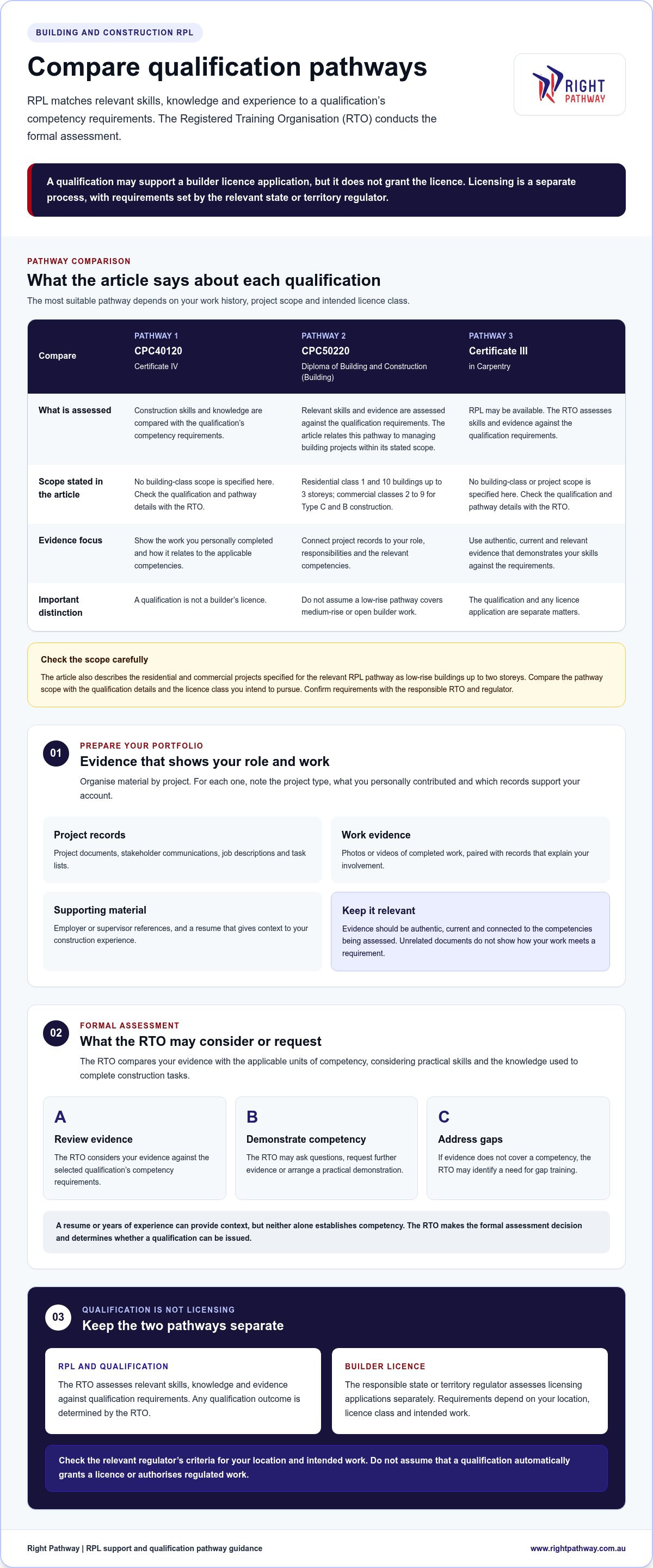
The RTO compares your evidence with the applicable units of competency in CPC40120. It considers both practical skills and the knowledge used to complete construction tasks. Work on a residential project, for example, may demonstrate particular responsibilities, while related records can help explain how you carried them out.
The RTO may ask questions, request more evidence or arrange a practical demonstration. If your evidence does not cover a competency, the RTO may identify a need for gap training. RPL to get a builder’s licence depends on demonstrating the qualification requirements, not simply describing your years in construction.
RTO Assessment and Process Timing
The Registered Training Organisation conducting the formal assessment decides whether your evidence meets the qualification requirements and whether a qualification can be issued. Choose an RTO able to assess CPC40120 and follow its evidence instructions, since assessment methods and requests can vary.
Building and construction RPL certification may take 4-6 weeks, depending on the evidence provided. Receiving an RPL qualification typically takes 2-4 weeks after all materials are submitted. These stages depend on the portfolio and assessment process. The RTO may request more evidence or gap training before reaching an outcome.
Building and construction qualifications available through RPL
RPL may help experienced construction workers gain a qualification by assessing relevant skills against its requirements. The right pathway depends on your work history, project scope and intended licence class.
Qualifications and Australian Builder Licensing
A qualification can support a builder licence application, but it does not grant the licence. The responsible state or territory regulator assesses licensing applications separately and may consider other requirements. In Victoria, the Victorian Building Authority regulates building trade licences. Its Unlimited Domestic Builder licence covers residential buildings in classes 1, 2 and 4, plus associated class 10 buildings.
Compare the qualification’s scope with the work you intend to supervise or manage. CPC50220 Diploma of Building and Construction (Building) covers residential class 1 and 10 buildings up to 3 storeys. It also covers commercial construction in National Construction Code classes 2 to 9, for Type C and B construction. The relevant regulator’s licence criteria determine how a qualification fits your application.
Nationally Recognised Qualifications
RPL may be available for building and construction qualifications, including CPC50220 and Certificate III in Carpentry. The RTO assesses your skills and evidence against the qualification requirements. If you meet them, the RTO issues the qualification. This is different from credit transfer, which recognises equivalent completed study.
Match the qualification to your experience before you submit an application. For example, CPC50220 relates to managing building projects within its stated building classes and construction types. The residential and commercial projects specified for the relevant RPL pathway are low-rise buildings up to two storeys. Don’t assume that a low-rise qualification covers medium-rise or open builder work.
Low-rise, medium-rise and open builder descriptions can refer to different building scopes, while each qualification has defined competencies. Check the qualification title and code, then compare its scope with the licence class you are pursuing. Experience supervising larger projects may be relevant, but the RTO assesses it against the selected qualification.
Use qualification pathway guidance to organise your options around your experience and intended work. A free initial eligibility assessment can help you consider a suitable starting pathway.
Building licence requirements by Australian state and territory
Builder licensing is administered separately across Australia. Check the regulator’s requirements for your location, licence class and intended work before planning your qualification pathway.
RPL Evidence Requirements
For construction RPL, organise evidence that shows your role and relevant competencies. Project records, stakeholder communications, work photos or videos, task lists, a resume, and supervisor or employer references can support your portfolio. Choose material that clearly connects your work to the qualification requirements instead of submitting unrelated documents.
A diploma or other qualification may form part of your background, but it does not replace evidence of practical skills. The RTO assesses your evidence against the relevant units and may request more material. Keep project records authentic, current and relevant to the work being assessed.
Builder and Site Supervisor Licensing
Thresholds and licence categories differ by state. In Western Australia, a licence is required before residential building work valued at more than A$20,000 in labour and materials. The equivalent threshold is more than A$5,000 in New South Wales and Victoria, and more than A$33,000 in Queensland.
Licensing regulators differ by jurisdiction: Fair Trading NSW, the Queensland Building and Construction Commission, the Victorian Building Authority, the South Australian Government, the ACT Government, Western Australia’s Department of Mines, Industry Regulation and Safety, and Tasmania’s Consumer, Building and Occupational Services oversee licensing in their respective jurisdictions. Builder and site supervisor roles may have different criteria, so identify the relevant licence class and work scope before applying.
When an RPL support provider is not a Registered Training Organisation, be clear about who formally assesses competency and issues a qualification. The responsible RTO conducts the formal assessment and makes the qualification decision.
Northern Territory Registration Requirements
Northern Territory individual building practitioner registration requirements include at least three years of practical experience in relevant building work, net tangible assets of at least A$50,000, and three written references from registered building practitioners. These criteria show why a qualification alone may not cover every part of a registration application.
Use the relevant regulator’s current criteria to plan your next step. RPL can address learning and qualification requirements, while registration evidence, financial criteria and work history remain separate considerations in your building career.
Recognition of prior learning (RPL)
If you’re considering RPL to get a builder’s licence, understand that RPL assesses existing construction skills and knowledge against a relevant qualification. The Registered Training Organisation (RTO) decides whether your evidence meets the qualification requirements. The licensing regulator separately assesses your builder’s licence application.
For a Certificate IV such as CPC40120, the RTO considers how you demonstrate the required competencies. Time spent on site gives useful context, but experience alone does not establish every skill or knowledge area. Depending on the evidence, the RTO may request more information, a practical demonstration, a competency conversation or gap training.
Prepare evidence that shows your own contribution to a project. Gather records of your responsibilities, decisions and completed work, then organise them by project and relevant competency. For example, pair a work record with a brief explanation of your role and a reference from someone familiar with the work. This helps distinguish your contribution from the project’s overall result.
RPL differs from credit transfer. Credit transfer recognises relevant completed study, while RPL assesses skills and knowledge gained through work and other prior learning. A qualification issued after assessment is an education outcome, not builder registration, a licence, a migration skills assessment or authority to perform regulated work.
To use RPL to get a builder’s licence, first identify the licence class and jurisdiction you have in mind. Then consider which qualification aligns with that pathway and organise evidence against its requirements. The RTO conducts the formal assessment and decides whether to issue a qualification. The regulator handles the separate licensing application.
Keep these steps connected but distinct. Clear evidence can support the qualification assessment, while the regulator’s criteria shape your licensing application. This gives you a practical basis for planning your next move in construction.
Right Pathway: RPL support and administrative facilitation
Right Pathway helps experienced construction workers organise an RPL pathway with preliminary eligibility guidance and administrative support. Its free initial RPL eligibility assessment can help you consider whether your skills and work history may align with a relevant qualification. This is preliminary guidance, not a formal competency assessment.
Use the preliminary skills and experience eligibility consultation to discuss your background, then consider a preliminary evidence-readiness review to identify documents you could prepare. Right Pathway also guides you through evidence preparation and qualification pathway navigation. The responsible Registered Training Organisation conducts the formal assessment, determines whether your evidence meets the competency requirements, and issues any qualification. The relevant state or territory regulator separately decides licensing applications.
Contact Right Pathway to discuss your construction RPL pathway.
Plan your next step with confidence
If you’re considering RPL to get a builder’s licence, make your next decision practical: define the work you want to undertake and where you intend to do it. This gives you a clearer basis for discussing a qualification pathway and preparing for the regulator’s separate application process.
Before moving forward, outline your experience, the projects you’ve contributed to and the responsibilities you’ve held. This is a useful starting point for a preliminary eligibility discussion. Right Pathway provides RPL support and administrative facilitation, while the responsible RTO makes formal assessment decisions and the relevant regulator determines licensing applications.
A considered first step can help you focus on the pathway that matches your work history and goals. Start with a free initial eligibility review, then decide how you want to proceed.
Your construction experience is a strong starting point. Turn it into a clear plan for your next career move.
FAQs
What types of evidence do I need to provide?
Choose evidence that lets the RTO verify its source and its connection to your work. Before submitting anything, check that dates, project names and your role are consistent across documents. If records contain sensitive client or site details, prepare a suitable version that still explains the relevant work. Follow the RTO’s instructions for accepted formats and submission methods.
Can I get a builder qualification without completing an apprenticeship?
An apprenticeship is not the only background an RTO can consider for an RPL application. The key question is whether you can demonstrate your skills and knowledge against the selected qualification’s requirements. For example, a worker who developed skills through supervised employment may have a different learning history from an apprentice. The RTO assesses the evidence and determines whether any competencies remain to be addressed.
Do overseas qualifications count?
Overseas qualifications may help explain your education and construction background, but their relevance depends on the qualification being assessed and the evidence provided. Include clear details of the award, course content and issuing organisation, alongside records showing how you have applied that learning at work. The RTO assesses this material against the Australian qualification. RPL does not assess migration or visa eligibility.
Does my past experience count?
Relevant past experience can be considered, including work for previous employers or in self-employment. Focus on how that work relates to the qualification’s competencies rather than relying on job titles or time served. If your responsibilities have changed, distinguish earlier duties from your current role. This helps the RTO understand the scope of your experience and which parts relate to the assessment.
How does this program benefit my career?
A qualification can provide a formal record of learning gained through construction work. You could include it in a CV, tender submission or professional development record when relevant to the opportunity. Its value depends on the role and the employer’s or regulator’s criteria. It does not guarantee work, promotion or licensing, but it can provide recognised evidence of assessed competencies.
How much will the program fees be?
The cost depends on the qualification pathway, the RTO’s assessment requirements and whether further training is needed. Fees for RPL support and formal RTO assessment are separate considerations, so establish which services a quote covers. The price depends on the case and is provided after a quote request. Ask for a clear breakdown before proceeding, including any assessment or gap-training charges that may apply.

Article by
Right Pathway Team
Right Pathway supports experienced workers, tradespeople and skilled migrants with preliminary RPL eligibility guidance, evidence preparation and qualification pathway navigation.
Right Pathway is not a Registered Training Organisation and does not conduct formal competency assessments or issue qualifications. Formal enrolment, competency assessment and qualification issuance are completed by the responsible Registered Training Organisation.
Start with a free initial RPL eligibility assessment at https://www.rightpathway.com.au/eligibility-check
Disclaimer
Right Pathway is a facilitation and support service only. We are not a Registered Training Organisation (RTO), do not conduct formal RPL assessments and do not issue qualifications. All formal RPL assessments and certifications are completed by partner RTOs regulated by ASQA. Eligibility and qualification outcomes depend on each applicant’s evidence, experience and the RTO’s assessment decision.


