

Experience matters, but it must be supported by evidence. For RPL for a disability support worker qualification in Australia, there’s no universal minimum number of years required. An RTO considers whether your relevant skills, knowledge and evidence meet the qualification’s requirements.
If you’ve developed your skills through day-to-day support work, you may be wondering whether that experience can count. RPL for disability support worker experience depends on how clearly your evidence shows what you can do, how you work safely and professionally, and how your skills match the required competencies.
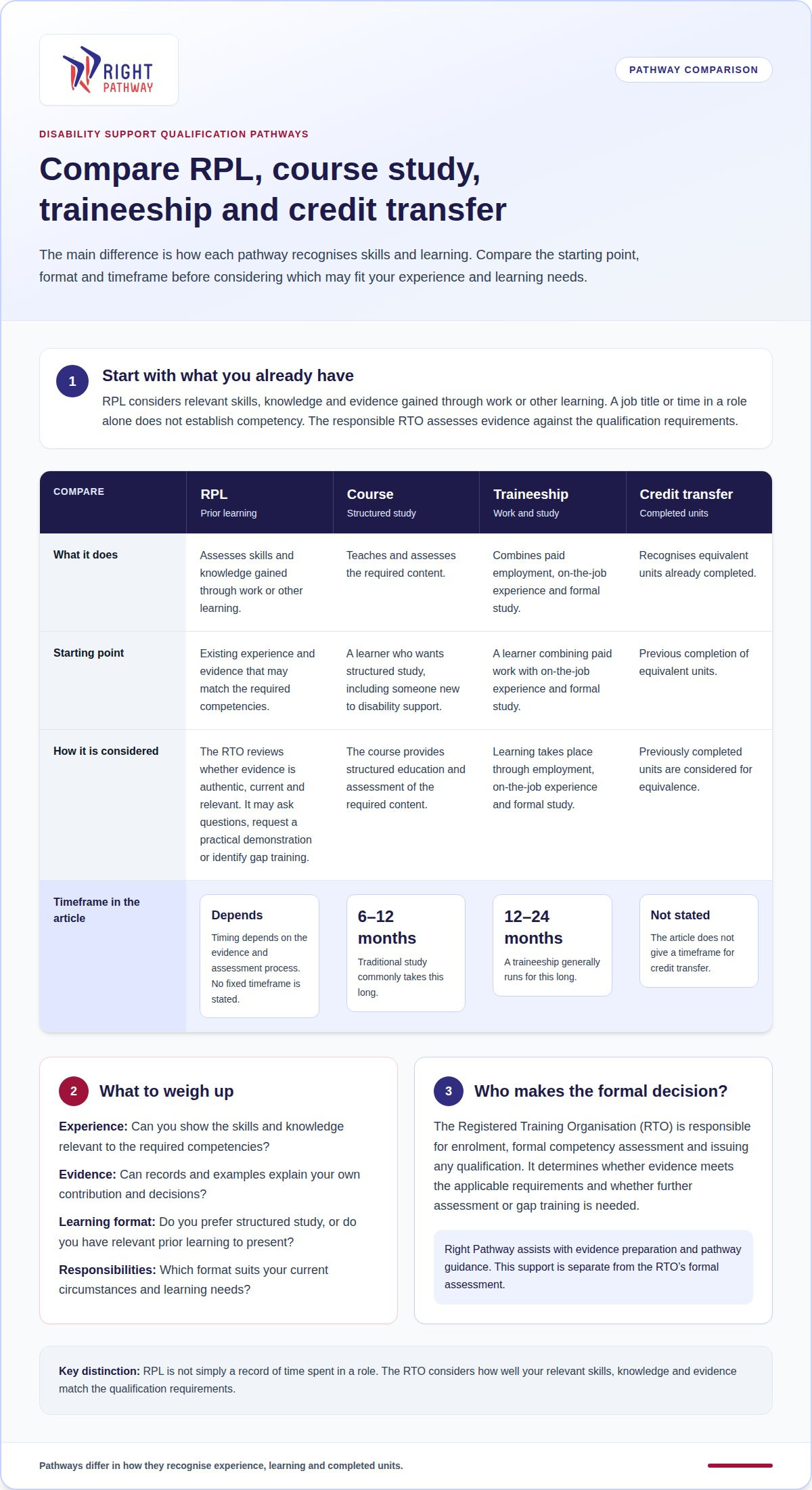
This guide explains the types of workplace evidence that may support an application, how eligibility is considered and what can happen if there are gaps. It also compares RPL with a traineeship and course study: traditional study commonly takes 6-12 months, while a traineeship generally runs for 12 to 24 months. RPL timing depends on the evidence and assessment process, so understanding the pathway can help you decide which option best fits your experience and circumstances.
Key Takeaways
- Understand which workplace records and examples can help show how your disability support skills match qualification requirements.
- See how an RTO considers experience, evidence and competency gaps when assessing an RPL application.
- Compare RPL, traineeship and course pathways to identify which may better suit your experience and learning needs.
- Learn how preliminary eligibility guidance and evidence preparation can help you approach the formal RTO process.
How to Get Your Cert III in Individual Support (Disability): RPL or Traineeship?
Choose a pathway by comparing your existing skills with the qualification requirements. Your work history can help identify a suitable option, but the RTO is responsible for assessing competency.
RPL, Course and Credit Transfer Options
RPL assesses skills and knowledge gained through work or other learning. A standard course teaches and assesses the required content, while credit transfer recognises equivalent units you’ve already completed. These options suit different starting points: an experienced worker may present evidence for RPL, while someone new to disability support may prefer structured study.
A traineeship combines paid employment with on-the-job experience and formal study. It generally takes 12 to 24 months, while traditional study commonly takes 6 to 12 months. Consider which format suits your current responsibilities and learning needs. The RPL pathway information can help you understand how prior learning is considered.
Choosing an RPL Provider
Before proceeding, find out which Registered Training Organisation (RTO) will enrol you, assess your competency and issue any qualification. Check that it is registered with the Australian Skills Quality Authority (ASQA) and that its scope includes the specific qualification you’re seeking. Registration alone does not mean an RTO can deliver every qualification.
Ask how the assessment covers your work experience, evidence and required competencies. For example, a portfolio might include workplace records, but the RTO may also request a competency conversation or practical demonstration. A Certificate III in Individual Support is different from a training and assessment qualification: the TAE40122 Certificate IV in Training and Assessment consists of 12 units. If an RPL application is unsuccessful, request feedback on competencies not yet demonstrated and ask about the RTO’s review or appeal process and any gap training.
RPL Certification Steps
The process begins by identifying the qualification and comparing your skills and knowledge with its units. Gather relevant evidence, such as a résumé, employer references, job descriptions, training records and workplace examples. The RTO reviews whether your evidence is authentic, current and relevant, then decides whether it demonstrates competency.
Further assessment may include questions, a practical demonstration or gap training if your evidence does not cover a requirement. The RTO decides whether you meet the applicable requirements and, if so, issues the qualification. Right Pathway helps with evidence preparation and pathway guidance, while the RTO conducts the formal assessment and issues certificates. Use a self-assessment to organise your experience, not to treat time in a role or a portfolio alone as proof of competency.
Recognition of Prior Learning eligibility and evidence
RPL eligibility depends on how closely your demonstrated skills, knowledge and experience match the qualification requirements. The RTO considers the relevance and quality of your evidence, as well as the work you have performed.
RPL Eligibility and Suitability
Your suitability depends on the support duties you can demonstrate, how recently you performed them and how clearly your evidence connects to the required competencies. A job title alone won’t show the full scope of your work. For example, if your duties focused on transport support, you may need additional evidence or assessment to demonstrate other relevant competencies.
Consider whether your experience covers different responsibilities and workplace situations. Work across home-based and community settings may give you varied examples, while a narrower role may leave some competencies unaddressed. The RTO assesses your evidence against the qualification and determines whether further assessment or gap training is needed.
Experience for Support Worker RPL
Support work can involve different responsibilities across disability services, aged care and community services. Focus on what you learned and can demonstrate in each setting, rather than simply how long you held a role. For instance, evidence of coordinating a change to a person’s routine may demonstrate planning and communication skills if it clearly describes your work.
Overseas work experience and qualifications may be considered for RPL in Australia when they relate to the competencies being assessed. They do not automatically convert into an Australian qualification. The RTO evaluates their relevance and supporting evidence against the Australian qualification requirements. RPL is also separate from a migration skills assessment or visa decision.
Evidence for an RPL Application
Useful evidence helps an assessor understand the context, your individual contribution and the skills you demonstrated. A workplace record may show an outcome, while supporting details explain your responsibilities and decisions. Make sure records are authentic and current, and protect confidential information about the people you support.
Arrange material so the connection to each competency is easy to follow. Where one document provides only partial information, other evidence can add context. The RTO may ask questions, request a practical demonstration or identify gap training if the evidence doesn’t establish a required skill. A preliminary RPL eligibility check can help you understand whether your experience and evidence appear relevant before formal assessment.
Course and RPL completion timeframes
Course study and RPL offer different pathways towards a disability support qualification. A course provides structured education and assessment; with RPL, an RTO considers whether your prior learning and current skills meet the qualification requirements. The course code identifies the specific qualification, so check that the course information and intended outcome refer to the same award before comparing pathways.
Course modules develop knowledge and practical capability in areas such as person-centred support, communication, safe work practices, infection control, and legal and ethical responsibilities. The RTO determines course delivery arrangements and assessment requirements. These details shape the study commitment, including how learning activities and workplace practice fit around employment and other responsibilities.
RPL timing depends on the evidence submitted and any further assessment required. Right Pathway’s general website information gives an approximate timeframe of 4-8 weeks after complete evidence is received. This is not a guaranteed completion date for a disability support qualification. The RTO’s assessment needs, requests for clarification and any gap training can affect how the process progresses.
Fees and payment arrangements depend on the pathway and organisation delivering it. Course fees and RTO assessment charges may cover different services, so review what each fee includes and when payment is due. For RPL, clarify how service fees relate to administrative support and how RTO assessment or gap training charges are handled. This helps you compare the overall commitment without assuming course and RPL costs are structured alike.
Before choosing, weigh the learning format against the evidence you can provide. A worker with relevant experience may want to explore RPL, while someone developing skills in the sector may prefer a structured course. The RTO assesses competency and determines whether further learning is needed. The assessment, not the pathway label, establishes whether requirements have been met.
Disability support worker experience requirements
For RPL, relevant support work must demonstrate competency, not simply time in a role. An RTO assesses whether your work and evidence match the qualification requirements.
Your experience should relate to the individual support tasks and responsibilities you’ve actually performed. For example, evidence may show how you follow a person’s support plan, communicate respectfully or apply safe work practices. These examples connect workplace practice with competencies covered by the Certificate III in Individual Support (Disability).
Care-sector experience may come from community services, aged care or disability support settings. The setting alone does not establish competency; the work you performed and evidence of your skills matter. A reference describing help with daily routines, for instance, is more useful when it explains your responsibilities and how you followed the person’s preferences.
Course learners have a separate practical requirement: the study pathway includes 120 hours of work placement. In an RPL application, workplace experience is considered against unit assessment requirements. The RTO may still require a practical demonstration or other assessment where your evidence doesn’t show a particular skill.
Does RPL help meet NDIS worker screening, training or employer requirements in Australia? An RPL qualification recognises assessed competency, but it is not an NDIS worker screening clearance. Employers may also set role-specific training or experience requirements, so qualification recognition and job requirements are separate considerations.
For your career, the clearest evidence links a task to the skill it demonstrates. Examples include supporting independence during a daily activity, documenting communication with a supervisor or applying infection-control procedures. These records help show how your experience relates to nationally recognised individual support competencies. RPL may recognise demonstrated competency, while gaps can point to skills that need further assessment or learning.
Right Pathway
Right Pathway helps disability support workers organise their experience and understand potential RPL pathways. If you’re unsure whether your work history matches the qualification, preliminary skills and experience guidance can help clarify your next steps.
We provide RPL support and administrative facilitation, including guidance on preparing evidence and understanding what an RTO may need. A preliminary evidence-readiness review can help you assess whether references, training documents and workplace examples relate to the required competencies.
Right Pathway does not conduct formal competency assessments or issue qualifications. The responsible Registered Training Organisation handles formal enrolment, assessment and qualification decisions. RPL outcomes depend on the evidence you provide and the RTO’s assessment.
Contact Right Pathway to discuss your disability support experience and possible next steps.
Take the next step with a clearer pathway
Experience is a useful starting point, but your next step is to present it against the qualification requirements. RPL for a disability support worker can recognise existing capability when your evidence demonstrates the required competencies. If gaps emerge, identifying them early can help you decide whether further learning or another study pathway better suits your goals.
Right Pathway provides RPL support and administrative facilitation, including a free initial eligibility assessment and preliminary skills and experience guidance. This support helps you understand potential pathways and prepare for the formal process. The RTO remains responsible for assessment decisions and issuing qualifications, so a preliminary review is not a qualification outcome.
Share your experience and current training details with Right Pathway to discuss practical next steps.
Your work has value. An organised pathway can help you take your next career step with confidence.
Frequently Asked Questions
Evidence requirements: What do I need to provide?
Provide records that show what you personally did, in which role and how your work relates to the relevant competencies. A supervisor’s performance review, workplace induction record or documented observation can add context to your work history. Keep dates and role details clear, and remove identifying client information from examples before sharing them. The RTO may request more evidence if a record does not establish your contribution.
Can I get credit for units I have already completed?
Yes. An RTO can grant credit for an equivalent unit when your certification is authenticated, subject to limited grounds for refusal. This differs from RPL: credit transfer recognises a completed equivalent unit, while RPL assesses skills gained through experience or learning. Provide your certificate or statement of attainment so the RTO can compare the completed unit with the qualification requirements.
How does RPL work?
RPL for a disability support worker involves an RTO comparing your demonstrated skills and knowledge with the relevant competency requirements. After reviewing your application, the RTO may ask questions about your role or ask you to demonstrate a task. For example, it may explore how you respond when a person’s support needs change. Further evidence or gap training may be needed if competencies remain unproven.
How long does the RPL process take?
For experienced Australian support workers, the Certificate III RPL pathway is commonly completed in 4-6 weeks. The timeframe depends on how quickly the required evidence is supplied, the RTO’s assessment steps and whether further assessment or gap training is needed. A request for clarification or practical demonstration can extend the process, so keep time available to respond to RTO requests.
How much does RPL cost?
The cost depends on the qualification pathway and the requirements identified during the process. RTO assessment fees may apply, and gap training may involve additional fees. Right Pathway discusses its service fees after considering your eligibility. Before proceeding, ask for the relevant fee details, including which charges relate to administrative support and which relate to the RTO’s assessment.
What does RPL mean for disability support workers in Australia?
Recognition of Prior Learning gives experienced workers a way to have their existing skills assessed against an Australian qualification’s requirements. It can make workplace learning visible, but it is not a worker screening clearance, migration skills assessment or guarantee of employment. The RTO decides whether your evidence demonstrates competency and issues any resulting qualification. Employers may also set separate role requirements.
Article by
Right Pathway Team
Right Pathway supports experienced workers, tradespeople and skilled migrants with preliminary RPL eligibility guidance, evidence preparation and qualification pathway navigation.
Right Pathway is not a Registered Training Organisation and does not conduct formal competency assessments or issue qualifications. Formal enrolment, competency assessment and qualification issuance are completed by the responsible Registered Training Organisation.
Start with a free initial RPL eligibility assessment at https://www.rightpathway.com.au/eligibility-check
Disclaimer
Right Pathway is a facilitation and support service only. We are not a Registered Training Organisation (RTO), do not conduct formal RPL assessments and do not issue qualifications. All formal RPL assessments and certifications are completed by partner RTOs regulated by ASQA. Eligibility and qualification outcomes depend on each applicant’s evidence, experience and the RTO’s assessment decision.


