

RPL for electricians with overseas experience can help have relevant skills and experience assessed towards an Australian qualification, but RPL alone does not grant an electrician’s licence. Electrical licences are issued separately by state and territory regulators, and the requirements vary across Australia.
Overseas work can provide valuable evidence, but experience alone does not show that your skills meet an Australian qualification’s requirements. A Registered Training Organisation (RTO) conducts the formal RPL assessment, comparing your evidence with the relevant units of competency. It may also require further assessment or training.
This guide explains how overseas experience may support an RPL application, what documents can help demonstrate your skills, and how qualification assessment differs from occupational licensing. You’ll also see why the next licensing steps depend on where you plan to work, so you can understand the pathway before deciding what to do next.
Key Takeaways
- Overseas experience may support an RPL application when it can be matched to the relevant Australian competency requirements.
- Work references, training records and examples of completed work can help demonstrate your skills and experience.
- An RPL qualification and an electrician’s licence are separate outcomes, with licensing requirements varying between states and territories.
- Understand how your experience and evidence may fit a qualification pathway before progressing to formal RTO assessment.
Documents required to upgrade to an electrician’s licence
Australia’s electrical licensing requirements differ by state and territory, and an RPL qualification is separate from a licence. Prepare evidence for both the RTO’s competency assessment and the licensing pathway in your intended state.
State and territory licensing requirements
Each state and territory regulates electrical licensing separately, so an applicant’s next steps depend on where they plan to work in Australia. A qualification or licence from overseas does not itself establish eligibility for an Australian licence. In Victoria, the Victorian Government states that electrical work is governed by the Electricity Safety Act 1998 and the Electricity Safety (General) Regulations 2019. These rules make the relevant jurisdiction central to understanding the licensing pathway.
Overseas qualifications, licences and experience
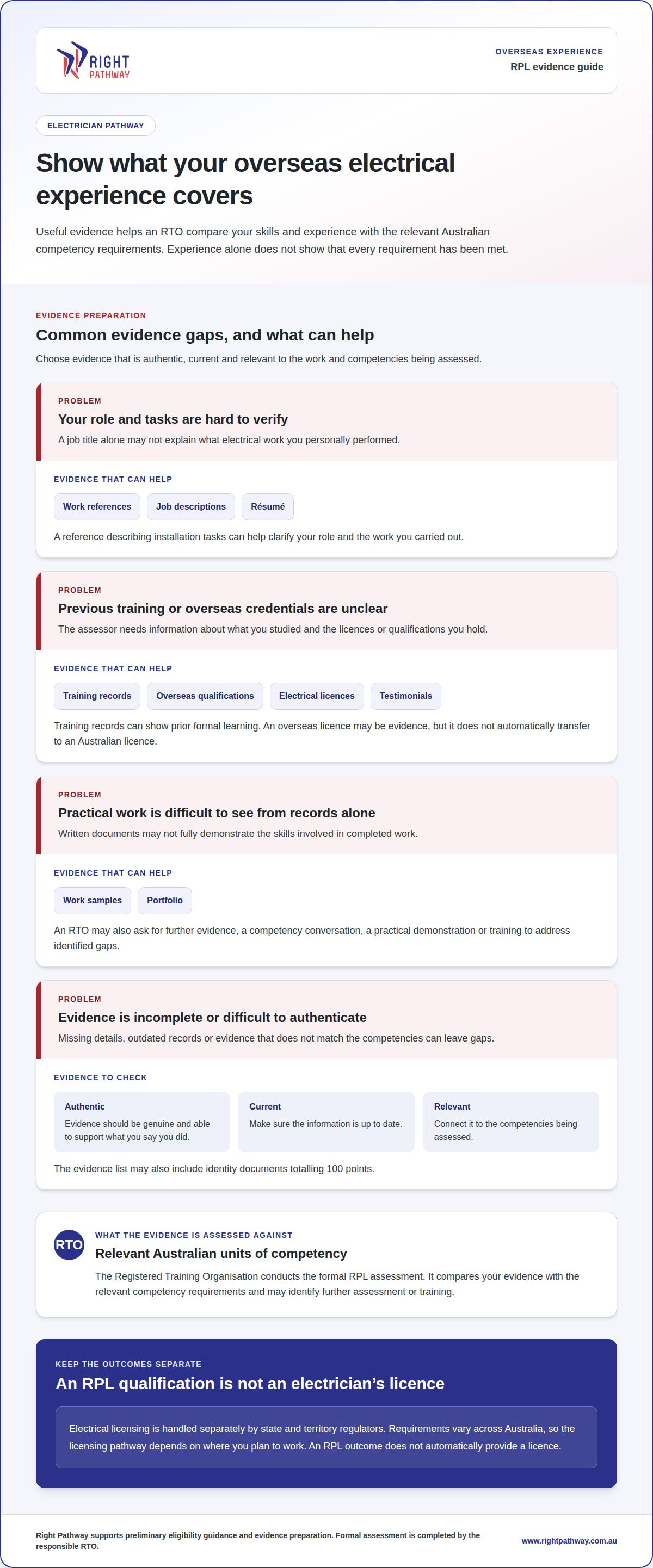
Overseas training records, electrical licences and work experience can help show what an applicant has learned and performed. Useful RPL evidence may include identity documents totalling 100 points, work references, a résumé, job descriptions, training records, work samples, a portfolio or testimonials. For example, a reference describing installation tasks can help explain the applicant’s role, while training records show prior formal learning. Evidence should be authentic, current and relevant to the competencies being assessed. Recognition of Prior Learning matches evidence against Australian competency requirements; it does not automatically transfer an overseas licence.
Requirements for a full licence or certificate
A full licence may require more than an Australian qualification. In New South Wales, overseas-trained applicants taking the OSAP pathway must complete Australian-context gap training and supervised employment to meet the full qualification requirements. Applicants may need to meet additional qualification requirements before applying for a full contractor licence or qualified supervisor certificate. Requirements vary by jurisdiction, so the relevant state regulator’s rules determine the steps.
Electrician RPL assessment costs vary by RTO and depend on the evidence provided and any further assessment or gap training. Fees are discussed after eligibility is confirmed. To verify an RTO, check its registration and approved delivery scope on training.gov.au, including the relevant qualification.
An application may be unsuccessful if evidence is incomplete, unauthenticated, outdated or poorly matched to the required competencies. Missing details about your work or training can also leave gaps that call for further evidence or assessment.
RPL and the Certificate III in Electrotechnology Electrician
RPL compares prior learning and practical skills with Australian qualification requirements. For electrical trades, an RPL qualification pathway and an overseas skills assessment serve different purposes.
The Certificate III in Electrotechnology Electrician
The Certificate III in Electrotechnology Electrician, code UEE30820, is an Australian qualification assessed against relevant units of competency. RPL may recognise skills and knowledge gained through overseas work or training where the evidence demonstrates those competencies.
An RTO’s formal assessment may involve more than reviewing documents. For example, evidence of technical installation work could be followed by a competency conversation or practical demonstration. The assessor may identify gaps that require further training. Suitability depends on your experience, evidence and the relevant units, not simply how long you have worked in the trade.
RPL and overseas skills assessments
RPL assesses skills against an Australian qualification, while an overseas skills assessment evaluates technical skills for a separate purpose. An RPL outcome is not a migration skills assessment or an electrical licence.
For the electrician pathway described, Trades Recognition Australia’s Offshore Technical Skills Record assessment has three stages: self-assessment, paper-based assessment, and practical assessment with a technical interview. This is separate from an RTO’s RPL assessment. If migration is relevant, seek advice from an appropriately registered migration professional.
Certification processes for international hires
For international hires, employers need to distinguish qualification recognition from permission to undertake regulated electrical work. An Australian RPL qualification does not itself provide a licence or establish work eligibility.
A regional NSW transport business used an RPL pathway to assess international auto electrician hires from the UAE and Qatar against Australian standards. Auto electricians working in Australia must have a Certificate III in Automotive Electrical Technology or an equivalent qualification. Employers should identify whether the role concerns automotive electrical work or electrician work, since these are distinct pathways. A preliminary RPL eligibility check can help clarify how overseas experience may align with a qualification pathway; the formal assessment remains with the RTO.
Can RPL alone make me a licensed electrician in Australia?
No. RPL can contribute towards an Australian qualification, but a qualification and an electrical licence are separate outcomes. Overseas experience may support an assessment, while licensing steps depend on the state or territory.
Recognising overseas qualifications and experience
RPL assesses overseas learning and electrical work experience against Australian units of competency; it does not itself recognise an overseas licence. In New South Wales, overseas-trained electricians may follow the Offshore Skills Assessment Program (OSAP) for the licensed occupation pathway. A successful OSAP applicant receives an Offshore Technical Skills Record (OTSR), which confirms partial completion of the technical requirements for an Australian Certificate III qualification.
For NSW OSAP, the occupations covered include Electrician (General), code 341111, and Electrician (Special Class), code 341112. The OTSR is not a full qualification or an electrical licence. It records progress towards the relevant Certificate III and helps clarify what further Australian training and supervised employment the pathway requires.
Practical assessments and gap training
Electrician RPL may involve practical assessment, so a paper review alone is generally insufficient. The RTO assesses evidence against the required competencies and may use a practical demonstration, challenge test or competency conversation to establish what you can do.
Any gap training depends on the competencies your evidence and assessment do not demonstrate. In NSW, an OSAP applicant must complete Australian-context gap training and supervised employment to meet the full qualification requirements. This pathway involves more than RPL alone.
Victoria has a separate recognition detail: applicants who received an Australian Recognised Trade Certificate before 30 September 2014 may still use it as evidence of overseas skills assessment. Overseas electrical qualifications must be assessed by Trades Recognition Australia or its nominated training providers before an application to Energy Safe Victoria. These are skills-assessment and licensing steps, not an RTO’s RPL decision. Keep the purpose of each assessment clear when planning your qualification and licensing pathway.
Eligibility for workers with overseas experience
Overseas experience may support an RPL application if it demonstrates skills relevant to Australian electrical competencies. RPL for electricians with overseas experience gives an RTO a way to assess how your prior learning aligns with an Australian qualification. Eligibility depends on relevant, authentic and sufficiently detailed evidence, not simply the number of years worked.
An RTO compares your knowledge and work history with the applicable units of competency. Evidence is more useful when it describes the task, your responsibilities, the equipment used and the outcome. For example, a reference detailing your fault-finding duties gives the assessor more context than a job title alone.
Create a clear record of the work you have done. Useful evidence can include employer references, job descriptions, training records, work samples and a portfolio. If your records use different trade terms, explain the tasks in plain English and connect them to the relevant competencies. Gaps in dates, duties or supporting documents can make it harder to show that your skills are current and relevant to Australian work.
Experience gained under an overseas licence may be relevant, but it does not automatically transfer to Australian licensing. An RPL qualification, a migration skills assessment and a state or territory electrical licence serve different purposes. Your intended pathway also matters: seeking an Australian qualification through an RTO involves a different assessment process from pursuing an occupational skills assessment. Keep qualification recognition separate from migration or licensing decisions.
Can overseas electricians work while completing RPL or licensing requirements in Australia? They may work for construction or electrical companies under an electrical permit and the supervision of an Australian electrician. Permit and supervision conditions matter, and applicants must follow the requirements in the relevant jurisdiction.
During an RTO assessment, expect your evidence to be checked against the relevant competencies, with further assessment if needed. WA Government assessment guidance says methods may be oral, written or practical, and suitable assessments may take place in the workplace. For example, an applicant might explain a fault-finding process and demonstrate relevant work under assessment conditions.
Use a free initial RPL eligibility assessment to discuss how your overseas skills and evidence may fit a qualification pathway.
Right Pathway: Preliminary skills and experience eligibility consultation
Right Pathway’s preliminary skills and experience eligibility consultation helps overseas-trained electricians explore how their work history may align with an Australian RPL pathway. It can help if you are unsure which qualification may suit your experience or how to organise evidence from different employers and countries.
A preliminary evidence-readiness review can help identify relevant documents and potential gaps before formal assessment. Right Pathway also provides RPL support and administrative facilitation, including guidance on preparing evidence. This guidance is preliminary, not a formal competency assessment. The partner RTO conducts the formal assessment and decides competency and qualification outcomes.
Contact Right Pathway to discuss your experience and possible next steps.
Plan your next step with confidence
Turn what you have learned into a short, practical plan. Start with the electrical role you want and the state or territory where you intend to work. Then list the questions that could affect your next move, such as which pathway applies to your role and what you must complete before undertaking particular work.
Keep your priorities clear. If your immediate goal is a qualification, focus on the assessment pathway and the evidence it requires. If you want to practise in a regulated role, make licensing requirements central to your plan. This helps you use discussions with relevant organisations efficiently and identify which decisions need attention first.
For RPL for electricians with overseas experience, a considered plan can make the transition from international trade experience to an Australian pathway easier to organise. When you are ready, contact Right Pathway to discuss your options and get a free initial eligibility check.
Your experience is a useful starting point. A clear plan can help you move forward with purpose.
Frequently Asked Questions
How long does RPL take?
An RPL assessment typically takes approximately 4-8 weeks after complete evidence is received. That period can extend if the evidence needs clarification or the RTO schedules further assessment or gap training. For planning, separate the evidence preparation stage from the formal assessment stage, and allow time to respond if the RTO asks for additional information. Assessment timing is not a fixed completion date.
How much experience do you need for RPL?
There is no universal minimum number of years required for RPL. An application’s strength depends on how closely your experience relates to the qualification and whether it demonstrates the required skills. Someone with experience across different electrical tasks may have relevant examples for more competencies than someone whose role covered a narrower range. Assessment focuses on demonstrated capability, not tenure alone.
Is RPL recognised by employers in Australia?
An RPL qualification issued by an authorised RTO is nationally recognised in Australia. Its relevance to a particular job depends on the employer’s requirements and the skills needed in that workplace. For example, an employer recruiting for maintenance work may look for evidence of experience with the tasks involved, alongside the qualification. Recognition does not guarantee employment or determine an employer’s selection decision.
What evidence do electricians need for RPL?
Present evidence so your own contribution is clear. Group material by project or type of work, then explain your responsibilities, decisions and results. A document showing that a team completed a job may not identify your individual skills. Keep supporting information consistent, relevant and verifiable, and remove confidential details you are not authorised to share.
What is RPL and how does it work?
RPL is a way to have skills gained outside formal study considered towards a qualification. In practice, your experience is mapped to the qualification requirements, then the relevant evidence is considered during formal assessment. The RTO may ask follow-up questions to understand the context of a work example. Any competencies not demonstrated can indicate further learning or assessment needed to complete the pathway.
What is Recognition of Prior Learning (RPL)?
Recognition of Prior Learning is the formal name for assessing relevant knowledge and skills gained through work, training or other experience. It differs from credit transfer, which recognises eligible learning completed through formal study. For an overseas-trained electrician, RPL focuses on demonstrated competencies against an Australian qualification, rather than simply converting an overseas course title or relying on length of service.

Article by
Right Pathway Team
Right Pathway supports experienced workers, tradespeople and skilled migrants with preliminary RPL eligibility guidance, evidence preparation and qualification pathway navigation.
Right Pathway is not a Registered Training Organisation and does not conduct formal competency assessments or issue qualifications. Formal enrolment, competency assessment and qualification issuance are completed by the responsible Registered Training Organisation.
Start with a free initial RPL eligibility assessment at https://www.rightpathway.com.au/eligibility-check
Disclaimer
Right Pathway is a facilitation and support service only. We are not a Registered Training Organisation (RTO), do not conduct formal RPL assessments and do not issue qualifications. All formal RPL assessments and certifications are completed by partner RTOs regulated by ASQA. Eligibility and qualification outcomes depend on each applicant’s evidence, experience and the RTO’s assessment decision.


