

RPL for business administration does not have one fixed price in Australia. Assessment fees vary between training providers, so the cost depends on the pathway and assessment arrangements. Payment options may also differ, making it useful to understand what a quote covers before deciding whether to proceed.
Cost is only one part of deciding whether RPL for business administration suits your goals. You may be weighing formal recognition against the time and commitment involved in further study. The practical question is how your experience and previous learning relate to a business qualification, and what steps an application could involve.
This guide explains the factors that affect RPL costs and payment arrangements, what previous work or study may contribute, and what evidence can help demonstrate your capability. It also outlines how RPL differs from course-based study and where preliminary guidance fits before an RTO’s formal assessment. Use these points to consider your options and identify the questions that matter to your circumstances before deciding whether to explore an application.
Key Takeaways
- RPL assessment fees vary between training providers, so understand what the quoted assessment covers before considering payment arrangements.
- Business administration experience may support an application when it demonstrates skills and knowledge relevant to the qualification’s requirements.
- Previous study and paid or unpaid work may contribute to an application, but they are considered differently from credit transfer.
- Job descriptions, work samples and records of learning can help show what you know and can do. Evidence needs to be relevant to the assessment.
Can You Get a Business Management Qualification Through RPL?
Yes. In Australia, recognition of prior learning (RPL) assesses relevant skills and knowledge against a qualification’s units of competency. Office administration, scheduling, records management and team coordination can provide useful examples when they match the qualification requirements.
RPL differs from studying a business administration course. A course develops skills through structured training, while RPL assesses existing capability and may identify areas requiring further learning. Work experience alone does not guarantee that an RTO will award a qualification.
For business administration, RPL means having prior learning assessed against applicable vocational requirements. The responsible Registered Training Organisation (RTO) conducts the formal assessment and decides whether your evidence demonstrates competency.
The process generally involves identifying a suitable qualification, mapping your experience to its requirements, submitting evidence and completing any further assessment requested by the RTO. An assessor may hold a professional discussion, ask you to explain workplace decisions or request work samples. For example, an office coordinator might describe how they maintain records and prioritise administrative tasks.
An RPL assessment may take approximately 4-8 weeks after complete evidence is received. The overall process can also involve evidence preparation and any additional assessment or gap training required by the RTO.
Choosing an unsuitable qualification can leave relevant experience unmatched to its competency requirements. Be cautious of claims that promise guaranteed outcomes or treat paperwork alone as proof. Check that the qualification aligns with your work and that the responsible RTO conducts the assessment and issues any resulting certification.
Explore the RPL process and support to understand how experience can be mapped to qualification requirements. Preliminary eligibility guidance can help identify a potential pathway, but it is not the RTO’s formal assessment.
Evidence supporting an RPL application
Useful evidence shows how your business administration skills match vocational requirements, not simply where you have worked. A resume, for example, can outline roles and responsibilities, while workplace records can demonstrate how you applied your knowledge. Evidence should be authentic, current and relevant to the units being assessed for a nationally recognised qualification.
Depending on the RTO’s requirements, an application may include job descriptions, references or performance appraisals. These records can establish your role, describe your duties and provide another perspective on your workplace performance. A job title alone offers limited detail, so pair it with examples of the tasks you performed.
For an office administrator, useful evidence might include:
- Redacted meeting minutes, correspondence or records you prepared.
- Scheduling examples showing how you coordinated competing priorities.
- Reports or spreadsheets demonstrating routine information management.
- Training records or certificates relevant to business administration.
Each item should help explain a specific skill. A roster, for instance, may show scheduling work, while a short explanation can clarify how you handled changes and communicated updates. Remove confidential business or personal information before sharing workplace material. If you cannot supply an original document, explain its context and discuss suitable alternatives as part of the application process.
Organise evidence by competency area, then connect each item to the task it demonstrates. This makes it easier to identify gaps between your experience and the assessment requirements. Advanced duties, such as coordinating an office procedure or preparing management reports, may show broader capability when they match the qualification requirements. A certificate supports evidence of prior learning, but does not by itself prove current workplace competence.
Before submitting documents, label each file clearly and note when and where the work was completed. This gives the assessor context for interpreting samples, particularly when a document has been redacted or comes from an older project. Keep an original copy of each item for your records.
RPL prices and payment methods
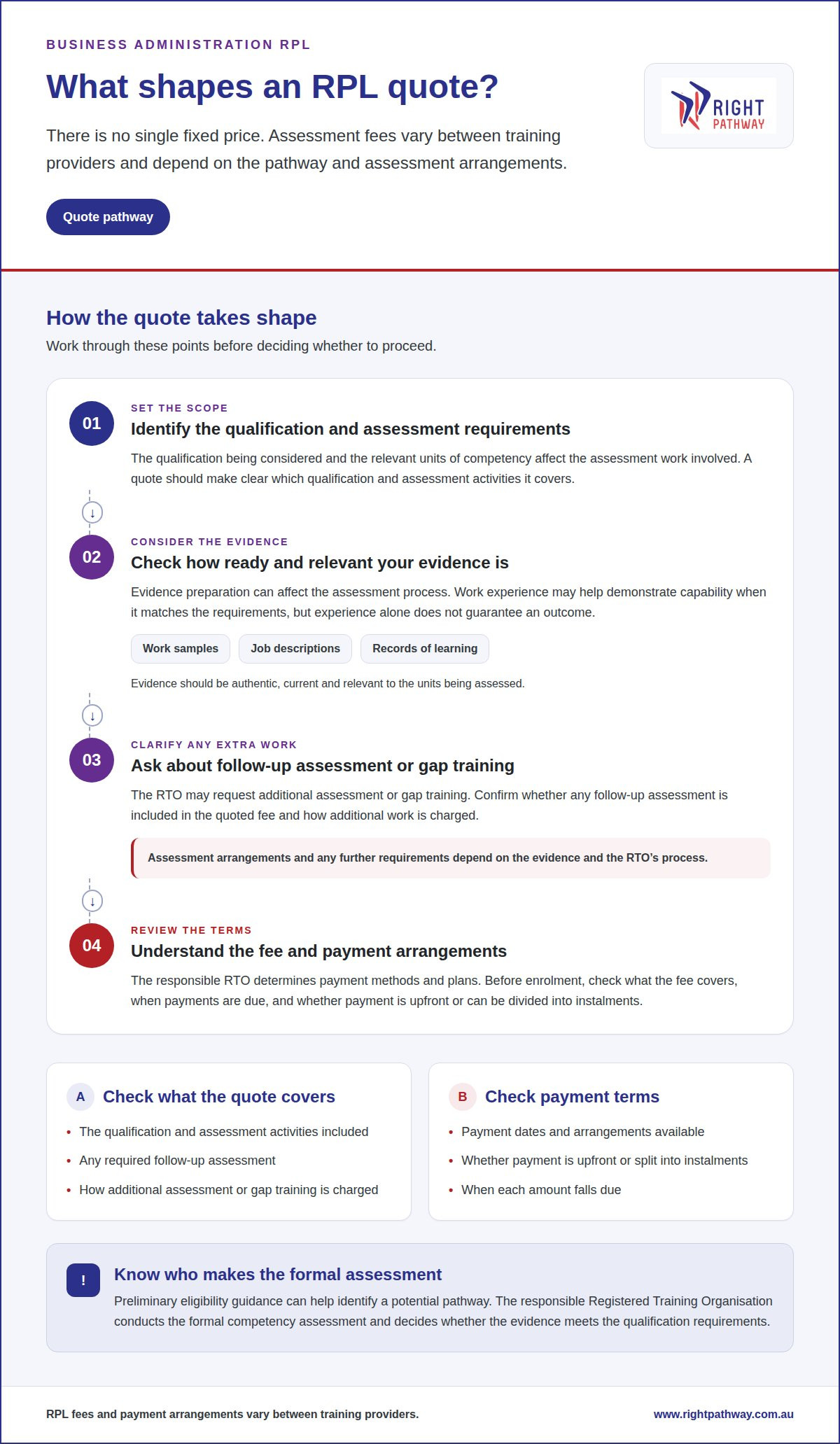
RPL assessment costs in Australia vary between training providers, and there is no single price for every business course. The cost depends on the qualification, assessment scope, evidence readiness and any further assessment or gap training required. Fees are discussed after eligibility is confirmed, so ask for a breakdown of the costs and payment terms before proceeding.
For example, an applicant seeking a Certificate IV may have different assessment requirements from someone pursuing a diploma. The relevant units, workplace evidence and assessor’s process all affect the work involved. Experience in administration or leadership can help demonstrate competence, but the RTO still assesses it against the qualification requirements.
Payment methods and plans are determined by the responsible RTO. Before enrolment, clarify the payment schedule and what the quoted fee covers. Ask whether payment is due upfront or can be divided into instalments, and confirm when each amount falls due. Also clarify how any additional assessment or gap training is charged.
- Confirm which qualification and assessment activities the quote covers.
- Check whether the fee includes any required follow-up assessment.
- Understand payment dates and available payment arrangements before proceeding.
RPL is different from enrolling in a course and completing all its training. If the assessment identifies competency gaps, further training may be needed, affecting the overall cost and payment schedule. Consider a diploma or Certificate IV pathway alongside the evidence you can provide and the assessment process involved.
For a clearer breakdown of cost factors, review this guide to RPL costs in Australia. Compare the scope and payment terms, not just the headline fee, before deciding whether the pathway suits your circumstances.
Recognition of prior study, work and volunteer experience
RPL can assess skills gained through paid work, unpaid work, volunteering and previous learning. In business administration, this might include coordinating office tasks for an employer or maintaining records for a community organisation. The RTO considers whether those skills match the relevant qualification requirements, rather than counting experience alone.
Previous education may also be relevant, but RPL and credit transfer are different. RPL assesses whether your skills and knowledge meet competency requirements. Credit transfer recognises relevant completed study where it matches course requirements. For example, a completed business subject may be considered for credit, while workplace experience is assessed through RPL.
Keep records of previous study, such as certificates, awards or academic transcripts. These help show what you completed and which learning may be relevant. The RTO determines whether previous study can be recognised and what documentation its process requires.
Volunteer experience can also demonstrate practical business administration skills. For example, coordinating meeting records for a community organisation may show planning and record-keeping capability. Provide evidence of your role and explain the tasks you performed, so the assessor can consider how they relate to the competencies.
RPL duration depends on how ready your evidence is, the assessment requirements and any additional tasks requested by the RTO. A competency discussion or practical demonstration may form part of the process. The delivery mode describes how assessment activities take place; the RTO still needs sufficient evidence to assess each applicable competency.
To find RTOs offering a relevant business qualification, search the Australian Government’s training.gov.au National Register by qualification and provider. Review the provider’s registration status and whether the qualification is on its scope. A nationally recognised qualification is issued by the responsible RTO, not an RPL support service.
For help exploring how your work, study or volunteer experience may fit a qualification pathway, complete a free initial eligibility assessment.
Right Pathway: Business and management RPL support
Right Pathway supports business and management RPL applications by helping you explore a suitable qualification pathway and prepare relevant evidence. Turn to us if you have administrative or management experience but need help understanding how it may align with RPL requirements.
A preliminary skills and experience eligibility consultation can help clarify potential next steps. Right Pathway also provides RPL support and administrative facilitation, including guidance on organising application information. This initial guidance is not a formal competency assessment. The responsible Registered Training Organisation conducts the formal assessment, makes the RPL decision and issues any qualification.
If you’re considering RPL for business administration, begin with a free initial eligibility assessment. Complete the free initial eligibility assessment with Right Pathway to discuss a potential pathway based on your experience and available evidence.
Take the next step towards a suitable pathway
Choosing RPL for business administration is a decision about how your existing capability fits your career direction. Consider the qualification you want to pursue, the work you can evidence and whether further learning would help close any gaps. A clear starting point can help you make a considered decision without treating RPL as a shortcut or guaranteed outcome.
Right Pathway provides business and management RPL support, including administrative facilitation and preliminary skills and experience eligibility consultation. Our free initial RPL eligibility assessment helps you explore a potential pathway. This guidance is preliminary; the responsible RTO conducts the formal assessment and decides whether your competencies meet the qualification requirements. Suitability depends on your experience, evidence and the applicable assessment.
Bring your questions about your work history and qualification goals to the first discussion. A more informed pathway starts with understanding how they connect.
Frequently Asked Questions
How much does RPL cost?
RPL fees vary between Australian training providers, so there’s no single price for a business administration application. The amount depends on the qualification, assessment scope, evidence available and any further assessment or gap training required. Before proceeding, ask the RTO for a written breakdown of what the fee covers and what payment arrangements apply. This helps you understand the likely total commitment before enrolment.
What evidence do I need for RPL?
Evidence should show how you performed relevant work tasks and developed the required skills. Depending on your experience, useful records may include employment contracts, payslips, position descriptions, supervisor references, work samples, invoices or previous qualifications. For example, a payroll task might be supported by a redacted work sample and a position description explaining your responsibilities. Protect confidential workplace and personal information when preparing documents.
How long does the RPL process take?
An RPL assessment may take approximately 4-8 weeks after complete evidence is received. This timeframe relates to the assessment stage, not necessarily every step from first enquiry to outcome. Evidence collection, follow-up questions, a competency conversation or gap training can affect the overall sequence. The responsible RTO conducts the formal assessment, so its requirements and assessment process shape when it can finalise your application.
Is an RPL qualification the same as one from TAFE?
An RPL qualification can be nationally recognised when an authorised RTO issues it. TAFE is one type of training provider, and an RPL pathway may involve a different RTO. The key consideration is whether the awarded qualification is the appropriate recognised qualification for your goals, rather than whether you completed classroom-based training. RPL recognition does not itself provide a licence, professional registration or migration outcome.
What are the possible results?
The RTO may find that your evidence demonstrates the required competencies, identifies gaps requiring further assessment or training, or does not demonstrate particular requirements. For example, an administrator might show strong records-management skills but need to provide further evidence for another competency. The RTO explains its assessment outcome and any next steps. An RPL support service can help organise evidence, but does not decide competency or issue qualifications.
What happens if my evidence does not cover every unit?
Missing evidence for a unit does not automatically end an application. The RTO may ask for additional documents, discuss your work through a competency conversation, arrange a practical demonstration or identify gap training. For example, if records show your administrative duties but not how you manage a specific process, the assessor may request another way to demonstrate that skill. The RTO determines what evidence or further learning is required.

Article by
Right Pathway Team
Right Pathway supports experienced workers, tradespeople and skilled migrants with preliminary RPL eligibility guidance, evidence preparation and qualification pathway navigation.
Right Pathway is not a Registered Training Organisation and does not conduct formal competency assessments or issue qualifications. Formal enrolment, competency assessment and qualification issuance are completed by the responsible Registered Training Organisation.
Start with a free initial RPL eligibility assessment at https://www.rightpathway.com.au/eligibility-check
Disclaimer
Right Pathway is a facilitation and support service only. We are not a Registered Training Organisation (RTO), do not conduct formal RPL assessments and do not issue qualifications. All formal RPL assessments and certifications are completed by partner RTOs regulated by ASQA. Eligibility and qualification outcomes depend on each applicant’s evidence, experience and the RTO’s assessment decision.