

Your experience may count towards the qualification, but it still needs to demonstrate the required skills. Certificate III in Individual Support RPL assesses your existing knowledge and experience against the relevant units, while a traineeship combines employment-based experience with formal study.
When comparing these pathways, consider how much relevant experience you can document and whether you would prefer to learn while working. Neither pathway bypasses competency requirements: a Registered Training Organisation (RTO) conducts the formal assessment and may request more evidence or training.
This guide explains how to assess your skills, what can support an RPL application and how to organise your documents. You’ll also learn when a traineeship may be a better fit, so you can choose a practical next step based on your experience and learning needs.
Key Takeaways
- Map your support experience to the relevant skills and units, then identify where you may need more evidence or training.
- Consider RPL if you can demonstrate existing competence; a traineeship may suit you better if you want to learn while working.
- Queensland Government says Career Start funding is unavailable if you completed a Certificate III or higher within the last 10 years, while school qualifications don’t count against you.
- Organise relevant work records, training documents and employer evidence so they can be considered together for an RPL application.
Assessment of current skills and knowledge
RPL for the Certificate III in Individual Support compares your skills with CHC33021 competencies. An RTO decides whether your evidence demonstrates the required performance.
RPL Evidence Review Process
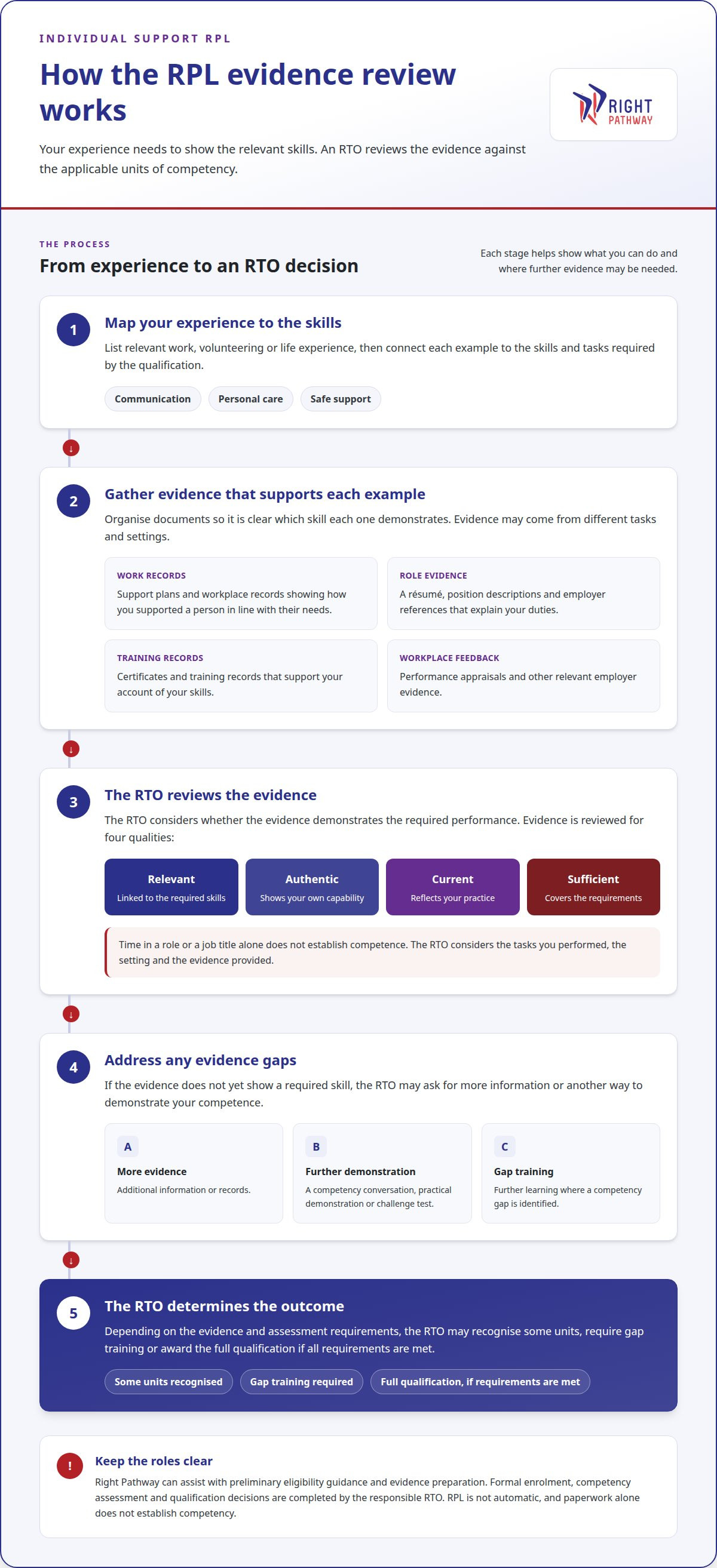
The RTO assesses evidence against the qualification’s units, considering whether it is relevant, authentic, current and sufficient. For example, a support plan and workplace records might show how you support a person with disability in line with their needs. Organise each document so it is clear which skill the example demonstrates.
If the evidence leaves gaps, the RTO may request more information, a competency conversation, a practical demonstration or a challenge test. It may recognise some units, require gap training or award the full qualification if you meet all requirements.
RPL Eligibility and Skills Assessment
Eligibility depends on how your experience matches the required skills, not simply how long you have worked. Examples involving communication, personal care and safe support may be relevant. Tasks completed in an aged-care workplace could demonstrate transferable skills, but the RTO assesses them against the applicable competencies.
Australian RTOs registered to deliver CHC33021 may offer RPL, though availability varies. The RTO completes formal assessment and issues the qualification when its requirements are satisfied. RPL recognition is not automatic, and paperwork alone does not establish competency.
After qualifying, possible roles include disability support, personal care and community support work. Depending on your goals and course entry requirements, you could consider further study, such as Certificate IV-level aged-care study or a Diploma of Community Services. These pathways can support different aims, from developing care skills to moving into broader community-services work.
Recognition of Prior Learning (RPL) eligibility and evidence
RPL eligibility depends on how well your skills and experience match the competencies for CHC33021 Certificate III in Individual Support. Relevant disability, aged care or community support work can help demonstrate that match. Around 6-12 months of consistent care-sector experience may be relevant, but time in a role alone doesn’t establish competence. The RTO considers your evidence, the work you performed and how recently you performed it.
Build an evidence set that shows your practice across different tasks and settings. Useful documents may include:
- A résumé, position descriptions and employer references that explain your duties.
- Training records, certificates and performance appraisals that support your account.
- Workplace evidence showing how you followed individual support plans and communicated with clients or colleagues.
Evidence from recent work can help demonstrate current practice. If your experience does not cover every required competency, the RTO may request more evidence or gap training. RPL can recognise individual units or a full qualification. Credit transfer is different: it recognises equivalent units verified through formal training records, rather than assessing workplace skills.
Queensland funding has separate eligibility rules. According to Queensland Government, Queensland Career Start funding is unavailable to people who completed a Certificate III or higher within the last 10 years, while school qualifications do not count against them. This funding rule concerns access to that programme, not whether your workplace skills meet RPL requirements.
A disability support traineeship may suit you if you’re building experience and want to combine paid employment with structured study. Traineeships typically run for 12 to 24 months. RPL may better suit experienced support workers who can provide current evidence against the qualification’s competencies, while a traineeship provides learning alongside ongoing workplace practice.
To map your experience and documents against a potential pathway, start with a free initial eligibility assessment. It provides preliminary guidance, while the RTO makes the formal assessment decision.
Choosing a pathway based on experience and learning preferences
RPL may suit you if your work history demonstrates relevant skills; a traineeship may suit you if you prefer structured learning alongside employment. Your evidence, experience and preferred way of learning can help you decide which pathway fits.
Pathway for Existing Aged-Care Experience
Residential aged-care experience may support an RPL application when your duties align with the qualification’s competencies. For example, records of helping residents with daily activities can demonstrate applied skills, while a job title alone cannot establish competence. The assessor considers the tasks you performed, the setting and the supporting evidence. Your experience may also highlight areas where further learning is needed.
Workplace and Life Experience as Prior Learning
Prior learning can come from paid work, volunteering or relevant life experience if it demonstrates skills required by the qualification. Supporting a family member, for example, may build communication and practical care experience, but the RTO needs evidence linked to the required competencies. Connect each example to a work task, record or referee who can support your account.
Work Experience and Workplace Hours
Workplace hours matter where a unit specifies practical experience. According to the Australian Government Department of Employment and Workplace Relations, Unit CHCCCS040 requires at least 120 hours of work in an aged care, home and community, disability or community service organisation. This requirement is distinct from simply having a long work history. Check whether your placement or employment records identify the organisation and relevant work completed.
If you learn best through supervised practice and regular study, a traineeship combines employment with formal education. Disability support traineeships typically run for 12 to 24 months. RPL may suit experienced workers whose evidence already reflects the competencies, though an RTO may identify learning gaps.
Risks of Unregistered or Guaranteed-RPL Providers
Only a Registered Training Organisation can take responsibility for formal assessment and issuing a qualification. A guarantee of RPL overlooks the evidence review and competency decision required for each applicant. Before proceeding, identify which RTO will enrol and assess you, and clarify who issues the qualification. A sound pathway relies on demonstrated skills, not a promise of automatic recognition.
Documents for an RPL application
Build your application file so the documents give a clear picture of your work history and responsibilities. For CHC33021, a position description can explain your role, while a supervisor reference can add context about tasks you performed. Use the RTO’s application checklist to organise records in the order requested and identify missing items before submission.
Relevant documents may include:
- A résumé, job descriptions and employer references describing your support duties.
- Certificates, training records and performance appraisals that show learning and workplace feedback.
- Relevant licences and records connected to particular responsibilities.
- Identity documents requested for the application, which may include 100 points of identification.
Keep evidence readable and easy to identify. Where the application accepts digital copies, prepare colour scans and use clear file names, such as “position description” or “training record”. If a document contains several pages, keep them together so the reviewer can follow its context. Store original records securely in case the RTO requests to see them.
Group documents by role or work activity, then note what each item demonstrates. For example, pair a performance appraisal with the related position description if both describe the same duties. A short index can help the RTO locate records without adding unsupported claims about your work. Identify the source of each document, especially when a supervisor or organisation has supplied it.
Before submitting, check that files are legible and complete, and that your personal details are consistent. If names differ across records, include a brief explanation and supporting documents where available. Keep identity documents separate from skills evidence, and leave out unrelated personal information. An orderly application is easier to navigate, but the RTO decides whether the evidence meets its assessment requirements.
Right Pathway
Right Pathway helps you organise your experience and evidence, understand potential eligibility and consider whether RPL or a traineeship better suits your circumstances. A preliminary skills and experience consultation and evidence-readiness review can help you identify useful documents and possible gaps before formal assessment.
Right Pathway provides RPL support and administrative facilitation, not formal competency assessment. The responsible RTO determines enrolment, assesses competency and decides the qualification outcome; it may also request more evidence or training. Preliminary guidance can help you prepare, but it is not a formal RPL decision or a guarantee of recognition.
If you’re ready to discuss your experience and possible next steps, contact Right Pathway through the free initial eligibility assessment.
Take the next step with a clear plan
Before choosing a pathway, consider what you want the qualification to support: continuing in disability support, moving into another care setting or preparing for further study. If you are considering certificate iii in individual support RPL, this goal can focus an initial discussion on your relevant experience and the evidence you can provide.
Right Pathway offers preliminary skills and experience eligibility guidance, evidence-readiness support and RPL administrative facilitation. Its free initial RPL eligibility assessment is an early guide, not a formal competency assessment. The responsible RTO reviews the evidence, conducts formal assessment and decides whether you meet the competency requirements.
Use an initial conversation to clarify a practical pathway and prepare for the RTO’s next steps. Right Pathway can help you find a clear starting point, understand your evidence and move forward with purpose.
Frequently Asked Questions
How do I get a Certificate III in Individual Support (Disability), through RPL or a traineeship?
RPL may suit workers who already perform relevant support duties and can document them. A traineeship may fit better if you want structured study alongside employment. Consider whether you prefer to demonstrate existing skills or build them through supervised learning. Your experience, work arrangements and the RTO’s requirements all shape the pathway.
Can I get my Certificate III in Individual Support through RPL?
Yes. An RTO can issue the qualification through RPL if its formal assessment finds that you meet the relevant competency requirements. Your work history informs the assessment, but time in the sector alone does not establish competence. If some skills are not demonstrated, the RTO may recognise completed units and identify further learning needed for the remaining requirements.
What evidence requirements apply?
Evidence should show what you know and can do in relevant support work. The RTO considers whether it is genuine and sufficiently connected to the competencies being assessed. If a document lacks context, explain your role, the task involved and how you completed it. The assessor may ask follow-up questions to clarify your contribution.
How long does the RPL process take?
There is no single timeframe for every applicant. The duration can depend on how quickly you complete your application, the volume and clarity of your evidence, and whether the RTO requests further assessment or learning. Allow time for both preparation and formal review, rather than assuming submission is the final step.
What evidence can support an RPL portfolio?
Potential portfolio material includes records of your role, training and work practice, such as a position description, performance review or supervisor reference. Choose items that add context instead of submitting duplicates. For example, a reference describing your responsibilities can complement a training record related to those duties. The RTO decides which items it can accept.
What is an RPL qualification?
An RPL qualification is a formal qualification issued by an authorised RTO after it completes its assessment and confirms the required competencies. Recognition of Prior Learning is the pathway for assessing existing knowledge and skills, not a different type of certificate. It is separate from occupational registration and migration skills assessment, which serve different purposes and involve different decisions.

Article by
Right Pathway Team
Right Pathway supports experienced workers, tradespeople and skilled migrants with preliminary RPL eligibility guidance, evidence preparation and qualification pathway navigation.
Right Pathway is not a Registered Training Organisation and does not conduct formal competency assessments or issue qualifications. Formal enrolment, competency assessment and qualification issuance are completed by the responsible Registered Training Organisation.
Start with a free initial RPL eligibility assessment at https://www.rightpathway.com.au/eligibility-check
Disclaimer
Right Pathway is a facilitation and support service only. We are not a Registered Training Organisation (RTO), do not conduct formal RPL assessments and do not issue qualifications. All formal RPL assessments and certifications are completed by partner RTOs regulated by ASQA. Eligibility and qualification outcomes depend on each applicant’s evidence, experience and the RTO’s assessment decision.