

A portfolio can contain strong evidence and still be difficult to assess if its structure obscures what each item proves. Knowing how to build a portfolio for RPL means selecting evidence that is valid, current, sufficient and authentic, then linking each item to the skills and knowledge required for the qualification. Clear labels, a contents page and concise explanations help an assessor follow that connection.
It’s understandable to think that more documents make a stronger application. In practice, relevant evidence with clear context is more useful than a large collection of unrelated or unexplained files. Each sample should show your contribution and make its connection to the qualification requirements easy to understand.
This guide explains how to select and verify evidence, show what your work demonstrates, and organise your portfolio into accessible sections. You’ll also learn how to handle confidential workplace material and prepare for possible follow-up questions or practical demonstrations during the RTO’s formal assessment.
Key Takeaways
- Map evidence to the relevant competency requirements, and make clear what each item demonstrates about your skills and experience.
- Prepare to explain your work, as an RTO may seek further evidence, ask questions or request a practical demonstration.
- Use specific verification from people familiar with your work to add context and support your account of your contribution.
- Arrange documents under clear headings and use a contents page so assessors can find and review evidence efficiently.
How can a professional help build a strong RPL evidence portfolio?
A professional can review workplace records, assess evidence quality and connect examples with qualification requirements. A practical approach to how to build a portfolio for RPL starts with identifying what each item demonstrates, then checking whether the material supports the relevant competency.
-
How a professional gathers work performance evidence
Gather work samples that show your own tasks, decisions and results. A professional can help select relevant reports, project outputs, performance reviews, job descriptions and competency records. For example, a completed report may show the outcome, while a supervisor’s observation can clarify your contribution. Avoid relying on broad workplace documents without explaining your role, the work context and the skills involved.
-
How a professional checks evidence quality
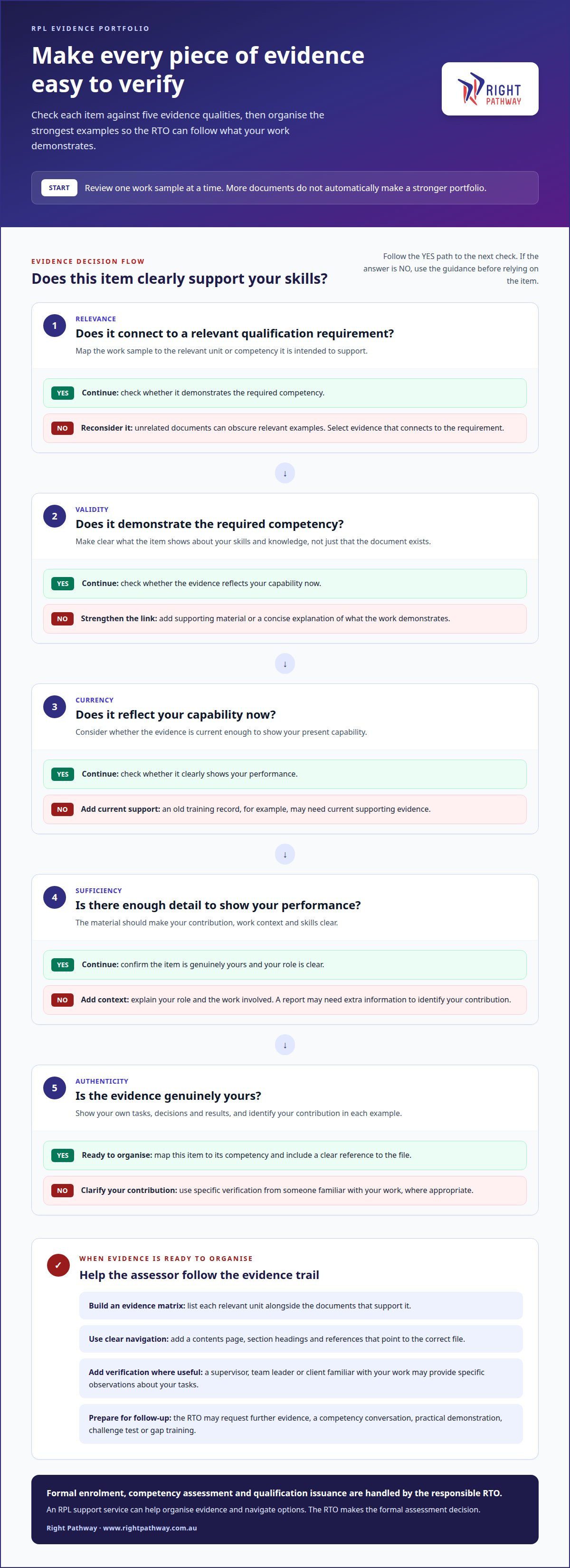
Review each item for relevance, validity, currency, sufficiency and authenticity. Relevant evidence connects to the qualification; valid evidence demonstrates the required competency; current evidence reflects your capability now. Sufficiency means the material clearly shows your performance, while authenticity means it is genuinely yours. An old training record, for example, may need current supporting evidence, and a report may need context that identifies your role.
-
How a professional maps evidence to qualification units
Connect each work sample to the relevant qualification units and explain what it demonstrates. An evidence matrix can list each unit alongside the documents that support it. For instance, a project report may show planning skills, while a performance review adds context. This makes gaps easier to spot and prevents unrelated documents from obscuring relevant examples. Guidance on how to build a portfolio for RPL can help you identify which records support each requirement.
-
Get professional guidance on options for evidence gaps
Address evidence gaps before relying on incomplete documents. If your portfolio does not sufficiently demonstrate competency, the RTO may request more evidence, a practical demonstration or gap training. Credit transfer may be relevant if previous formal study aligns with training requirements. Overseas qualifications and work experience may also be considered when relevant and supported by evidence. The RTO makes the formal assessment decision.
Assessor questions and practical demonstrations
Choose an Australian Registered Training Organisation (RTO) that delivers the relevant qualification, and review its details on training.gov.au. Fees for RTO assessment or required gap training are discussed after eligibility is confirmed. The general assessment timeframe is approximately 4-8 weeks after complete evidence is received.
-
Get support preparing for assessor questions and identifying skill gaps
Prepare to explain how your experience demonstrates each competency. An assessor may ask why you chose a method, how you handled an issue or what outcome followed. Use specific examples from your work rather than memorised general answers. Reviewing possible questions alongside your evidence can reveal where you need a clearer explanation or additional supporting material before formal assessment.
-
Consider Assessment Methods Beyond Documents
Be prepared to demonstrate practical skills if documents alone do not show your competency. Depending on the qualification and evidence, an RTO may use a practical demonstration, competency conversation, challenge test or gap training. For example, a tradesperson may demonstrate a task, while another applicant explains the decisions behind a report. The RTO selects the assessment methods and makes the formal decision.
- Arrange documents so an assessor can move easily from a competency to its supporting evidence. Use clear section labels, a contents page and references that identify your role in each example. Keep related reports and work samples together, and check that every reference points to the correct file. This helps the assessor find information and identify areas that may need further discussion.
The responsible RTO handles formal enrolment, competency assessment and certificate issuance. An RPL support service can help you prepare and organise your evidence, but the RTO makes the assessment decision and issues any qualification.
How a professional arranges verification of work by people familiar with it
- Ask a professional to identify people who directly observed your work, such as a supervisor, team leader or client. They can help prepare a focused request describing the tasks, dates and competencies needing verification. A useful third-party report gives specific observations, not general praise. For example, a supervisor might explain how you followed a workplace procedure and handled an unexpected issue.
- Map each work period to relevant qualification competencies before requesting verification. Comparing your duties with the required skills can help identify which referee can speak to each area. A supervisor who observed you operating equipment may verify that work, while a project manager may confirm planning and reporting tasks. This gives the RTO clearer context for your prior learning.
- Prepare a work and learning timeline using your resume, employment dates, training records and project milestones. A professional can arrange entries chronologically and note changes in responsibilities, workplaces or methods. Include employer details and explain any gaps that affect the evidence story. For example, a timeline can show how an apprentice’s supervised tasks developed into independent work.
- Collect work samples that show your contribution, then connect each one to its context and outcome. Reports, project plans, photographs or completed tasks can demonstrate practical skills. For workplace procedures, explain the task, decisions made and result rather than submitting the procedure alone. Remove sensitive workplace or client information before sharing documents through the approved submission method.
- Gather an up-to-date resume that describes your relevant work experience, duties and learning. Compare its claims with references, statements of service and supporting samples to identify inconsistencies or missing details. Keep dates and job titles consistent across documents. If you’ve worked across short contracts or in self-employment, evidence from several sources can help show the scope of your experience.
How a professional organises portfolio sections with headings and a contents page
- Plan the portfolio’s navigation before adding documents. Create a contents page that names each section and gives its page number or digital file location. Group evidence under practical headings, such as employment history, formal learning, workplace outputs and supporting records. This gives the assessor a clear route through the material instead of an unstructured folder of attachments.
- Use one labelling system throughout the portfolio. Choose descriptive headings and file names that identify both the document and its purpose, such as “Maintenance report, equipment inspection”. Avoid labels like “scan three” or “final version”, which reveal little about the contents. Matching labels across the contents page, digital files and document headers makes cross-referencing more reliable.
- Arrange each section in a predictable order. You might put a brief introduction first, followed by supporting documents ordered by date or topic. Keep the sequence consistent throughout. For example, a work-history section could present an employer record before related position descriptions and project materials, helping the assessor understand how the documents fit together.
- Use concise annotations to guide the reader through complex records. A short note can identify a document’s date, workplace context and your relevant contribution without repeating the entire document. If an item appears in more than one section, cross-reference its original location instead of duplicating it. This keeps the portfolio organised and reduces the risk of conflicting versions.
- Review the assembled portfolio as a navigation tool before submission. Confirm that every contents entry matches a heading, page number or file name, and that digital documents open in the intended order. Keep the same naming convention when updating the portfolio so earlier references remain easy to trace. The aim is a clear, consistent structure that helps the assessor locate relevant material.
Right Pathway
Right Pathway helps you navigate the administrative steps between gathering workplace evidence and entering an RPL process. We support preparation and qualification pathway navigation, while the responsible RTO conducts the formal assessment and decides the outcome.
If you’re weighing up whether your experience is ready to present, the next step is to discuss your circumstances and clarify a suitable pathway. Formal assessment remains with the responsible Registered Training Organisation.
Take the next step towards RPL
Use your portfolio as a practical record of the capabilities you want formally recognised, not simply an archive of past work. As your responsibilities change, keep relevant examples and supporting documents together. This makes it easier to build on your evidence if you pursue another qualification pathway later.
A clear plan for how to build a portfolio for RPL can help you identify what to prepare before formal assessment. Right Pathway provides RPL support and administrative facilitation, including preliminary guidance on your skills and experience and a free initial eligibility check. We can help clarify potential next steps, while the responsible Registered Training Organisation conducts the formal assessment and decides the outcome.
If you’re ready to discuss your experience and possible pathway, take the next step at a pace that suits you.
Your work has value. A well-prepared portfolio can make your experience easier to understand and assess.
Frequently Asked Questions
What is an RPL portfolio?
An RPL portfolio is a collection of evidence showing how your existing skills and knowledge relate to a qualification’s requirements. It can bring together workplace records, training documents and examples of completed work. For instance, a maintenance worker might include a job record alongside a supervisor’s account of their role, giving the assessor more context than either item provides alone.
How can professional RPL portfolio support help strengthen your application?
RPL support can help you identify useful documents, explain their relevance and prepare a more coherent submission. It can also clarify the difference between preliminary evidence guidance and the RTO’s formal assessment. For example, if a work sample does not clearly identify your contribution, support can help you add context or consider other evidence. The RTO decides whether the evidence demonstrates competency.
What evidence types should you include?
Choose evidence that reflects the work you’ve actually performed and the skills being assessed. Depending on your role, useful material may include reports, photographs of completed work, training records, job descriptions, performance reviews or referee comments. A mix can show both the outcome and your involvement. Include only material you can explain, rather than adding documents simply to make the portfolio larger.
What evidence should be included in an RPL portfolio in Australia?
Australian applicants can draw on employment records, statements of service, work samples, relevant licences, training certificates and referee reports. Self-employed workers may also have contracts, invoices or client confirmations that help establish their work history. Protect private or sensitive information before submission, and make sure each item relates to your own work. The RTO considers evidence against the applicable qualification requirements.
How can a professional map work experience and qualifications to Australian competency units?
RPL support can help compare your documented duties and prior study with the competency requirements for a potential qualification pathway. For example, a team leader’s position description may support a claim about coordinating staff, while a project record could show how that work was carried out. This mapping helps identify where evidence supports a requirement and where further information may be needed.
What portfolio formats and evidence requirements do Australian RTOs accept?
RTOs set their own submission instructions, so accepted formats and evidence requirements can differ. A portfolio might be submitted as organised digital files or in another format specified by the RTO. Before submitting, use clear file names, make sure documents open correctly and retain a copy of what you provide. Follow the RTO’s directions for file types and any secure submission method.

Article by
Right Pathway Team
Right Pathway supports experienced workers, tradespeople and skilled migrants with preliminary RPL eligibility guidance, evidence preparation and qualification pathway navigation.
Right Pathway is not a Registered Training Organisation and does not conduct formal competency assessments or issue qualifications. Formal enrolment, competency assessment and qualification issuance are completed by the responsible Registered Training Organisation.
Start with a free initial RPL eligibility assessment at https://www.rightpathway.com.au/eligibility-check
Disclaimer
Right Pathway is a facilitation and support service only. We are not a Registered Training Organisation (RTO), do not conduct formal RPL assessments and do not issue qualifications. All formal RPL assessments and certifications are completed by partner RTOs regulated by ASQA. Eligibility and qualification outcomes depend on each applicant’s evidence, experience and the RTO’s assessment decision.