

Your work experience may already demonstrate skills that formal study would otherwise teach. The benefits of an RPL qualification can include clearer recognition of those skills, a more direct route to a relevant credential, and potential savings in study time and costs. The key is evidence: recognition depends on how your existing skills and knowledge match the requirements of a qualification.
Recognition of Prior Learning (RPL) is a structured process that evaluates skills, knowledge and experience gained through work, training and other learning against the units of competency in an Australian qualification. A Registered Training Organisation (RTO) conducts the formal assessment and decides whether the evidence meets those requirements. Work experience alone doesn’t guarantee a qualification, and additional evidence, practical demonstrations or gap training may be needed.
If you’re weighing up further study or want your practical skills recognised, this guide explains the benefits of an RPL qualification, including how RPL may support career progression and recognise existing capability across Australian industries. It also explains what RPL can and can’t do, and why the quality of your evidence matters.
Key Takeaways
- Identify how formal recognition of your existing skills may support career development or further study.
- Understand how an RTO compares your experience and evidence with the requirements of a qualification.
- See how recognising existing competence may reduce the training required, with time and costs shaped by your evidence and any skills gaps.
- Explore how RPL pathways apply across Australian industries, while keeping qualification recognition separate from licensing or registration.
1. Career advancement and professional development
RPL may help experienced workers apply existing skills to a new career direction. For example, someone moving into construction supervision could draw on experience coordinating tasks, following workplace procedures and supporting colleagues. The qualification must suit both their demonstrated skills and the work they want to pursue. Formal recognition depends on how their evidence matches the qualification’s competency requirements.
A nationally recognised qualification can give employers a clearer record of assessed capability. It may support an application for a role that requires or prefers a formal credential, or help an employee demonstrate readiness for greater responsibility. For example, an aged-care worker seeking a team-leader role could include relevant assessed competencies in their application. A qualification does not guarantee promotion or employment.
RPL may also help you plan further development. If you’re considering a diploma, for example, you can explore whether your previous learning is relevant to a suitable pathway. The benefits of an RPL qualification depend on how your evidence matches the qualification requirements and your career goal. Any skills gaps may mean further learning is needed.
Can RPL affect government funding, licensing, immigration or employment eligibility in Australia? RPL may contribute to gaining a qualification, but it does not determine access to funding, a licence, visa outcomes or a job. Each has separate eligibility requirements. For licensing questions, contact the relevant state or territory regulator.
What are the risks of using an RPL provider, and how can you check it is legitimate? Check whether the organisation conducting the formal assessment is a Registered Training Organisation listed on the National Training Register, which the Australian Government Department of Employment and Workplace Relations says students can use to check provider registration. Also clarify who assesses competence and issues any qualification.
For more context on how RPL may support career development, consider how your existing skills relate to the role or study pathway you’re pursuing.
2. What is Recognition of Prior Learning (RPL)?
Recognition of Prior Learning (RPL) is a formal process for assessing skills, knowledge and experience gained outside, or alongside, structured study. In Australia, a Registered Training Organisation (RTO) compares evidence with relevant units of competency. Learning may come from courses, employment, workshops, volunteering, self-directed study or other life experience. This means a tradesperson’s prior learning can be relevant even when it happened outside a classroom.
A tradesperson’s evidence might include work samples, job descriptions, references, certificates or records of completed projects. For example, a welder could submit work examples and records showing how their skills align with the required competencies. Evidence needs to be authentic, current and relevant. Time spent working in a trade alone does not prove that every unit’s requirements have been met.
The process starts by identifying a suitable qualification and mapping your skills and experience against its requirements. The responsible RTO reviews the evidence and may ask questions, request further documents or arrange a practical demonstration. If the evidence reveals gaps, further training may be needed. The RTO decides whether you have met the requirements for a nationally recognised qualification, and its assessment may also clarify what learning remains.
RPL differs from credit transfer. Credit transfer recognises relevant units completed through formal training, while RPL assesses competence gained through work and other learning. Both can contribute towards a qualification, but they rely on different evidence. RPL lets tradespeople have practical skills assessed against formal standards, which may support professional development without repeating learning they can already demonstrate.
To explore whether your trade experience may suit a qualification pathway, start with a preliminary RPL eligibility check. This is guidance on potential suitability, not the RTO’s formal assessment or decision.
3. Potential time and cost savings compared with traditional study
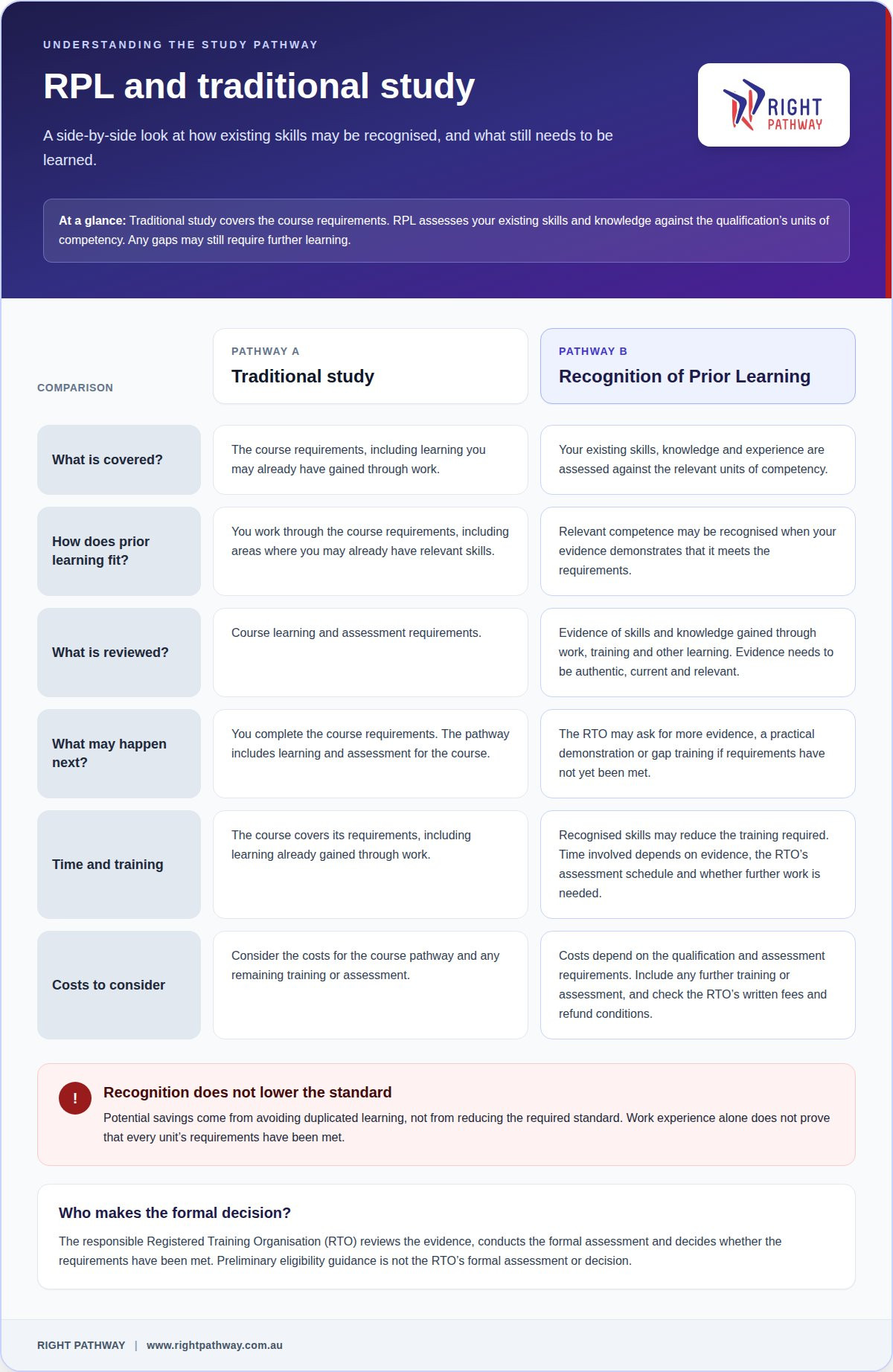
Traditional study covers the course requirements, including learning you may already have gained through work. RPL assesses existing knowledge and skills against the qualification’s competencies. If the responsible RTO finds that your skills meet those requirements, it can recognise them rather than require you to repeat the same learning. This may reduce the training required, but any identified gaps still need to be addressed.
How long does RPL take compared with completing a course? There is no single timeframe for every pathway. The time involved depends on how quickly you provide complete evidence, the responsible RTO’s assessment schedule and whether further evidence, demonstrations or gap training are needed.
RPL costs in Australia depend on the qualification and assessment requirements. Refunds depend on the relevant RTO’s terms, so review its written fees and refund conditions before enrolling. When comparing a study pathway, include any remaining training or assessment costs, not only the initial fee. These RPL cost factors help frame the comparison.
Potential savings come from avoiding duplicated learning, not from lowering the required standard. An experienced worker who demonstrates relevant knowledge, for example, may need less training than someone learning those skills through a course. The responsible RTO still assesses competence, and any gaps affect the training required.
A formal qualification may be relevant when employers require or prefer a credential for a role. An experienced worker applying for a supervisory position, for example, could present an assessed qualification alongside their workplace experience. This may support their application, but it does not establish a particular salary or guarantee employment. Employers consider the role’s requirements and the candidate’s broader experience.
Compare the full pathway, including any training still required, time away from work, evidence preparation and assessment tasks. This gives you a practical basis for deciding whether RPL suits your circumstances or structured study better meets your learning needs.
4. RPL qualifications across Australian industries
In Australia, RPL may be relevant in industries where a qualification aligns with a worker’s duties and experience. Potential pathways include construction, mining, automotive, healthcare, aged care, community services, hospitality, retail, business and management. The right qualification depends on the work performed and the competencies it covers, not simply the industry or job title.
The most useful evidence depends on the work. A construction worker might provide project records and role descriptions, while a hospitality worker’s workplace procedures and task records may better show relevant skills. In community services, records of responsibilities and professional references may help explain the scope of a person’s work. The responsible RTO considers whether the evidence is authentic, current and relevant to the competencies being assessed.
Industry requirements shape how evidence is assessed. A portfolio that describes duties but does not show how the work was performed may leave gaps for the responsible RTO to explore. It may ask questions, request further records or arrange a practical demonstration. This helps the assessment focus on demonstrated skills against the qualification requirements, rather than relying on a general claim of experience.
A nationally recognised qualification provides formal evidence of assessed competence, but it does not automatically grant an occupational licence, professional registration or permission to perform regulated work. A worker may hold a relevant qualification and still need to meet separate requirements for a regulated role. Licensing rules vary by occupation and state or territory, so treat qualification recognition and permission to practise as separate matters.
To decide whether an industry pathway fits, compare the qualification’s competencies with your actual responsibilities and the evidence those duties produce. Experience from another sector may also be relevant if your skills match the new pathway’s requirements. This comparison can show which capabilities your work history demonstrates and where you may need further learning or evidence.
Right Pathway
Right Pathway helps experienced workers understand how their skills and evidence may align with an Australian qualification. Its RPL support includes preliminary skills and experience eligibility guidance, an evidence-readiness review, evidence-preparation guidance and help navigating qualification pathways.
This support can help if you’re unsure which qualification relates to your work, what evidence may be relevant or what steps come next. Right Pathway’s free initial RPL eligibility assessment provides preliminary guidance, not a formal competency assessment. The responsible Registered Training Organisation conducts the formal assessment and decides on enrolment, recognition and qualification issuance.
RPL relies on authentic, current and relevant evidence that meets the qualification’s requirements. Right Pathway can help you understand the next steps while making the RTO’s role clear. Contact Right Pathway for a free initial eligibility assessment.
Choose your next step with purpose
Before pursuing RPL, define the work you want to do and the credential that role requires. This gives you a practical basis for considering a qualification, rather than pursuing one simply because you have extensive experience.
Be clear about what you want the qualification to support, such as applying for a particular role, progressing at work or preparing for further study. The benefits of an RPL qualification are most relevant when the pathway matches that goal and your evidence can demonstrate the required competencies.
Use your goal to guide a focused discussion about your skills, experience and possible pathway. Right Pathway provides preliminary eligibility guidance and administrative support. The partner RTO conducts the formal assessment and decides whether you meet the requirements for a qualification.
A clear goal is a practical place to begin. Take the next step when you’re ready to explore your options.
Frequently Asked Questions
What is Recognition of Prior Learning (RPL)?
Recognition of Prior Learning (RPL) is a way to have existing capability assessed against an Australian qualification’s requirements. The RTO conducting the assessment reviews evidence of learning gained at work or through other experience, then decides which competencies you have demonstrated. For example, a mechanic’s work records may support their application, but the RTO may request more evidence or a practical demonstration.
What are the benefits of RPL for tradespeople?
For tradespeople, the benefits of an RPL qualification may include:
- Recognition of practical skills
- Less repeated learning
- A clearer record of competence
- Support for career progression
- Evidence for role applications
- A pathway to further study
- Identification of skill gaps
- Greater clarity about next steps
Which benefits apply depends on the qualification and the evidence assessed by the RTO.
Are there any limitations to RPL?
Yes. RPL recognises only competencies supported by sufficient, authentic and relevant evidence. Experience alone may not demonstrate every required skill, so the RTO conducting the assessment may ask for more documents, a competency conversation or a practical demonstration. RPL does not itself provide a trade licence, professional registration, employment or a migration outcome. Each has separate requirements.
Can I pursue further study after obtaining an RPL qualification?
Yes, an RPL qualification may support an application for further study, depending on the course and education provider’s entry requirements. A completed vocational qualification, for instance, may be relevant when applying for a higher-level course. It does not guarantee admission or exemption from prerequisites. The education provider decides how it recognises prior qualifications and what additional requirements apply.
How can I get credit for my previous work experience and education?
Start by identifying a qualification that matches your experience, then gather evidence linked to its requirements. Work records, references, project samples and job descriptions can help demonstrate practical skills. If you have completed formal study, include relevant qualification or unit records too. The RTO conducting the assessment assesses RPL evidence; credit transfer applies to previously completed formal units.
Is RPL equivalent to a formal qualification?
RPL is an assessment pathway, not a separate type of qualification. If the responsible RTO finds that you meet the requirements for a complete qualification, it can issue that qualification through its formal processes. If you demonstrate only some competencies, the outcome may differ. A qualification issued after successful RPL is distinct from a licence or professional registration.

Article by
Right Pathway Team
Right Pathway supports experienced workers, tradespeople and skilled migrants with preliminary RPL eligibility guidance, evidence preparation and qualification pathway navigation.
Right Pathway is not a Registered Training Organisation and does not conduct formal competency assessments or issue qualifications. Formal enrolment, competency assessment and qualification issuance are completed by the responsible Registered Training Organisation.
Start with a free initial RPL eligibility assessment at https://www.rightpathway.com.au/eligibility-check
Disclaimer
Right Pathway is a facilitation and support service only. We are not a Registered Training Organisation (RTO), do not conduct formal RPL assessments and do not issue qualifications. All formal RPL assessments and certifications are completed by partner RTOs regulated by ASQA. Eligibility and qualification outcomes depend on each applicant’s evidence, experience and the RTO’s assessment decision.