

What matters for RPL eligibility is not simply how long you have worked, but how your skills and knowledge match formal competency requirements. This RPL eligibility checklist can help you consider whether your experience is relevant and what evidence might support it. Your experience needs to align with applicable units of competency, supported by evidence that is relevant, authentic, current and sufficient.
It can be hard to tell whether your day-to-day tasks count, or which records best explain your work. A practical checklist helps you identify where your experience appears to fit, where evidence may be missing, and what to organise before considering next steps. It is a starting point, not a prediction of the formal assessment outcome.
This guide will help you review your experience, sort useful evidence such as work records and examples, and understand the difference between preliminary eligibility guidance and a formal RPL assessment. The responsible Registered Training Organisation (RTO) makes the formal assessment decision and may request further evidence or a practical demonstration.
Key Takeaways
- Use the RPL eligibility checklist to compare your practical tasks, decisions and responsibilities with relevant competency requirements.
- Sort work records, project examples and supporting documents by competency area to identify evidence gaps more easily.
- Keep preliminary guidance, the RTO’s formal assessment and a qualification outcome distinct. They are separate steps, and an outcome is not guaranteed.
- Choose a relevant qualification area, organise genuine work examples and note any gaps before deciding on your next steps.
RPL eligibility checklist: five questions to screen your experience
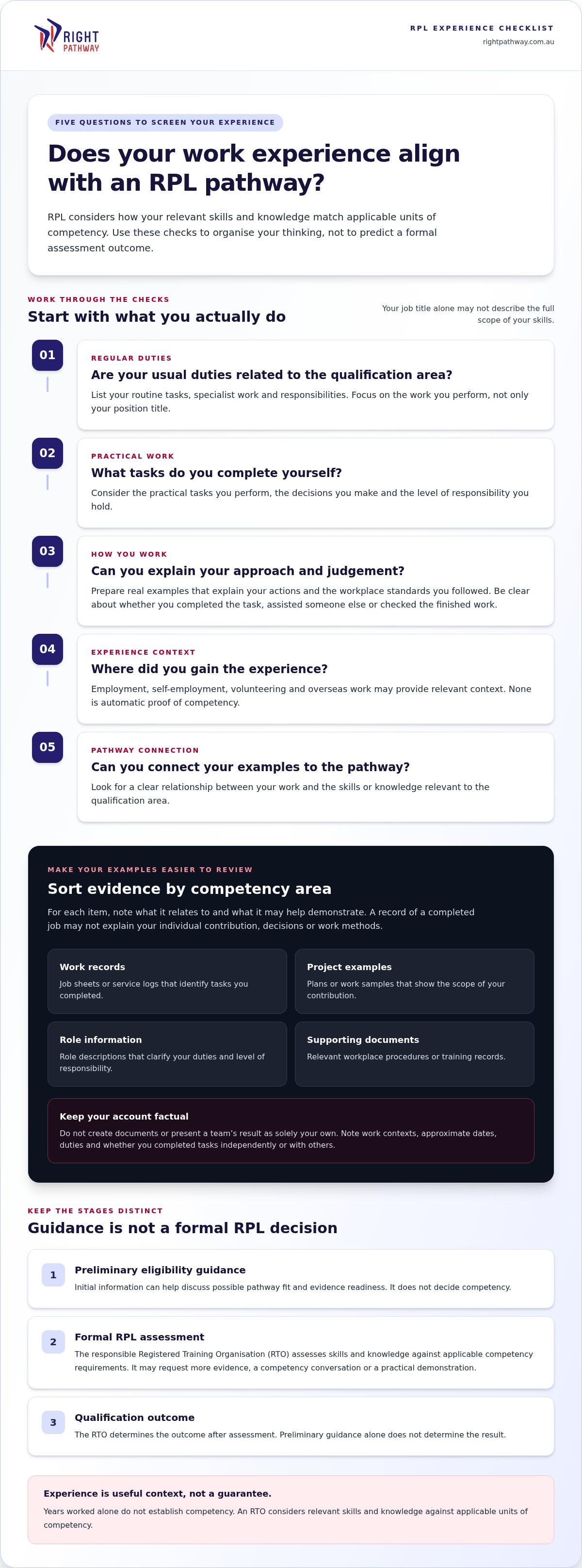
RPL eligibility is explored by comparing your relevant skills and experience with the requirements of applicable units of competency. Use this RPL eligibility checklist to decide whether your background may be worth discussing, not to predict a formal result.
- Are your regular duties related to the qualification area? Write down the tasks you perform, including specialist work and responsibilities. Your job title alone may not describe your actual duties.
- Have you performed practical tasks? Consider what you complete yourself, the decisions you make and the level of responsibility you hold.
- Can you explain how you do the work? Prepare examples that show your approach, judgement and how you follow relevant workplace standards.
- Where did you gain the experience? Employment, self-employment, volunteering and overseas work may all provide relevant context, but none is automatic proof of competency.
- Can you connect your examples to the pathway? Look for a clear relationship between your work and the skills or knowledge relevant to the qualification area.
Does your work experience match the qualification area?
Make a short list of routine duties, less frequent specialist tasks and decisions you are trusted to make. For example, coordinating job schedules may involve planning responsibilities, but the job title alone will not show the full scope of your skills. An RTO considers your relevant knowledge and skills against applicable units of competency. Right Pathway’s RPL pathway guidance can help you consider how your experience may relate to a qualification area.
Can you describe what you know and do?
Choose real examples and describe the task, your actions, the decisions involved and the standards you followed. Be specific about your own role, especially if the work was shared. For example, explain whether you completed a task, assisted someone else or checked the finished work. An initial match is a reason to explore a pathway, not a formal eligibility decision. Years worked can provide useful context, but they do not establish competency or guarantee an outcome on their own.
RPL evidence checklist: organise proof that demonstrates competency
Evidence helps an RTO consider whether your skills and knowledge align with relevant competency requirements. Group your material by competency area so it is easier to see what each item may demonstrate. A document showing a completed job can confirm the result, but it may not explain your individual contribution, decisions or work methods.
Start by grouping available material, such as:
- work records, job sheets or service logs that identify tasks you completed;
- project examples, plans or work samples that show the scope of your contribution;
- role descriptions that clarify your duties and level of responsibility;
- supporting documents, such as relevant workplace procedures or training records.
For each item, note what it relates to and what it may help demonstrate. For example, a job sheet may record the work completed, while a short explanation can clarify which parts you performed and how you approached them. Keep claims factual. Do not create documents or present a team’s result as solely your own.
What should you record before seeking guidance?
Note employers or work contexts, approximate dates, duties and examples of completed work. Add enough detail to distinguish routine tasks from specialist work, and state whether you completed each task independently or with others. For trade experience, record the types of jobs you handled and the responsibilities involved. This creates a useful reference when discussing how your background may relate to a pathway.
How can you spot evidence gaps early?
Create a simple mapping table with three columns: the competency area, a possible supporting item and any detail that still needs explanation. Mark areas with clear examples separately from those where evidence is limited, out of date or unclear. An RTO may request more material or an assessment activity, such as a competency conversation or practical demonstration. The RPL process outlines the stages that may follow as your information is reviewed.
RPL eligibility is not a qualification guarantee: understand the checks
An early indication that your experience may align with a pathway is not a qualification outcome. These stages have different purposes and decision-makers:
What does a free initial eligibility assessment tell you?
Right Pathway reviews the initial information you provide and can discuss potential pathway options and evidence preparation. This preliminary guidance can help you understand what may be worth exploring, but it is not a formal RPL assessment and does not confirm eligibility or guarantee an outcome. The responsible RTO’s assessment process is separate.
Who makes the formal RPL decision?
The responsible RTO conducts the formal assessment and decides whether your evidence demonstrates the required competency. It may request further material, a competency conversation, practical demonstration or challenge test. If the assessment identifies gaps, gap training may be discussed.
Keep related processes distinct. Credit transfer recognises previously completed formal study, while RPL considers skills and knowledge gained through experience. An RPL qualification is not a trade licence, professional registration or migration skills assessment. Each serves a different purpose, and an RPL qualification by itself does not guarantee a licence, registration, visa or employment outcome.
After the RPL eligibility checklist: prepare your next steps
Use your RPL eligibility checklist to turn an initial impression into a practical plan. Keep the first steps simple and evidence-led:
- Select a relevant qualification area that reflects the work you actually perform.
- Organise genuine work examples and note your duties, decisions and contribution.
- Identify evidence gaps or examples that need more context.
- Seek preliminary guidance to discuss potential pathways and what may be needed next.
Keep every claim factual. Describe your own responsibilities accurately, and do not create documents or present team outcomes as solely your work. This preparation can make a discussion about your experience more focused, but it does not replace the RTO’s formal assessment.
What information should you have ready?
Prepare a concise work history with employers or work contexts, approximate dates and main duties. Add a few relevant examples that show the type of work you completed, along with a brief outline of supporting evidence you already have. You do not need to send sensitive documents before you understand the process or know what information is relevant. Start with a clear summary, then organise further material as appropriate.
Take a considered first step with Right Pathway
Right Pathway can review your initial information and provide preliminary eligibility guidance, evidence preparation support and qualification pathway navigation. This can help clarify potential next steps, subject to your evidence and the responsible RTO’s requirements. For general queries before you proceed, browse these RPL questions and answers. The formal competency assessment and any qualification decision remain with the responsible RTO.
When you are ready, complete Right Pathway’s free initial eligibility assessment to discuss your experience and potential next steps. It is a preliminary review, not a formal RPL assessment or a guarantee of an outcome.
Take your next step with a clearer picture
Your RPL eligibility checklist can help turn uncertainty into a practical starting point. You do not need to have every record in hand before exploring a pathway. A clear account of your work, responsibilities and examples can help identify what may align and where further evidence could be needed.
Right Pathway supports preliminary guidance, evidence preparation and qualification pathway navigation. The company has supported over 2,000 applicants across 18 industries. This support can help you organise your next steps, while the responsible RTO remains responsible for formal assessment and decisions.
Start with what you know, be accurate about your experience, and take the next step when you are ready. A considered beginning can make the pathway ahead clearer.
Frequently Asked Questions
Can I be eligible for RPL if I am self-employed?
Yes, self-employed experience may be relevant if it demonstrates skills and knowledge connected to the applicable competency requirements. Note the types of jobs you completed, your responsibilities and how you carried out the work. Invoices or contracts may show work history, while work samples or client feedback may help explain your contribution. The RTO decides whether the evidence is suitable for formal assessment.
Can overseas work experience count towards RPL in Australia?
Yes, overseas experience may be considered if it relates to the relevant competency requirements and can be supported with evidence. Explain unfamiliar job titles, workplace practices or technical terms so your responsibilities are clear. Records from employers, projects or clients can help provide context. The RPL eligibility checklist can help you identify experience to discuss, but an Australian RTO makes the formal assessment decision.
Does older work experience count for RPL?
Older experience may be relevant, but its age alone does not establish that it demonstrates current competency. Describe the work accurately and consider whether you can still provide reliable examples or records. If your work practices have changed since then, newer examples may help show how your skills apply now. The RTO considers the evidence against applicable requirements rather than relying on time served alone.
Do I need to have held the exact job title for RPL?
No, an exact job title is not the only way to show relevant experience. Titles vary between employers, so explain the scope of your role, the tasks you personally handled and the decisions you were authorised to make. For example, clarify whether you assisted with a task, completed it independently or checked another person’s work. This gives the RTO clearer context than a title alone.
Is Right Pathway’s free eligibility check a formal RPL assessment?
No, it is a preliminary review of the information you provide, not a formal RPL assessment. Right Pathway can offer initial pathway guidance and help you consider evidence preparation. The responsible Registered Training Organisation (RTO) conducts the formal competency assessment and decides the outcome. It may request further evidence or assessment activities before reaching a decision, so the initial check does not guarantee an outcome.

Article by
Right Pathway Team
Right Pathway supports experienced workers, tradespeople and skilled migrants with preliminary RPL eligibility guidance, evidence preparation and qualification pathway navigation.
Right Pathway is not a Registered Training Organisation and does not conduct formal competency assessments or issue qualifications. Formal enrolment, competency assessment and qualification issuance are completed by the responsible Registered Training Organisation.
Start with a free initial RPL eligibility assessment at https://www.rightpathway.com.au/eligibility-check
Disclaimer
Right Pathway is a facilitation and support service only. We are not a Registered Training Organisation (RTO), do not conduct formal RPL assessments and do not issue qualifications. All formal RPL assessments and certifications are completed by partner RTOs regulated by ASQA. Eligibility and qualification outcomes depend on each applicant’s evidence, experience and the RTO’s assessment decision.


