

The cheaper pathway isn’t always the one with the lower upfront fee. If you’re asking, is RPL cheaper than studying, it can be when your experience and evidence already demonstrate the required competencies. However, gaps in your evidence or skills may lead to further assessment or training, which can change the overall cost.
Compare more than course fees. Through RPL, an RTO assesses your relevant skills, knowledge and experience against the qualification requirements. Study involves learning through a course, with its own fees and time commitments. The responsible RTO sets its fees and decides what assessment or training is needed.
This guide compares the costs and commitments of each pathway, including evidence preparation, possible extra requirements and study time. You’ll also learn when a mix of RPL and gap training may be worth considering. By the end, you can weigh your experience and evidence against the likely requirements without assuming you’re eligible or that either pathway guarantees a particular result.
Key Takeaways
- RPL may cost less than studying when your experience and evidence cover the required competencies, but extra assessment or gap training can affect the total cost.
- To judge whether RPL is cheaper than studying in your situation, compare fees alongside time commitments, evidence preparation and possible additional requirements.
- Start by identifying the qualification outcome you need, then check its current status on training.gov.au and compare your experience with its competency requirements.
- Preliminary eligibility guidance can help you explore possible next steps. The responsible RTO makes the formal assessment decision and may request further evidence or training.
Is RPL Cheaper Than Studying? Start with What You Are Comparing
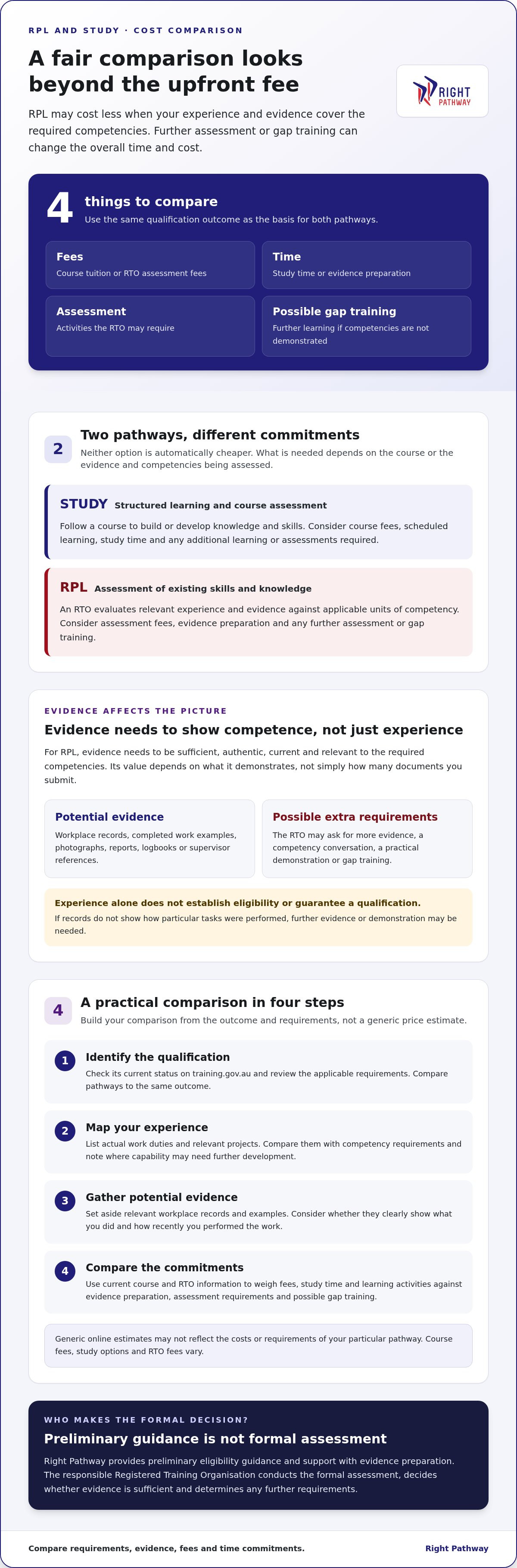
RPL may cost less than studying, but the result depends on your circumstances. Compare more than the upfront fee: include the time you’ll spend studying or preparing evidence, as well as any additional assessment or training that may be needed. To work out whether RPL is cheaper than studying for you, compare the pathways to the same qualification outcome and consider the requirements of each.
What costs belong in a fair comparison?
Separate direct fees from the time commitment. Study may involve course fees and scheduled learning. RPL involves an RTO assessing your skills and knowledge against the applicable units of competency, and preparing evidence also takes time. Course fees, study options and RTO fees vary. A general online estimate may not reflect the requirements or costs of your particular pathway.
For a clearer comparison, consider:
- course tuition or RTO assessment fees;
- time spent studying or preparing evidence;
- assessment activities the RTO may require; and
- possible gap training if you haven’t demonstrated some competencies.
For more detail on factors that can influence fees, read RPL cost factors in Australia.
Why RPL is not automatically the cheaper option
RPL isn’t based on years worked alone. An RTO needs sufficient, authentic, current and relevant evidence mapped to the required competencies. If your documents don’t show how you perform particular tasks, the RTO may ask for more evidence, a competency conversation or a practical demonstration. If there are skill gaps, further training may be needed, affecting the overall time and cost.
For example, a tradesperson may have substantial site experience but limited records of particular tasks. That experience is relevant, but it doesn’t establish eligibility or guarantee a qualification. Right Pathway provides preliminary guidance and support with evidence preparation. The responsible RTO makes the formal assessment decision. Learn more about the RPL pathway.
RPL vs Study: How Evidence and Competency Assessment Affect Value
The value of RPL depends partly on how clearly your evidence demonstrates the required competencies. Study provides structured learning and assessment. With RPL, an RTO evaluates your relevant skills and knowledge against the applicable units of competency.
| Factor | Study | RPL |
|---|---|---|
| Learning | Follow a course to build or develop knowledge and skills. | Recognition is based on relevant skills and knowledge already gained. |
| Evidence | Complete learning activities and provide evidence required by the course. | Submit evidence that demonstrates your existing competence. |
| Assessment | Complete the assessments set as part of the course. | The RTO maps and assesses your evidence against relevant units. |
| Possible extra requirements | Complete any additional learning or assessments required by the course. | The RTO may request further evidence, a competency conversation, a practical demonstration or gap training. |
When existing evidence may make RPL better value
Workplace records, completed work examples, photographs, reports, logbooks or supervisor references may help show what you can do. These are examples, not a fixed checklist. Evidence needs to be authentic, current, relevant and sufficient for the competencies being assessed. Its value depends on what it demonstrates, not simply how many documents you submit. For a general overview of recognising skills gained outside formal education, see Benefits of RPL from PriorLearning.ie.
When study or gap training may still be needed
If your evidence doesn’t cover a competency, the RTO may seek more evidence or ask you to demonstrate your skills. Where a gap remains, training may be needed. Paperwork alone can’t replace demonstrated competence. This can affect the time and overall cost of an RPL pathway, so weigh your evidence against the required outcomes. Read how the RPL process works for more detail, or use a free initial eligibility assessment to explore possible next steps. Right Pathway provides preliminary guidance, not formal assessment.
How to Compare RPL and Study for Your Own Circumstances
Start with the outcome you need, not a general price estimate. A qualification’s current status and requirements shape what you’ll need to study or demonstrate through RPL. RPL value depends on how well your evidence covers the required competencies.
A practical comparison in four steps
- Identify the qualification. Search training.gov.au to check its current status and review the applicable requirements. Make sure you’re comparing pathways to the same outcome.
- Map your experience. List your actual work duties and relevant projects, then compare them with the competency requirements. Note where you have direct experience and where you may need to develop your capability further.
- Gather potential evidence. Set aside relevant workplace records and examples that could support your claims. Consider whether they clearly show what you did and how recently you performed the work. The RTO decides whether the evidence is sufficient and may require other assessment activities.
- Compare the commitments. Use current course and RTO information to compare fees, study time and learning activities with evidence preparation, assessment requirements and possible gap training. Don’t treat generic online estimates as a quote for your circumstances.
Questions to resolve before choosing a pathway
Ask yourself whether you need structured learning to build knowledge, or whether you already have relevant workplace capability that you can support with evidence. Consider whether you can set aside time to study, prepare supporting material or take part in an assessment activity. If key competencies aren’t covered, an RTO may require further assessment or training, so include that possibility in your comparison.
Read about the benefits of RPL as factors to weigh, not guaranteed savings. Right Pathway can provide preliminary eligibility guidance and help you consider potential evidence and pathway options. The responsible RTO makes the formal assessment decision.
Choose Your Next Step: Eligibility Guidance Before an RPL Decision
RPL may be worth exploring if your relevant skills and experience appear to match the qualification requirements and you can support them with suitable evidence. Study or additional training may be a better fit if you need to build capability, prefer structured learning or have gaps you can’t yet demonstrate. So, is RPL cheaper than studying for you? That depends on the evidence and requirements the responsible RTO considers, not experience alone.
What the free initial eligibility assessment can clarify
Right Pathway offers a free initial eligibility assessment based on the information you provide. It’s preliminary guidance, not a formal RPL assessment. Right Pathway can help you consider your experience, prepare evidence and navigate potential qualification pathways, then discuss possible next steps subject to the evidence available and RTO requirements.
Keep expectations realistic before proceeding
The responsible Registered Training Organisation handles formal enrolment and competency assessment, decides whether your evidence meets the required units, and issues any qualification. It may request more evidence, a competency conversation, a practical demonstration or gap training. An eligibility check doesn’t guarantee RTO enrolment, recognition or a qualification.
If you’re still weighing the options, explore this RPL Australia guide for broader information about the recognition pathway. Then consider whether your evidence is ready and what you still need to establish. Preliminary guidance can help you understand possible next steps without assuming a particular outcome.
Make a Confident, Informed Next Move
So, is RPL cheaper than studying? It may be when your existing skills and evidence address the qualification’s requirements, but extra assessment or gap training can change the overall cost. Compare fees alongside study time, evidence preparation and possible assessment activities. Then consider whether you need structured learning or can demonstrate relevant capability gained at work.
Use current information about the qualification and the responsible RTO’s requirements rather than relying on generic estimates. Right Pathway has supported over 2,000 applicants across 18 industries. The team can help you prepare evidence and navigate potential qualification pathways, while the responsible Registered Training Organisation conducts the formal assessment and decides whether a qualification can be issued. An initial eligibility assessment offers preliminary guidance, not a formal assessment or guaranteed outcome.
Start with your experience, the evidence you can provide and the qualification outcome you need. A clearer view of the requirements helps you weigh your options and choose a sensible next step.
Frequently Asked Questions
Is RPL cheaper than studying in Australia?
RPL can cost less than studying, but it depends on your evidence, the RTO’s assessment requirements, course fees and whether gap training is needed. Compare the full pathway, including time spent studying or preparing evidence, rather than assuming RPL will save money. The responsible RTO sets its fees and decides what further assessment or training may be required.
How much does RPL cost compared with a course?
There’s no single price for RPL or a course. Fees vary by qualification and RTO, and current study costs or funding may depend on the course and your circumstances. Right Pathway supports evidence preparation and pathway navigation, while the responsible RTO sets its fees and conducts formal assessment. Review current RPL cost information and compare it with course details from the relevant provider.
Can I get a qualification through RPL without studying?
Possibly, if the RTO is satisfied that your evidence demonstrates the required competencies. RPL assesses relevant skills and knowledge against the applicable units, rather than providing training. The RTO may still request more evidence, a competency conversation or a practical demonstration, and may identify a need for gap training. Work experience alone doesn’t guarantee eligibility or a qualification.
What happens if my RPL evidence does not cover every competency?
The RTO may ask you to provide further evidence or demonstrate your skills another way. Depending on the assessment, this could involve a competency conversation, practical demonstration or challenge test. If a competency gap remains, the RTO may require gap training. The appropriate next step depends on what your evidence shows and the RTO’s assessment of the relevant requirements.

Article by
Right Pathway Team
Right Pathway supports experienced workers, tradespeople and skilled migrants with preliminary RPL eligibility guidance, evidence preparation and qualification pathway navigation.
Right Pathway is not a Registered Training Organisation and does not conduct formal competency assessments or issue qualifications. Formal enrolment, competency assessment and qualification issuance are completed by the responsible Registered Training Organisation.
Start with a free initial RPL eligibility assessment at https://www.rightpathway.com.au/eligibility-check
Disclaimer
Right Pathway is a facilitation and support service only. We are not a Registered Training Organisation (RTO), do not conduct formal RPL assessments and do not issue qualifications. All formal RPL assessments and certifications are completed by partner RTOs regulated by ASQA. Eligibility and qualification outcomes depend on each applicant’s evidence, experience and the RTO’s assessment decision.


