

A long mining work history doesn’t automatically point to the right qualification. The best-fit pathway for RPL mining qualifications depends on how your actual duties, skills and knowledge align with the requirements of a current qualification, not simply how long you’ve worked on site.
It’s understandable to be unsure where your experience fits, particularly when qualifications, competency assessments and site tickets serve different purposes. Recognition of Prior Learning (RPL) compares your skills and experience with the applicable units of competency. The responsible Registered Training Organisation (RTO) needs sufficient, authentic, current and relevant evidence to assess that match. Work history alone may not be enough.
This guide explains how to identify a potential qualification pathway based on your mining role, organise evidence that may demonstrate your competence, and prepare for further assessment if the RTO requests it. Right Pathway supports preliminary eligibility guidance, evidence preparation and pathway navigation. The responsible RTO handles formal enrolment and assessment and makes the final decision.
Key Takeaways
- Compare your day-to-day duties and level of responsibility with current qualification requirements to narrow down a suitable pathway.
- Choose a potential RPL pathway based on the skills you can demonstrate, not simply the number of years you’ve worked.
- Organise authentic, current, relevant and sufficient evidence to show how your experience matches the competencies being assessed.
- Clarify your qualification goal and prepare details of your experience before exploring preliminary eligibility and possible next steps.
RPL mining qualifications: what pathway are you comparing?
Mining-industry RPL is a formal process in which an RTO assesses your relevant skills and knowledge against the units of competency in a current qualification. A suitable pathway depends on the work you do, what you can demonstrate, the evidence available and the qualification’s requirements.
RPL mining qualifications aren’t selected by job title or years on site alone. The key is whether your actual responsibilities align with the competencies required. Right Pathway can help you explore RPL support and qualification pathways and consider how your experience may fit.
When does mining experience point towards an RPL qualification?
Operational experience might include carrying out production tasks or using equipment. Maintenance experience may involve inspecting, servicing or fault-finding. Supervisory responsibilities can include coordinating work or applying site procedures. These are starting points for exploring a pathway, not proof of a match. A job title describes a role, but doesn’t show that you’ve demonstrated every competency in a qualification. The RTO assesses your evidence against the applicable requirements.
How does a qualification differ from a site ticket?
A formal qualification recognises competency across its specified requirements. A site induction covers local safety and site procedures, while a ticket or workplace competency record may relate to particular equipment, tasks or authorisations. They serve different purposes and aren’t interchangeable. Relevant tickets or records may help show your experience, but they don’t automatically amount to a qualification.
A qualification also doesn’t automatically grant an occupational licence or authorise regulated work. Licensing and work authorisations are separate matters, and requirements can depend on the relevant regulator and jurisdiction. Keep your qualification goal distinct from any site access or role-specific requirements that may also apply.
How to compare mining qualifications against your actual duties
Start with the work you perform, then compare it with the competencies in a suitable current qualification. One task, machine or responsibility won’t establish a match across the whole qualification. For RPL mining qualifications, consider the range of your duties, your level of responsibility and the knowledge you can explain, then identify evidence that supports each area.
Which parts of your work history matter to pathway fit?
Write down your recurring duties, the equipment or processes you work with, and the decisions you’re responsible for. Focus on what you can do, not just time served. For example, operating equipment may be one part of your experience. Planning work, responding to changing conditions or coordinating tasks may demonstrate different skills. Use these examples to investigate competency fit, not to assume a particular qualification is suitable.
- Operational work: Describe the tasks and processes you perform. Note records that could support your account, such as task documentation or work records, and compare your experience with relevant operational competencies.
- Maintenance work: List inspection, servicing or fault-finding tasks. Identify related job records or supervisor reports, then consider which requirements they may help demonstrate.
- Supervisory work: Describe how you coordinate work, make decisions and apply procedures. Consider whether work plans, reports or other relevant records support those responsibilities.
Use these examples as prompts, not as a checklist for an outcome. Evidence for one task won’t necessarily demonstrate the wider set of competencies. The RTO assesses your evidence against the applicable qualification requirements.
How do you check a qualification is current?
Before settling on a pathway, use the National Register at training.gov.au to verify the exact qualification title, code and status. Don’t assume an older qualification is still current or guess its replacement. You can also read the register’s guidance on how to identify genuine RPL when considering the process and the RTO’s role.
What evidence supports RPL for mining qualifications?
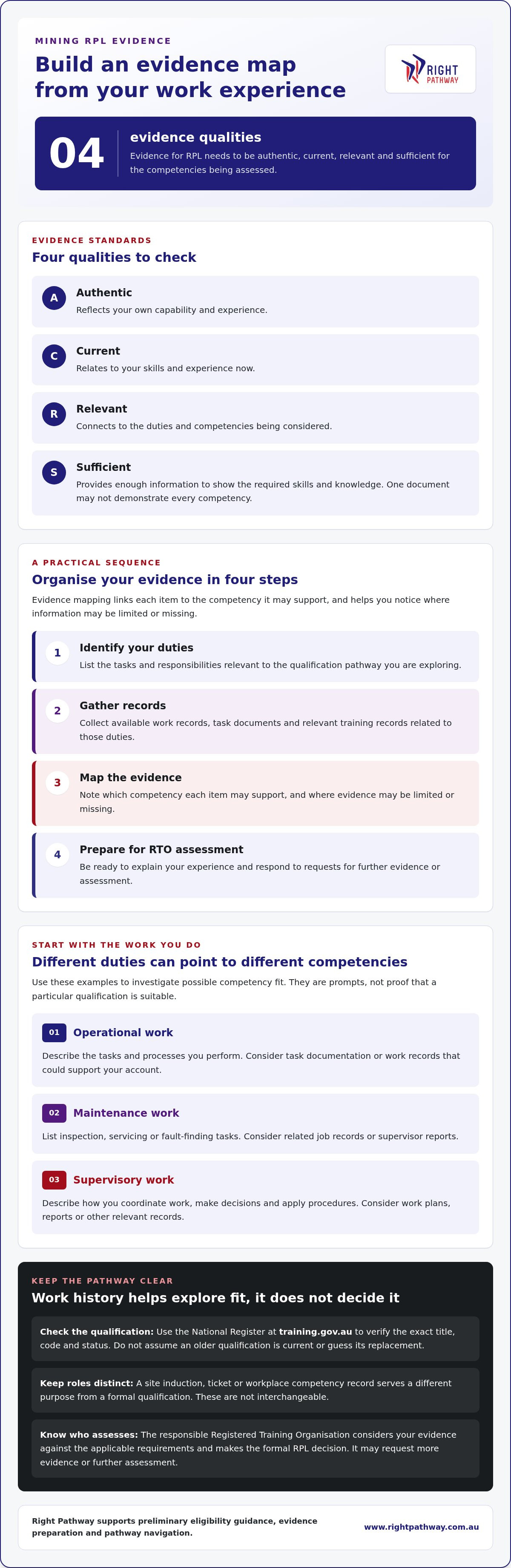
For RPL mining qualifications, evidence needs to show what you can do against the applicable units of competency. It must be authentic, current, relevant and sufficient. A long work history or a single document won’t necessarily demonstrate every required skill.
How does evidence mapping work for mining experience?
Evidence mapping means linking each piece of evidence to the competency it may support. A work record could help show your involvement in a task, while a task document may provide context about the process followed. As you organise your evidence, note what each item demonstrates and where there may be gaps. The RTO considers whether the material demonstrates the required skills and knowledge, not just whether a document exists.
Use this sequence to organise your material:
- Identify your duties: List the tasks and responsibilities relevant to the qualification pathway you’re exploring.
- Gather records: Collect available work records, task documents and relevant training records that relate to those duties.
- Map evidence: Note which competency each item may support, and where your evidence may be limited or missing.
- Prepare for RTO assessment: Be ready to explain your experience and respond to requests for further evidence or assessment.
Evidence should reflect your own capability and relate to the competencies being assessed. The RTO may ask for more information, a competency conversation, practical demonstration, challenge test or gap training. These steps help the RTO determine whether your evidence demonstrates the required competence.
Who makes the formal RPL decision?
Right Pathway supports preliminary eligibility guidance, evidence preparation and qualification pathway navigation. It doesn’t conduct formal competency assessments or decide RPL outcomes. The responsible RTO handles formal enrolment and assessment, determines whether you’ve met the requirements, and issues any resulting qualification.
Choosing your next step for a mining RPL qualification
Move forward in stages: clarify the qualification you’re aiming for, document your mining duties and experience, then explore whether your background may suit an RPL pathway. The right fit depends on how your skills and evidence align with current qualification requirements. Treat preliminary guidance as a starting point, not a formal assessment decision.
What does Right Pathway support before formal assessment?
Right Pathway can help you explore preliminary eligibility, review your evidence-readiness and navigate a potential qualification pathway. This may include organising your information around relevant competency requirements. The free initial eligibility assessment is an exploratory step. It isn’t a formal RPL assessment and doesn’t guarantee RTO acceptance, credit or a qualification.
If you proceed, the responsible RTO handles formal enrolment and competency assessment, decides whether the requirements have been met, and issues any resulting qualification. It may request further evidence or assessment. Right Pathway supports preparation and coordination, but doesn’t assess competence or make the final decision.
What should you expect after an initial eligibility check?
Right Pathway reviews the information you submit and discusses potential next steps based on your experience and the pathway you’re exploring. That discussion can help you understand what information may be useful to prepare and how the process could proceed, subject to the evidence available and the RTO’s requirements. It doesn’t confirm an outcome or set a completion timeframe.
To explore a possible pathway for your experience, complete Right Pathway’s free initial eligibility assessment. This is a way to discuss potential next steps, not a formal RTO assessment.
Take the next step with a clearer pathway
Choosing suitable RPL mining qualifications starts with matching your actual duties and demonstrated skills to the requirements of a current qualification. A job title or years on site won’t establish that match on its own. Your evidence needs to support the competencies being assessed, and a qualification is distinct from site tickets, inductions and licensing.
Right Pathway can help you explore preliminary eligibility, organise evidence and navigate a potential pathway. It has supported more than 2,000 applicants across 18 industries. The free initial eligibility assessment is an exploratory step to discuss possible next steps, not a formal RPL assessment or a guarantee of an outcome. The responsible RTO conducts the formal assessment and decides whether the qualification requirements have been met.
Start by setting out your mining duties and the evidence you have available. A clear summary of your experience is a practical basis for exploring a potential pathway with Right Pathway.
Frequently Asked Questions
Can mining experience count towards an RPL qualification?
Yes, mining experience may support an RPL application when your skills and knowledge align with the competencies in a current qualification. For RPL mining qualifications, the RTO considers your actual duties and relevant evidence, not just your job title or years worked. It may request further information or a practical demonstration before deciding whether you’ve demonstrated the required competencies.
What mining qualifications can you get through RPL?
Potential pathways may cover operational, maintenance or supervisory work in the resources and infrastructure industries, depending on current qualifications and how your experience aligns with their requirements. There isn’t one qualification that suits every mining worker. Check the exact qualification title, code and status on training.gov.au, then consider the full competency requirements with the responsible RTO.
What evidence do I need for mining RPL?
Prepare evidence that is authentic, current, relevant and sufficient to demonstrate the competencies being assessed. Depending on your work, this could include work records, task documents or relevant training records. Organise each item around the duties and skills it may demonstrate, and note where evidence is missing. The RTO may ask for additional evidence, a competency conversation, practical demonstration, challenge test or gap training.
Does an RPL mining qualification give me a site ticket or licence?
No. A qualification, site induction, equipment competency record, ticket and occupational licence serve different purposes. An RPL qualification doesn’t automatically provide a site ticket, grant a licence or authorise regulated work. Site access and licensing requirements are separate from qualification assessment. For licensing requirements, refer to the relevant state or territory regulator.
Who assesses and issues an RPL mining qualification?
The responsible RTO conducts formal enrolment and competency assessment, decides the RPL outcome and issues any resulting qualification. Right Pathway supports preliminary eligibility guidance, evidence preparation and pathway navigation, but doesn’t conduct formal assessments or make the final decision. Its free initial eligibility assessment helps explore possible next steps. It doesn’t guarantee RTO acceptance or a qualification.

Article by
Right Pathway Team
Right Pathway supports experienced workers, tradespeople and skilled migrants with preliminary RPL eligibility guidance, evidence preparation and qualification pathway navigation.
Right Pathway is not a Registered Training Organisation and does not conduct formal competency assessments or issue qualifications. Formal enrolment, competency assessment and qualification issuance are completed by the responsible Registered Training Organisation.
Start with a free initial RPL eligibility assessment at https://www.rightpathway.com.au/eligibility-check
Disclaimer
Right Pathway is a facilitation and support service only. We are not a Registered Training Organisation (RTO), do not conduct formal RPL assessments and do not issue qualifications. All formal RPL assessments and certifications are completed by partner RTOs regulated by ASQA. Eligibility and qualification outcomes depend on each applicant’s evidence, experience and the RTO’s assessment decision.


