

Could the work you already do in a business role support an Australian qualification, even if your job title doesn’t match the course name? For business RPL Australia applicants, the important question is how their actual responsibilities relate to the applicable competencies. A job title or years of experience alone aren’t enough to establish that a person meets them.
Recognition of Prior Learning (RPL) involves assessing your skills, knowledge and experience against the units of competency for a qualification. This guide explains how to connect your work to those requirements, choose useful evidence and protect sensitive business information. The responsible Registered Training Organisation (RTO) conducts the formal assessment and may request more evidence or another way to demonstrate your skills. Right Pathway can help you prepare and explore potential pathways, but preliminary guidance is not an assessment outcome.
Key Takeaways
- Business RPL Australia focuses on how your actual responsibilities relate to competency requirements, not your job title alone.
- Compare your workplace tasks with the applicable units for a potential qualification pathway, then note where evidence is missing or unclear.
- Work outputs, procedures and role records may help demonstrate your contribution when they are authentic, current and relevant.
- Prepare a clear summary of your experience and evidence. Right Pathway can provide preliminary guidance, while the RTO makes the formal assessment decision.
What business RPL in Australia can recognise, and what it cannot promise
Business RPL in Australia is a formal assessment of relevant skills and knowledge against the applicable units of competency for a qualification. The Australian Skills Quality Authority provides information about RPL and the role of registered training organisations. Your potential pathway depends on the competencies involved and the evidence you can provide, not simply your job title.
Business responsibilities vary from role to role. One person may maintain records and support administration, while another coordinates operations, improves procedures or supervises a team. Time in a position can help explain your experience, but it does not prove competence by itself. You need evidence relevant to the requirements, and the responsible RTO makes the formal assessment decision. If you meet the requirements, the RTO is responsible for issuing any resulting qualification.
Which business experience may be relevant to RPL?
Start with the work you personally perform. You might coordinate a workflow, maintain business records, apply workplace procedures, support day-to-day operations or contribute to improving a process. These tasks may be relevant when they show how you use the skills and knowledge required. A title such as “office manager” or “team leader” does not explain your actual duties or demonstrate how you meet a competency requirement.
How is RPL different from a course or credit transfer?
With RPL, an RTO assesses your relevant prior skills and experience against competency requirements. A course involves learning and assessment through a structured programme. Credit transfer is different: it recognises an equivalent unit you have already completed through formal study, rather than assessing your workplace competence.
For an overview of the stages involved, read the RPL process guide. Right Pathway can help you explore RPL pathways, prepare evidence and understand potential next steps. Formal assessment and any qualification decision remain with the responsible RTO.
How business skills mapping connects workplace tasks with competency requirements
Skills mapping connects your documented workplace capability with the applicable competency requirements. For business RPL Australia, this provides a structured way to identify what you may be able to demonstrate and where more information could be needed.
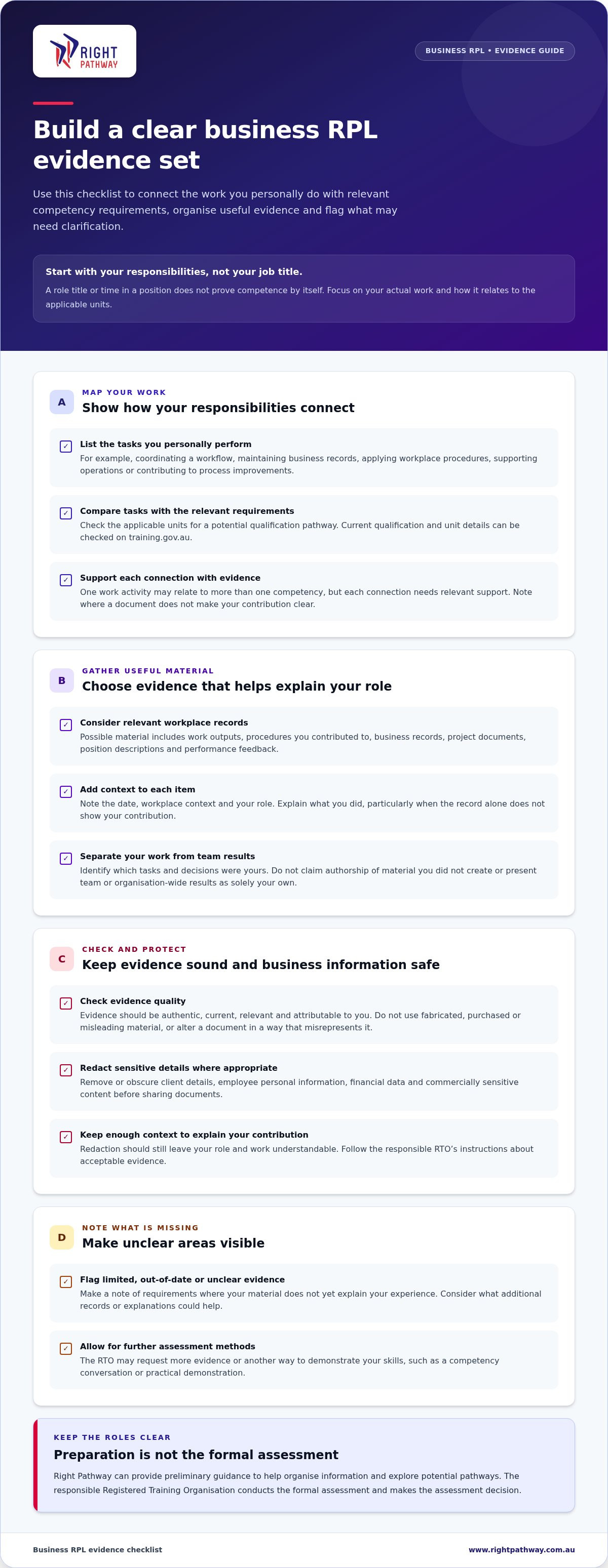
Begin by listing your responsibilities, then compare them with the requirements for a potential qualification pathway. Check current qualification and unit details on training.gov.au, as the relevant units depend on the pathway. The Australian Qualifications Framework provides context about how Australian qualifications are structured. Then identify evidence for each relevant requirement, note any gaps and prepare for the RTO’s formal assessment.
One work activity might relate to more than one competency, but each connection needs support. For example, a project record could show that you tracked progress. It may also help show coordination skills if it documents your decisions and responsibilities. Don’t assume that one document demonstrates several competencies unless it provides relevant evidence for each.
Turn ordinary business responsibilities into evidence prompts
Use de-identified records to help describe your role. A procedure you helped maintain could prompt an explanation of how you applied a process. A project summary might show which tasks you coordinated and how you monitored progress. Add context about your own contribution, because a document may not make that clear on its own.
Identify evidence gaps before formal assessment
Make a note of requirements for which your material is limited, out of date or unclear. Consider what additional records or explanations could help describe your experience. The RTO may request more evidence or use another assessment method, such as a competency conversation or practical demonstration. Right Pathway can provide preliminary guidance to help you organise your information, but the RTO remains responsible for formal assessment.
What evidence can support business RPL, and how should you organise it?
For business RPL Australia, evidence should show what you personally did and how your work relates to the relevant competency requirements. Depending on your pathway and experience, useful material may include work outputs, procedures you contributed to, business records, project documents, position descriptions and performance feedback.
Protect confidential information before sharing documents. Remove or obscure client details, employee personal information, financial data and commercially sensitive content where appropriate. Keep enough context for your role and contribution to be understood, and follow the RTO’s instructions about acceptable evidence. Evidence should be authentic, current, relevant and attributable to you.
Build an evidence set that reflects your own contribution
Separate your own work from team or organisation-wide results. For each item, note the date, workplace context and your role. Don’t claim authorship of material you didn’t create or alter a document in a way that misrepresents it. Never use fabricated, purchased or misleading evidence.
A simple evidence table can help you identify what each item may demonstrate and what needs clarification:
| Item | Responsibility | Possible relevance | Follow-up needed |
|---|---|---|---|
| Redacted workflow procedure | Explaining a process you maintained | Applying workplace procedures | Clarify your contribution and date |
| Project summary | Tracking agreed tasks | Coordinating work activity | Identify which tasks were yours |
These examples are prompts, not proof by themselves. The RTO considers whether your complete evidence set demonstrates the required competence.
What if your evidence is incomplete?
Gaps don’t automatically end the process. An RTO may request more evidence, hold a competency conversation or ask for a practical demonstration. If the assessment identifies requirements you have not met, gap training may be considered. For factors that can affect fees, see the RPL cost information.
The free initial eligibility assessment is a way to share your background and explore potential next steps. It provides preliminary guidance, not a formal RPL assessment or a guarantee of an outcome.
Your next steps for business RPL in Australia, from eligibility guidance to RTO assessment
To explore a business RPL Australia pathway, prepare a clear picture of your work and the evidence you can provide. Use this sequence to get started:
- Summarise your experience: list your roles, responsibilities and relevant workplace learning.
- Organise initial evidence: gather examples that show your own contribution and protect confidential information.
- Provide accurate eligibility details: describe your background and experience clearly.
- Consider potential next steps: use preliminary guidance to understand possible pathways and evidence needs.
Right Pathway provides preliminary eligibility guidance, evidence preparation support and qualification pathway navigation. This is not a formal RPL assessment. The responsible Registered Training Organisation (RTO) handles formal enrolment and competency assessment, and issues any resulting qualification if its requirements are met.
What happens after preliminary eligibility guidance?
Potential pathways depend on your experience and available evidence. Right Pathway can help you consider how your background may relate to a qualification pathway and organise information for the next stage. The RTO sets its assessment requirements and makes the formal decision. It may ask for additional evidence or another way to demonstrate your competence. For broader context, read this guide to RPL in Australia.
Take a practical first step without assuming an outcome
Share accurate details about your work history and responsibilities. Right Pathway has supported over 2,000 applicants across 18 industries, including business, with preliminary guidance and evidence preparation. This support can help you organise potential next steps, but it does not determine an RTO’s assessment outcome or guarantee a qualification.
Take a clear next step with your business experience
Business RPL Australia is about showing how your skills and knowledge relate to the relevant competency requirements, not relying on your job title or time in a role. A focused evidence set can make your responsibilities and contribution clearer, while helping identify areas that may need further support.
Keep your material authentic, current and relevant, and protect confidential business information before sharing it. Preliminary eligibility and evidence guidance can help you explore a potential pathway, but it is separate from formal assessment. The responsible Registered Training Organisation determines assessment requirements and outcomes.
Right Pathway has supported over 2,000 applicants across 18 industries, including business. Complete the free initial eligibility assessment to share your experience and discuss possible next steps. It is an initial review, not a formal RTO assessment or a promise of a qualification.
Your existing work is a practical place to begin. Start with clear information and realistic expectations.
Frequently Asked Questions
Can I use business experience to get a qualification through RPL?
Business experience may support an RPL application if your skills and knowledge match the applicable units of competency. Your job title or time in a role is not enough on its own. Describe the responsibilities you handled and provide relevant evidence. The RTO assesses that evidence, decides whether requirements are met and may request more information or another assessment activity.
What evidence do I need for business RPL?
Evidence depends on the qualification pathway and the competencies being assessed. It may include work outputs, procedures, business records or documents describing your role. Choose material that is authentic, current and connected to your own work. Add brief context explaining your contribution, and protect confidential business, client or employee details. The RTO decides whether the evidence is sufficient and may request more.
Does Right Pathway assess or issue business qualifications?
No. Right Pathway provides preliminary eligibility guidance, evidence preparation support and qualification pathway navigation. It is not a Registered Training Organisation, and it does not conduct formal competency assessments, make RPL decisions or issue qualifications. The responsible RTO handles formal enrolment and assessment, then issues a qualification if its requirements are met. Preliminary guidance can help you understand possible next steps, but it is not a formal assessment outcome.
How much does business RPL cost in Australia?
Business RPL costs vary according to the qualification pathway and the RTO’s assessment arrangements. Right Pathway’s free initial eligibility check provides preliminary guidance, not a formal assessment, and does not guarantee enrolment or a qualification. Review the RPL cost information for factors that may affect fees, then refer to the relevant pathway for applicable charges.
Can RPL give me a business qualification based only on paperwork?
No. RPL is not simply a paperwork exercise, and documents alone do not guarantee an outcome. The RTO considers whether your evidence demonstrates the required skills and knowledge. It may request further material, a competency conversation, practical demonstration, challenge test or gap training. The RTO’s formal assessor determines whether the evidence meets the applicable requirements and whether a qualification can be issued.

Article by
Right Pathway Team
Right Pathway supports experienced workers, tradespeople and skilled migrants with preliminary RPL eligibility guidance, evidence preparation and qualification pathway navigation.
Right Pathway is not a Registered Training Organisation and does not conduct formal competency assessments or issue qualifications. Formal enrolment, competency assessment and qualification issuance are completed by the responsible Registered Training Organisation.
Start with a free initial RPL eligibility assessment at https://www.rightpathway.com.au/eligibility-check
Disclaimer
Right Pathway is a facilitation and support service only. We are not a Registered Training Organisation (RTO), do not conduct formal RPL assessments and do not issue qualifications. All formal RPL assessments and certifications are completed by partner RTOs regulated by ASQA. Eligibility and qualification outcomes depend on each applicant’s evidence, experience and the RTO’s assessment decision.


