

Your carpentry experience may help demonstrate your competence without repeating training in areas you already know. With certificate iii in carpentry rpl, your existing skills and knowledge are considered against the requirements of CPC30220 Certificate III in Carpentry. Time on the tools alone, however, doesn’t guarantee a qualification.
RPL is not a certificate issued from paperwork alone. The responsible Registered Training Organisation (RTO) formally assesses your evidence and may ask you to provide more information or demonstrate your skills.
This guide explains how your work history may relate to the qualification, how to organise authentic, current and relevant evidence, and what to expect from the RTO pathway. It also explains how a qualification differs from a trade licence, so you can decide on a practical next step without assuming you’re eligible or guaranteed an outcome.
Key Takeaways
- Certificate iii in carpentry rpl considers how your skills and knowledge align with the applicable competency requirements. Experience alone doesn’t guarantee a qualification.
- Organise relevant work history, project records and workplace documents to help the RTO consider your evidence.
- The pathway includes preliminary guidance and evidence preparation, followed by the RTO’s formal assessment. The RTO may identify further requirements.
- Right Pathway can help you prepare evidence and understand potential next steps. The responsible RTO handles formal assessment and qualification issuance.
What does Certificate III in Carpentry RPL recognise?
Certificate III in Carpentry RPL assesses an experienced worker’s existing carpentry skills and knowledge against the applicable competency requirements. Recognition of Prior Learning (RPL) is a formal process for evaluating skills and knowledge gained through work and other relevant experience. It is not a licence, a job offer or an automatic qualification.
The national training register lists CPC30220 Certificate III in Carpentry as current. The key question for certificate iii in carpentry rpl isn’t simply how long you’ve worked. It’s whether your skills and knowledge, supported by suitable evidence, meet the relevant requirements. The responsible Registered Training Organisation (RTO) makes the formal assessment decision.
Who may consider carpentry RPL?
RPL may be worth exploring if you’ve developed carpentry skills through employment, self-employment, overseas work or other relevant experience. Work involving framing, setting out or fitting, for example, can help describe the tasks you’ve performed. Those tasks alone don’t establish eligibility. Your evidence must relate to the applicable requirements, and the RTO may identify areas that need further assessment or learning. Explore Right Pathway’s RPL support to see how preliminary pathway guidance can help you organise your next steps.
Does the qualification provide a carpentry licence?
No. A qualification and occupational licensing or registration are separate matters. Holding CPC30220 does not automatically authorise you to carry out work that requires a licence or registration. Requirements can depend on the work and where it’s performed, so check with the relevant state or territory regulator before relying on a qualification for regulated work. RPL also doesn’t guarantee employment or another occupational outcome.
How does RPL assess carpentry skills against competency requirements?
For certificate iii in carpentry rpl, your relevant work experience is considered against the qualification’s applicable units of competency. Right Pathway provides preliminary eligibility guidance and helps you prepare evidence, but this is not a formal assessment. The responsible Registered Training Organisation (RTO) decides whether your evidence demonstrates competence and handles enrolment and qualification issuance.
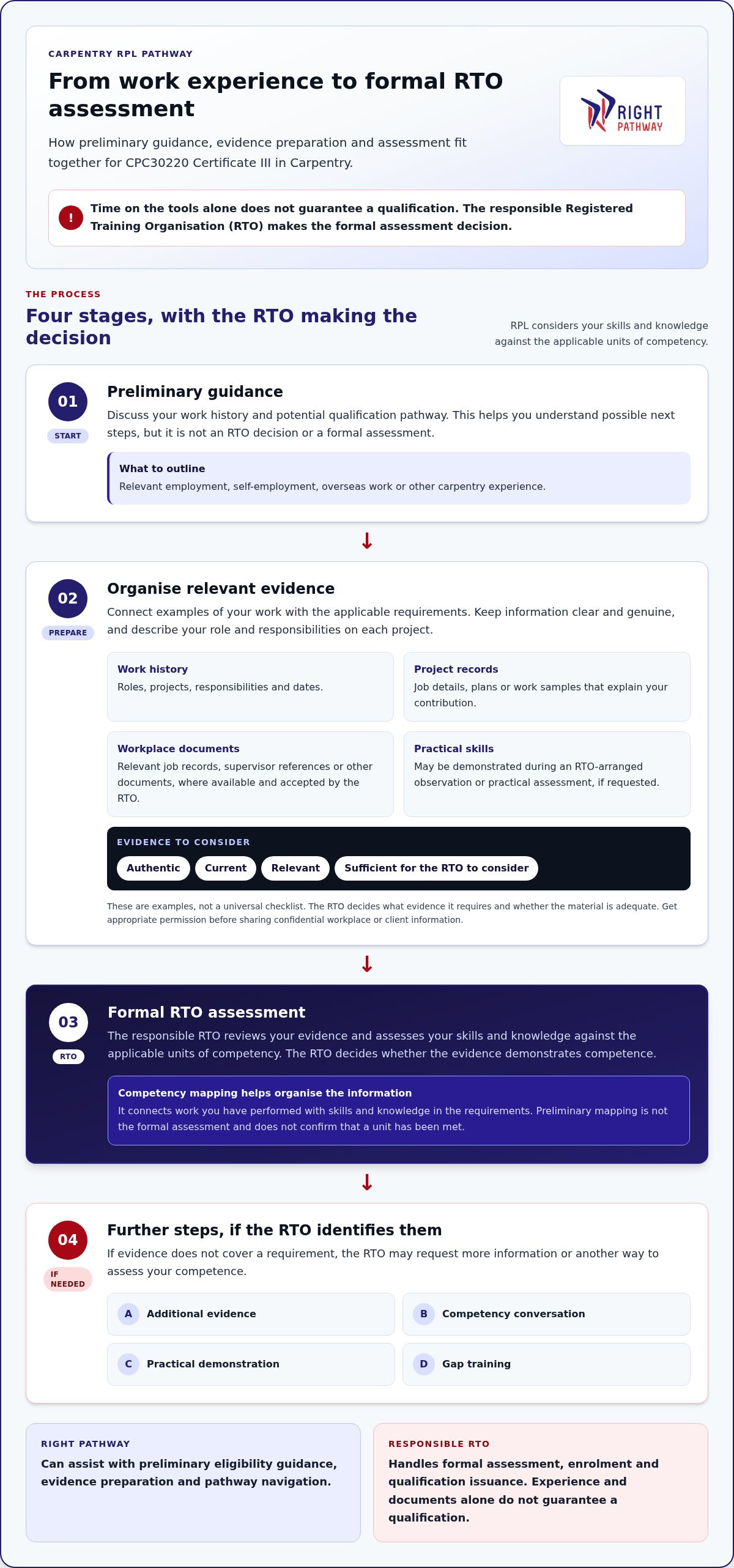
The pathway generally includes these stages, although the RTO sets its own assessment requirements:
- Preliminary guidance: Discuss your work history and potential qualification pathway. This is not an RTO decision.
- Evidence preparation: Organise relevant records and examples so they can be considered against the requirements.
- Formal RTO assessment: The RTO reviews your evidence and assesses your skills and knowledge against the applicable units.
- Further steps, if needed: The RTO may request more evidence, a competency conversation, practical demonstration or gap training.
What happens during competency mapping?
Competency mapping connects the work you’ve performed with the skills and knowledge described in the relevant requirements. For example, you could describe your role on a project and provide records that help show how you carried out the work. Preliminary mapping helps organise this information, but it is not the formal assessment or a decision that you’ve met a unit. The RTO determines whether your evidence is sufficient.
Who makes the formal RPL decision?
The responsible RTO conducts the formal assessment and decides whether your evidence demonstrates the required competence. Right Pathway supports evidence preparation and pathway navigation, but does not assess or certify. Read how the RPL process works for an overview of the stages. For broader trade context, Carpentry Australia provides information relevant to the carpentry industry.
What evidence can support a Certificate III in Carpentry RPL application?
For certificate iii in carpentry rpl, your evidence should show how your skills and knowledge relate to the qualification’s applicable requirements. It needs to be authentic, current, relevant and sufficient for the RTO to consider. Work experience and documents can support your application, but neither guarantees a qualification. See the official CPC30220 Certificate III in Carpentry qualification for the current requirements.
Depending on your work history and the RTO’s process, possible evidence may include:
- Work history: A record of roles, projects, responsibilities and dates.
- Project records: Job details, plans or work samples that help explain your contribution.
- Workplace documents: Relevant job records, supervisor references or other documents, where available and accepted by the RTO.
- Practical skills: Skills demonstrated during an RTO-arranged observation or practical assessment, if requested.
Photographs, references and job records are examples, not a universal checklist. The RTO decides what evidence it requires and whether the material is adequate.
How can you organise evidence from different carpentry jobs?
For each project, note the context, your responsibilities and the work you completed. Then identify which applicable requirements the example may relate to, without assuming it proves competence. Keep records clear and genuine. If documents contain confidential workplace or client information, obtain appropriate permission before sharing them and follow the RTO’s evidence instructions.
What if the evidence does not cover every requirement?
A gap in your documents doesn’t automatically end the process. The RTO may request further evidence, a competency conversation, practical demonstration or gap training. Right Pathway can help you organise your material and understand possible next steps. Its RPL support includes evidence preparation guidance, while the RTO remains responsible for formal assessment and decisions.
How can Right Pathway support your carpentry RPL next steps?
Right Pathway helps experienced tradespeople explore a potential certificate iii in carpentry rpl pathway through preliminary eligibility guidance, evidence preparation and qualification pathway navigation. This support can help you organise your work history and identify useful evidence before formal assessment. For a broader overview, read about trade qualification RPL in Australia.
Right Pathway is not a Registered Training Organisation (RTO). The responsible RTO handles formal enrolment, assesses competency against the applicable requirements, determines whether further assessment or training is needed, and issues a qualification if its requirements are met. Preliminary guidance is not an RTO assessment and does not guarantee eligibility, enrolment or an outcome.
What to prepare before an initial eligibility check
Start with a concise summary of your carpentry work history. Include the types of projects you’ve worked on, your typical tasks and responsibilities, and evidence you may be able to access, such as job records or project documents. This information helps frame an initial discussion, but it is not proof that you’ll qualify or a set of formal entry requirements. Right Pathway can review the details and discuss potential next steps, subject to your evidence and RTO requirements.
What happens after preliminary guidance?
If a pathway appears worth exploring, Right Pathway can help you organise evidence and navigate potential RTO options, including referral and coordination where appropriate. The RTO sets its enrolment conditions, decides what evidence or practical assessment is required, and makes the formal competency decision. You can begin with the work history and documents you have, then complete the free eligibility check to discuss potential next steps with Right Pathway.
Take the next step towards recognising your carpentry experience
Certificate iii in carpentry rpl gives experienced carpenters a pathway to have their skills and knowledge considered against the qualification requirements. The strength of your evidence matters: work history and documents can help show what you’ve done, but they don’t guarantee a qualification. The responsible Registered Training Organisation makes the formal assessment decision and handles enrolment and qualification issuance.
Right Pathway supports you with preliminary guidance, evidence preparation and qualification pathway navigation. The service has supported more than 2,000 applicants across 18 industries. This initial guidance can help you organise your information and understand possible next steps, while keeping the formal RTO assessment process clear.
If you’re ready to discuss how your carpentry experience may fit the pathway, start with a free initial eligibility assessment. It’s a practical first step, not a guarantee of acceptance or an assessment outcome.
Organise your work history and the evidence you can provide, then take the next step with a clearer picture of your potential pathway.
Frequently Asked Questions
Can I get a Certificate III in Carpentry through RPL?
You may be able to have relevant carpentry skills and knowledge assessed through RPL against the applicable requirements for CPC30220 Certificate III in Carpentry. The responsible Registered Training Organisation (RTO) makes the formal decision based on your evidence and assessment. Work experience can be a starting point, but years on the tools alone don’t guarantee a qualification. Further evidence, practical demonstration or gap training may be required.
What evidence do I need for carpentry RPL?
Evidence depends on your work history and the RTO’s requirements. Examples may include a record of projects and responsibilities, job documents, workplace records, photographs or references. Organise material so it clearly shows your own contribution, and make sure it’s authentic, current and relevant. These examples aren’t a universal checklist. Submitting documents alone doesn’t guarantee that the RTO will find your skills meet the requirements.
How does the Certificate III in Carpentry RPL process work?
The certificate iii in carpentry rpl pathway generally begins with preliminary eligibility guidance and evidence preparation, followed by formal enrolment and assessment through the responsible RTO. The RTO considers your skills and knowledge against applicable competency requirements. It may request more evidence, a competency conversation, practical demonstration or gap training. Right Pathway can help you prepare and understand possible next steps, but doesn’t conduct the formal assessment or decide the outcome.
Does a Certificate III in Carpentry automatically give me a trade licence?
No. A Certificate III in Carpentry and a trade licence or registration are separate matters. Holding the qualification doesn’t automatically authorise you to perform work that requires a licence or registration. Requirements vary by state or territory and can depend on the type of work. Check with the relevant regulator in your jurisdiction for current requirements before relying on a qualification to undertake regulated work.
Is a free RPL eligibility check the same as a formal assessment?
No. A free eligibility check is an initial review of your experience and potential pathway, not a formal RPL assessment. Right Pathway provides preliminary guidance and evidence preparation support. The responsible RTO handles formal enrolment, assesses your competence and decides whether your evidence meets the applicable requirements. Completing an eligibility check doesn’t guarantee RTO acceptance, a positive assessment result or a qualification.

Article by
Right Pathway Team
Right Pathway supports experienced workers, tradespeople and skilled migrants with preliminary RPL eligibility guidance, evidence preparation and qualification pathway navigation.
Right Pathway is not a Registered Training Organisation and does not conduct formal competency assessments or issue qualifications. Formal enrolment, competency assessment and qualification issuance are completed by the responsible Registered Training Organisation.
Start with a free initial RPL eligibility assessment at https://www.rightpathway.com.au/eligibility-check
Disclaimer
Right Pathway is a facilitation and support service only. We are not a Registered Training Organisation (RTO), do not conduct formal RPL assessments and do not issue qualifications. All formal RPL assessments and certifications are completed by partner RTOs regulated by ASQA. Eligibility and qualification outcomes depend on each applicant’s evidence, experience and the RTO’s assessment decision.


