

Could your experience in a busy kitchen, restaurant or hotel count towards a formal qualification? It may, but hospitality RPL Australia is a competency-mapping process, not certification based on your job title or time on the job. Your skills and knowledge need to be matched to the relevant units of competency, and a Registered Training Organisation (RTO) makes the formal assessment decision.
If you’re unsure which qualification fits your work, start by listing the tasks you perform and the evidence you can share. This article explains how hospitality RPL works, how to organise evidence that relates to your experience, and how to explore a suitable qualification pathway. It also covers why an RTO may request more evidence or a practical demonstration, and why preliminary guidance doesn’t guarantee eligibility or an outcome.
Key Takeaways
- Hospitality RPL Australia maps relevant skills and knowledge to qualification competencies, not simply to job titles or time worked.
- Organise work records, role information and task examples so an RTO can consider what you personally did.
- An RTO may request further assessment, and experience alone doesn’t guarantee a qualification.
- Use a practical sequence to explore possible pathways and check current qualification details on training.gov.au.
Hospitality RPL in Australia: What Can Your Experience Demonstrate?
Hospitality RPL evaluates your relevant skills and knowledge against the units of competency in a qualification. The process looks at what you can demonstrate in practice, not just your job title or how long you’ve worked in the industry. The responsible RTO sets the assessment requirements and makes the formal decision.
The right hospitality RPL Australia pathway depends on the work you’ve done, the evidence you can provide, the qualification being considered and the RTO’s assessment. Experience is a useful starting point, but it doesn’t prove competency by itself.
Which hospitality duties may be relevant to RPL?
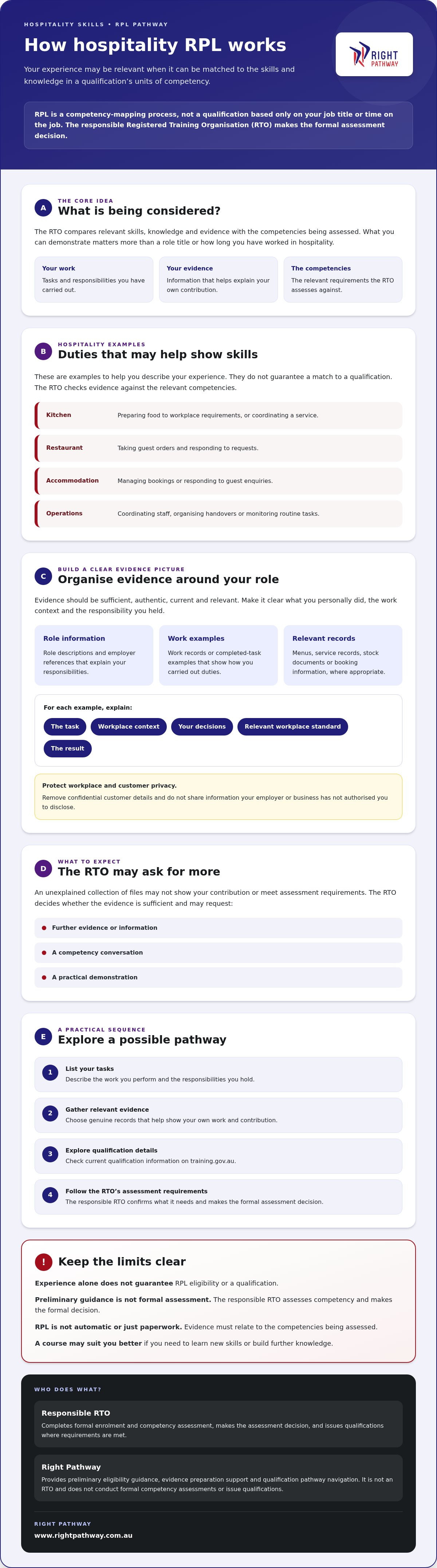
Start with your responsibilities and the skills or knowledge behind them. In a kitchen, preparing food to workplace requirements or coordinating a service may be relevant. In a restaurant, taking guest orders and responding to requests could help illustrate service skills. Accommodation work may involve managing bookings or guest enquiries. Hospitality operations may include coordinating staff, organising handovers or monitoring routine tasks. These examples don’t guarantee a match to a qualification. The RTO checks them against the relevant competencies.
How is hospitality RPL different from a course?
A course generally involves learning and assessment through a training programme. RPL assesses learning and skills you’ve already gained through work, training or other relevant experience. Consider RPL if you can provide evidence of the competencies being assessed. If you need to learn new skills, a course or further learning may be more appropriate. RPL isn’t automatic and isn’t just a matter of submitting paperwork. Evidence needs to be sufficient, authentic, current and relevant. The RTO may also ask for more information, a competency conversation or a practical demonstration.
The RTO decides whether your evidence meets its requirements and makes the formal assessment decision. Right Pathway can provide preliminary eligibility guidance, evidence preparation support and qualification pathway navigation, but it doesn’t conduct the formal assessment or issue qualifications. Explore RPL support and pathway guidance to understand how preparation can help.
Hospitality RPL Evidence: How to Show Skills Against Competencies
For hospitality RPL Australia, evidence needs to be authentic, current and relevant to the competencies being considered. The RTO decides whether it’s sufficient. A collection of documents may not show what you personally did, the conditions you worked in or the level of responsibility you held. Choose evidence that helps explain both the task and your contribution.
What evidence could hospitality workers organise?
Start with genuine records that relate to your role. Depending on your workplace and duties, these could include:
- Role descriptions and employer references that explain your responsibilities.
- Work records or completed-task examples that show how you carried out duties.
- Menus, service records, stock documents or booking information, where relevant and appropriate.
Protect privacy before sharing anything. Remove confidential customer details and information your employer or business doesn’t authorise you to disclose. Add a short note to each item explaining what it is, when it relates to and which skills or responsibilities it may help demonstrate. For example, connect a work record to the task you performed and describe your role in completing it. Don’t assume an unexplained collection of files will make your contribution clear.
How can workplace examples map to competencies?
Describe each example in a simple sequence: the task, the workplace context, the decisions you made, any relevant workplace standard you followed, and the result. For instance, a kitchen worker might explain how they prepared for a service period, prioritised assigned tasks and responded when service requirements changed. Be specific about your own actions rather than describing only what the team did. The RTO determines whether your account and supporting evidence meet the relevant competencies.
Assessment requirements vary, so ask the responsible RTO what evidence it needs and whether it may request further evidence, a competency conversation or a practical demonstration. Right Pathway’s RPL evidence preparation guide offers process context. Keep your records organised and follow the RTO’s instructions about what to submit and how to protect sensitive information.
Does Hospitality Experience Guarantee a Qualification? Understand the Limits
No. Time spent working in hospitality doesn’t, by itself, guarantee RPL eligibility or a qualification. For hospitality RPL Australia, the responsible RTO compares your evidence with the relevant units of competency and makes the formal assessment decision. It considers what you can demonstrate, not only how long you’ve held a role.
If your evidence doesn’t clearly address a competency, the RTO may ask for more information or another assessment activity. Depending on its requirements, this could include a competency conversation, practical demonstration, challenge test or gap training. These are possibilities, not steps every applicant must complete. If further learning is needed, the RTO can explain what it requires.
What happens if evidence does not cover every competency?
A gap in your evidence doesn’t automatically determine the outcome. The RTO may identify what is missing and request additional evidence or assessment to check your skills and knowledge. If a competency gap remains, further learning or gap training may be required. Ask the RTO to clarify its process and the next steps for your situation.
What RPL does not provide by itself
Preliminary eligibility guidance is not a formal RPL assessment. Right Pathway can help you organise evidence and explore a possible pathway, but the RTO conducts the formal assessment and, where requirements are met, handles qualification issuance. A qualification is also separate from a licence, professional registration or permission to carry out regulated work. Check applicable requirements with the relevant state or territory regulator. For migration or visa matters, seek advice from an appropriately registered migration professional.
Keep these distinctions in mind as you consider your next step. RPL can assess existing learning, but the formal outcome depends on the RTO’s assessment of your evidence and competency. Before approaching an RTO, review your work history, gather relevant records and identify any areas where you may need more information.
How to Explore a Hospitality RPL Pathway with Clear Next Steps
Organise your experience before deciding which qualification may suit. For hospitality RPL Australia, consider your duties, the skills you use and the evidence you can lawfully share. Then explore possible pathways and confirm current qualification details on training.gov.au. Check with the relevant RTO whether it offers the pathway and what its assessment process requires.
What to prepare before seeking initial eligibility guidance
Gather a current work history, a brief summary of your hospitality experience and a description of your duties in each role. Note any relevant training you’ve completed and the records or work examples you can share. Keep the information factual and protect confidential customer, employer or business details. This preparation can help clarify which pathways may be worth exploring, but it doesn’t confirm eligibility.
What happens after an initial eligibility check?
Right Pathway can review your initial information and discuss potential next steps, including evidence preparation and qualification pathway navigation. This is preliminary guidance, not a formal RPL assessment. Formal enrolment and competency assessment are handled by the responsible RTO, which determines its requirements and outcome. Any qualification issuance also remains subject to the RTO’s assessment. Read the RPL support overview to understand Right Pathway’s facilitation role.
From there, follow the RTO’s directions, including any request for additional evidence or assessment activities. Keep copies of documents you submit and ask the RTO to clarify anything you’re unsure about. A free initial eligibility assessment can help you discuss possible next steps, but it doesn’t guarantee acceptance or a qualification.
Take the Next Step with a Clear Hospitality RPL Pathway
Hospitality RPL Australia is based on demonstrated skills and knowledge, not job title or time in the industry alone. The RTO compares your evidence with relevant competencies and makes the formal assessment decision. Preparing a clear work history and relevant records can help you explore a suitable pathway and understand what may be needed next.
Right Pathway provides preliminary guidance, evidence preparation and qualification pathway navigation for hospitality applicants. The service has supported applicants across a range of industries. This support can help you organise your information, but it doesn’t replace the RTO’s assessment or guarantee a qualification.
Start with what you’ve done, gather evidence you can share, and take the next step by requesting Right Pathway’s free initial eligibility assessment.
Frequently Asked Questions
Can hospitality experience be recognised through RPL in Australia?
Yes, relevant hospitality skills and knowledge may be assessed through RPL against the competencies in a suitable qualification. Hospitality RPL Australia considers what you can demonstrate, rather than relying on your job title or time worked. Kitchen, restaurant, accommodation and operational duties may be relevant, depending on the qualification and evidence available. The responsible Registered Training Organisation (RTO) decides whether your evidence meets its assessment requirements.
What evidence do I need for hospitality RPL?
Evidence should be authentic, current and relevant to the competencies being assessed. Depending on your role, useful material may include work records, role descriptions, employer references and examples of completed tasks. Menus, service records, booking documents or stock records could also help if genuine and appropriate. Explain what each item demonstrates, show your own responsibilities, and remove confidential information you aren’t authorised to share.
Does hospitality RPL guarantee a qualification if I have years of experience?
No. Time spent working in hospitality doesn’t guarantee RPL eligibility or a qualification. The RTO assesses your skills and knowledge against the applicable competencies and decides whether your evidence is sufficient. It may request further evidence or assessment activities, such as a competency conversation or practical demonstration. If gaps remain, further learning may be needed. The formal outcome depends on the RTO’s assessment, not experience alone.
Who assesses hospitality RPL and issues the qualification?
The responsible Registered Training Organisation (RTO) conducts the formal RPL assessment and issues a qualification if its requirements are met. Right Pathway is an RPL support and facilitation service, not an RTO. It can provide preliminary eligibility guidance, help with evidence preparation and assist with pathway navigation, but it doesn’t make the formal assessment decision or issue qualifications. An initial eligibility review isn’t a confirmed RTO outcome.
Can I use overseas hospitality experience for RPL in Australia?
Yes, overseas hospitality experience may be considered if it’s relevant to the competencies and can be supported by suitable evidence. The RTO determines what evidence it needs and whether your skills meet the applicable requirements. Prepare clear work history details, role responsibilities and records you’re able to share. Right Pathway supports applicants with overseas experience through preliminary guidance and evidence preparation, but this doesn’t guarantee an assessment outcome or qualification.

Article by
Right Pathway Team
Right Pathway supports experienced workers, tradespeople and skilled migrants with preliminary RPL eligibility guidance, evidence preparation and qualification pathway navigation.
Right Pathway is not a Registered Training Organisation and does not conduct formal competency assessments or issue qualifications. Formal enrolment, competency assessment and qualification issuance are completed by the responsible Registered Training Organisation.
Start with a free initial RPL eligibility assessment at https://www.rightpathway.com.au/eligibility-check
Disclaimer
Right Pathway is a facilitation and support service only. We are not a Registered Training Organisation (RTO), do not conduct formal RPL assessments and do not issue qualifications. All formal RPL assessments and certifications are completed by partner RTOs regulated by ASQA. Eligibility and qualification outcomes depend on each applicant’s evidence, experience and the RTO’s assessment decision.


