

Could years of managing people, budgets or business operations count towards a Diploma of Business, or do you need to show more? With diploma of business RPL, workplace experience is a starting point for evidence mapping, not a guarantee of a qualification. The responsible Registered Training Organisation (RTO) compares your skills and knowledge with the applicable units of competency and decides whether your evidence meets the requirements.
If you’re unsure how your experience matches the current BSB50120 Diploma of Business, this article explains what the RPL process involves and what evidence an RTO may ask for. Work records, documents and clear examples of your responsibilities can help demonstrate competency. If gaps remain, the RTO may request a conversation, practical demonstration or further training. Right Pathway can help with preliminary eligibility guidance and evidence preparation, while formal assessment and any qualification decision remain with the responsible RTO.
Key Takeaways
- Diploma of business RPL may recognise relevant workplace skills, but the responsible RTO decides whether your evidence meets the competency requirements.
- Map work examples to the applicable units, clearly recording your role, the context and the outcomes.
- Before preparing documents, check the qualification’s current title, code and status on training.gov.au, then ask the RTO about any evidence gaps.
- Right Pathway can help you explore potential pathways and prepare evidence, while formal assessment and qualification decisions remain with the RTO.
Diploma of Business RPL: What the pathway can and cannot recognise
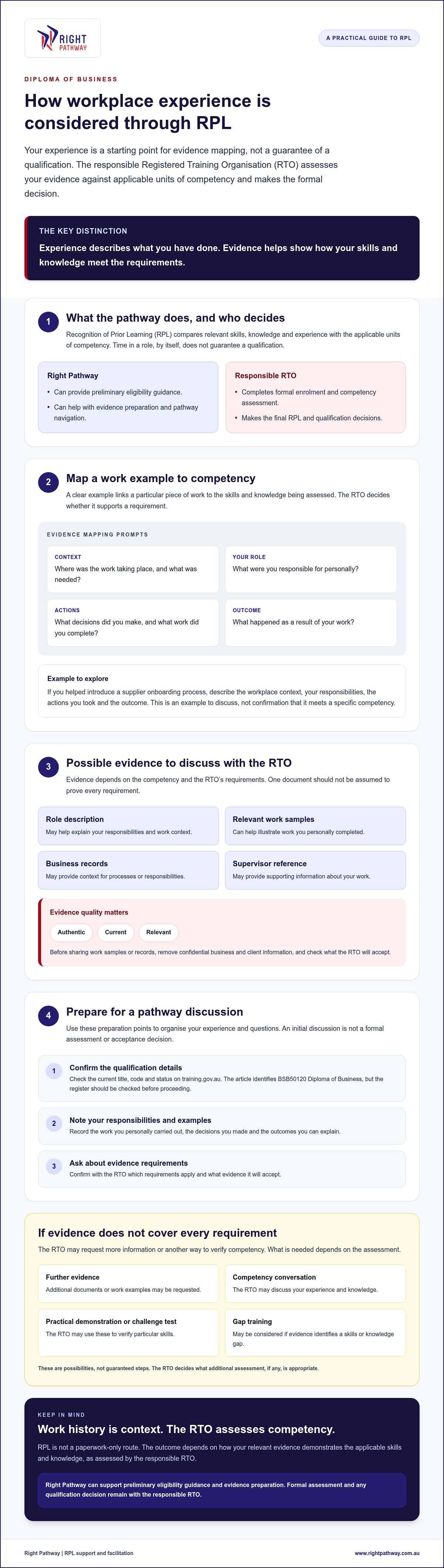
Relevant business experience may be considered towards a Diploma of Business through RPL, but your evidence must demonstrate the required skills and knowledge to the satisfaction of the responsible Registered Training Organisation (RTO). Recognition of Prior Learning (RPL) compares what you can do with the applicable units of competency. Time in a role can provide useful context, but it doesn’t guarantee a qualification.
Right Pathway can provide preliminary eligibility guidance and help you prepare evidence. It doesn’t conduct the formal assessment or make the RTO’s final decision. Before proceeding, check the current qualification title, code and status on training.gov.au, then confirm the assessment requirements with the responsible RTO.
What business experience may be relevant to RPL?
Start with tasks you’ve personally carried out, such as coordinating day-to-day operations, supporting a team, monitoring business processes or managing work priorities. These are possible areas to explore, not confirmation of specific Diploma of Business units. For each example, record your role, the decisions you made and the work you completed. Check the current qualification information and confirm any qualification-specific evidence requirements with the RTO.
RPL is not a guaranteed shortcut to a diploma
Evidence needs to be authentic, current and relevant to the competency being assessed. An RTO may ask for more documents, discuss your experience in a competency conversation or request a practical demonstration. If your evidence shows a gap in skills or knowledge, gap training may be considered.
Treat diploma of business RPL as a way to have existing capability assessed, not as a paperwork-only route. The formal assessment determines what, if anything, can be recognised.
How Diploma of Business RPL evidence is mapped to competency
For diploma of business RPL, the RTO considers evidence against the applicable units of competency, rather than judging experience by job title alone. Check the current qualification details on training.gov.au and ask the RTO which requirements apply to your assessment.
Evidence mapping links specific examples of your work to the skills and knowledge required by a competency. For example, if you helped introduce a supplier onboarding process, describe the workplace context, your responsibilities, the actions you took and the outcome. The RTO decides whether that example supports a particular requirement. NCVER research into RPL explores how RPL is applied in the Australian VET system, including its practical challenges.
Examples of evidence to discuss with the RTO
Depending on the competency and the RTO’s requirements, possible evidence may include a role description, relevant work samples, business records or a supervisor reference. Professional development certificates and accredited framework training, such as courses offered through yellowhouse.net, can also help demonstrate underlying knowledge in areas like project governance. Don’t assume one document proves every requirement. Evidence needs to be authentic, current and relevant to the skill being assessed. Before sharing work samples or records, remove confidential business and client information, and check what the RTO will accept.
What if the evidence does not cover every requirement?
Gaps don’t necessarily end the process. The RTO may ask for further evidence or a competency conversation. Depending on what needs to be verified, it may also consider a practical demonstration, challenge test or gap training. These are possibilities, not guaranteed steps. The RTO decides what additional assessment, if any, is appropriate.
If you’re unsure how to organise your documents, Right Pathway can provide preliminary eligibility guidance and evidence preparation support. A free initial eligibility check can help you discuss potential next steps, subject to the RTO’s requirements.
How to prepare for a Diploma of Business RPL pathway
A focused preparation process helps you identify relevant experience and questions for the RTO. For diploma of business RPL, work through these steps before treating an initial discussion as a formal assessment or acceptance decision:
- First, confirm the qualification. Check training.gov.au for the current title, code and status. The research for this article identifies BSB50120 Diploma of Business as current, but confirm the register before proceeding.
- Next, map your experience. Note your responsibilities and examples of work that show relevant business skills. Check the qualification’s current information before matching these examples to potential competency areas.
- Then, gather and organise evidence. Collect documents that support your examples and note what each item may demonstrate. Don’t assume a document alone proves competence.
- Finally, ask about gaps. Prepare questions about missing evidence, further assessment and possible learning needs. The RTO determines what is required through its formal process.
Review how the RPL process works, including the difference between preliminary pathway guidance and formal assessment.
Start with your role, responsibilities and evidence
Record the work you were accountable for, the decisions you made and any records or examples that could support your account. Your responsibilities might include coordinating work, monitoring business activity or supporting staff. Treat these as starting points, not confirmed qualification units. Once you’ve checked the current requirements, note what evidence you have, what you may need to locate and what questions to ask the RTO.
Separate RPL from credit transfer and other outcomes
RPL assesses existing skills and knowledge against competency requirements. Credit transfer is different: it recognises eligible prior formal study, subject to the provider’s requirements. A business qualification is also distinct from occupational licensing, professional registration or a migration skills assessment. It doesn’t automatically provide any of those outcomes.
Right Pathway can provide preliminary eligibility guidance and help you prepare information. The RTO handles formal enrolment, assessment and qualification decisions.
Choosing your next step for Diploma of Business RPL
For diploma of business RPL, keep the support and assessment roles clear. Right Pathway can provide preliminary eligibility guidance, help you prepare evidence and discuss potential qualification pathways. The responsible Registered Training Organisation (RTO) manages formal enrolment and competency assessment, then decides whether your evidence meets the applicable requirements. Outcomes depend on your experience, your evidence and the RTO’s formal decision.
Review the RPL process and assessment stages so you know what to clarify with the provider responsible for assessment.
Questions to ask before proceeding
Before committing, ask which current qualification and units the pathway relates to, who conducts the formal assessment, and what evidence or follow-up may be needed. Clarify applicable fees and terms directly with the responsible provider. An initial discussion can help you identify questions and possible next steps, but it isn’t a formal RTO assessment or acceptance decision.
What happens after an initial eligibility check?
Right Pathway reviews your initial information and can discuss potential next steps for evidence preparation and pathway navigation. The check isn’t a formal competency assessment and doesn’t guarantee RTO acceptance, recognition or a qualification. The RTO makes those decisions after considering your evidence against the applicable requirements.
If you’d like to explore whether your experience may be relevant, complete a free initial eligibility assessment. It’s a practical starting point, with no assumption that you’ll qualify.
Take the next step with a clear picture of your evidence
Diploma of business RPL gives experienced workers a way to have relevant skills and knowledge considered against the qualification’s applicable requirements. The key is evidence: your work history can help you identify examples, but the responsible Registered Training Organisation (RTO) decides whether they demonstrate competency. Check the current qualification details and be ready to discuss any evidence gaps or follow-up the RTO may require.
Right Pathway provides preliminary eligibility guidance and evidence preparation support to help you explore potential next steps. It doesn’t conduct the formal assessment or issue qualifications. Those responsibilities sit with the RTO, and an initial eligibility check isn’t a promise of enrolment or an outcome.
Start by organising what you’ve done and identifying what you can demonstrate. A clear first step can help you decide whether to explore the pathway further, with no assumption that your experience will automatically meet the requirements.
Complete a free initial eligibility assessment
Frequently Asked Questions
Can I get a Diploma of Business through RPL based on work experience?
Possibly, if your experience is relevant and you can provide evidence that demonstrates the required skills and knowledge. For diploma of business RPL, an RTO assesses your evidence against the applicable units of competency. Years in a role alone don’t guarantee a qualification. The RTO makes the formal decision and may ask for more evidence or a demonstration of your skills.
What evidence do I need for Diploma of Business RPL?
Evidence depends on the competencies being assessed and the RTO’s requirements. Possible examples include role descriptions, work samples, business records and supervisor references. Explain the context of each example, your responsibilities and the outcome, and ensure the material is authentic, current and relevant. One document may not cover every requirement. Remove confidential business or client information before sharing evidence, and ask the RTO what it accepts.
How long does Diploma of Business RPL take?
There isn’t a set timeframe that applies to every applicant. The process can depend on how quickly you assemble suitable evidence, the RTO’s assessment process and whether further evidence, a competency conversation or other follow-up is needed. Ask the responsible RTO about its current process and expected timeframes before proceeding. Be cautious of claims that promise a guaranteed completion date.
Is a Diploma of Business RPL qualification the same as a business licence?
No. A Diploma of Business is an educational qualification, not a business licence or occupational registration. Whether a particular activity or role requires a licence depends on the work and applicable rules. Don’t assume that holding a qualification authorises you to carry out regulated work. Check with the appropriate state or territory regulator if you need guidance about licensing or registration requirements.
Does Right Pathway conduct the formal Diploma of Business RPL assessment?
No. Right Pathway isn’t a Registered Training Organisation and doesn’t conduct formal competency assessments or decide whether you receive a qualification. It can provide preliminary eligibility guidance, help you prepare evidence and discuss potential pathways. The responsible RTO handles formal enrolment and assessment, decides whether your evidence meets the requirements, and issues any qualification or statement of attainment.

Article by
Right Pathway Team
Right Pathway supports experienced workers, tradespeople and skilled migrants with preliminary RPL eligibility guidance, evidence preparation and qualification pathway navigation.
Right Pathway is not a Registered Training Organisation and does not conduct formal competency assessments or issue qualifications. Formal enrolment, competency assessment and qualification issuance are completed by the responsible Registered Training Organisation.
Start with a free initial RPL eligibility assessment at https://www.rightpathway.com.au/eligibility-check
Disclaimer
Right Pathway is a facilitation and support service only. We are not a Registered Training Organisation (RTO), do not conduct formal RPL assessments and do not issue qualifications. All formal RPL assessments and certifications are completed by partner RTOs regulated by ASQA. Eligibility and qualification outcomes depend on each applicant’s evidence, experience and the RTO’s assessment decision.


