

A joinery job title and years on the tools don’t, by themselves, establish that you meet a qualification’s requirements. If you’re considering joinery RPL Australia, the important question is how your skills and work history match the relevant units of competency, including those for the CPC31920 Certificate III in Joinery.
Your work may cover workshop fabrication, installation and different types of projects, which can make it difficult to present clear, authentic evidence. This guide explains how an RTO may map your experience against competency requirements, what evidence you could start gathering, and whether further assessment, such as a practical demonstration or competency conversation, may be needed. It also explains the difference between preliminary eligibility guidance and the formal assessment completed by an RTO. You’ll find practical ways to explore next steps without assuming that experience alone guarantees an outcome.
Key Takeaways
- With joinery RPL Australia, focus on how your skills align with relevant competency requirements, not just your job title or time in the trade.
- Start organising work samples, plans, job records, photos and supervisor references. Then check which evidence the RTO may consider relevant.
- Understand the steps from discussing your experience to preparing evidence and meeting the RTO’s formal assessment requirements.
- Compare your work history, available evidence and potential qualification fit, then verify current qualification details on training.gov.au.
Joinery RPL Australia: What the pathway can recognise
Joinery RPL Australia involves considering your relevant skills and knowledge against the competency requirements for a suitable qualification. An RPL outcome isn’t based on your job title or years in the trade alone. You need to show what you can do and how your experience relates to the requirements.
RPL is a process in which an RTO formally assesses a person’s existing skills and knowledge against the requirements of a qualification or its units. The relevant requirements and evidence depend on the pathway being considered. The RTO makes the formal assessment decision.
Which joinery tasks may be relevant to an RPL discussion?
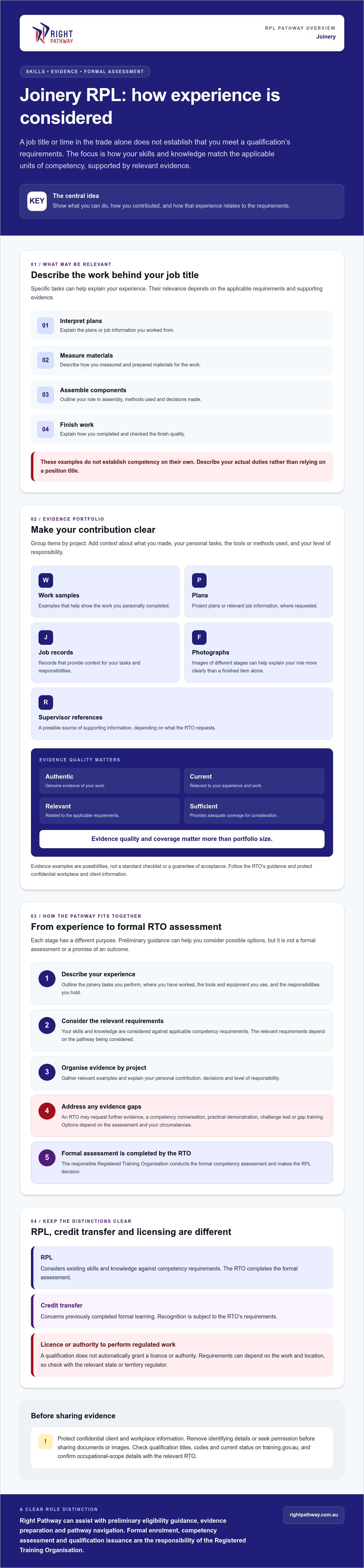
Make a list of the tasks you perform, the tools and equipment you use, and the responsibilities you hold. Examples such as interpreting plans, measuring materials, assembling components and finishing work can help you describe your experience. These tasks don’t establish competency on their own. Their relevance depends on the applicable requirements and supporting evidence.
Joinery and cabinetmaking can involve related work, but they aren’t interchangeable qualification labels. Describe your actual duties rather than relying on your position title. Check qualification titles, codes and current status on training.gov.au, and confirm any occupational-scope details with the relevant RTO.
RPL, credit transfer and licensing are different
RPL considers existing skills and knowledge against competency requirements. Credit transfer is different: it concerns previously completed formal learning, with any recognition subject to the RTO’s requirements. Ask the RTO which pathway applies to your circumstances.
A qualification and a licence are also different. Holding a qualification doesn’t automatically grant a licence or authority to perform regulated work. Licensing requirements can depend on the work and location, so check with the relevant state or territory regulator. For an overview of RPL support and pathway guidance, Right Pathway can help you prepare, while the RTO remains responsible for formal assessment.
Joinery RPL evidence: show how your skills match the work
For joinery RPL Australia, evidence needs to show how your skills relate to the applicable competency requirements. It should be authentic, current, relevant and sufficient. Evidence quality and coverage matter more than the size of your portfolio. Choose examples that help the RTO understand your contribution, not just the finished product.
Build a practical joinery evidence portfolio
Group evidence by project and explain your personal tasks, decisions and level of responsibility. Depending on what the RTO requests, you might include work samples, plans, job records, photographs or supervisor references. Add context to each item: what you were making, which tools or methods you used, and how you checked measurements, assembly or finish quality. For example, photographs showing different stages of a job may help explain your role more clearly than a picture of the completed item alone.
These are possible evidence types, not a standard checklist or a guarantee that any item will be accepted. Follow the RTO’s guidance and protect confidential client and workplace information. Remove identifying details or seek permission before sharing documents or images. The Australian Cabinet and Furniture Association (ACFA) is an industry reference point, but the RTO determines how submitted evidence is assessed.
What if your evidence does not cover every requirement?
A gap in your documents doesn’t automatically determine the outcome. The RTO may ask for further evidence or another way to demonstrate competence, such as a competency conversation, practical demonstration or challenge test. Gap training may also be required. The options depend on the RTO’s assessment and your circumstances.
Right Pathway can help you organise evidence and consider possible next steps before formal assessment. Read the RPL process overview to understand how preparation and RTO assessment fit together, or request a free initial eligibility assessment to discuss your experience. This preliminary guidance isn’t a formal assessment or a promise of an outcome.
How the joinery RPL process works, from eligibility to RTO assessment
The joinery RPL process moves from an initial discussion to evidence preparation and, if you proceed, formal assessment by an RTO. Each stage has a different purpose. Preliminary guidance can help you understand possible options, but it isn’t a formal assessment or a promise of an outcome.
- Describe your experience. Outline the joinery tasks you perform, the settings where you’ve worked and the evidence you may be able to provide.
- Discuss a potential pathway. Consider whether your experience appears relevant to a qualification pathway. Suitability depends on the applicable requirements and the RTO’s formal assessment.
- Prepare evidence. Organise relevant records and examples, then follow the RTO’s guidance on what it needs to review.
- Follow RTO assessment requirements. The responsible RTO reviews your evidence and determines whether further assessment is needed.
For more detail, review the stages of the RPL process. As you do, note which steps involve preliminary guidance and which are part of the RTO’s formal assessment.
What happens during an initial eligibility check?
An initial check is a preliminary review of your experience and possible pathway options. Give accurate details about the work you do, the settings where you’ve worked and the evidence available. This can help clarify potential next steps, but it doesn’t confirm competency or guarantee RTO enrolment.
What may happen during formal RTO assessment?
The RTO assesses evidence against the applicable requirements and decides whether it’s sufficient. Depending on its process and your evidence, it may request more material, a competency conversation, practical demonstration, challenge test or gap training. Requirements vary, so don’t assume a particular method, timeframe or result.
Only the responsible RTO makes the formal competency decision and can issue a qualification where requirements are met. Right Pathway can assist with preliminary guidance and evidence preparation, but it doesn’t conduct formal assessments or issue qualifications. Check the RTO’s assessment requirements directly before proceeding.
Choosing a joinery RPL pathway and taking the next step
Choose a potential pathway by comparing your actual work with the qualification requirements, rather than relying on your job title. Consider the tasks you perform, the evidence you can provide, how closely the requirements appear to fit, and what the responsible RTO expects during assessment. These points can help you prepare questions, but only the RTO can confirm its formal requirements and assessment outcome.
Questions to ask before proceeding
- Which qualification and competency requirements may align with my joinery work?
- What evidence can I provide, and could further evidence or assessment be required?
- What formal enrolment and assessment requirements should I confirm with the responsible RTO?
Check the exact qualification title, code and current status on training.gov.au. Then confirm the pathway details directly with the RTO. Qualification suitability depends on your experience, evidence and the RTO’s formal assessment. Treat preliminary information as a starting point for questions, not a decision.
Get preliminary guidance without assuming the outcome
Right Pathway provides RPL support and facilitation. It can review your initial information, help you organise evidence and discuss potential next steps. It isn’t an RTO, doesn’t conduct formal competency assessments and can’t guarantee acceptance, competency recognition or a qualification. The responsible RTO makes formal assessment decisions and issues any qualification where its requirements are met.
Before proceeding, prepare a clear outline of your work history and the evidence you may be able to access. Use it to ask the RTO about its requirements and decide whether to explore a preliminary eligibility discussion with Right Pathway. This can help you approach the next stage with a clearer understanding of what still needs to be confirmed.
Take a clear next step towards your joinery qualification
With joinery RPL Australia, the key is to connect your actual work and supporting evidence to the applicable competency requirements. A job title or years of experience alone don’t establish competency. Check that a potential qualification fits your work, verify its current details on training.gov.au, and confirm the formal requirements with the responsible RTO.
Right Pathway can help you organise evidence and explore possible pathways, while the RTO remains responsible for formal assessment and any qualification decision. Right Pathway has supported over 2,000 applicants across 18 industries. That experience informs its facilitation role, but preliminary guidance doesn’t guarantee RTO acceptance, competency recognition or a qualification.
Use the initial discussion to clarify what to check next and prepare for the RTO’s requirements. Start by gathering a clear account of your experience and asking which evidence or assessment steps the RTO may require.
Frequently Asked Questions
Can I get a joinery qualification through RPL in Australia?
Possibly. For joinery RPL Australia, an RTO considers how your skills and knowledge align with the applicable competency requirements and whether your evidence demonstrates them. Your job title or years of experience alone don’t guarantee an outcome. Check the qualification’s exact title, code and current status on training.gov.au, then ask the responsible RTO about its requirements and formal assessment process.
What evidence do I need for joinery RPL?
Evidence must be authentic, current, relevant and sufficient for the applicable requirements. Depending on your work, useful starting points may include project records, work samples, plans, photographs and supervisor references. These examples aren’t a universal checklist, and providing documents doesn’t guarantee that requirements are met. Ask the responsible RTO what evidence it accepts and whether it may require further evidence or another assessment method.
Is joinery RPL just a paperwork assessment?
No. RPL considers relevant skills and knowledge against competency requirements, and documents may not demonstrate everything. Depending on its process and the evidence provided, an RTO may request additional material, a competency conversation, a practical demonstration, a challenge test or gap training. Assessment methods vary, so don’t assume a particular approach or result. The RTO determines whether the requirements have been met.
Does Right Pathway assess or issue a joinery qualification?
No. Right Pathway provides preliminary eligibility guidance, evidence preparation support and qualification pathway navigation. It isn’t a Registered Training Organisation, doesn’t conduct formal competency assessments and doesn’t issue qualifications. The responsible RTO handles formal enrolment and assessment, and issues a qualification where its requirements are met. An initial eligibility discussion can help you explore possible next steps, but it isn’t a formal assessment or a guarantee of an outcome.
Does a joinery RPL qualification automatically give me a trade licence?
No. A qualification and an occupational licence or registration are separate, and holding a qualification doesn’t automatically authorise regulated work. Requirements depend on the work and the relevant state or territory. Check directly with the appropriate regulator for your circumstances rather than relying on an RPL provider for definitive licensing advice. Confirming this separately can help you understand what, if anything, is needed beyond a qualification.

Article by
Right Pathway Team
Right Pathway supports experienced workers, tradespeople and skilled migrants with preliminary RPL eligibility guidance, evidence preparation and qualification pathway navigation.
Right Pathway is not a Registered Training Organisation and does not conduct formal competency assessments or issue qualifications. Formal enrolment, competency assessment and qualification issuance are completed by the responsible Registered Training Organisation.
Start with a free initial RPL eligibility assessment at https://www.rightpathway.com.au/eligibility-check
Disclaimer
Right Pathway is a facilitation and support service only. We are not a Registered Training Organisation (RTO), do not conduct formal RPL assessments and do not issue qualifications. All formal RPL assessments and certifications are completed by partner RTOs regulated by ASQA. Eligibility and qualification outcomes depend on each applicant’s evidence, experience and the RTO’s assessment decision.


