
Could the support plans, client conversations and referrals you handle each week help you gain formal recognition? For people exploring community services RPL Australia, the answer depends less on job title or time served than on how clearly their experience demonstrates the requirements of a relevant qualification. Learn more about RPL and RPL in Australia.
It’s understandable to be unsure whether day-to-day work matches formal requirements, or what evidence an assessor may need. This guide explains how Recognition of Prior Learning (RPL) works in community services, what workplace records and examples may be useful to discuss with a Registered Training Organisation (RTO), and how to explore a realistic pathway without assuming you’re eligible or that an outcome is guaranteed.
Right Pathway can guide you with evidence preparation and skills mapping, but it isn’t an RTO and doesn’t conduct formal assessments. Partner RTOs assess your evidence and make decisions about competency and certification. A practical first step is to describe your actual duties, then identify the evidence that may help show how you performed them. An RTO can advise what it needs and identify any gaps.
Key Takeaways
- With community services RPL Australia, relevant experience may be assessed against qualification requirements, but recognition isn’t automatic.
- Focus on evidence that demonstrates your skills, such as suitable work samples, references or workplace documents, rather than simply collecting more paperwork.
- Start by describing your duties, gathering relevant evidence and discussing a possible qualification pathway with an RTO.
- Right Pathway can guide evidence preparation and pathway navigation; partner RTOs conduct the formal assessment and decide the outcome.
How community services RPL can recognise relevant work experience
Relevant community services experience may be assessed through Recognition of Prior Learning, but recognition isn’t automatic. Community services RPL is an assessment of your existing skills and knowledge against the requirements of a current qualification. An RTO considers whether your evidence demonstrates the required competence; length of service alone doesn’t establish that you meet those requirements. For an overview of the concept, see Recognition of Prior Learning (RPL).
Which community services experience may be relevant?
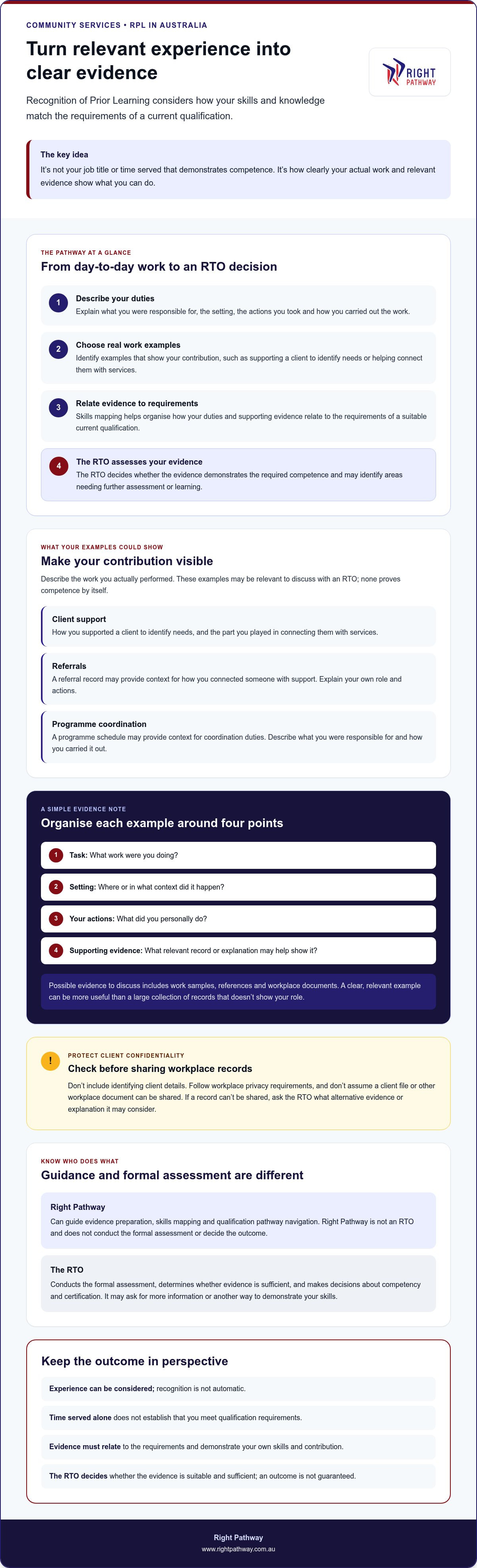
Paid work, volunteering or other relevant practice may give an RTO evidence to consider. What matters is the work you actually performed, the setting and how your responsibilities relate to the requirements of a suitable current qualification. For example, you might describe how you supported a client to identify needs, helped connect them with services, or coordinated a community programme. The important detail is your contribution: what you were responsible for, what steps you took and how you carried out the work. These examples aren’t a guarantee of eligibility; the RTO needs to assess your evidence against the qualification requirements.
For community services RPL Australia, explain your role and contribution rather than relying on a job title. A referral record, for instance, may help show how you connected someone with support, while a programme schedule could provide context for coordination duties. Neither record proves competence by itself. Its relevance depends on what it demonstrates, how it relates to a requirement and whether it can be shared appropriately.
What RPL can and cannot do
RPL evaluates demonstrated competence against qualification requirements. It isn’t automatic credit for time served, and it doesn’t guarantee certification. The RTO determines how your skills are assessed and whether your evidence is sufficient. If evidence doesn’t demonstrate a requirement, the RTO may identify areas that need further assessment or learning.
Start by exploring the RPL pathway, then discuss your duties and possible qualification fit with an RTO. Suitability depends on your evidence, the current requirements and the RTO’s assessment, not simply on how long you’ve worked in the sector.
How community services RPL evidence demonstrates your skills
For community services RPL, evidence needs to show how your experience relates to the competency requirements, not simply fill a folder. A small set of relevant, well-explained records may be more useful than a large collection that doesn’t make your role or skills clear. The RTO decides what evidence it can accept and may ask for more information or another way to demonstrate your skills.
Build evidence around real work examples
Choose examples that show what you did in context. For each one, note the task, the setting, the actions you took and the outcome. Be specific about your own responsibilities, especially if the work was shared with colleagues. For example, when describing a referral, explain the part you played in identifying a support need and connecting the person with an appropriate service, rather than simply naming the referral as evidence. Possible evidence to discuss with the RTO includes work samples, references and workplace documents that relate to your duties.
Protect client confidentiality. Don’t include identifying details in examples, and follow your workplace’s privacy requirements when preparing or sharing records. Don’t assume a client file or workplace document can be shared for an assessment. If a document can’t be shared, ask the RTO what alternative evidence or explanation it may consider.
Map duties to current competency requirements
Skills mapping connects what you can demonstrate at work with specific requirements for a current qualification. A simple working note can help you prepare: list a duty, describe a real example, record what evidence may support it and note any confidentiality or access limits. This can help organise your evidence and identify areas that may need more information, but it doesn’t replace the RTO’s formal assessment or determine the result.
Evidence is valuable because it demonstrates a relevant skill, not because you submit more documents. A workplace record may provide context, while your explanation clarifies your contribution and how it relates to a requirement. The RTO will judge whether the evidence is suitable and sufficient for its assessment.
If you’re unsure how to organise examples before speaking with an RTO, Right Pathway can provide evidence preparation guidance. A free eligibility check is an initial pathway discussion, not a formal assessment.
How to choose a community services RPL pathway in Australia
Choose a pathway by matching your demonstrated skills to the requirements of a current qualification, not simply by selecting the title that sounds most appealing. For community services RPL Australia, a practical starting sequence is to describe your current duties, gather relevant evidence, explore a possible qualification fit, then confirm suitability with an RTO. If the qualification requirements don’t match your experience, ask about other relevant pathways rather than trying to make your evidence fit an unsuitable option.
Check qualification details before choosing
Use training.gov.au to check qualification titles, codes and current status. The register can help you identify the qualification details to discuss, but it can’t determine whether your work experience meets the requirements. Suitability depends on the evidence you can provide and the RTO’s assessment. The RTO makes the formal decision after reviewing your evidence and conducting its assessment.
For an overview of the stages involved, read the RPL process guide. Broader Australian RPL guidance can also help you understand the pathway, but use current register information and the RTO’s advice when checking qualification details. When comparing possible qualifications, focus on the listed requirements and whether you can give clear examples of the work you have personally done.
Prepare for an initial pathway discussion
Before seeking guidance, make a concise list of:
- your current and previous roles, including paid or volunteer experience
- your main responsibilities and the work you personally carried out
- examples of relevant duties, such as supporting people or coordinating services
- evidence you may be able to provide, and any access or confidentiality limits.
This outline helps clarify which parts of your experience may be relevant and what questions to ask. Right Pathway can support evidence preparation and pathway navigation, but it isn’t an RTO and doesn’t conduct formal assessments. Partner RTOs assess evidence and decide whether competency has been demonstrated. An initial eligibility check is a pathway discussion, not a promise of an outcome.
What happens next with community services RPL and Right Pathway?
For community services RPL Australia, the next steps separate pathway guidance from formal assessment. You can first discuss your background through a free initial eligibility check, then organise relevant evidence before a partner RTO assesses it and decides whether you’ve demonstrated the required competencies. The check is an initial discussion, not a formal assessment or guarantee of certification.
- Initial eligibility check: Share your experience and discuss possible qualification pathways.
- Evidence preparation: Organise relevant records and explanations of your work.
- RTO assessment: A partner RTO reviews your evidence and conducts the formal assessment.
- RTO decision: The RTO determines the outcome and, where requirements are met, completes certification.
Right Pathway’s role in your RPL journey
Right Pathway supports evidence preparation and qualification pathway navigation. It is not an RTO, does not conduct formal assessments and does not issue qualifications. Partner RTOs complete assessment and certification, with outcomes depending on your evidence and their assessment. Right Pathway also does not provide migration or visa advice. You can read more about its role in the RPL support and process information.
Right Pathway has supported over 2,000 applicants across 18 industries since its founding in 2019. This reflects its experience supporting applicants, not a promise of any individual assessment outcome.
Take a low-pressure next step
Before you begin, note your roles, responsibilities and the evidence you may be able to access. Use that outline to discuss whether a pathway may be worth exploring. You can also note questions about qualification requirements, acceptable evidence and any documents you can’t share. The RTO remains responsible for the formal assessment and decision.
Take the next step with confidence
With community services RPL Australia, relevant experience may support an RPL pathway, but the outcome depends on evidence that demonstrates the required competencies. Start by setting out your duties and gathering relevant records, then discuss which current qualification may fit your experience. A clear evidence trail can help make that conversation more focused, particularly when you explain what you did and how it relates to the requirements.
Right Pathway supports applicants nationwide and has reported helping over 2,000 applicants across 18 industries. It can guide evidence preparation and pathway navigation, but it isn’t an RTO and doesn’t conduct formal assessments. Partner RTOs assess your evidence, decide whether competency has been demonstrated, and complete certification where requirements are met.
A free eligibility check is a practical way to discuss your experience and possible next steps. It isn’t a formal assessment or a promise of a particular result. Your roles, responsibilities and evidence outline can help make the initial discussion more specific.
Frequently Asked Questions
Can community services experience count towards RPL in Australia?
Yes, relevant experience may be considered if it can be mapped to the requirements of a current qualification. For community services RPL Australia, your job title or years in a role aren’t enough on their own. An RTO reviews your evidence and decides whether it demonstrates the required competence. Suitability depends on your experience, the evidence available and the RTO’s assessment process, so recognition isn’t automatic.
What evidence do I need for community services RPL?
Evidence requirements depend on the qualification and the RTO’s process. Possible items to discuss include work records, relevant workplace documents, references and clear explanations of your responsibilities. Explain what you personally did and how it relates to the requirements, rather than relying on time in a role alone. Protect client confidentiality when preparing examples, follow workplace privacy requirements and ask the RTO what evidence it will accept.
Does Right Pathway assess or issue community services qualifications?
No. Right Pathway isn’t an RTO, doesn’t conduct formal assessments and doesn’t issue qualifications. It supports applicants with evidence preparation, skills mapping and pathway guidance. A partner RTO conducts the formal assessment, decides whether your evidence demonstrates the required competence and completes certification when its requirements are met. The outcome depends on your evidence and the RTO’s assessment, not on guidance or preparation support alone.
How do I know which community services qualification to consider for RPL?
Compare your actual duties and available evidence with the requirements of current qualifications. Check the qualification code, title and training package details on training.gov.au, then discuss the possible fit with an RTO. A job title alone can’t establish suitability. The RTO reviews your evidence, conducts the formal assessment and makes the final decision about whether you’ve demonstrated the required competence.
Is the Right Pathway eligibility check a formal RPL assessment?
No. The free eligibility check is an initial opportunity to discuss your experience and explore a possible pathway. It isn’t a formal RPL assessment and doesn’t guarantee enrolment or a qualification. If you proceed, a partner RTO reviews your evidence and conducts the formal assessment under its requirements. The RTO determines the outcome, including whether your evidence demonstrates the relevant competencies.
To discuss your experience and possible community services RPL pathway, complete Right Pathway’s free initial eligibility check. It’s a pathway discussion, not a formal assessment or a guarantee of an outcome.
Article by
Right Pathway Team
Right Pathway supports experienced workers, tradespeople and skilled migrants with preliminary RPL eligibility guidance, evidence preparation and qualification pathway navigation.
Right Pathway is not a Registered Training Organisation and does not conduct formal competency assessments or issue qualifications. Formal enrolment, competency assessment and qualification issuance are completed by the responsible Registered Training Organisation.
Start with a free initial RPL eligibility assessment at https://www.rightpathway.com.au/eligibility-check
Disclaimer
Right Pathway is a facilitation and support service only. We are not a Registered Training Organisation (RTO), do not conduct formal RPL assessments and do not issue qualifications. All formal RPL assessments and certifications are completed by partner RTOs regulated by ASQA. Eligibility and qualification outcomes depend on each applicant’s evidence, experience and the RTO’s assessment decision.


