

Could years in a commercial kitchen count towards a formal cookery qualification? They may support a certificate iii in commercial cookery RPL pathway, but time served alone isn’t enough. Your skills must align with the qualification requirements, and a Registered Training Organisation (RTO) must assess your evidence.
The current qualification is SIT30821 Certificate III in Commercial Cookery, in the SIT: Tourism, Travel and Hospitality Training Package. This guide explains what an RTO may assess, what evidence could help demonstrate your kitchen skills, and how to check whether your experience may support an RPL pathway.
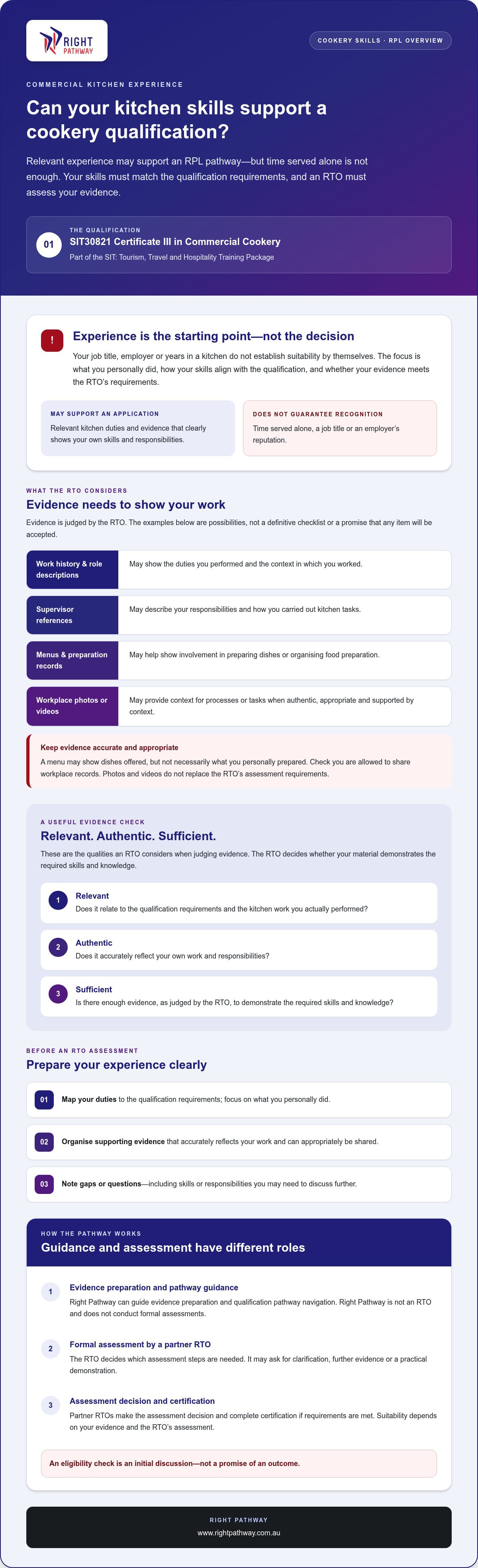
Right Pathway can guide evidence preparation and qualification pathway navigation, but it isn’t an RTO and doesn’t conduct formal assessments. Partner RTOs make assessment decisions and complete certification if requirements are met. Suitability depends on your evidence and the RTO’s assessment, so treat an eligibility check as an initial discussion, not a promise of an outcome.
Key Takeaways
- Check that your pathway relates to the current SIT30821 Certificate III in Commercial Cookery and the SIT: Tourism, Travel and Hospitality Training Package.
- With certificate iii in commercial cookery RPL, relevant kitchen experience may support an application, but suitability depends on your evidence and the RTO’s assessment.
- Map your actual duties to the qualification requirements, organise supporting evidence and identify responsibilities or skills you may need to discuss further.
- Right Pathway can guide evidence preparation and pathway navigation, but partner RTOs conduct formal assessments and decide whether certification requirements are met.
Certificate III in Commercial Cookery RPL: Which qualification are you considering?
Experienced cooks may be suited to certificate iii in commercial cookery RPL if their skills match the qualification requirements and they can provide relevant evidence. An RTO assesses that evidence. Years in a kitchen don’t automatically count as credit.
Cookery RPL is a formal assessment of relevant skills and knowledge against a qualification, using evidence of your work and an RTO’s assessment process. Your job title or employer’s reputation alone can’t establish suitability. The focus is what you can demonstrate through your own work and evidence.
For context on the role, the professional cook entry outlines the chef profession and its training paths. The video below also discusses commercial cookery RPL.
Is SIT30821 the current Certificate III in Commercial Cookery?
At September 2026, training.gov.au lists SIT30821 Certificate III in Commercial Cookery as the current qualification, within the SIT: Tourism, Travel and Hospitality Training Package. It replaced the superseded SIT30816 qualification. Before preparing an application, check the code and package listing, as qualification details can change.
Who might consider commercial cookery RPL?
Consider it if your actual kitchen duties appear to align with the qualification requirements. For example, your work may involve preparing and cooking dishes, but the RTO will determine what evidence and assessment steps are needed. The strength of your application depends on how clearly your evidence shows your own skills and responsibilities.
Right Pathway can guide evidence preparation and pathway navigation, but it isn’t an RTO and doesn’t conduct formal assessments. Learn about the RPL process in Australia before deciding on your next step.
What commercial cookery skills and evidence may an RTO assess?
For certificate iii in commercial cookery RPL, the RTO compares your evidence with the applicable requirements of SIT30821 Certificate III in Commercial Cookery, part of the SIT: Tourism, Travel and Hospitality Training Package. The RTO decides which assessment steps are needed and whether your evidence demonstrates the required skills and knowledge.
RPL evidence must be relevant, authentic and sufficient as judged by the RTO. The examples below are possibilities, not a definitive checklist or a promise that any item will be accepted.
| Possible evidence | Kitchen capability it may help demonstrate |
|---|---|
| Work history and role descriptions | The duties you performed and the context in which you worked |
| Supervisor references | Your responsibilities and how you carried out kitchen tasks |
| Genuine menus or food preparation records | Your involvement in preparing dishes or organising food preparation |
| Workplace records, photographs or videos | Examples of processes or tasks, where authentic, appropriate and supported by context |
What workplace evidence could you organise?
Start with records that accurately reflect your own work. A menu may show the dishes offered, but it won’t necessarily prove what you personally prepared. Photographs or videos can provide context, yet they don’t replace the RTO’s assessment requirements. Before including workplace records, check that you’re allowed to share them and that the material is appropriate.
For a practical approach to organising documents, see this RPL evidence preparation guide. The Australian Culinary Federation can also provide wider industry context on professional development and career pathways.
Can years of kitchen experience replace assessment?
No. Experience informs your application, but time served doesn’t guarantee recognition. An RTO may ask for clarification, further evidence or a practical demonstration. If you’re unsure what to prepare, a free eligibility check can help you consider a possible next step.
How to prepare a stronger Certificate III in Commercial Cookery RPL application
A clear application helps an RTO understand what you’ve done and where your evidence comes from. It won’t determine the result. For certificate iii in commercial cookery RPL, use a methodical approach:
- Confirm the qualification: Check the current SIT30821 Certificate III in Commercial Cookery and the SIT: Tourism, Travel and Hospitality Training Package.
- Map your duties: Compare your actual kitchen responsibilities with the applicable qualification requirements.
- Gather evidence: Collect genuine records that relate to your own work and can be shared appropriately.
- Note gaps: Mark unclear or unsupported areas to discuss, rather than filling them with assumptions.
How do you map kitchen duties to evidence?
Use a simple table to connect each duty with a real example and the record you have. Note when, where and how you completed the work. Be specific about your role: describe what you did yourself, not what the team or workplace did overall. If a record only gives general context, don’t present it as proof of a task you personally completed.
| Relevant duty | Genuine example to describe | Supporting record, if available |
|---|---|---|
| Preparing and cooking dishes | A dish or preparation task you personally completed | Relevant preparation record or supervisor reference |
| Following food safety practices | How you applied hygiene practices during your work | Relevant workplace record or reference |
| Cleaning kitchen equipment | Equipment or cleaning tasks you were responsible for | Relevant workplace record or role description |
What if your evidence doesn’t cover every requirement?
Don’t overstate your competence or try to make a record prove more than it shows. An RTO may identify gaps and decide whether it needs further evidence, clarification or another assessment step. Not every gap can be resolved with documents, and preparation can’t predetermine the assessment decision. Suitability depends on your evidence and the RTO’s assessment.
For general information about fees, see the RPL assessment costs in Australia guide.
What happens after a cookery RPL eligibility check?
A free eligibility check is an initial discussion about whether your experience may support a certificate iii in commercial cookery RPL pathway. It isn’t a full RPL assessment, a decision on your skills or a guarantee of a qualification. Suitability depends on your evidence and the formal assessment completed by a partner RTO.
Who makes the formal RPL decision?
Right Pathway can support evidence preparation and qualification pathway navigation, but it isn’t an RTO and doesn’t conduct formal assessments or issue qualifications. The partner RTO compares your evidence with the qualification requirements, determines the assessment steps and decides whether you meet them. You’ll need to meet that RTO’s evidence and assessment requirements. The partner RTO completes certification if requirements are met.
This distinction matters before you proceed. An eligibility discussion can help you understand possible next steps, but only the RTO’s formal assessment determines the outcome. Work history alone can’t confirm that you’ll receive a qualification.
What should you clarify before proceeding?
Before taking the next step, confirm the qualification code and title you’re considering. For commercial cookery, the current qualification is SIT30821 Certificate III in Commercial Cookery, in the SIT: Tourism, Travel and Hospitality Training Package. Ask which RTO would conduct the formal assessment, what evidence it may require and whether additional assessment steps could apply. Read this Recognition of Prior Learning overview for more context on the pathway.
Right Pathway doesn’t provide migration or visa advice. Keep any questions about those matters separate and seek guidance from an appropriately qualified source.
If you’d like to discuss whether your experience may fit a cookery RPL pathway, you can complete the free eligibility check. It’s a starting point, not a commitment or an assessment outcome.
Take a considered next step towards cookery recognition
For certificate iii in commercial cookery RPL, start by confirming the current qualification, SIT30821 Certificate III in Commercial Cookery, and its place in the SIT: Tourism, Travel and Hospitality Training Package. Then organise genuine evidence that shows what you’ve done and how your kitchen experience relates to the requirements.
Time in the industry doesn’t guarantee recognition. Right Pathway helps applicants prepare evidence and understand their pathway, but it isn’t an RTO and doesn’t conduct formal assessments. Partner RTOs assess applicants and complete certification when requirements are met. Right Pathway reports supporting more than 2,000 applicants across 18 industries, helping people take a clearer, evidence-led approach.
A free eligibility check is a starting discussion, not an assessment outcome or qualification guarantee. It can help you consider whether your experience may support a pathway and what questions to ask next.
Your kitchen experience is worth exploring. Take the next step with clear expectations and let the formal assessment process determine what it can support.
Frequently Asked Questions
Can I get Certificate III in Commercial Cookery through RPL?
Yes, Recognition of Prior Learning may be an option if your existing skills and evidence align with the qualification requirements. For certificate iii in commercial cookery RPL, a partner RTO assesses your evidence and decides whether further steps are needed. A free eligibility check can help you discuss a possible pathway, but it isn’t a formal assessment and can’t guarantee a qualification outcome.
What is the current code for Certificate III in Commercial Cookery?
As of September 2026, the current qualification is SIT30821 Certificate III in Commercial Cookery, in the SIT: Tourism, Travel and Hospitality Training Package. Check training.gov.au before applying to confirm the current code, exact title and package details. SIT30821 replaced the superseded SIT30816 qualification, so make sure any pathway information you use refers to the current qualification.
What evidence do I need for cookery RPL?
The evidence depends on your experience and the requirements the partner RTO assesses. Possible material includes work history, role details, supervisor references and relevant workplace records. Organise genuine evidence around duties you personally performed, and ask how the RTO will address any gaps. The assessor decides whether evidence is relevant and sufficient. No single document guarantees recognition.
Does Right Pathway assess or issue the Certificate III qualification?
No. Right Pathway is an RPL support and facilitation service, not a Registered Training Organisation, and it doesn’t conduct formal assessments or issue qualifications. It can guide evidence preparation and qualification pathway navigation. Partner RTOs conduct formal assessment and certification, and decide whether you meet the requirements. A free eligibility check is an initial discussion, not a formal assessment.
Is commercial cookery RPL just a paperwork process?
No. Documents can help demonstrate your experience, but RPL isn’t paperwork-only, and time served doesn’t guarantee recognition. Depending on its assessment requirements, a partner RTO may ask for clarification, more evidence or a practical demonstration. Prepare accurate examples of your own work, then follow the RTO’s instructions. Suitability depends on your evidence and the RTO’s assessment.

Article by
Right Pathway Team
Right Pathway is an Australian Recognition of Prior Learning (RPL) support and facilitation service helping experienced workers, tradespeople and skilled migrants prepare evidence for nationally recognised qualification pathways.
Founded in 2019, Right Pathway has supported over 2,000 applicants across construction, mining, healthcare, aged care, business, community services, hospitality, automotive and the trades.
We work with ASQA-regulated partner Registered Training Organisations (RTOs) to support evidence preparation, skills mapping and qualification pathway guidance. Right Pathway is not an RTO and does not issue qualifications directly.
Start with a free RPL eligibility assessment at rightpathway.com.au.
Disclaimer
Right Pathway is a facilitation and support service only. We are not a Registered Training Organisation (RTO), do not conduct formal RPL assessments and do not issue qualifications. All formal RPL assessments and certifications are completed by partner RTOs regulated by ASQA. Eligibility and qualification outcomes depend on each applicant’s evidence, experience and the RTO’s assessment decision.


