

What if years of carpentry experience are only the starting point, not proof of competency? For carpentry RPL in Australia, the key question is whether your work evidence can be mapped to the requirements of CPC30220 Certificate III in Carpentry, from the CPC Construction, Plumbing and Services Training Package. Experience may be relevant, but it doesn’t guarantee a qualification.
It’s understandable to be unsure whether your everyday tasks show the full range and quality of your skills. An RTO considers evidence against the required competencies and may identify gaps or request further assessment. Photos, job records and employer references may help demonstrate your experience, provided they’re relevant, clear and connected to your role.
This guide explains how the process works, what evidence may support your application and what to ask before choosing a pathway. Right Pathway can help you organise evidence and understand your options, but it isn’t an RTO and doesn’t conduct formal assessments. A partner RTO is responsible for assessment and certification, so the outcome depends on your evidence and its assessment.
Key Takeaways
- Carpentry RPL Australia considers evidence against formal competency requirements. Time on the tools alone doesn’t determine the outcome.
- Discuss work records, project documents and references with your RTO to understand how they may support your evidence.
- Before preparing an application, check CPC30220 Certificate III in Carpentry and its training package title on training.gov.au. Suitability depends on your evidence and the RTO’s assessment.
- Clarify who does what: Right Pathway supports evidence preparation, while the partner RTO conducts formal assessment and certification.
Carpentry RPL Australia: what recognition can and cannot do
Carpentry RPL Australia considers relevant skills and evidence against formal qualification requirements. Work history matters, but years on the tools alone don’t establish an assessment outcome. The current trade qualification is CPC30220 Certificate III in Carpentry, from the CPC Construction, Plumbing and Services Training Package. Confirm its current status and details on training.gov.au, and remember that suitability depends on your evidence and the RTO’s assessment.
To hear a worker’s perspective on an RPL pathway, watch this video:
What carpentry RPL means in practice
Recognition of Prior Learning (RPL) assesses skills and knowledge gained through work and other experience against a qualification’s requirements. You can read more about Recognition of Prior Learning as a general concept, but an Australian RPL outcome rests with the assessing RTO. Carpentry RPL is an RTO assessment of relevant evidence against qualification requirements, not an automatic qualification based on experience. Right Pathway is not an RTO and doesn’t conduct formal assessments. It supports evidence preparation and pathway navigation, while partner RTOs assess and certify.
Who may want to explore a carpentry pathway
Experienced carpenters and construction workers with relevant work histories may wish to explore whether their skills align with CPC30220. Start by listing the kinds of work you’ve done, your responsibilities on each project and what records could help demonstrate your contribution. Then ask how those examples relate to the qualification requirements. There’s no guaranteed outcome: suitability depends on your evidence and the RTO’s assessment. For broader RPL pathway guidance, visit Right Pathway’s RPL hub.
Carpentry RPL evidence: how an RTO may assess your experience
For carpentry RPL Australia, evidence helps an assessor understand how your work relates to required skills. It doesn’t replace the RTO’s formal assessment. The RTO determines what evidence it needs, whether it is relevant and current, and whether it demonstrates the required competencies. Requirements and assessment methods can vary, so confirm instructions directly with your RTO.
Build an evidence set around actual carpentry work
Choose project examples that show what you did, what you were responsible for and how you contributed. Depending on RTO guidance, possible evidence might include dated work records, project documents, photographs or client references. For each item, note the project or job, when it took place, your role and which part of your work it helps explain. This gives the assessor context instead of leaving them to interpret a folder of unlabelled files. Remove or obscure private or commercially sensitive details before sharing documents, and check with the RTO if you’re unsure what can be supplied. Just as construction consultancies such as PK Services advocate for rigorous standards across the Australian building industry, assessors look for that same clarity and professionalism in your trade records.
Map evidence to CPC30220 requirements
For CPC30220 Certificate III in Carpentry, from the CPC Construction, Plumbing and Services Training Package, the RTO identifies relevant qualification requirements and evaluates whether your evidence addresses them. Evidence needs to demonstrate the required skills, not merely document time served. A project record may show you were involved, for example, but the assessor decides whether it provides enough relevant information to establish competency. Gaps may lead to requests for further evidence or another assessment activity.
Keep your notes organised by project, task and responsibility, then ask the RTO how it wants each item presented. For a broader overview of stages, read about the RPL process. Trades Recognition Australia assesses skills for specific migration programs, which is separate from an RTO’s qualification RPL process. See the official Trades Recognition Australia (TRA) programs information for its scope. Right Pathway can help you prepare and organise evidence, but it isn’t an RTO and doesn’t conduct formal assessments. If you’re unsure where to begin, request a free eligibility check to discuss pathway suitability.
How to prepare for carpentry RPL in Australia
A clear preparation sequence can help you understand what to ask and organise before an RTO assessment. For carpentry RPL Australia, the RTO sets the formal assessment requirements and decides whether your evidence demonstrates the required competencies.
- Identify the qualification. Check CPC30220 Certificate III in Carpentry and the CPC Construction, Plumbing and Services Training Package on training.gov.au. Confirm the current details with your chosen RTO.
- Gather relevant evidence. Organise work records and project documents by the tasks you performed and your responsibilities. Add a short note explaining your role in each example, then ask the RTO what evidence it accepts and how it should be provided.
- Discuss possible gaps. Ask whether your experience appears relevant to the qualification requirements and whether further evidence or a practical demonstration may be requested. Only the RTO can determine what needs to be demonstrated.
- Follow the RTO’s instructions. Use its process for submitting evidence and responding to requests. An initial eligibility discussion is not a formal assessment or a promise of an outcome.
Questions to ask before proceeding
Confirm which partner RTO will conduct the assessment, what its process involves and what evidence it may need. Ask whether additional assessment steps may apply, and check the fees and what they include directly with the relevant provider. You can also review RPL costs in Australia as you prepare questions. Be cautious of claims of guaranteed or instant qualification outcomes. Formal assessment depends on your evidence and the RTO’s decision.
Right Pathway can help with evidence preparation and pathway guidance, but it isn’t an RTO and doesn’t conduct formal assessments. Its free eligibility check is an initial discussion about your experience and possible pathway fit, not a full RPL assessment. It doesn’t guarantee RTO acceptance or a qualification.
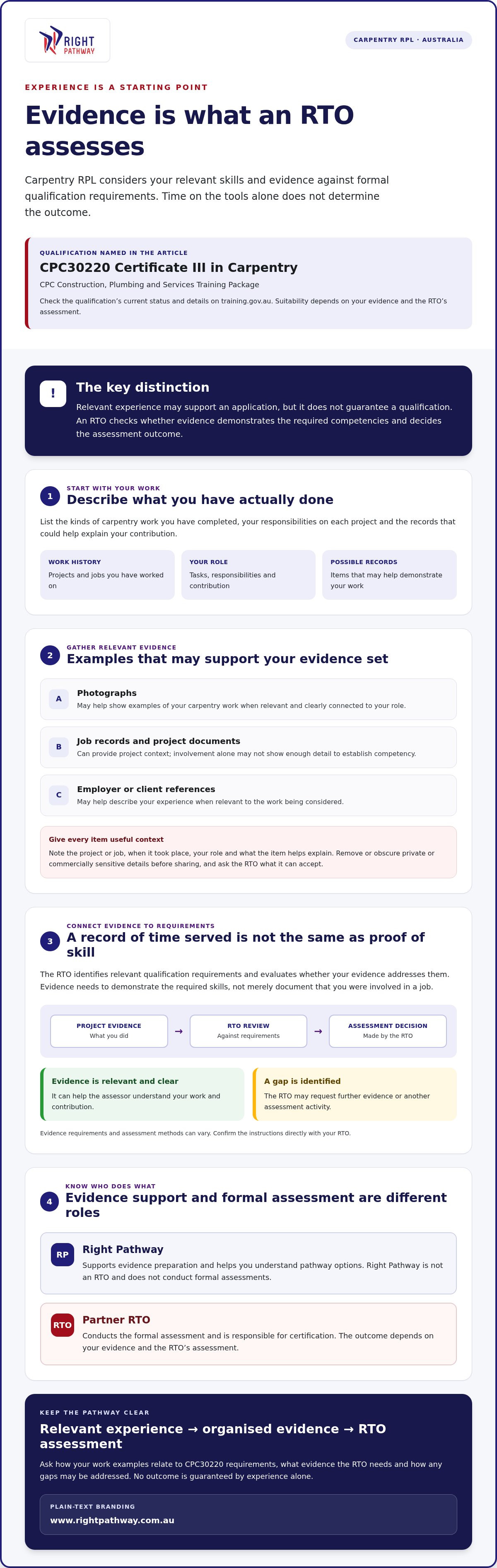
Choosing carpentry RPL support: understand who assesses and certifies
With carpentry RPL Australia, it’s important to distinguish preparation support from the formal decision. Right Pathway is not an RTO and does not conduct formal assessments. Partner RTOs assess the application and decide whether the evidence meets their requirements. Suitability and any outcome depend on the evidence provided and the RTO’s assessment.
| Support facilitator | Partner RTO |
|---|---|
| Helps organise evidence, map skills and explore a qualification pathway. | Sets assessment requirements and formally assesses evidence and competency. |
| Guides preparation and explains possible next steps. | Makes the assessment decision and, where requirements are met, handles certification. |
What Right Pathway does, and doesn’t do
Right Pathway provides evidence preparation guidance, skills mapping support and qualification pathway navigation. It does not provide migration advice, visa services or trade licensing services. For a clearer explanation of the facilitator’s role and the assessment stages, read about the Right Pathway RPL process. Preparation support can help you organise your information, but it can’t replace the RTO’s formal assessment or determine its result.
Take the next step without assuming an outcome
For an initial discussion, outline your relevant carpentry work, the tasks you’ve carried out and the evidence you may have available. A free eligibility check can help explore whether a pathway may fit your background. It isn’t a formal RPL assessment and doesn’t guarantee that an RTO will accept your application or award a qualification. Only the RTO can formally assess your evidence and make that decision.
Take a considered next step with your carpentry experience
Carpentry RPL Australia is a formal assessment pathway, not an automatic outcome based on time in the trade. Relevant evidence helps an RTO assess your skills against qualification requirements. The RTO decides whether your evidence is sufficient or further demonstration is needed.
Right Pathway can help you organise evidence and explore a suitable pathway, but it isn’t an RTO and doesn’t conduct formal assessments or provide migration or visa advice. Founded in 2019, it has supported over 2,000 applicants across 18 industries and works with ASQA-regulated partner RTOs. Those RTOs remain responsible for formal assessment and certification. Your next step can simply be to outline your experience and the evidence you have, without assuming an outcome.
A clear first discussion can help you understand what to ask and how to prepare. Your experience is worth exploring, one practical step at a time.
Frequently Asked Questions
Can I get a carpentry qualification through RPL in Australia?
Potentially. An RTO can assess your existing skills and evidence against CPC30220 Certificate III in Carpentry, from the CPC Construction, Plumbing and Services Training Package. Confirm the current qualification details on training.gov.au. For carpentry RPL Australia, relevant experience is a starting point, not a guarantee. Your suitability and any outcome depend on your evidence, the qualification requirements and the RTO’s assessment.
What evidence do I need for carpentry RPL?
Evidence should help demonstrate your carpentry skills and responsibilities against the qualification requirements. Depending on the RTO’s guidance, examples to discuss may include dated work records, project documents, photographs and references. Organise examples by project and explain your role in each. The RTO decides what it needs to assess your competency, so ask about its evidence requirements before submitting documents.
Does carpentry RPL mean I automatically receive a qualification?
No. Recognition of Prior Learning is an assessment process, not an automatic qualification based on time served or a collection of documents. An RTO evaluates your evidence against the relevant requirements and may ask for further information or competency demonstration. The RTO makes the formal assessment decision and handles certification if requirements are met. Outcomes depend on your evidence and the RTO’s assessment.
Is Right Pathway an RTO for carpentry RPL?
No. Right Pathway is an RPL support and facilitation service, not a Registered Training Organisation, and it doesn’t conduct formal assessments or issue qualifications. It can guide evidence preparation, skills mapping and pathway navigation. Partner RTOs conduct formal assessment and certification. Right Pathway also doesn’t provide migration or visa advice, visa services or trade licensing services.
What does a free carpentry RPL eligibility check include?
It’s an initial discussion to consider your work experience and whether a carpentry RPL pathway may be suitable to explore. You can outline the tasks you’ve done and the evidence you may have. It isn’t a full RPL assessment, doesn’t confirm RTO acceptance and can’t guarantee a qualification. Only an RTO can formally assess your application and determine the outcome.

Article by
Right Pathway Team
Right Pathway is an Australian Recognition of Prior Learning (RPL) support and facilitation service helping experienced workers, tradespeople and skilled migrants prepare evidence for nationally recognised qualification pathways.
Founded in 2019, Right Pathway has supported over 2,000 applicants across construction, mining, healthcare, aged care, business, community services, hospitality, automotive and the trades.
We work with ASQA-regulated partner Registered Training Organisations (RTOs) to support evidence preparation, skills mapping and qualification pathway guidance. Right Pathway is not an RTO and does not issue qualifications directly.
Start with a free RPL eligibility assessment at rightpathway.com.au.
Disclaimer
Right Pathway is a facilitation and support service only. We are not a Registered Training Organisation (RTO), do not conduct formal RPL assessments and do not issue qualifications. All formal RPL assessments and certifications are completed by partner RTOs regulated by ASQA. Eligibility and qualification outcomes depend on each applicant’s evidence, experience and the RTO’s assessment decision.


