

What if the clearest way to raise RPL with your manager is to focus on the skills you can demonstrate, not a qualification you hope to receive? If you’re asking yourself how to talk to my boss about RPL, it’s reasonable to feel unsure how to explain the process or what support to request.
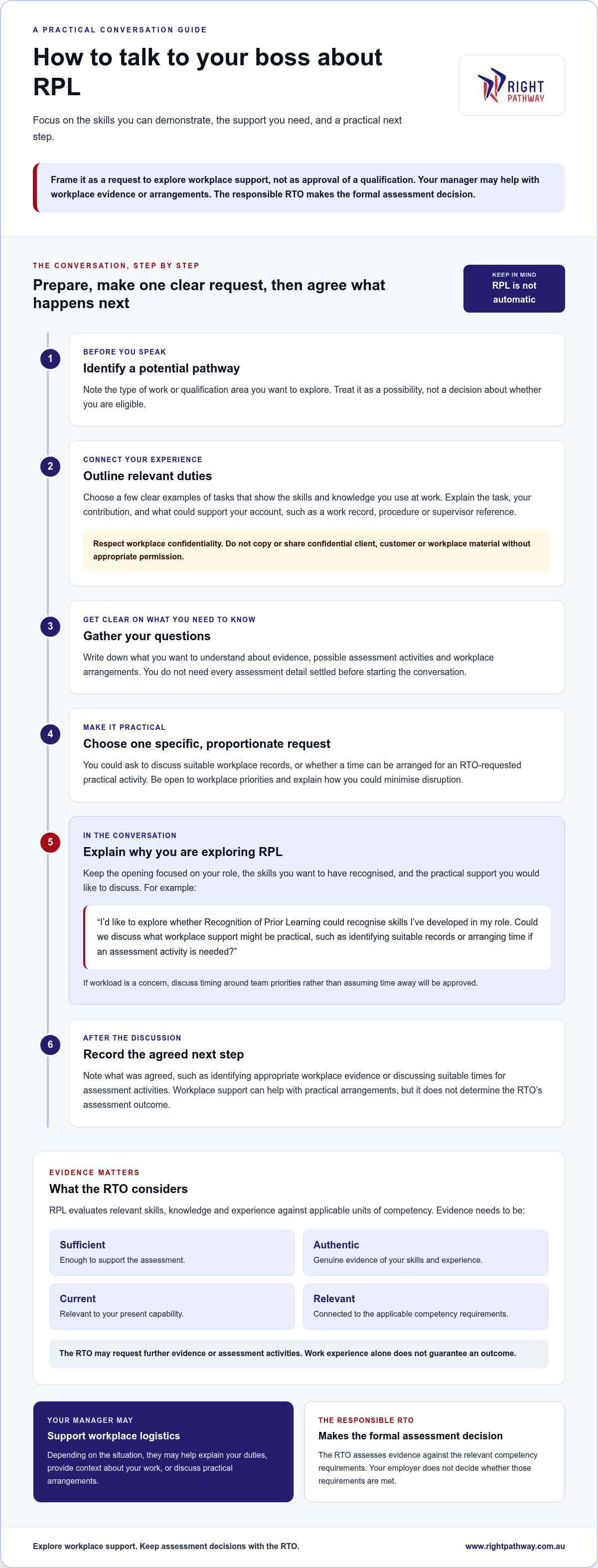
RPL isn’t an automatic qualification. The responsible Registered Training Organisation (RTO) assesses your skills and experience against the relevant units of competency, using evidence that is sufficient, authentic, current and relevant. Your employer can help you access workplace evidence or discuss practical arrangements, but the RTO makes the assessment decision.
This guide will help you prepare a calm, professional conversation: explain how RPL relates to your work, make a specific and reasonable request, and agree on useful next steps. You’ll also learn what happens after the discussion, including how the RTO may review your evidence and whether it needs further information or assessment activities.
Key Takeaways
- Frame the discussion as a request to explore workplace support, not approval of a qualification.
- Prepare examples of your relevant duties and decide what practical support you’d like to discuss.
- When planning how to talk to my boss about RPL, be ready to explain that the RTO assesses your evidence against competency requirements.
- Follow up by recording agreed actions, while keeping in mind that your manager doesn’t decide the RTO’s assessment outcome.
Why talk to your boss about RPL, and what should the conversation achieve?
If you’re working out how to talk to my boss about RPL, frame the discussion as a request to explore practical support, not approval of a qualification. You might want to document skills developed in your current role, clarify how your experience aligns with a potential training pathway, or plan further development. A useful conversation ends with an agreed next step, such as identifying relevant workplace evidence or discussing suitable times for any assessment activities.
RPL considers skills and knowledge gained through work and other experience against the requirements of relevant units of competency. It requires suitable evidence, and experience alone doesn’t guarantee an outcome. You can also explore how RPL may benefit your work and development before raising the subject with your manager.
What support might you reasonably ask your manager for?
Make one clear, proportionate request. For example, ask whether your manager can help identify appropriate work records or discuss a suitable time for an RTO-requested practical activity. Explain how you’ll minimise disruption and be open to workplace priorities. Support isn’t automatic, so treat the conversation as a chance to agree what is workable, rather than assume access or time will be approved.
What is your boss’s role in an RPL pathway?
Your manager may be able to explain your duties, provide context about your work or discuss workplace arrangements, depending on the situation. They don’t decide whether your evidence meets competency requirements. The responsible Registered Training Organisation conducts the formal assessment and, if requirements are met, issues the qualification. In short: an employer may support workplace logistics, while an RTO makes formal assessment decisions.
How to prepare your RPL conversation with evidence and a clear request
A useful answer to how to talk to my boss about RPL starts with preparation, not a pile of documents. Map out a possible qualification pathway, identify duties that may relate to it, note what you need clarified, then choose one practical request. RPL evidence needs to be authentic, current and relevant, and an RTO will assess it against applicable competency requirements. Your examples help explain your experience, but they don’t guarantee an outcome.
- Identify a potential pathway. Note the type of work or qualification area you want to explore, without assuming you’re eligible.
- Outline relevant duties. Select tasks that show the skills and knowledge you use in your role.
- Gather questions. Write down what you need to understand about evidence, assessment activities and workplace arrangements.
- Choose your request. Decide whether to ask for an evidence discussion, access to suitable records or a conversation about scheduling.
The RPL process overview can help you understand the pathway stages before you raise specific questions with your manager.
How to connect your experience to the role
Choose a few clear examples and describe the task, your contribution and what could support your account, such as a work record, procedure or supervisor reference. For example, explain the type of maintenance work you carry out and the records that document it. Don’t copy or share confidential client, customer or workplace material without appropriate permission. A brief description may be enough for the initial discussion.
How to decide what to ask for
Keep your request specific and proportionate. You could ask your manager to discuss which workplace records may be appropriate, or whether a practical assessment activity could be scheduled without disrupting operations. For broader context, the RPL Australia guide explains the pathway. If you’d like to explore a potential route before approaching your manager, start with a free initial eligibility assessment.
What to say to your boss about RPL, including how to handle concerns
Planning how to talk to my boss about RPL is easier when you keep the opening focused on your role, your reason for exploring recognition and one practical request. You’re inviting your manager to discuss whether workplace support is feasible, not asking them to decide your eligibility.
A simple way to open the discussion
Try adapting this wording: “I’d like to explore whether Recognition of Prior Learning could recognise skills I’ve developed in my role as [role]. I’m interested in understanding the evidence and assessment requirements. Could we discuss what workplace support might be practical, such as identifying suitable records or arranging time if an assessment activity is needed?” Keep the request specific to your work and leave room for your manager to raise operational considerations.
How to respond if your boss is unsure
If your manager asks whether RPL guarantees a qualification, explain calmly that it doesn’t. The responsible Registered Training Organisation (RTO) assesses evidence against the relevant competency requirements. The RTO may also request further evidence or assessment activities. An employer’s support can help with workplace arrangements, but it doesn’t replace the RTO’s formal assessment or determine its outcome.
Be ready for practical questions. If workload is a concern, suggest discussing timing around team priorities rather than assuming time away will be approved. If your manager asks about evidence access, offer to identify suitable records while respecting workplace confidentiality and any applicable handling procedures. If they ask why you’re raising it now, explain your reason plainly, such as wanting to document relevant skills or plan your development. You don’t need to have every assessment detail settled before starting the conversation.
If your boss can’t answer technical questions, note them down to discuss with the RTO. Keep the meeting focused on what your manager can reasonably help with and agree on a manageable next step.
What to do after the conversation and how to explore your RPL pathway
After discussing RPL with your manager, send a short follow-up that confirms what was agreed, who will take each action and any workplace arrangements to revisit. For example, note that you’ll identify suitable records and your manager will consider whether a scheduling request is workable. This gives you a practical reference point without suggesting that a qualification or assessment outcome has been promised.
A manager’s response concerns workplace support. It doesn’t determine your formal RPL eligibility or assessment result. The responsible Registered Training Organisation (RTO) reviews evidence against the relevant competency requirements and may ask for more evidence or further assessment activities.
If your manager supports the discussion
Agree on a manageable next step, such as identifying appropriate records or discussing possible timing for an assessment activity. Keep workplace information confidential and follow any relevant handling processes. Treat the agreed support as help with logistics, not confirmation that you’ll receive a qualification. The RTO makes the formal assessment decision.
If your manager cannot support the request
A workplace decision doesn’t prevent you from seeking preliminary guidance about a potential RPL pathway. You can still explore your experience, evidence readiness and possible options. If RPL relates to a specific development goal, the RPL benefits overview may help you clarify what you hope to achieve.
Right Pathway can provide preliminary eligibility guidance, help you prepare evidence and support qualification pathway navigation. Formal enrolment, competency assessment and any qualification issuance remain with the responsible RTO. If you’re considering how to talk to my boss about RPL, remember that the discussion is one workplace step, not the formal assessment itself.
Take the next step towards a clear RPL pathway
Before taking action, write down the main question you still need answered and the information you’ll need to make a considered decision. If you’re thinking about how to talk to my boss about RPL, you can use that question to shape a focused follow-up, whether it’s about timing, workplace records or your own development priorities.
A free initial eligibility assessment can help you explore a potential pathway and consider what to do next with Right Pathway.
Complete a free initial eligibility assessment
Take the next step at a pace that works for you. A clear question is a good place to start.
Frequently Asked Questions
Do I need my boss’s permission to apply for RPL?
Not necessarily to begin exploring a pathway, but workplace permission or arrangements may matter if you need access to organisational records, a supervisor’s input or time during work hours. You can start by listing your own duties and experience, then ask about any specific workplace process before seeking documents or scheduling activities. Requirements can depend on your circumstances, so don’t assume one rule applies everywhere.
What should I say to my boss when asking about RPL?
Ask for a brief discussion and make the purpose clear. For example: “I’m exploring whether RPL could be relevant to my experience in this role. Could we set aside time to discuss what information I can use and any workplace considerations?” A focused request helps your manager prepare. You can then explain why you’re exploring RPL and invite questions, rather than trying to settle every detail in the first conversation.
Can my employer assess my RPL or approve my qualification?
Your employer can help confirm factual details about your work, such as your role, responsibilities or employment history, but that input isn’t a formal RPL decision. The responsible Registered Training Organisation makes the assessment decision and issues any qualification. If your manager is asked for a reference or workplace information, their contribution supports the account of your experience, it doesn’t determine the assessment result.
What evidence can I discuss with my employer for RPL?
You could discuss whether records such as training logs, rosters, performance reviews or examples of completed work exist and can be appropriately accessed. First describe the record, rather than forwarding it or taking it off-site. Ask who can authorise its use and whether a redacted or de-identified version is suitable. The RTO will determine whether particular material is useful for its assessment.
What if my boss does not support my RPL request?
Ask which part of the request is difficult, then consider whether you can adjust it. If operational demands prevent time away, you might ask about a later discussion; if access to records is the issue, identify other material you can lawfully use. You can still seek preliminary pathway guidance independently. Keep expectations realistic: guidance can help you explore options, but it doesn’t promise an assessment outcome.

Article by
Right Pathway Team
Right Pathway supports experienced workers, tradespeople and skilled migrants with preliminary RPL eligibility guidance, evidence preparation and qualification pathway navigation.
Right Pathway is not a Registered Training Organisation and does not conduct formal competency assessments or issue qualifications. Formal enrolment, competency assessment and qualification issuance are completed by the responsible Registered Training Organisation.
Start with a free initial RPL eligibility assessment at https://www.rightpathway.com.au/eligibility-check
Disclaimer
Right Pathway is a facilitation and support service only. We are not a Registered Training Organisation (RTO), do not conduct formal RPL assessments and do not issue qualifications. All formal RPL assessments and certifications are completed by partner RTOs regulated by ASQA. Eligibility and qualification outcomes depend on each applicant’s evidence, experience and the RTO’s assessment decision.


