

Why should you spend years sitting in a classroom learning skills you've already mastered through a decade of hard work? If you're like many experienced professionals, you've likely felt like just another number in a rigid TAFE system, or perhaps you've felt overwhelmed by the sheer volume of evidence required to prove what you already know. The process of recognised prior learning (RPL) shouldn't be an impenetrable barrier to your career progression. While it isn't a "shortcut" or a simple paperwork exercise, it's a rigorous, evidence-based pathway that respects your professional history.
We understand that distinguishing between RPL and credit transfer can be confusing, and the pressure of meeting strict RTO assessment requirements often causes unnecessary anxiety. This guide provides a clear, structured roadmap to help you convert your professional expertise into a nationally recognised qualification. You'll learn how to map your skills against current training packages and what high-quality evidence actually looks like. As a facilitation service, Right Pathway isn't an RTO and doesn't issue certificates; instead, we act as your expert guide, helping you prepare your evidence before a partner RTO conducts the formal assessment.
Key Takeaways
- Learn how to align your existing skills with the Australian Qualifications Framework (AQF) to formalise your professional expertise.
- Understand the eligibility requirements for recognised prior learning, focusing on the necessity of recent, relevant industry experience.
- Discover a structured approach to gathering primary evidence, from position descriptions to work samples, for your professional portfolio.
- Clarify the vital role of evidence preparation guidance and why a partner RTO must conduct the final, formal assessment.
- Gain a clear roadmap for navigating the documentation phase to achieve career progression or trade licensing eligibility.
What is Recognised Prior Learning (RPL) in Australia?
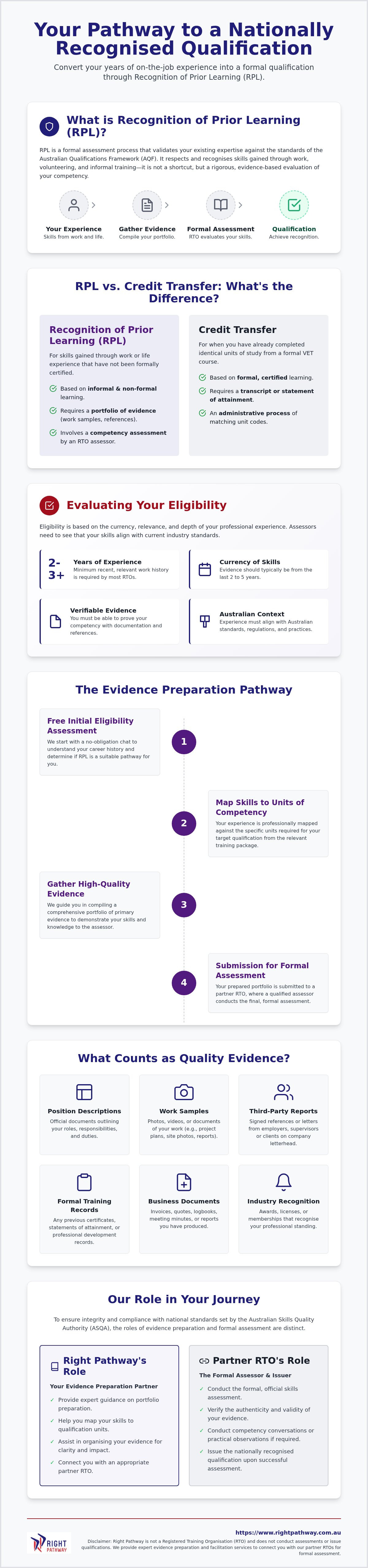
In the Australian vocational education sector, What is Recognition of Prior Learning? It's a formal assessment process designed to validate your existing expertise against the standards set by the Australian Qualifications Framework (AQF). Recognised prior learning acknowledges the skills you've developed through years of work experience, volunteer contributions, and informal training. It's vital to understand that this isn't a shortcut or a method for "buying" a certificate. Instead, it's a high-standard evaluation that requires robust, authentic evidence to prove your competency in specific areas. Essentially, it's the process of mapping your professional history against 'Units of Competency' from a specific training package.
The Role of the Australian Skills Quality Authority (ASQA)
The Australian Skills Quality Authority (ASQA) is the national regulator that ensures the integrity of qualifications across the country. ASQA sets the rigorous standards that Registered Training Organisations (RTOs) must follow when conducting assessments. This oversight ensures that every certificate issued carries genuine weight in the industry. Right Pathway acts as your guide through this complex landscape, providing evidence preparation support. However, it's important to clarify that Right Pathway is not an RTO and does not conduct formal assessments. Only a partner RTO can perform the final evaluation and issue a nationally recognised qualification.
RPL vs. Credit Transfer: Knowing the Difference
Many professionals confuse these two pathways, yet they serve distinct purposes in the VET system. Understanding which applies to you can save significant time during your application:
- Credit Transfer: This applies when you've already completed formal units of study that are identical to those in your new qualification. It's a direct administrative recognition of previous VET study.
- RPL: This focuses on skills gained "on the job" or through life experience that haven't been formally certified. It requires you to prove your current competency through a portfolio of evidence.
Choosing the right path depends on your history. If you have the experience but lack the paper, RPL is your primary route to professional validation.
Evaluating Your Eligibility for Skills Recognition
Determining if you qualify for recognised prior learning requires more than just a list of previous jobs. Eligibility is anchored in the currency and depth of your professional history. Most Registered Training Organisations (RTOs) look for a minimum of two to three years of recent, relevant experience before considering an application. This ensures your skills align with current industry standards and safety regulations. You can determine your suitability on a case-by-case basis through a free initial eligibility assessment.
Successful applicants often find that their work history provides a direct path to RPL for course credits and exemptions, allowing them to bypass redundant training. For instance, a carpenter seeking the CPC30220 Certificate III in Carpentry (Construction, Plumbing and Services Training Package) must provide specific trade-based evidence, such as site photos and signed employer references, to prove they can perform tasks like framing or roofing to Australian standards. Suitability always depends on the specific evidence you can provide and the final assessment by the RTO.
Industry Sectors for RPL
While the process is applicable across many fields, certain industries have higher demand for formal validation. Key sectors include:
- Construction (e.g., carpentry and plumbing trades).
- Mining (operations and safety management).
- Healthcare (e.g., CHC33021 Certificate III in Individual Support from the Community Services Training Package).
- Business and Management.
Each training package has unique evidence requirements. An assessor for a healthcare qualification will focus on clinical placement hours and duty of care, whereas a business assessor will look for project management logs and budget reports. This specificity ensures the integrity of the qualification remains intact.
The Importance of Currency
Currency is a non-negotiable requirement in the VET sector. To be considered valid, your evidence should generally stem from the last two to five years. If your experience is older than this, industry standards or technologies may have changed significantly. In such cases, an RTO might identify a "skills gap" and require gap training to ensure you meet modern benchmarks. This rigorous approach ensures that a nationally recognised qualification remains a true reflection of your current ability.
How to Prepare Your RPL Evidence: A Step-by-Step Guide
Compiling a portfolio for recognised prior learning is a systematic task that requires a high level of detail. It's not enough to simply provide a resume; you must build a compelling case that proves your competence to a formal assessor. This process is structured to ensure that every unit in a qualification is backed by verifiable proof of your skills.
- Step 1: Conduct a skills assessment. This initial step identifies which qualification from the national training system accurately matches your current professional experience.
- Step 2: Gather primary evidence. This includes employment contracts, detailed position descriptions, and payslips. These documents establish the foundation of your work history.
- Step 3: Collect secondary evidence. Assessors look for practical proof such as photos of completed work, videos of you performing technical tasks, project logs, and third-party reports.
- Step 4: Map your evidence. You must align each piece of proof against the specific Units of Competency found in the relevant training package. This is often the most complex stage, as it requires a deep understanding of formal training standards.
What Makes High-Quality Evidence?
Assessors judge your portfolio using the VSAC framework: Validity, Sufficiency, Authenticity, and Currency. For evidence to be valid, it must relate directly to the unit being assessed. Sufficiency means you've provided enough proof to cover every aspect of that unit. Authenticity ensures the work is yours, and currency proves you can still perform the task today. A single reference letter is rarely enough to prove competency for an entire qualification. It might confirm your employment, but it doesn't demonstrate the specific technical abilities required by the Australian Skills Quality Authority (ASQA).
The Role of Third-Party Reports
A third-party report is a formal testimonial where a supervisor or a licensed contractor verifies your skills. They act as a witness to your daily performance on the job. When choosing someone to provide this validation, select a professional who understands the technical requirements of your industry. Their expert testimony provides the assessor with confidence that your skills meet the rigorous benchmarks of a nationally recognised qualification.
Navigating the Pathway with Right Pathway Support
Right Pathway serves as your 'Knowledgeable Navigator' through what is often a complex and bureaucratic documentation phase. Since 2019, we've supported over 2,000 applicants across Australia in formalising their expertise. We provide detailed evidence preparation guidance to ensure your portfolio aligns with the specific expectations of an assessor. By managing the heavy lifting of skills mapping and document review, we allow you to bypass the administrative hurdles that frequently stall recognised prior learning applications. This facilitation ensures you can focus on your career goals while we help you bridge the gap between your experience and recognised prior learning outcomes.
It's essential to understand the structure of this partnership. Right Pathway is not a Registered Training Organisation (RTO) and does not conduct formal assessments or issue qualifications directly. We don't provide migration or visa advice. Instead, we work with a network of ASQA-regulated partner RTOs who are the final authorities in the process. Our role is to ensure your evidence is presented in its best possible light before it reaches their desk.
What to Expect During the RTO Assessment
Once your portfolio is submitted, the partner RTO begins their formal review. Depending on the industry and the level of the qualification, an assessor might request a competency conversation or a practical observation to verify your skills in real time. This is a standard part of the quality assurance process. Your suitability for the final certificate depends entirely on the RTO's independent assessment of your portfolio and any follow-up interactions.
Your Next Steps to Professional Recognition
The journey towards a nationally recognised qualification starts with a clear understanding of your current standing. You should begin with a free initial eligibility assessment to identify which training package matches your background. From there, you can organise a consultation to map out a specific industry pathway tailored to your experience. This methodical approach ensures you're moving toward a valid outcome without wasting time on redundant study.
Take the Next Step Toward Professional Validation
Converting your professional history into a formal qualification requires a methodical approach to evidence collection and a deep understanding of current training standards. We've explored how recognised prior learning serves as a vital bridge for experienced workers, provided the evidence meets the strict benchmarks of validity and currency. By focusing on a structured portfolio rather than traditional classroom study, you can secure the credentials you deserve while maintaining your professional commitments.
At Right Pathway, we provide the straight-talking advice and expert guidance needed to navigate this journey with confidence. Since 2019, our team has supported over 2,000 applicants across every Australian state and territory, spanning over 18 different industries. We act as your knowledgeable navigator, ensuring your documentation is robust and ready for formal assessment by our partner RTOs. This partnership reduces the anxiety of the process and ensures you have a clear path forward.
Your years of hard work are your most valuable asset. It's time to turn that practical experience into a formal milestone that opens new doors for your career progression.
Frequently Asked Questions
Is recognised prior learning easier than doing the full course?
Recognised prior learning isn't necessarily "easier" than a traditional course, but it's a more efficient pathway for those who already possess the required skills. While a full course teaches you new information from scratch, RPL requires you to prove you've already mastered those competencies through your work history. You must still meet the exact same national standards as a student in a classroom, which involves providing high-quality, authentic evidence that satisfies a formal assessor.
How much does an RPL certificate cost in Australia?
The cost of obtaining a qualification through RPL varies significantly depending on the industry, the level of the certificate, and the specific Registered Training Organisation (RTO) involved. These fees generally cover the professional time required for an assessor to review your portfolio, conduct interviews, and verify your evidence. While we don't set these prices, investing in skills recognition is often more cost-effective than paying for years of redundant tuition and taking time away from paid employment to attend classes.
Can skilled migrants use overseas experience for RPL?
Yes, skilled migrants can use their international work history as evidence for recognised prior learning in Australia. To be successful, your overseas experience must be verifiable and align closely with the current Australian training package requirements for your chosen trade or profession. We help migrants by providing guidance on how to map these international skills into a portfolio that meets local RTO standards, though it's important to note that we don't provide migration or visa advice.
What happens if I have 'gaps' in my skills during the assessment?
If an assessor identifies 'gaps' where your evidence doesn't fully meet a unit of competency, you won't need to redo the entire qualification. Instead, the RTO will usually recommend 'gap training' for those specific units. This allows you to complete a small amount of targeted study to bridge the difference between your current skills and the national standard. Once those specific units are completed, you'll be eligible for the full qualification without repeating the areas where you're already competent.
How long does the RPL process typically take from start to finish?
The duration of the process depends largely on how quickly you can gather and organise your evidence. For most professionals, the preparation phase takes a few weeks of dedicated effort to collect the necessary documents and work samples. Once your completed portfolio is submitted to a partner RTO, their formal assessment and verification phase usually takes between two and four weeks. Being thorough during the initial documentation stage is the best way to ensure a fast and successful outcome.

Article by
Right Pathway Team
Right Pathway is an Australian Recognition of Prior Learning (RPL) support and facilitation service helping experienced workers, tradespeople and skilled migrants prepare evidence for nationally recognised qualification pathways.
Founded in 2019, Right Pathway has supported over 2,000 applicants across construction, mining, healthcare, aged care, business, community services, hospitality, automotive and the trades.
We work with ASQA-regulated partner Registered Training Organisations (RTOs) to support evidence preparation, skills mapping and qualification pathway guidance. Right Pathway is not an RTO and does not issue qualifications directly.
Start with a free RPL eligibility assessment at rightpathway.com.au.
Disclaimer
Right Pathway is a facilitation and support service only. We are not a Registered Training Organisation (RTO), do not conduct formal RPL assessments and do not issue qualifications. All formal RPL assessments and certifications are completed by partner RTOs regulated by ASQA. Eligibility and qualification outcomes depend on each applicant’s evidence, experience and the RTO’s assessment decision.


