

Why should you spend months in a classroom learning how to manage workplace hazards you've already successfully mitigated for years? You've likely spent a significant portion of your career navigating complex safety protocols and ensuring team compliance, yet you might feel stuck without the formal credentials to move into a senior safety advisor role. It's frustrating to consider redundant training for skills you use every day, especially when your schedule is already stretched thin by full-time work and site commitments.
This guide explains how to convert your extensive professional history into a BSB41419 Certificate IV in Work Health and Safety through a structured Recognition of Prior Learning (RPL) process. By focusing on the quality of your existing evidence, you can achieve a nationally recognised qualification without the need for unnecessary study. We'll explore the 2026 evidence requirements, including updated standards for psychosocial hazards, and provide a clear roadmap to help you navigate complex VET sector terminology. You'll discover how to prepare a robust portfolio that reflects your true competency for formal assessment and certification by a partner RTO.
Key Takeaways
- Understand why the certificate iv in work health and safety (BSB41419) remains the essential benchmark for safety coordinators and advisors across Australia.
- Compare the practical advantages of Recognition of Prior Learning against traditional classroom study to determine the most efficient path for your career.
- Learn how to compile a robust portfolio of workplace evidence that meets the rigorous standards required by partner RTOs for formal assessment.
- Identify the specific types of "third-party evidence" needed to demonstrate your current competency in managing modern workplace hazards.
- Discover how our free initial eligibility assessment helps you map your existing safety experience against national training package requirements.
What is the Certificate IV in Work Health and Safety (BSB41419)?
The BSB41419 Certificate IV in Work Health and Safety is the current, nationally recognised benchmark for safety practitioners in Australia. It serves as the primary credential for those responsible for managing Occupational safety and health within their organisations. This updated training package replaces all superseded versions, ensuring that safety advisors and coordinators are equipped with the latest knowledge regarding legislative compliance and risk management protocols. In a regulatory climate that now places heavy emphasis on psychosocial hazards and mental health, holding the most current qualification is essential for professional credibility.
For many professionals, this qualification isn't about learning new concepts from scratch. Instead, it's about validating the practical skills you've developed on-site or in the office. It provides a formal framework for your existing ability to identify hazards and implement controls before incidents occur. If you're aiming for a role as a WHS officer or safety coordinator, this is the standard employers expect to see on your resume.
To better understand the value this qualification provides for your career, watch this helpful overview:
Core Competencies of the BSB41419 Package
The qualification consists of 10 units of competency that cover the full spectrum of modern safety management. These units ensure you can effectively lead safety initiatives within any Australian workplace. Key competency areas include:
- Interpreting the WHS legislative framework to ensure your workplace remains compliant with current laws.
- Contributing to WHS consultation and participation processes to build a stronger safety culture.
- Implementing systematic hazard identification, risk assessment, and control measures.
- Assisting with responding to workplace incidents and conducting thorough investigations to prevent recurrence.
Who is this Qualification For?
The certificate iv in work health and safety is designed for individuals who already carry safety responsibilities but lack the formal certification to match their experience. It's particularly relevant for:
- Site supervisors and team leaders who manage daily safety briefings and site inspections.
- Health and Safety Representatives (HSRs) looking to transition into dedicated safety advisor roles.
- Skilled migrants who have extensive overseas safety experience and need their skills mapped to Australian standards.
Right Pathway acts as your "Knowledgeable Navigator" through the RPL process, helping you compile the necessary evidence to prove your competency. It's important to clarify that while we provide expert guidance and support, formal assessment and the issuance of the qualification are completed by our partner RTOs.
Study vs RPL: Choosing the Best Path for Your Career
Deciding how to obtain your certificate iv in work health and safety often comes down to one fundamental question: do you need to learn the material, or do you just need to prove you already know it? Traditional study involves attending classes and completing assessments on topics you likely master through daily site operations. If you've been managing risk registers and conducting tool-box talks for years, sitting through an entry-level lecture can feel like a poor use of your professional time. Traditional courses can take anywhere from 6 to 18 months to complete, which is a significant commitment for a full-time worker.
Reviewing the official BSB41419 qualification details shows a heavy emphasis on practical application in real-world settings. This is where Recognition of Prior Learning (RPL) becomes a viable alternative. RPL acknowledges that your current work experience meets national standards. It's vital to understand that RPL is not a "shortcut" or a guaranteed outcome. It's a rigorous assessment of your existing evidence portfolio conducted by a partner RTO to ensure you meet every requirement of the training package. Suitability for this path depends entirely on the quality of your evidence and the final RTO assessment outcome.
The Benefits of Recognition of Prior Learning
Choosing the RPL pathway allows you to eliminate the need to repeat basic safety training you perform daily. For many, this can significantly reduce the time taken to achieve a nationally recognised qualification. Instead of a long-term study commitment, experienced workers often find the process takes between 4 and 8 weeks from evidence submission to completion. This efficiency lets you focus your energy on higher-level safety leadership rather than entry-level theory. If you're unsure if your current role provides enough documentation, you can start with a free initial eligibility assessment to see how your skills map to the requirements.
When is Traditional Study Better?
RPL isn't the right fit for everyone. Traditional study is often the better choice if you are transitioning into safety from a completely unrelated industry or if you lack access to workplace documents due to a career break. It provides a structured, teacher-led environment that's ideal for those who prefer learning new WHS legislation in a controlled setting. If you don't have a portfolio of current safety reports, incident investigations, or risk assessments from the last few years, the classroom provides the necessary environment to build those skills from the ground up.
Evidence Requirements: How to Map Your WHS Experience
Navigating the requirements for a certificate iv in work health and safety involves more than just listing past job titles. You need a robust portfolio of "third-party evidence" that demonstrates your active involvement in safety management within a professional environment. This evidence must be current, generally within the last 2 to 3 years, and directly relevant to current Australian WHS standards. While Right Pathway acts as your guide in organising and reviewing these documents, we don't issue the final certificate; that responsibility lies with our partner RTOs after a formal assessment. For an RTO assessment to be successful, your portfolio must adhere to the four Rules of Evidence: validity, ensuring the evidence relates to the unit; sufficiency, providing enough proof; authenticity, confirming it's your own work; and currency, showing your skills are up to date.
Common Examples of WHS Evidence
Workers often have the right documents in their filing cabinets without realising their value for a qualification. You'll need to provide Safe Work Method Statements (SWMS) or Job Safety Environmental Analyses (JSEA) that you have personally authored or reviewed. Incident reports, investigation notes, and records of corrective actions taken after a site hazard are also vital. Additionally, minutes from safety committee meetings or toolbox talks you've facilitated serve as excellent proof of your consultation and participation skills. These documents prove you don't just know the theory but can apply it under real-world pressure.
The Role of Skills Mapping
Skills mapping is the methodical process of aligning your daily tasks with the specific units in the BSB41419 training package. This approach helps identify "gaps" where you might need to find additional documentation to satisfy a specific competency. Organisations like the Australian Institute of Health & Safety emphasise that professional development requires this level of rigorous validation. To confirm your competency, a supervisor or manager will typically need to verify your skills through a third-party report, acting as a formal witness to your workplace performance and leadership.
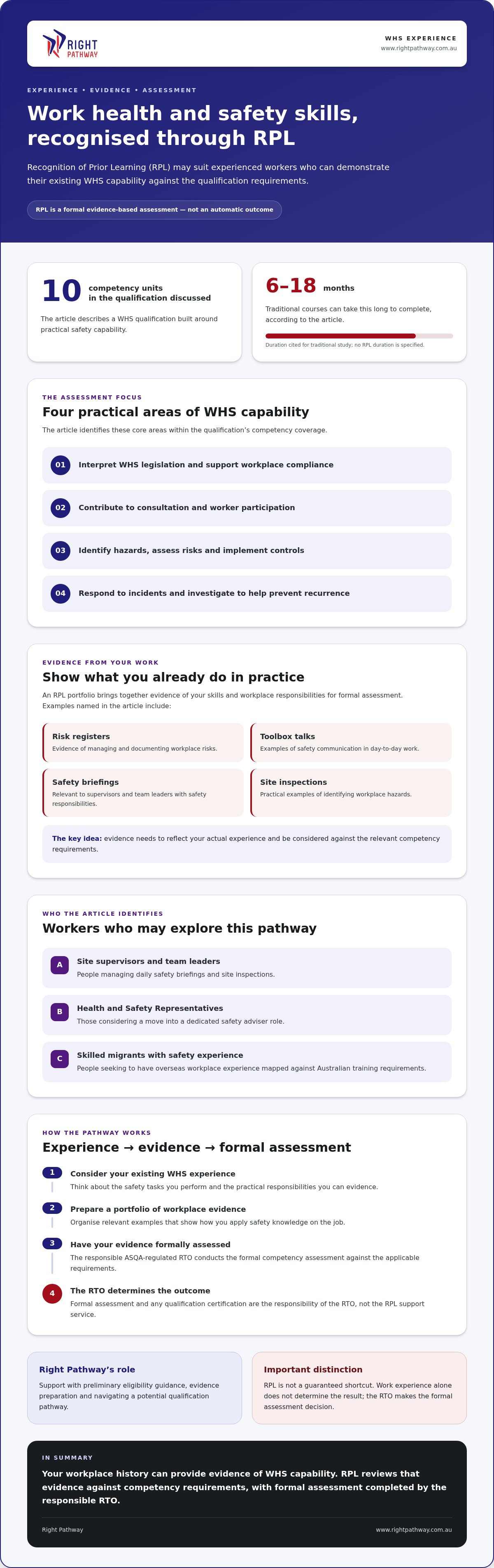
The Right Pathway Process: From Experience to Qualification
Obtaining your certificate iv in work health and safety through experience doesn't have to be a bureaucratic nightmare. Our role at Right Pathway is to facilitate the RPL assessment process, acting as your guide through the technical requirements set by national training authorities. We provide a free initial eligibility assessment to determine if your current safety duties align with the BSB41419 training package. It's important to understand that Right Pathway is not an RTO; we don't conduct formal assessments or issue qualifications. Instead, we support your evidence preparation while our partner RTOs handle the formal certification. This consultative approach reduces the anxiety of professional validation and helps you focus on your career progression into senior safety roles.
Steps in the Facilitation Journey
We've structured our service to move you through a logical funnel from initial curiosity to your final qualification outcome. The journey follows a clear, three-step path:
- Step 1: Complete your free eligibility check to verify that your work history meets the required standards.
- Step 2: Work closely with our consultants to gather, filter, and organise your evidence portfolio into a professional submission.
- Step 3: Undergo a final review before your documents are submitted to a partner RTO for their formal assessment and issuance of your certificate.
Why Use a Facilitator for Your RPL?
Attempting to navigate the complexities of the rpl certificate australia standards alone can lead to significant delays. Many applicants find their submissions for a certificate iv in work health and safety rejected because their evidence is either insufficient or poorly mapped to the units of competency. Using a facilitator ensures your portfolio meets RTO requirements the first time, drastically reducing the risk of a "not yet competent" result. You'll receive straight-talking, honest advice about your prospects before you commit significant time or resources to the process. This advocacy ensures you get the credit you deserve for your existing hard work without the frustration of redundant study.
Formalise Your Safety Expertise for 2026 and Beyond
Securing your certificate iv in work health and safety is a significant milestone that validates your practical leadership and commitment to workplace safety. By opting for Recognition of Prior Learning, you leverage your existing career history to meet national standards without the need for repetitive classroom sessions. Our team has already guided over 2,000 successful applicants across 18 diverse industries, ensuring their evidence portfolios are robust and professionally mapped for RTO assessment.
Professional validation shouldn't be a source of stress. With expert facilitation, you can navigate the bureaucracy of the VET sector with clarity and focus on your transition into senior safety advisor or coordinator roles. We're committed to providing the straight-talking advice you need to understand your eligibility before you commit to the full process.
Your experience is your greatest asset. We're here to help you turn that experience into the formal credentials you need to advance your career with confidence.
Frequently Asked Questions
Is the Certificate IV in Work Health and Safety (BSB41419) via RPL legitimate?
Yes, obtaining a certificate iv in work health and safety through Recognition of Prior Learning is a fully legitimate pathway within the Australian VET sector. The BSB41419 qualification issued via RPL holds the same weight as one earned through a classroom course because it's based on the same national training standards. It's important to note that Right Pathway is not an RTO; we facilitate the process by helping you prepare evidence for formal assessment and certification by our partner RTOs.
How long does the RPL process take compared to a traditional WHS course?
The RPL process is generally much faster for experienced safety professionals, often taking between 4 and 8 weeks from the time you submit your evidence. In contrast, traditional online or face-to-face courses for the BSB41419 training package typically take between 6 and 18 months to complete. This timeline depends on the quality of your documentation and the speed of the RTO assessment. It's a pragmatic way to secure a nationally recognised qualification without repeating theory you already apply daily.
What happens if I have gaps in my WHS evidence portfolio?
If gaps are identified during your free initial eligibility assessment, we'll guide you on how to address them through targeted evidence collection. You won't necessarily need to complete a full course; instead, you might only need to provide additional workplace documents or complete specific units where evidence is insufficient. Our consultants specialise in skills mapping to ensure your portfolio is as robust as possible before it reaches the partner RTO for formal assessment.
Can I use overseas work experience for an Australian WHS RPL assessment?
You can use overseas experience as part of your evidence portfolio, provided it's relevant to the Australian certificate iv in work health and safety standards. The assessment focuses on your ability to apply safety principles, but you must demonstrate an understanding of Australian WHS legislative frameworks. We help skilled migrants map their international expertise to local requirements, ensuring the evidence is presented in a way that Australian RTO assessors can validate.
Does Right Pathway provide migration or visa advice for safety professionals?
Right Pathway does not provide migration or visa advice under any circumstances. We are specialist RPL facilitators focused on skills recognition and evidence preparation for Australian qualifications. While securing a qualification may assist with professional requirements, we strongly recommend consulting a registered migration agent for any questions regarding visas or residency. Our role is strictly to support your path to certification through our partner RTOs.

Article by
Right Pathway Team
Right Pathway supports experienced workers, tradespeople and skilled migrants with preliminary RPL eligibility guidance, evidence preparation and qualification pathway navigation.
Right Pathway is not a Registered Training Organisation and does not conduct formal competency assessments or issue qualifications. Formal enrolment, competency assessment and qualification issuance are completed by the responsible Registered Training Organisation.
Start with a free initial RPL eligibility assessment at https://www.rightpathway.com.au/eligibility-check
Disclaimer
Right Pathway is a facilitation and support service only. We are not a Registered Training Organisation (RTO), do not conduct formal RPL assessments and do not issue qualifications. All formal RPL assessments and certifications are completed by partner RTOs regulated by ASQA. Eligibility and qualification outcomes depend on each applicant’s evidence, experience and the RTO’s assessment decision.


