

A successful RPL portfolio is a curated narrative of your professional career, not just a disorganised folder of old payslips and generic job descriptions. You’ve likely spent years mastering your trade, yet the prospect of proving those skills to an assessor often feels more daunting than the work itself. It’s a common frustration to feel that your daily expertise doesn't easily translate into the technical language found in national training packages.
This guide provides clear RPL evidence portfolio examples to show you exactly how to bridge the gap between your on-the-job experience and formal standards. We’ll explore industry-specific requirements for qualifications like the CPC30220 Certificate III in Carpentry, helping you identify which documents satisfy RTO expectations. While Right Pathway isn't an RTO and doesn't issue qualifications, we specialise in evidence preparation to make the journey manageable. You’ll learn how to organise your work history into a professional showcase, giving you the confidence to start a free initial eligibility assessment and finally get the credit you’ve earned through years of hard work.
Key Takeaways
- Learn the four essential pillars of evidence, including Validity, Sufficiency, Currency, and Authenticity, to ensure your portfolio meets strict RTO standards.
- Explore industry-specific RPL evidence portfolio examples, such as site photos for carpentry or logbooks for individual support, to identify the best proof for your application.
- Discover how to balance direct evidence like task-based videos with indirect proof such as supervisor reports to create a comprehensive professional profile.
- Master the use of an Evidence Matrix to systematically map your daily work tasks to specific units of competency for a seamless assessment process.
Defining the RPL Evidence Portfolio: Why Quality Beats Quantity
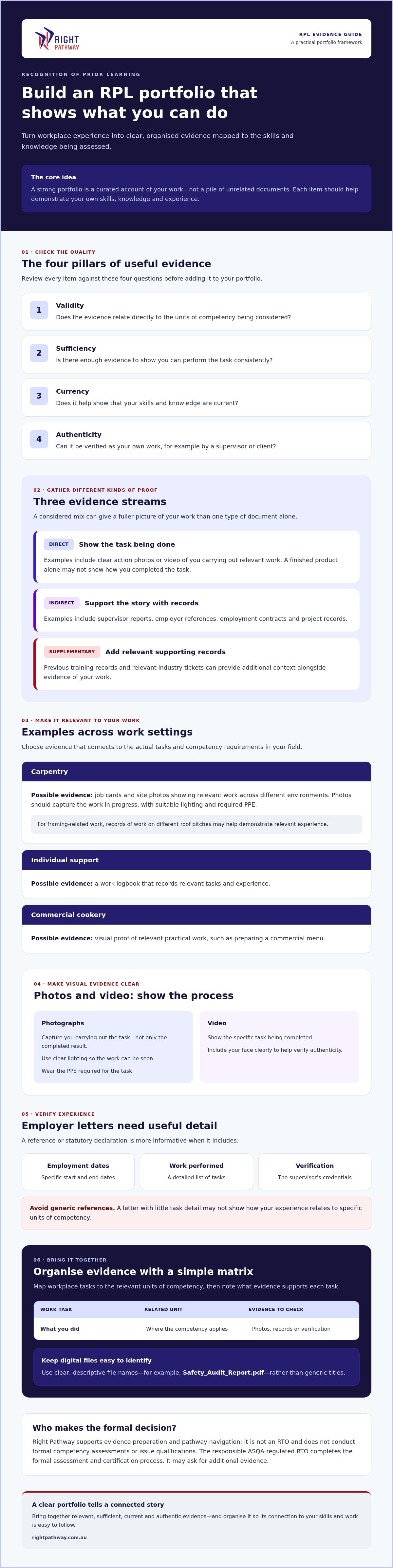
An RPL evidence portfolio is a curated collection of professional records designed to prove your competency against a specific Australian training package. It isn't just a disorganised folder of paperwork; it's a strategic map of your career. To be successful, every piece of proof must stand up to the four pillars of evidence required by Australian Skills Quality Authority (ASQA) standards.
- Validity: The evidence directly relates to the units of competency you're claiming.
- Sufficiency: You've provided enough proof to show you can perform the task consistently over time.
- Currency: Your skills are recent, usually demonstrated through work performed in the last few years.
- Authenticity: The work is undeniably your own, verified by supervisors or clients.
A common mistake is "data dumping," where applicants submit hundreds of irrelevant documents. Ten high-quality RPL evidence portfolio examples, such as a specific project log or a detailed third-party report, are far more effective than fifty generic payslips. While Right Pathway isn't an RTO and doesn't conduct formal assessments, we provide the guidance needed to ensure your portfolio meets these rigorous standards before it reaches a partner RTO for certification.
The Role of Evidence in Recognition of Prior Learning
In the RPL process, your workplace history replaces traditional classroom learning. Your portfolio must tell a story of professional progression, showing how you've mastered complex tasks through years of practice. It's about demonstrating "how" and "why" you do what you do, rather than just proving you were present at a job site.
Digital vs. Physical Portfolios in 2026
The industry has shifted toward cloud-based evidence submission for faster RTO review. Best practices now involve using clear, logical file names such as "Safety_Audit_Report_2025.pdf" rather than generic titles. A well-structured digital folder helps assessors verify your skills efficiently, reducing the need for repetitive requests for more information.
Primary Evidence Examples: The Core of Your RPL Application
To build a robust portfolio, you must categorise your proof into three main streams: direct, indirect, and supplementary. Direct evidence is the "gold standard" and includes visual proof of you performing tasks, such as a carpenter framing a roof or a chef preparing a commercial menu. Indirect evidence consists of documents like third-party reports, supervisor references, and employment contracts. Supplementary evidence rounds out your application with industry tickets, such as White Cards or High Risk Work Licences, and previous training records. Every application requires 100 points of ID and a professionally formatted resume. While Right Pathway assists in the preparation of these documents, remember that a partner RTO ultimately determines if the proof meets the national standard.
Photographic and Video Evidence Best Practices
Visual proof must be high-quality to satisfy an RTO assessor. Photos shouldn't just show a finished product; they need to be "action shots" that capture you in the process of working. Ensure there's clear lighting and that you're wearing all required Personal Protective Equipment (PPE) relevant to the task. Video evidence should clearly show your face and the specific task being completed to prove authenticity. These RPL evidence portfolio examples serve as primary proof that you possess the practical skills required by the national training package.
Employer Letters and Testimonials
While photos prove skill, letters prove experience. A valid employer letter or Statutory Declaration must include specific start and end dates, a detailed list of tasks performed, and the supervisor's own credentials. Generic "to whom it may concern" letters are usually insufficient because they lack the technical detail needed to map your experience to specific units of competency. If you're unsure if your current documents are enough, a free initial eligibility assessment can help clarify what's missing.
Industry-Specific Portfolio Examples: From Trades to Management
Effective RPL evidence portfolio examples vary significantly depending on the sector and the specific qualification code. For a CPC30220 Certificate III in Carpentry, RTO assessors look for job cards and site photos that demonstrate technical proficiency across different environments. A letter confirming work on various roof pitches is particularly valuable for framing units. In the healthcare sector, a CHC33021 Certificate III in Individual Support requires logbooks, workplace observations, and clear proof of manual handling competency. Mining professionals should prioritise RII-standard site inductions, equipment pre-start checks, and production reports to demonstrate compliance with rigorous site safety standards.
Management applicants seeking a BSB50420 Diploma of Leadership and Management need a different approach. Here, the focus shifts to strategic documents like project plans, meeting minutes, and performance review records. While Right Pathway is not an RTO and does not issue qualifications, we specialise in helping you identify which of these workplace documents carry the most weight for an assessor.
Mapping Your Experience to Units of Competency
Mapping is the process of linking your daily tasks to the technical language of a training package. It's about efficiency; one well-chosen piece of evidence can cover multiple units. For example, a comprehensive site safety plan often satisfies requirements for WHS, planning, and communication. A practical mapping example is documenting a "Daily Toolbox Talk," which directly maps to the unit BSBCMM401 Make a presentation. This logical approach prevents you from needing a separate document for every single unit.
The Importance of Currency in Your Portfolio
Australian RTOs typically require evidence from the last 2 to 3 years to ensure your skills meet current industry standards. If you've recently moved into a supervisory role, you may need to provide evidence showing you still understand modern technical requirements, even if you're no longer performing the manual tasks daily. This ensures your professional validation remains relevant to the current Australian Qualifications Framework.
Organising and Annotating Your Evidence for RTO Assessment
A disorganised portfolio is the primary cause of assessment delays. To ensure a smooth review, you must present your proof in a logical, structured format. Start by categorising your evidence into major themes such as Safety, Technical Skill, and Administration. This helps the assessor navigate your professional history without getting lost in a sea of files.
Using an "Evidence Matrix" is the most effective way to map your documents. This simple table shows exactly which file proves which unit of competency. You should also annotate your files; a photo of a commercial kitchen is far more valuable when you provide a brief note explaining the specific menu items you were preparing. Finally, conduct a thorough review for Authenticity. Ensure your name and dates are consistent across every document to avoid red flags during the RTO's verification process.
How Right Pathway Facilitates Your Evidence Journey
Right Pathway acts as your expert guide throughout this preparation phase. We review your RPL evidence portfolio examples to identify any missing links or gaps before your application reaches an assessor. While we provide the strategic support needed to build a strong case, it's important to remember that Right Pathway is not an RTO. We don't conduct formal assessments or provide migration advice; the final certification decision always rests with our partner RTOs.
Next Steps: From Portfolio to Certification
After your evidence is organised and submitted to an RTO, the formal assessment begins. The timeline varies based on the complexity of the qualification and the quality of your documentation. Providing a high-standard portfolio is the best way to move efficiently toward achieving a nationally recognised qualification.
Ready to see where you stand? Complete your free initial eligibility assessment today.
Building Your Professional Future with Evidence
Transforming years of hard work into a formal qualification requires more than just a stack of documents; it demands a strategic approach to evidence. By focusing on the four pillars of validity, sufficiency, currency, and authenticity, you ensure your portfolio speaks the technical language that RTO assessors require. We've explored various RPL evidence portfolio examples across 18 industries, demonstrating that success lies in how clearly you map your daily tasks to national standards.
Right Pathway has supported over 2,000 applicants since 2019, providing expert guidance across 18 industries. We act as an essential navigator, helping you prepare documentation for our partner ASQA-regulated RTOs. Right Pathway is not an RTO and doesn't conduct formal assessments; however, we ensure your history is mapped accurately to satisfy rigorous standards. Your experience is valuable. It's time to ensure it's officially recognised.
Take the first step toward your professional validation today.
Frequently Asked Questions
What counts as "strong" evidence for an RPL portfolio?
Strong evidence is recent, authentic, and directly mapped to units of competency. It includes direct proof like videos of you performing tasks and third-party reports from qualified supervisors. These RPL evidence portfolio examples demonstrate your practical skills in a real-world setting. High-quality proof must also be verifiable. This means providing contact details for supervisors who can confirm your work history and technical proficiency during the RTO's audit process.
Can I use photos and videos taken on my phone as evidence?
Yes, you can use phone-captured media as long as it is clear, well-lit, and shows you performing the task. RTO assessors need to see your face and the specific activity being completed to ensure authenticity. Avoid blurry shots or photos of finished work where you aren't visible. It's best to record short clips that focus on technical tasks, ensuring you are wearing all necessary PPE throughout the footage.
How much evidence do I need to provide for a full qualification?
The volume of evidence depends on the specific qualification and your years of experience, but quality always beats quantity. You don't need hundreds of files; instead, focus on providing a few high-quality examples for each unit of competency. A well-organised portfolio typically includes a mix of employment contracts, site photos, and supervisor testimonials. Right Pathway helps you identify exactly how much is sufficient to satisfy an RTO's rigorous assessment standards.
What happens if I cannot find old payslips or contracts?
If you lack formal records like payslips, you can often use alternative proof such as Statutory Declarations or detailed letters from past employers. These documents must clearly outline your roles, responsibilities, and dates of employment. While Right Pathway assists with evidence preparation, the partner RTO will determine if these alternatives meet the national standard. Providing tax records or bank statements showing income from relevant work can also help bridge these gaps.
Does my evidence need to be from work performed in Australia?
No, evidence from overseas experience can be used for RPL, provided it meets the current Australian training package requirements. You must ensure all documents are in English or professionally translated. The RTO will assess if your international experience maps to the specific units of competency within the Australian Qualifications Framework. This is a common pathway for skilled migrants looking to have their prior experience recognised by an Australian training authority.

Article by
Right Pathway Team
Right Pathway supports experienced workers, tradespeople and skilled migrants with preliminary RPL eligibility guidance, evidence preparation and qualification pathway navigation.
Right Pathway is not a Registered Training Organisation and does not conduct formal competency assessments or issue qualifications. Formal enrolment, competency assessment and qualification issuance are completed by the responsible Registered Training Organisation.
Start with a free initial RPL eligibility assessment at https://www.rightpathway.com.au/eligibility-check
Disclaimer
Right Pathway is a facilitation and support service only. We are not a Registered Training Organisation (RTO), do not conduct formal RPL assessments and do not issue qualifications. All formal RPL assessments and certifications are completed by partner RTOs regulated by ASQA. Eligibility and qualification outcomes depend on each applicant’s evidence, experience and the RTO’s assessment decision.


