
Imagine sitting down to discuss your decade of site management experience, only to find yourself struggling to explain a routine safety check because it feels too "obvious" to mention. It's a common fear, but understanding what happens in an RPL competency conversation is the first step to overcoming that anxiety. Under the Standards for RTOs 2025, this discussion is a formal assessment method used by Registered Training Organisations (RTOs) to verify that your skills are current and authentic. It isn't a memory test; it's a professional validation of the expertise you've built on the job.
We understand the pressure of proving your worth, especially when your experience is vast but undocumented. This guide provides a clear roadmap of the conversation's structure and how to map your daily tasks to official units found on training.gov.au. While Right Pathway is not an RTO and does not conduct formal assessments, we specialise in evidence preparation and guidance. We'll show you how to prepare so you can walk into your interview with confidence. Discover how a free initial eligibility assessment can start your journey toward a formal Australian credential by ensuring your evidence meets the rigorous standards required by our partner RTOs.
Key Takeaways
- Understand that the competency conversation is a formal interview designed to validate your practical expertise through targeted verbal evidence.
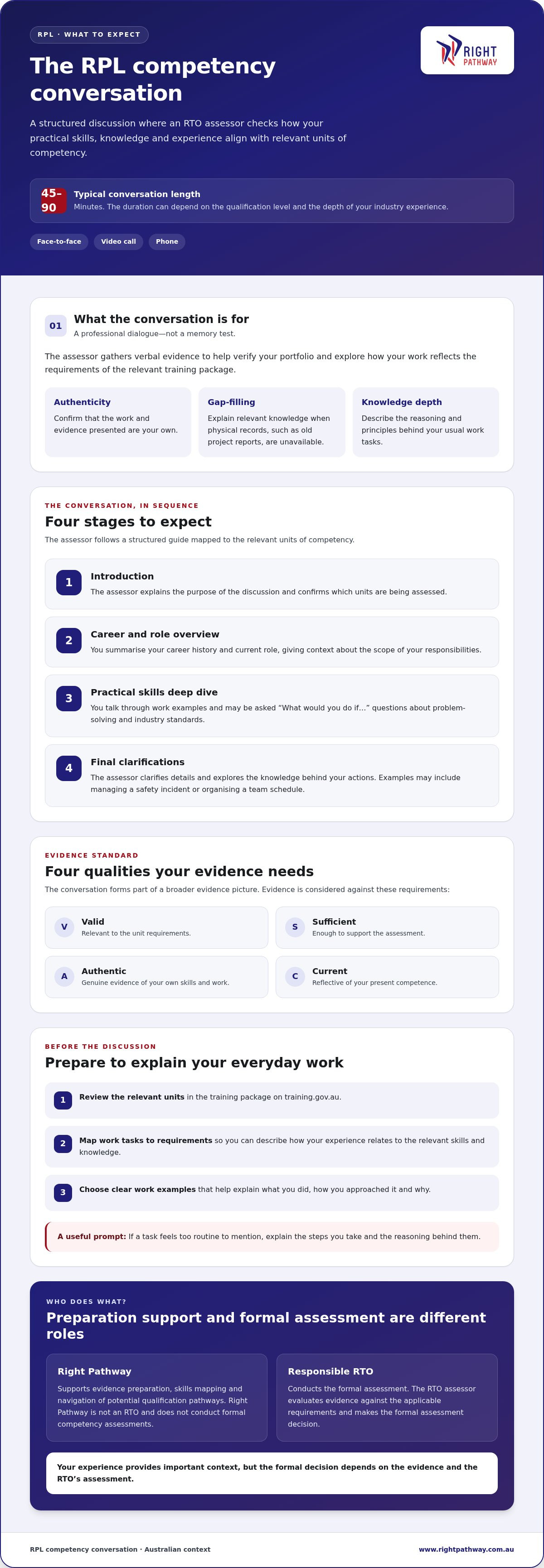
- Learn exactly what happens in an RPL competency conversation, including the typical 45 to 90-minute duration and the various formats used by Registered Training Organisations.
- Master the process of mapping your daily work tasks to official training package standards on training.gov.au to ensure your evidence portfolio is robust and relevant.
- Discover how to interpret your assessment results and use a free initial eligibility assessment to streamline your preparation for a successful outcome with a partner RTO.
Defining the RPL Competency Conversation in Australia
A competency conversation is a structured interview between a candidate and a qualified assessor from a Registered Training Organisation (RTO). It serves as a vital tool for gathering verbal evidence to support a portfolio for a formal qualification. The global framework of Recognition of Prior Learning (RPL) often relies on this interaction to validate non-formal learning. It allows you to demonstrate that your practical skills align with specific training package requirements; for instance, the BSB50420 Diploma of Leadership and Management from the Business Services Training Package. This isn't a high-pressure oral exam. It is a professional dialogue where you explain your daily work in your own words.
Why Assessors Use This Method
Assessors use this method to confirm that the documents in your portfolio are authentic. It serves several critical functions during the assessment process:
- Authenticity: Ensuring the work presented is your own.
- Gap-filling: Addressing areas where physical evidence, like old project reports, might be unavailable but the knowledge is present.
- Knowledge Depth: Ensuring you understand the underlying principles and the "why" behind your daily tasks.
This verification is essential for RTOs to meet the Standards for RTOs 2025 and ensure the integrity of the Australian vocational education system. It transforms your hands-on experience into formal evidence.
The Role of Right Pathway Before the Conversation
Knowing what happens in an RPL competency conversation helps reduce pre-interview nerves. Right Pathway is not an RTO and does not conduct formal assessments or provide migration advice. We act as your guide, assisting with evidence preparation and detailed skills mapping against requirements on training.gov.au. By helping you navigate the RPL process, we ensure you can speak confidently about your skills. We offer a free initial eligibility assessment to help determine if your background matches a specific qualification. Remember that final suitability depends on evidence and RTO assessment. Our support ensures your evidence is ready for that final review.
What to Expect: The 4 Stages of the Conversation
Most candidates find that what happens in an RPL competency conversation is a logical, sequential progression through their professional history. These sessions typically last between 45 and 90 minutes. This duration depends on the qualification level and the depth of your industry experience. Depending on the RTO's requirements, the session is conducted face-to-face, via video call, or over the phone. The assessor follows a structured guide mapped to the specific units of competency within the training package. To maintain regulatory integrity, assessors must follow the Rules of Evidence, which state that all evidence must be valid, sufficient, authentic, and current.
Phase 1 & 2: Introduction and General Overview
The session starts with a formal introduction where the assessor explains the purpose of the call and confirms the units being assessed. You'll then provide a high-level summary of your career history and current role. This stage establishes the context for your evidence. It allows the assessor to understand the scope of your responsibilities before diving into specific technical requirements. It's an opportunity to frame your experience in a way that aligns with the qualification's core objectives and demonstrates your professional standing.
Phase 3 & 4: Deep Dive and Final Clarifications
The latter half of the conversation involves a detailed exploration of your practical skills. The assessor will ask "What would you do if..." scenarios to test your problem-solving abilities and adherence to industry standards. For instance, they may ask you to walk through a specific project, such as how you managed a safety incident or organised a team schedule. These questions ensure you understand the theoretical principles behind your actions. If you're feeling uncertain about how to describe your daily tasks in formal terms, starting with a free initial eligibility assessment can help you map your history to the right units before the formal RTO interview.
Preparing Your Evidence and Mapping Your Skills
A successful RPL assessment relies on how precisely your experience aligns with the standards listed on training.gov.au. Before the interview, review your evidence portfolio thoroughly. Having your site photos, videos, payslips, and references fresh in your mind allows for a smoother dialogue. You must be ready to discuss "the why" behind your actions. For example, don't just state that you wear PPE; explain the risk assessment and hierarchy of controls that necessitated that specific equipment.
Right Pathway facilitates this process through "skills mapping." This involves linking your daily tasks to formal unit requirements. While we aren't an RTO and don't issue qualifications, we ensure your evidence is organised logically. This preparation helps you understand what happens in an RPL competency conversation and ensures you don't "blank out" when asked about technical details. Suitability for any qualification depends on evidence and RTO assessment.
Translating 'Trade Talk' into Competency Language
Assessors look for specific terminology that reflects the training package. Instead of saying "I fixed a site issue," explain how you "identified a non-compliance and implemented a corrective action plan." This shift in language demonstrates your professional maturity. Use specific, recent examples to prove "currency." This shows the assessor you've applied these skills recently, meeting the rigorous standards of modern RTO assessments.
Common Questions You Might Be Asked
Expect questions tailored to your industry. For leadership roles, you might be asked: "Can you describe a time when you had to manage a conflict within your team?" In construction, a likely question is: "What steps do you take to ensure all work meets Australian Standards and WHS regulations?" Preparing these answers in advance builds the confidence needed for a successful outcome.
Outcomes and Next Steps After the Conversation
Once the discussion concludes, the assessor synthesises your verbal responses with the physical evidence portfolio you've previously submitted. Understanding what happens in an RPL competency conversation involves recognising that this is a holistic review process. The assessor evaluates whether your combined evidence meets the strict standards of validity and sufficiency. You will receive one of two results for each unit: "Competent" (C) or "Not Yet Competent" (NYC). This determination is based on whether you've demonstrated sufficient mastery of the training package requirements as defined on training.gov.au.
What Happens if There Are Gaps?
Being deemed "Not Yet Competent" isn't a final "fail." It usually indicates that the RTO requires further evidence or that a specific knowledge gap exists. For instance, you might have the skills but lacked the specific documentation to prove it during the interview. In these cases, the RTO may suggest "gap training" for specific units where your experience doesn't fully meet the national standard. Right Pathway helps you identify these potential gaps early through our free initial eligibility assessment. We provide guidance on mapping your skills so you can present the strongest possible case to the RTO before the formal assessment begins.
Final Certification and Career Progression
Once all units of competency are successfully cleared, the partner RTO will issue your nationally recognised qualification. This formal credential validates years of hard work and opens doors to higher-level roles, site supervisor positions, or salary increases. You can learn more about the benefits of RPL to see how this process supports your long-term career goals in Australia. While Right Pathway is not an RTO and does not conduct formal assessments, our support ensures you are prepared for the rigours of the final review. Suitability for any qualification depends on the quality of your evidence and the final RTO assessment.
Secure Your Professional Future Today
Understanding what happens in an RPL competency conversation removes the uncertainty often associated with formal assessments. By focusing on evidence mapping and translating your daily tasks into formal competency language, you position yourself for a successful outcome. Right Pathway has provided expert guidance to over 2,000 successful applicants across 18 industries, ensuring their work history meets the rigorous standards of our partner ASQA-regulated RTOs.
While we are not an RTO and do not issue qualifications directly, our facilitation service bridges the gap between your practical experience and formal certification. We help you organise your portfolio so you can speak confidently during your interview. Your years of dedication on-site or in the office are valuable assets that deserve formal validation through a nationally recognised qualification. Suitability for any qualification depends on your evidence and the final RTO assessment.
Take the first step toward the career progression you've earned. We're here to help you navigate the path forward with clarity and confidence.
Frequently Asked Questions
Is the RPL competency conversation like a job interview?
It's similar to a professional dialogue where you discuss your career history. Unlike a job interview, the focus is on mapping your skills to specific units of competency. You aren't competing against other candidates; you're proving your own expertise to an RTO assessor. It's a pragmatic discussion about your daily tasks and technical knowledge rather than a personality test or a corporate screening.
What happens if I get nervous and forget something during the RPL conversation?
Don't panic if you "blank out" during the call. The assessor's goal is to help you demonstrate your skills, not to catch you out. They'll often rephrase the question or ask for a specific site example. Understanding what happens in an RPL competency conversation helps reduce this anxiety. If a gap remains, the RTO might request additional written evidence or photos to confirm your knowledge later.
Can I have my notes or evidence in front of me during the call?
You are encouraged to have your evidence portfolio and notes ready during the session. Having project reports, site photos, or unit requirements helps you provide specific, detailed answers. This ensures your verbal evidence is consistent with the documents you've submitted. Right Pathway assists with evidence preparation so your notes are organised logically before the partner RTO begins their formal assessment and certification process.
How long does it take to get my results after the competency conversation?
Turnaround times vary between partner RTOs, but you'll typically receive feedback within one to two weeks. The assessor needs time to review your verbal responses alongside your physical evidence portfolio. Once they determine you've met the standards for all units, the RTO proceeds with certification. This isn't an instant process; it requires a thorough review to ensure your qualification is robust and meets national standards.
Do I need to do a competency conversation for every single unit in the qualification?
Not necessarily. The assessor uses the conversation to verify "clusters" of related skills or to address specific gaps in your paperwork. If your physical evidence for a unit is exceptionally strong, a deep-dive conversation for that area might be shorter. However, the conversation is a critical part of what happens in an RPL competency conversation to ensure the authenticity and currency of your skills.
Article by
Right Pathway Team
Right Pathway supports experienced workers, tradespeople and skilled migrants with preliminary RPL eligibility guidance, evidence preparation and qualification pathway navigation.
Right Pathway is not a Registered Training Organisation and does not conduct formal competency assessments or issue qualifications. Formal enrolment, competency assessment and qualification issuance are completed by the responsible Registered Training Organisation.
Start with a free initial RPL eligibility assessment at https://www.rightpathway.com.au/eligibility-check
Disclaimer
Right Pathway is a facilitation and support service only. We are not a Registered Training Organisation (RTO), do not conduct formal RPL assessments and do not issue qualifications. All formal RPL assessments and certifications are completed by partner RTOs regulated by ASQA. Eligibility and qualification outcomes depend on each applicant’s evidence, experience and the RTO’s assessment decision.


