

Why would you spend thousands of dollars and hundreds of hours sitting in a classroom to learn skills you've already mastered on the job? For many experienced workers, the barrier to a promotion or a trade licence isn't a lack of knowledge, but the absence of formal certification. It's understandable to feel hesitant when the RPL qualification cost isn't always transparent, leaving you worried about hidden fees or the risk of paying for an assessment that doesn't yield results.
We believe your years of hard work deserve official validation without the stress of re-learning your trade. This guide provides a clear breakdown of the factors that determine RPL fees in 2026, helping you distinguish between facilitation support and formal RTO assessment charges. While Right Pathway isn't an RTO, doesn't conduct formal assessments, and doesn't provide migration advice, we help you navigate the evidence process. You'll learn how to maximise your experience to work towards a nationally recognised qualification and how a free initial eligibility assessment can provide a clear roadmap. We'll also examine the ROI of this pathway to give you total financial clarity.
Key Takeaways
- Understand the multi-stage fee structure, which includes evidence facilitation support and formal RTO assessment fees.
- Learn how the RPL qualification cost fluctuates depending on your specific industry and whether you are pursuing a Certificate III or a Diploma level.
- Compare the total investment of RPL against traditional study by accounting for both tuition fees and the significant opportunity cost of lost working hours.
- Minimise financial risk by utilising a free initial eligibility assessment to verify your evidence quality before committing to the formal assessment process.
Understanding the RPL Fee Structure: What are You Paying For?
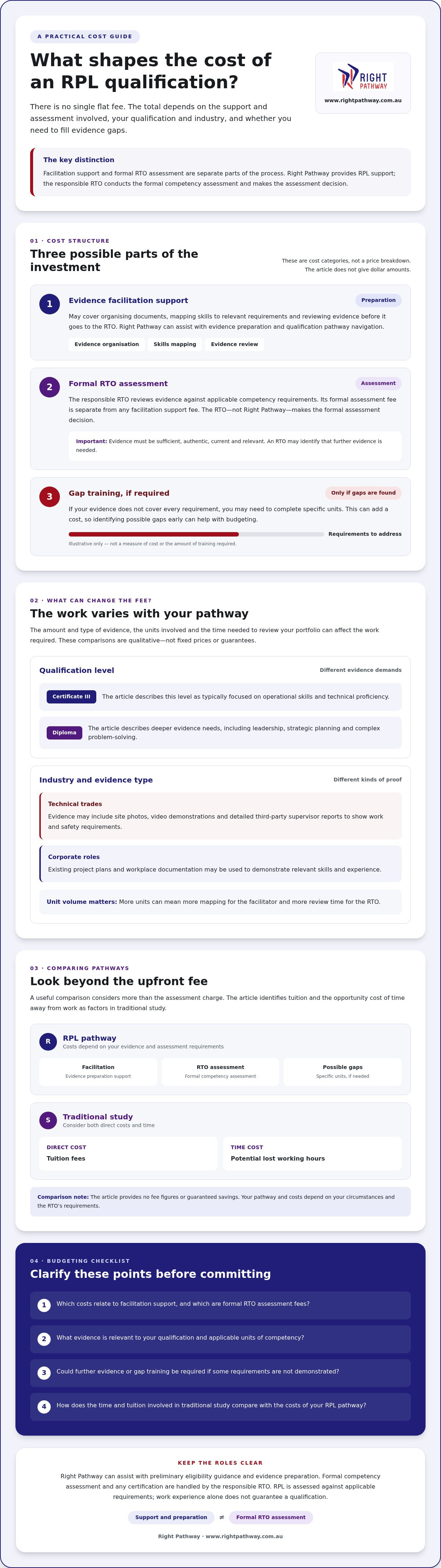
Viewing the RPL qualification cost as a single "purchase" is a common mistake. In reality, it's a multi-stage investment in your professional equity. The process is a service-based journey that transforms your years of unrecognised expertise into formal credentials. This investment typically covers three distinct areas: evidence facilitation, formal RTO assessment fees, and national registration. Because every career is unique, the fee structure reflects the complexity of the evidence required to meet specific units of competency within a training package.
Right Pathway serves as your expert facilitator in this process. We aren't an RTO and don't issue qualifications directly. Our role is to map your existing skills against the standards of Recognition of Prior Learning to ensure your portfolio is robust. By organising your evidence to meet strict RTO standards, we help you avoid the frustration of a disorganised application.
Facilitation vs. Formal Assessment Fees
Facilitation fees cover the heavy lifting of document preparation, skills mapping, and evidence review. This stage is crucial because it ensures your application is "RTO-ready" before you commit to the final assessment. The formal assessment fee is a separate component paid to the partner RTO. They're the final authority that validates your evidence and issues the certificate. Professional guidance during the facilitation phase often prevents the significant cost of a failed assessment, as it ensures you don't submit a weak portfolio that an assessor might reject.
The Cost of Gap Training
You might find that your work experience doesn't cover every single requirement of a qualification. Gap training refers to the cost of completing specific units where your evidence is insufficient. It's a pragmatic way to bridge the distance between your current skills and formal standards. We recommend starting with a free initial eligibility assessment. This step identifies potential gaps early, allowing you to plan your budget without facing unexpected costs mid-way through the process.
Factors That Influence the Cost of Your RPL Qualification
The RPL qualification cost is rarely a flat rate because the rigour required for a valid assessment varies between different levels and industries. National standards set by the Australian Skills Quality Authority (ASQA) ensure that every qualification issued through RPL maintains the same integrity as one earned through traditional study. Consequently, the volume of evidence and the time an assessor spends validating your portfolio will directly influence the final fee structure. Understanding the RPL qualification cost for your specific industry is the first step toward a successful application.
Certificate III vs. Diploma Level Investments
A Certificate III typically focuses on operational skills and technical proficiency. In contrast, a Diploma level qualification, such as the BSB50420 Diploma of Business from the BSB Business Services Training Package, demands evidence of leadership, strategic planning, and complex problem-solving. Because these higher-level qualifications require deeper analysis of your professional history, the assessment process is more intensive. However, many professionals find the extra investment worthwhile as a Diploma often provides a streamlined pathway to university entry.
Industry-Specific Requirements
Technical trades, such as the CPC40120 Certificate IV in Building and Construction (Building) from the CPC Construction, Plumbing and Services Training Package, often involve higher facilitation costs than corporate roles. This occurs because trade evidence usually requires site photos, video demonstrations, and detailed third-party supervisor reports to prove safety and compliance on-site. Corporate roles may rely more on existing project plans and workplace documentation, which can be faster to map. The total number of units in a training package also dictates the workload; more units mean more mapping for the facilitator and more review time for the partner RTO. If you're unsure where your experience fits, you can request a free initial eligibility assessment to clarify your specific requirements.
RPL vs. Traditional Study: Comparing the Real Costs
When evaluating the RPL qualification cost, many applicants focus solely on the upfront assessment fee. However, a true comparison requires looking at the hidden expenses of traditional study, such as TAFE tuition, student service levies, and the recurring cost of textbooks. While a full course can cost between $4,000 and $15,000, the RPL pathway typically ranges from $1,500 to $5,000. This makes it a significantly more affordable entry point for those who already possess the required skills through years of on-the-job experience.
The Opportunity Cost of Traditional TAFE
The most substantial saving isn't found in the tuition fees, but in your time. Traditional study often requires 12 to 24 months of commitment. For a full-time professional, attending classes during business hours can result in thousands of dollars in lost wages over the duration of the course. RPL eliminates this barrier by allowing you to "earn while you certify." You continue your daily work while gathering evidence, ensuring your income remains stable throughout the process. This pragmatic approach removes the financial anxiety often associated with taking long-term study leave.
Long-Term ROI of a Nationally Recognised Qualification
Speed-to-market is a critical factor in your career progression. Obtaining a nationally recognised qualification in weeks rather than years allows you to apply for promotions, higher-tier roles, or trade licences almost immediately. This accelerated timeline can lead to an earlier pay rise, which often offsets the RPL qualification cost within the first few months of completion. Beyond salary, having your skills validated can make you eligible for government tenders or specialised site work that was previously out of reach. You also eliminate secondary expenses like daily commuting to a campus and the purchase of mandatory learning materials.
How to Avoid Unnecessary Costs During the RPL Process
Reducing the RPL qualification cost starts with a strategic approach to your application. One of the most effective ways to protect your investment is to begin with a free initial eligibility assessment. This step ensures you have sufficient evidence before any fees are paid; it prevents you from committing funds to a pathway that may not be viable. Additionally, choosing the correct qualification level is vital. You shouldn't pay for a Diploma if a Certificate IV meets your specific industry licensing requirements. Always verify that the final certificate will be issued by an ASQA-regulated partner RTO to ensure its validity and professional standing.
The Importance of Quality Evidence Preparation
Claims that RPL is merely a "paperwork-only" or "instant" process are myths that can lead to expensive mistakes. To succeed, you must provide high-quality evidence that demonstrates your skills in a real-world context. Our team assists by mapping your daily tasks to the specific units of competency within a training package. Organising your documents early, such as site logs, contracts, and project photos, reduces the time spent on facilitation. "Clean" evidence that is clearly labelled and relevant allows for a smoother review, ensuring your portfolio is "RTO-ready" from the start.
Choosing a Facilitator for Long-Term Savings
While it might seem tempting to manage the process alone, expert guidance often leads to significant long-term savings. A professional facilitator identifies potential gaps before they become costly hurdles during the formal assessment phase. By ensuring your evidence is robust and compliant, you avoid the secondary cost of re-submitting files or paying for additional assessments due to insufficient proof. Right Pathway provides the essential support needed to bridge the gap between your experience and a nationally recognised qualification. Because we are not an RTO, we do not conduct formal assessments or provide migration advice; instead, we focus on evidence preparation while our partner RTOs handle certification. You can check your suitability for this process via our eligibility check.
Secure Your Professional Future with Expert RPL Facilitation
Investing in your career through RPL is a pragmatic decision that balances upfront fees against the significant long-term ROI of formal certification. By choosing this pathway, you avoid the heavy opportunity cost of lost wages and classroom time. We've supported over 2,000 successful applicants across 18 industries, ensuring their evidence is mapped to strict standards before reaching a partner RTO.
While the RPL qualification cost varies based on your specific industry and level, our expert guidance helps you avoid hidden expenses and unnecessary gap training. Right Pathway acts as your essential guide, helping you get the credit you've already earned. Our facilitation remains aligned with ASQA-regulated standards to ensure your portfolio is robust and RTO-ready.
Take the next step toward your promotion or trade licence with confidence. We look forward to helping you navigate the journey to professional validation.
Frequently Asked Questions
Is RPL cheaper than a standard TAFE course in Australia?
Yes, RPL is generally more cost-effective because it removes the need for classroom tuition and student levies. While a full course might cost up to $15,000, the RPL qualification cost is typically much lower. You also save on secondary expenses like commuting and textbooks. Crucially, it prevents the loss of wages that occurs when you take time off work for traditional study.
Are there hidden fees in the RPL assessment process?
Transparency is essential, so you should look for a breakdown that includes both facilitation and RTO assessment fees. Potential extra costs often arise from gap training if your work experience doesn't meet every unit requirement. Right Pathway helps you identify these needs during a free initial eligibility assessment. This proactive approach ensures you understand the full financial commitment before the formal process begins.
Can I get a refund if my RPL application is not successful?
Refund policies vary between service providers and RTOs, but fees for facilitation and assessment are usually non-refundable once work has commenced. This is because you're paying for the professional time spent mapping and reviewing your evidence. To minimise this risk, we focus on a rigorous evidence review process to ensure your portfolio is robust and meets the required standards before submission.
Does the cost of RPL include the final certificate?
Yes, the total fee typically covers the formal assessment by a partner RTO and the issuance of your official certificate upon success. It's important to clarify that Right Pathway is not an RTO; we facilitate the evidence preparation while the RTO is the body that awards the qualification. This final fee is part of the investment that validates your skills against official Australian training package standards.
Why do Diplomas cost more than Certificate III qualifications via RPL?
Diplomas require a more intensive assessment process because they focus on high-level management and strategic skills. While a Certificate III validates technical proficiency, a Diploma involves mapping evidence against complex leadership units. This increased depth of analysis requires more time from both facilitators and assessors. Consequently, the RPL qualification cost reflects the additional professional rigour needed to verify these advanced competencies.

Article by
Right Pathway Team
Right Pathway supports experienced workers, tradespeople and skilled migrants with preliminary RPL eligibility guidance, evidence preparation and qualification pathway navigation.
Right Pathway is not a Registered Training Organisation and does not conduct formal competency assessments or issue qualifications. Formal enrolment, competency assessment and qualification issuance are completed by the responsible Registered Training Organisation.
Start with a free initial RPL eligibility assessment at https://www.rightpathway.com.au/eligibility-check
Disclaimer
Right Pathway is a facilitation and support service only. We are not a Registered Training Organisation (RTO), do not conduct formal RPL assessments and do not issue qualifications. All formal RPL assessments and certifications are completed by partner RTOs regulated by ASQA. Eligibility and qualification outcomes depend on each applicant’s evidence, experience and the RTO’s assessment decision.


