

What if your years of site management or business leadership could be proven without sitting through a single three-hour exam? For many time-poor professionals, the challenge isn't a lack of skill, but understanding exactly what evidence is needed for RPL to satisfy a formal assessment. It's common to feel overwhelmed by the distinction between direct work samples and indirect references, or to worry that your experience from three years ago is no longer considered current by regulatory standards. At Right Pathway, we act as your knowledgeable navigator, helping you sort through the clutter to ensure your portfolio is RTO-ready.
This guide provides a clear, industry-aligned roadmap for gathering the documentation required to secure a nationally recognised qualification. We'll explore the specific work samples, employer declarations, and portfolios that partner RTOs look for when evaluating your competency. While Right Pathway is not an RTO and does not issue certificates or provide migration advice, we specialise in evidence preparation guidance to simplify your journey. You'll learn how to bridge the gap between your daily tasks and formal benchmarks, moving you closer to the professional validation you've earned.
Key Takeaways
- Understand the distinction between direct work samples and third-party validation to ensure your portfolio meets the rigorous standards of partner RTOs.
- Learn exactly what evidence is needed for rpl by exploring the "Rules of Evidence"—validity, authenticity, and currency—required under the Standards for RTOs 2025.
- Discover industry-specific requirements for qualifications like CPC30220 Certificate III in Carpentry or BSB50420 Diploma of Leadership and Management to map your skills to national benchmarks.
- Follow a structured, step-by-step approach to organising your documents, starting with a free initial eligibility assessment to identify your best qualification pathway.
Understanding the Three Categories of RPL Evidence
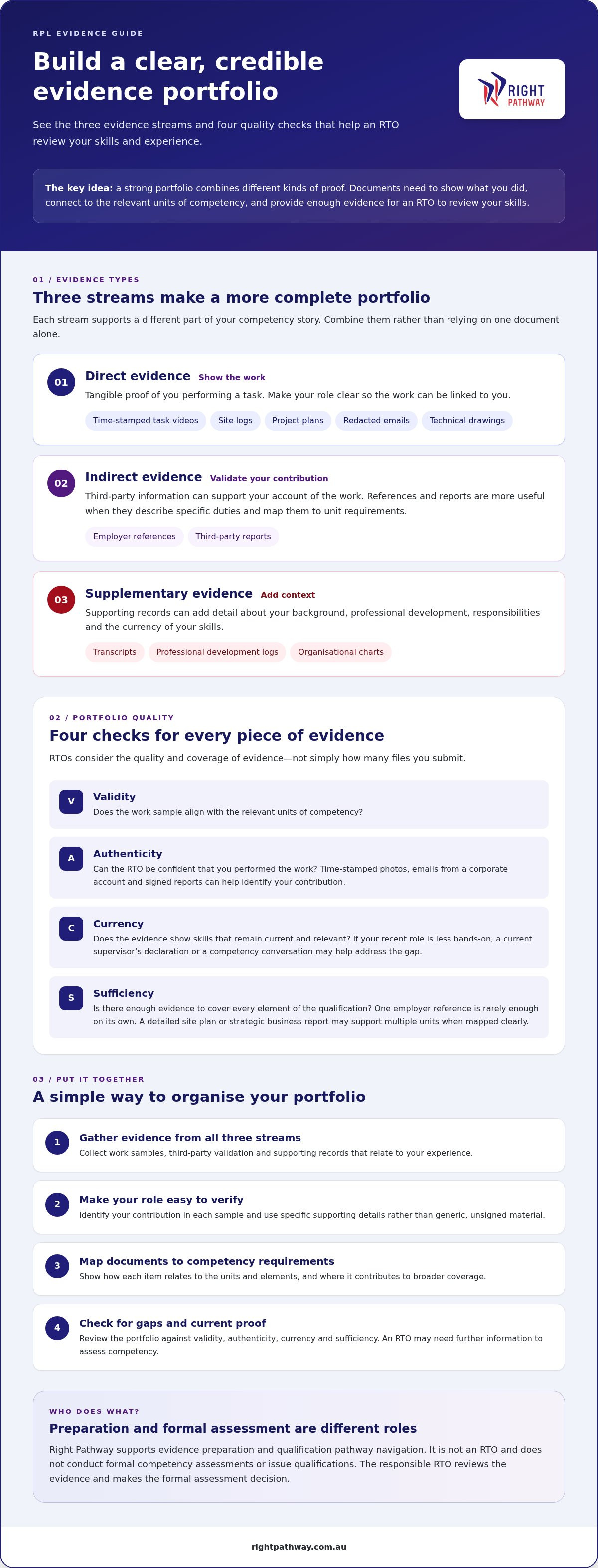
To successfully convert your experience into a qualification, you must provide a balanced portfolio. Understanding what evidence is needed for rpl begins with categorising your professional history into three distinct streams: direct, indirect, and supplementary. This structured approach is central to the global concept of Recognition of prior learning, ensuring that every claim of competency is backed by verifiable facts.
RTO assessors don't just look for a single document; they require a portfolio approach to ensure sufficiency. This means combining different evidence types to paint a complete picture of your skills. While Right Pathway is not an RTO and doesn't conduct assessments, we guide you through the RPL process to ensure your collection is robust. This preparation is vital when determining what evidence is needed for rpl to satisfy a formal review.
To better understand how these categories work in practice, watch this helpful video from SpecTraining:
Direct Evidence: Showing, Not Just Telling
Direct evidence is tangible proof of you performing a task. It's about showing, not just telling. High-quality examples include time-stamped video recordings of complex on-site tasks, site logs, and project plans. Assessor scrutiny often focuses on "Authenticity," so ensure your samples clearly identify you as the person doing the work. Redacted emails or technical drawings can also serve as powerful proof of your hands-on involvement.
Indirect and Supplementary Proof
Indirect evidence involves third-party validation. This often takes the form of a "Third-Party Report" or an employer reference. For an RTO to accept these, they must be specific, mapping your duties to unit requirements. Supplementary evidence, like old transcripts or professional development logs, adds weight to your application. Combining these with organisational charts helps prove your level of responsibility and the currency of your skills.
The Rules of Evidence: How RTOs Grade Your Portfolio
RTOs don't just look at the quantity of documents; they grade them against the "Rules of Evidence." These benchmarks ensure your qualification is robust and defensible. When considering what evidence is needed for rpl, you must ensure every item in your portfolio meets four strict criteria: Validity, Authenticity, Currency, and Sufficiency. Under the Standards for RTOs 2025, assessors are under increased pressure to maintain high rigour during this review process.
Validity requires that your work samples align perfectly with the specific units of competency in the relevant training package. Authenticity is equally critical. An RTO assessor must be certain the work was performed by you without unauthorised assistance. This is why time-stamped site photos, emails from a corporate account, or project reports with your signature are highly valued over generic, unsigned documents.
The "Currency" Challenge for Experienced Workers
Currency is a common hurdle for those who have moved into senior or management roles. Most RTOs require proof of performance from within the last 2 to 3 years. If your most significant hands-on projects occurred five years ago, you must bridge the gap. We often suggest using recent statutory declarations from current supervisors or preparing for a "current competency" interview with the assessor to confirm your skills remain sharp and relevant to current industry standards.
Meeting the "Sufficiency" Benchmark
Sufficiency means having enough proof to cover every element of the qualification. One employer reference is rarely enough to secure a full certificate. Instead, we help you map single documents, such as a comprehensive site plan or a strategic business report, across multiple units of competency to build a dense, compliant portfolio. This ensures the assessor can see consistent performance over time. If you are unsure where your current documents sit against these rules, a free initial eligibility assessment can clarify your position.
Industry-Specific Evidence for Australian Qualifications
While the rules of evidence remain constant, the practical application varies significantly by sector. Determining what evidence is needed for rpl requires a deep dive into your specific industry standards. For construction trades, such as CPC30220 Certificate III in Carpentry, partner RTOs typically look for Safe Work Method Statements (SWMS), site inductions, and time-stamped photos of structural work. In the mining sector, evidence often centres on site-specific inductions, heavy machinery tickets, and formal Verification of Competency (VOC) records.
For management roles, such as the BSB50420 Diploma of Leadership and Management, the focus shifts to strategic plans, budget reports, and minutes from meetings you chaired. Healthcare professionals seeking the CHC33021 Certificate III in Individual Support must provide de-identified case notes and supervisor observations. Right Pathway acts as your knowledgeable navigator to help you gather these documents, though it's important to remember we are not an RTO and do not conduct formal assessments ourselves.
Trade Evidence: Beyond the Toolbelt
Bosses move on and companies close. If a former employer is unavailable, a Statutory Declaration can confirm your trade experience. This legal document, alongside detailed diary logs, helps prove the consistent application of your skills over time. These logs act as a chronological map of your expertise, which is essential for proving your competency during a trade-based RPL assessment.
Evidence for Management and Healthcare Roles
Privacy is paramount in leadership and care sectors. When gathering evidence, you must redact sensitive client or corporate information to maintain confidentiality while preserving the document's validity. Proving soft skills, like conflict resolution or team mentoring, is best achieved through professional references and peer testimonials. These third-party accounts provide the qualitative data assessors need to verify your leadership capabilities without breaching privacy protocols.
Organising Your Evidence for a Successful RPL Assessment
Gathering your documents is only the first stage of the journey. To ensure a successful outcome, you must present your professional history in a way that aligns with the rigorous standards of Australian vocational education. Understanding what evidence is needed for rpl is a strategic process that requires methodical organisation rather than a simple data dump.
Follow these four steps to prepare your submission:
- Step 1: Conduct a free initial eligibility assessment. This identifies the most suitable qualification and prevents you from wasting time on irrelevant documentation.
- Step 2: Gather all raw documents. This includes current photo ID, older transcripts, and any certificates from previous training.
- Step 3: Map your daily work tasks to the specific units of competency in the current training package. This demonstrates how your practical skills meet formal benchmarks.
- Step 4: Conduct a gap analysis. If you lack proof for a specific unit, you may need to record a new video of a task or request a fresh reference from a supervisor.
The Role of an RPL Facilitator
Right Pathway acts as your expert guide during the complex skills mapping phase. We help you curate a portfolio that is RTO-ready, which reduces the likelihood of assessor requests for more information. It's important to remember that Right Pathway is not an RTO. We don't conduct formal assessments or issue certificates. Instead, we facilitate the process, while formal evaluation and certification are completed by our partner RTOs. Learn more about our RPL process and how we support your career progression.
Common Mistakes to Avoid
Many applicants fail because they prioritise quantity over quality. Providing 50 blurry, undated photos won't satisfy an assessor. Each piece of evidence must be clear and directly linked to the "Performance Criteria" of the unit. Avoid providing irrelevant information that doesn't prove competency. A concise, well-mapped portfolio is far more effective than a disorganised folder of raw data. This strategic approach ensures the assessor can easily verify what evidence is needed for rpl in your specific case.
Take the Next Step Toward Your Qualification
Securing a qualification through experience is a strategic journey that relies on the precision of your portfolio. You've learned that identifying what evidence is needed for rpl involves more than just gathering old paperwork. It requires mapping your hands-on skills to the latest national training standards. Whether you're working in the trades or leadership, your evidence must meet strict rules of validity and currency to be successful.
Right Pathway has supported over 2,000 successful applicants by providing expert guidance through this intricate evidence mapping process. We are not an RTO, do not conduct formal assessments, and do not provide migration or visa advice. Instead, we ensure your documentation is RTO-ready for our ASQA-regulated partners. Having a knowledgeable navigator in your corner reduces the anxiety of complex bureaucratic requirements and clarifies your path forward.
Your years of dedication and hard work deserve formal validation. Start the process today and get the credit you've already earned in the workplace.
Frequently Asked Questions
Can I get RPL with only a reference letter from my employer?
No, a single reference letter isn't sufficient for a successful outcome. While employer references are valuable forms of indirect evidence, RTO assessors require a portfolio approach to confirm competency. You will typically need to provide direct evidence, such as work samples, site photos, or project plans, alongside third-party validation. This ensures the assessor can verify your skills across all required units within the national training package.
How old can my work experience evidence be for an RPL assessment?
Most RTOs require evidence to be current, which generally means within the last two to three years. This ensures your skills align with current industry standards and the latest version of the training package. If your best work samples are older, you might need to provide a recent statutory declaration or undergo a competency interview to prove you have maintained those specific skills in your current role.
What happens if I do not have enough evidence for a specific unit?
If a gap is identified in your portfolio, you won't necessarily fail the entire process. You may be asked to provide additional documentation, such as a new video of a specific task, or perform a practical demonstration for the assessor. In some cases, you might need to complete gap training for that specific unit. We help identify these gaps during our evidence preparation guidance to ensure your submission is robust.
Do I need to provide original documents or certified copies?
Most partner RTOs accept high-quality digital scans of your documents for the initial review. However, for official identification and previous transcripts, you may be required to provide certified copies to ensure authenticity. It's essential that all scans are clear, undated documents are avoided, and every file is correctly named. This methodical organisation helps the assessor navigate your portfolio efficiently and reduces the need for follow-up requests during the assessment.
Is a video of me working considered valid evidence for a trade qualification?
Yes, time-stamped videos are considered excellent direct evidence for trade qualifications. A video showing you performing a complex task, such as installing a structural beam or wiring a circuit, provides clear proof of your hands-on competency. When determining what evidence is needed for rpl, videos are often the most persuasive documents because they demonstrate your skills in real-time, making it easier for the assessor to verify your expertise.
How do I prove my skills if I was self-employed or a contractor?
Proving competency as a contractor doesn't have to be complex, but it requires a focus on business records and client validation. You can use contracts, project tenders, invoices, and site-specific inductions to demonstrate your work history. Additionally, references from regular clients can act as third-party reports. Tax records or a business registration can also support your currency, ensuring your portfolio meets the rigorous standards required by partner RTOs.

Article by
Right Pathway Team
Right Pathway supports experienced workers, tradespeople and skilled migrants with preliminary RPL eligibility guidance, evidence preparation and qualification pathway navigation.
Right Pathway is not a Registered Training Organisation and does not conduct formal competency assessments or issue qualifications. Formal enrolment, competency assessment and qualification issuance are completed by the responsible Registered Training Organisation.
Start with a free initial RPL eligibility assessment at https://www.rightpathway.com.au/eligibility-check
Disclaimer
Right Pathway is a facilitation and support service only. We are not a Registered Training Organisation (RTO), do not conduct formal RPL assessments and do not issue qualifications. All formal RPL assessments and certifications are completed by partner RTOs regulated by ASQA. Eligibility and qualification outcomes depend on each applicant’s evidence, experience and the RTO’s assessment decision.


