

You don't need a perfectly preserved archive of every email you've ever sent to secure the qualification your career deserves. For many experienced workers, the biggest barrier to career progression isn't a lack of skill, but the daunting task of figuring out how to prove work experience for RPL without drowning in paperwork. It's understandable to feel anxious about "missing" documents from previous roles or confused by the complex technical language often used by training organisations. You shouldn't have to spend weeks chasing old managers just to validate the work you do every single day.
This guide provides a pragmatic roadmap to help you collect, organise, and present your professional history effectively. You'll learn exactly which pieces of evidence meet the strict standards set by the Australian Skills Quality Authority (ASQA) and how to map your current skills to a nationally recognised qualification. While Right Pathway isn't a Registered Training Organisation (RTO) and doesn't issue certificates, we act as your expert navigator. We'll show you how to build a streamlined portfolio that gives partner RTOs exactly what they need for a formal assessment, turning your years of on-the-job experience into a tangible asset.
Key Takeaways
- Identify the four core rules of evidence—Validity, Sufficiency, Authenticity, and Currency—to ensure your portfolio meets mandatory ASQA requirements.
- Learn how to prove work experience for RPL by effectively balancing direct evidence, such as work samples, with indirect evidence like professional references.
- Streamline your application by following a structured digital collection guide, starting with a free initial eligibility assessment to target the correct qualification level.
- Understand the role of skills mapping and technical interviews in aligning your practical experience with the specific standards required by partner RTOs.
What Counts? Building a Compliant RPL Evidence Portfolio
An Evidence Portfolio is a curated collection of professional documents that demonstrate your competency in a specific field. Many professionals mistakenly believe that having ten years of experience is enough to secure a certificate, but years on the job without physical proof won't satisfy an assessor. Learning how to prove work experience for RPL requires a strategic approach to gathering documentation that meets the Standards for Registered Training Organisations (RTOs) 2025.
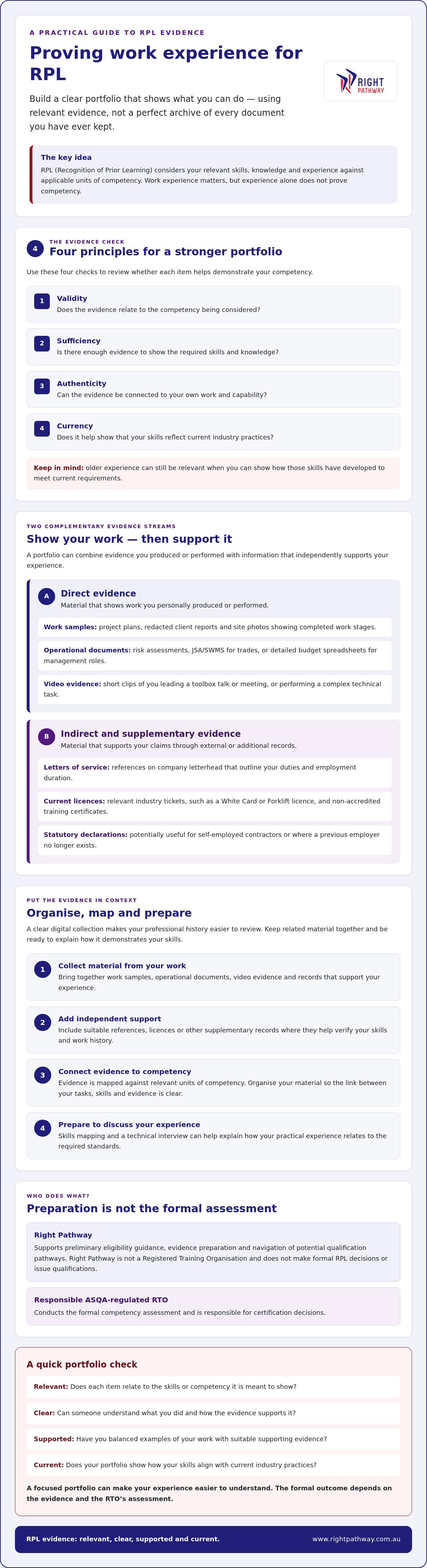
To be successful, your evidence must adhere to the four core rules: Validity, Sufficiency, Authenticity, and Currency. Right Pathway is not an RTO and does not conduct formal assessments. We do not provide migration or visa advice. Instead, we act as your expert navigator, helping you prepare this portfolio so that partner RTOs can complete the formal certification process. This preparation is a critical step in the RPL process.
The Role of Currency in RPL
Assessors generally look for evidence produced within the last 3-5 years. This ensures your skills align with modern industry practices and current Recognition of Prior Learning standards. If you have older experience, it remains relevant only if you can demonstrate how those foundational skills have evolved to meet today's requirements. This timeline is essential when determining how to prove work experience for RPL successfully.
Official Standards and Training Packages
Every piece of evidence you provide is mapped against specific units of competency found on training.gov.au. For example, evidence for a Certificate IV in Business (BSB40120) is assessed against the BSB Business Services Training Package. Your suitability for a nationally recognised qualification depends entirely on evidence quality and the final RTO assessment. Assessors use these benchmarks to verify that your practical history meets rigorous training package requirements.
Direct and Indirect Evidence: Demonstrating Your Competency
To understand how to prove work experience for RPL, you must categorise your documentation into direct and indirect evidence. Direct evidence consists of items you have personally produced or performed. Indirect evidence involves third-party validation of your skills. RTO assessors look for a balanced mix of both to confirm that your skills are genuine and meet national standards. While Right Pathway helps you curate this material, the final assessment is conducted by our partner RTOs.
Third-party reports are particularly influential. When a supervisor or a licensed tradesperson vouches for your technical proficiency, it provides a layer of authenticity that documents alone cannot reach. If you aren't sure which documents carry the most weight for your specific industry, you can start with a free initial eligibility assessment to identify your strongest evidence types.
Examples of Direct Evidence
Direct evidence is the core of your portfolio. It shows exactly what you've done in your professional capacity. Common examples include:
- Work samples: Project plans, redacted client reports, or site photos showing completed work stages.
- Operational documents: Risk assessments, JSA/SWMS for trades, or detailed budget spreadsheets for management roles.
- Video evidence: Short clips of you leading a toolbox talk, leading a meeting, or performing a complex technical task.
Examples of Indirect and Supplementary Evidence
Indirect evidence supports your claims by providing external verification. This is vital for showing how to prove work experience for RPL when direct documentation is limited. Key items include:
- Letters of service: Detailed references on company letterhead outlining your specific duties and duration of employment.
- Current licences: Industry-specific tickets such as a White Card, Forklift licence, or non-accredited training certificates.
- Statutory Declarations: These are essential for self-employed contractors or individuals whose previous employers no longer exist.
How to Organise Your Evidence: A Step-by-Step Collection Guide
Organising your portfolio is often more time-consuming than gathering the documents themselves. To avoid confusion, start with a free initial eligibility assessment. This identifies exactly which qualification level matches your current role, ensuring you don't waste time on irrelevant paperwork. When considering how to prove work experience for RPL, remember that RTO assessors value quality over quantity. Dumping 500 unlabelled site photos or random emails into a folder will likely lead to delays or requests for clarification.
Step 1: Identify the Qualification Units
Review the specific "Elements and Performance Criteria" for your target qualification. For instance, if you're pursuing a BSB50420 Diploma of Leadership and Management (BSB Business Services Training Package), you'll need to show evidence of managing team effectiveness and operational plans. Understanding these specific requirements is a core part of the RPL process. Suitability for any qualification depends entirely on the quality of your evidence and the final assessment by a partner RTO.
Step 2: Audit Your Existing Documents
Once you know the units, create a dedicated digital folder for each "Unit of Competency". Audit your files and place relevant documents inside the corresponding folder. This structured approach simplifies the technical challenge of how to prove work experience for RPL by breaking a massive task into manageable segments. It also helps you quickly identify "gaps" where you might need to take a fresh photo of a task or request a specific reference from a past employer.
Step 3: Verify and Authenticate
Ensure every document is clear, legible, and officially signed where required. Partner RTOs must verify the authenticity of your submission to meet ASQA standards. For those in manual sectors, our Trade Qualification RPL Australia guide offers industry-specific tips on authenticating on-site evidence.
Mapping Evidence to RTO Standards: Ensuring a Successful Outcome
The final phase of understanding how to prove work experience for RPL involves "Skills Mapping". This process translates your daily professional activities into the formal language of Australian training packages. Right Pathway facilitates this by aligning your specific tasks, such as managing workplace health and safety or coordinating project resources, to the performance criteria of your chosen qualification. This ensures your portfolio isn't just a collection of papers, but a clear evidence trail that an assessor can easily follow.
Many Registered Training Organisations (RTOs) also conduct a "Challenge Test" or technical interview. This is a standard procedure used to verify that the skills shown in your documentation are genuinely your own. It's a professional conversation between you and an industry expert to confirm your competency. It's vital to remember that while Right Pathway provides expert guidance and evidence preparation support, the formal assessment and certification are completed exclusively by our partner RTOs.
Why Presentation Matters to RTO Assessors
Assessors often manage high volumes of applications. A well-indexed and professionally presented portfolio can significantly reduce the RPL assessment time. We review your evidence against strict compliance standards to ensure it meets the RTO's requirements before submission. This meticulous preparation reduces the risk of being asked for additional documentation, making the process more efficient for all parties involved.
Next Steps: Get Your Experience Recognised
Ultimately, successfully demonstrating how to prove work experience for RPL is about being systematic and professional. Your nationally recognised qualification is more than just a certificate; it's a career-long asset that validates your expertise and opens doors to higher-level roles or licensing requirements. Suitability for any qualification depends entirely on your specific evidence and the final RTO assessment.
Start your journey without financial risk by completing a free initial eligibility assessment to see where your experience stands today.
Secure Your Professional Future with Strategic Evidence Preparation
Understanding how to prove work experience for RPL is the first step in bridging the gap between your on-the-job expertise and a formal qualification. By focusing on the quality of your evidence and ensuring it meets the core rules of validity, sufficiency, authenticity, and currency, you position yourself for a successful outcome. Right Pathway has supported over 2,000 successful applicants since 2019, providing specialised guidance across more than 18 industries. We provide expert evidence mapping to ensure your portfolio aligns with the strict standards required for a formal assessment by our partner RTOs.
While suitability for any qualification depends entirely on your specific documentation and the final RTO assessment, having a knowledgeable navigator in your corner reduces the stress of the process. We are not an RTO, but we help you prepare for the certification phase with confidence. Your years of hard work deserve to be officially recognised. Start today and turn your professional history into a tangible asset for your future career.
Frequently Asked Questions
Can I use photos and videos as evidence for my RPL application?
Yes, photos and videos are highly effective forms of direct evidence. They visually demonstrate your technical proficiency and the specific environments you work in. When considering how to prove work experience for RPL, ensure your media is clear and captioned with the date and task performed. Partner RTOs use these visuals to verify that your practical skills align with the required performance criteria of your target certificate.
What happens if I cannot find my old payslips or employment contracts?
You can still move forward by providing alternative documentation like bank statements showing salary deposits or Australian Taxation Office records. Detailed letters of service on company letterhead also provide strong validation of your professional history. If a previous employer is defunct, a Statutory Declaration can support your claim. Our team can guide you through these alternatives during a free initial eligibility assessment to ensure your portfolio remains compliant for RTO review.
Do I need to provide evidence for every single unit in the qualification?
Yes, you must demonstrate competency for every unit within the qualification to receive the full award. However, a single high-quality document, like a complex project report, can often cover multiple units simultaneously. This clustering of evidence makes the collection process more efficient. While Right Pathway assists with this mapping, the final decision on whether your evidence is sufficient for every unit rests entirely with the partner RTO conducting the formal assessment.
How long does it take to gather enough evidence for a successful RPL assessment?
The timeline varies depending on your organisation and the accessibility of your documents, but most applicants take between two to four weeks to compile a comprehensive portfolio. It is not an instant process; it requires a systematic approach to ensure every document meets the strict Rules of Evidence. Starting with a free initial eligibility assessment helps you target the correct documents early, preventing wasted time on irrelevant paperwork.
Is a Statutory Declaration enough to prove my work experience?
A Statutory Declaration is a useful supporting document, especially for self-employed contractors, but it is rarely enough on its own to secure a certificate. RTO assessors prioritise direct evidence like work samples and third-party reports from supervisors. When you are figuring out how to prove work experience for RPL, think of a Statutory Declaration as a way to support your narrative rather than the foundation of your entire application. Its weight depends on the RTO assessment.

Article by
Right Pathway Team
Right Pathway supports experienced workers, tradespeople and skilled migrants with preliminary RPL eligibility guidance, evidence preparation and qualification pathway navigation.
Right Pathway is not a Registered Training Organisation and does not conduct formal competency assessments or issue qualifications. Formal enrolment, competency assessment and qualification issuance are completed by the responsible Registered Training Organisation.
Start with a free initial RPL eligibility assessment at https://www.rightpathway.com.au/eligibility-check
Disclaimer
Right Pathway is a facilitation and support service only. We are not a Registered Training Organisation (RTO), do not conduct formal RPL assessments and do not issue qualifications. All formal RPL assessments and certifications are completed by partner RTOs regulated by ASQA. Eligibility and qualification outcomes depend on each applicant’s evidence, experience and the RTO’s assessment decision.


