

Why would you spend four years as a junior apprentice when you've already spent a decade mastering your craft on the tools? It's a question many experienced workers ask when they find themselves stuck in lower-paying roles or hit a career ceiling because they lack formal papers. You shouldn't have to sacrifice years of your life to relearn skills you already use every day on-site. We understand that the prospect of returning to a classroom or starting a traditional training contract as an adult is both time-consuming and financially daunting.
The good news is that your years of hard work are actually your greatest asset. This guide shows you exactly how to get trade qualification without apprenticeship hurdles by using Recognition of Prior Learning (RPL). We'll walk you through how to transform your existing expertise into a nationally recognised qualification, such as a Certificate III in Carpentry (CPC30220) or Painting and Decorating (CPC30620). You'll discover how we facilitate the evidence preparation process, bridging the gap between your practical skills and the formal assessment conducted by our partner Registered Training Organisations (RTOs).
Key Takeaways
- Understand how Recognition of Prior Learning (RPL) acts as a formal assessment pathway for skilled workers who have already mastered their trade.
- Discover the specific steps required to get trade qualification without apprenticeship by converting your years of on-site experience into a nationally recognised certificate.
- Identify current, high-demand qualifications listed on training.gov.au that are eligible for RPL facilitation, such as the Certificate III in Carpentry (CPC30220).
- Learn how to prepare a comprehensive evidence portfolio that includes work samples, site photos, and references to meet rigorous Australian regulatory standards.
- Clarify how expert support helps you navigate the complex mapping process and prepares you for formal assessment by a Registered Training Organisation (RTO).
Can You Get a Trade Qualification Without an Apprenticeship?
The short answer is yes. While many believe that a four year apprenticeship is the only way to enter the Australian trades sector, an alternative pathway exists for those who already possess the necessary skills. This process is known as Recognition of Prior Learning (RPL). It is a formal assessment method that validates the knowledge you've acquired through years of practical work experience, previous study, or life experiences.
It's vital to distinguish between learning and assessment. For a newcomer, an apprenticeship is a learning pathway where they are taught the trade from scratch. However, if you are an experienced worker, you've already done the learning on the job. In this case, you can get trade qualification without apprenticeship requirements by choosing the assessment pathway. Instead of attending TAFE classes to learn how to use a saw or install tiles, you provide evidence to prove you can already do it to a professional standard.
This "Trade Recognition" model is particularly effective for skilled migrants and long-term labourers. However, exceptions exist for highly regulated licensed trades. For example, the Certificate III in Electrotechnology Electrician (UEE30820) often requires a traditional training contract due to strict safety and regulatory standards. For most other trades, like carpentry, tiling, or plumbing, the RPL pathway is a viable and respected route to professional validation.
RPL vs. Traditional Apprenticeships
The most significant difference between these two pathways is time. A traditional apprenticeship typically takes four years to complete, involving a mix of on-site work and classroom theory. In contrast, an RPL assessment can often be finalised in a matter of weeks or months, depending on how quickly you can gather your evidence. It's a far more efficient route for adults who cannot afford to live on apprentice wages. Despite the difference in duration, the end result is exactly the same. The Certificate III you receive through RPL is identical to the one issued at the end of a four year apprenticeship, and it carries the same weight with employers and licensing bodies across Australia.
Eligibility for Trade Recognition
To be a successful candidate for this pathway, you generally need between three to five years of relevant industry experience. This experience doesn't necessarily have to be from an Australian workplace. We frequently assist workers who have gained extensive expertise overseas and now need their skills recognised locally. The core of the process involves a thorough skills assessment where your practical abilities are mapped against the specific units of competency within a national training package. If you can demonstrate that you meet these standards through documentation and work samples, you are likely eligible to bypass traditional training.
Common Trade Qualifications Available via RPL
Many tradespeople are surprised to learn how many pathways are open to them. If you have the skills, you can get trade qualification without apprenticeship contracts for dozens of different roles. It is essential to ensure any qualification you pursue is current on training.gov.au, as superseded versions may not be accepted by licensing boards or for insurance purposes. Our role at Right Pathway is to act as your expert facilitator, helping you compile the complex evidence required to meet these national standards. While we are not a Registered Training Organisation (RTO), we bridge the gap by preparing your portfolio for formal assessment and certification by our partner RTOs.
Construction and Building Trades
The construction sector offers some of the most popular RPL pathways. The Certificate III in Carpentry (CPC30220) is frequently sought after because it's a foundational requirement for those looking to apply for a builder's licence in many Australian states. For masonry specialists, the Certificate III in Bricklaying and Blocklaying (CPC30120) provides a way to formalise years of site experience. We also see high demand for the Certificate III in Painting and Decorating (CPC30620), which allows experienced painters to move into commercial contracting or supervisory roles.
Specialised and Manufacturing Trades
Beyond the building site, manufacturing and specialised joinery trades are also highly eligible for recognition. Professionals in the timber industry often utilise the Certificate III in Cabinet Making and Design (MSF30322) to validate their craftsmanship. For those in metalwork, the Certificate III in Engineering - Fabrication Trade (MEM30319) is the gold standard for experienced welders. If you're looking to move off the tools entirely, a Certificate IV in Building and Construction can pave the way for site management or contract administration roles.
The official body Trades Recognition Australia (TRA) provides extensive resources on these pathways, particularly for those with international experience. If you aren't sure which code matches your current workload, you can check your eligibility online to see which qualification fits your experience best.
How the RPL Process Works: From Experience to Paper
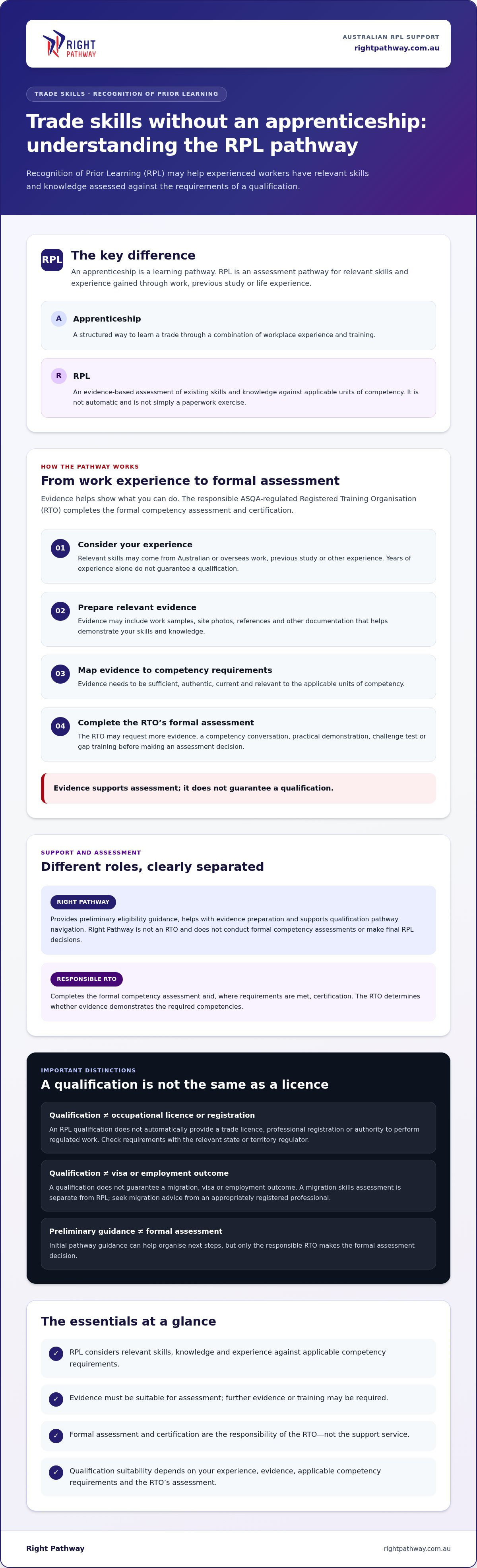
The journey to formal recognition follows a structured, multi-stage path designed to validate your expertise. It's a logical progression that moves you from the job site to a nationally recognised certificate without the need for traditional classroom study. This methodical approach is how you get trade qualification without apprenticeship delays. It respects your time while maintaining the integrity of the Australian vocational education sector.
The process involves four primary stages:
- Initial Eligibility Check: We review your work history to confirm your experience aligns with the specific units of the qualification.
- Evidence Collection: You gather documents that prove your skills. This is the most critical phase of the journey.
- Skills Mapping: We map your daily tasks against the national training standards to ensure every competency is covered.
- RTO Review: A partner Registered Training Organisation (RTO) performs the formal assessment to verify the evidence meets all regulatory requirements.
What Counts as Evidence?
Evidence must be valid, sufficient, current, and authentic. You can't just say you can do the job; you have to prove it. Practical examples include payslips, employment contracts, and detailed references from licensed supervisors. One of the most powerful tools is a third-party report, where a qualified colleague or manager validates your technical proficiency on site. We also encourage you to build a digital portfolio using photos and videos of your work. This visual proof allows assessors to see your skills in action. The Recognition of trade skills process relies heavily on this high-quality documentation to ensure standards are met.
Addressing the 'Gap' Training
Sometimes, an experienced worker might meet 90% of the requirements but lack a specific unit, such as a particular safety module or a niche technical skill. If this happens, you don't need to start a full course. Our partner RTOs can provide targeted gap training to bridge these small deficiencies. This ensures you still meet the full criteria for the qualification without wasting time on things you already know. Take the first step toward your trade certificate by completing a free eligibility assessment today.
Navigating Your Trade Pathway with Right Pathway
Navigating the bureaucracy of the Australian vocational education system can be a major hurdle when you're busy on a job site. We act as your dedicated facilitator to simplify this journey. It's entirely possible to get trade qualification without apprenticeship delays, but the evidence mapping must be precise to satisfy national standards. Right Pathway is not a Registered Training Organisation (RTO). Instead, we act as the essential bridge between your years of practical experience and the strict requirements of the RTOs that conduct formal assessments. By choosing this path, you unlock the benefits of RPL, including significantly higher earning potential and the official trade recognition required for licensing. Rest assured that every certificate is issued by our ASQA-regulated partner RTOs, ensuring your qualification is valid and respected across the country.
Why Professional Facilitation Matters
Many workers attempt to handle the RPL process alone, only to have their applications rejected due to insufficient or poorly organised evidence. Expert guidance reduces this risk by ensuring your portfolio is comprehensive from the start. We save you dozens of hours by taking the lead on documentation and evidence review. Viewing the RPL cost in Australia as an investment in your career stability is a pragmatic approach. It's a one-off expense that can lead to a lifetime of better pay and more secure job prospects.
Your Next Steps to Qualification
It's time to stop working under the radar. Getting the professional respect you deserve starts with formalising the skills you already use every day. You don't need to go back to school to prove you're a master of your craft. We provide a clear, manageable path forward that respects your time and your expertise. The first step is simple and requires no commitment. You can find out exactly where you stand by using our online tools. Book your free RPL eligibility assessment today and take control of your professional future.
Formalise Your Expertise and Advance Your Career
Your years of dedication on the tools have already provided you with the skills required for professional success. The Recognition of Prior Learning pathway is the most efficient way to get trade qualification without apprenticeship hurdles, allowing you to turn that practical knowledge into a nationally recognised asset. We've supported over 2,000 successful applicants through this transition, offering the expert guidance on evidence preparation needed to meet strict regulatory benchmarks.
By partnering with ASQA-regulated RTOs, we ensure that the certificates our clients receive are of the highest standard and fully compliant with Australian requirements. You've already done the hard work on site; now it's time to ensure you receive the formal credit you deserve. This isn't just about a piece of paper; it's about opening doors to licensing, higher pay, and long-term job security.
Achieving a higher income and better job security means you can finally start planning those well-deserved holidays, perhaps by connecting with travel communities like Adventurerz to explore your next getaway.
Get your free RPL eligibility assessment now to discover which qualifications match your experience. We look forward to helping you navigate your path to professional validation.
Frequently Asked Questions
Can I really get a trade certificate without doing an apprenticeship?
Yes, you can obtain a nationally recognised certificate through Recognition of Prior Learning (RPL). This pathway allows you to get trade qualification without apprenticeship contracts by proving you already possess the required skills through past work. It is a legitimate, assessment-based process used by thousands of workers to bypass years of entry-level training and formalise their existing expertise.
How much experience do I need for trade recognition through RPL?
Most partner Registered Training Organisations (RTOs) look for a minimum of three to five years of relevant industry experience. This duration ensures you have encountered enough varied scenarios on site to meet all the units of competency within a qualification. We provide a consultation to help you determine if your specific work history is sufficient to build a strong evidence portfolio for assessment.
Is an RPL certificate the same as one earned through TAFE?
Yes, the qualification you receive is identical to one earned through a traditional four year apprenticeship or TAFE course. It is issued under the Australian Qualifications Framework (AQF) and carries the same legal weight for licensing and employment. Employers and regulatory bodies recognise the certificate as proof of your professional competence, regardless of whether it was achieved through classroom study or formal skills assessment.
What if I have overseas experience but no Australian papers?
Overseas experience is highly valued in the RPL process and can be used to meet Australian standards. We specialise in skilled migrant RPL support, helping you map your international expertise against local qualification requirements. As long as you can provide evidence like references, photos, and payslips from your time abroad, those skills can be formally recognised here to help you secure your Australian trade papers.
How long does the RPL process take compared to an apprenticeship?
The RPL process is significantly faster, often taking only a few weeks or months to complete once your evidence is organised. This is a sharp contrast to a traditional apprenticeship, which requires a four year commitment. The speed of the process depends largely on how quickly you can gather your documentation and how many units of competency you already meet through your existing on-site experience.

Article by
Right Pathway Team
Right Pathway supports experienced workers, tradespeople and skilled migrants with preliminary RPL eligibility guidance, evidence preparation and qualification pathway navigation.
Right Pathway is not a Registered Training Organisation and does not conduct formal competency assessments or issue qualifications. Formal enrolment, competency assessment and qualification issuance are completed by the responsible Registered Training Organisation.
Start with a free initial RPL eligibility assessment at https://www.rightpathway.com.au/eligibility-check
Disclaimer
Right Pathway is a facilitation and support service only. We are not a Registered Training Organisation (RTO), do not conduct formal RPL assessments and do not issue qualifications. All formal RPL assessments and certifications are completed by partner RTOs regulated by ASQA. Eligibility and qualification outcomes depend on each applicant’s evidence, experience and the RTO’s assessment decision.


